2025-12-05 — Battery Backup Power Basics, Some Zero Retries Interesting Trends For 2026, Unofficial IETF draft - five nonillion IPv6 addresses to ham radio, MySat Kit, your first personal satellite
Zero Retries is an independent newsletter promoting technological innovation in and adjacent to Amateur Radio, and Amateur Radio as (literally) a license to experiment with and learn about radio technology. Radios are computers - with antennas! Now in its fifth year of publication, with 3300+ subscribers.
My thanks to Justin AI6YM for becoming a newFounding Member Subscriber 0022 to Zero Retries this past week!
Founding Member Subscribers are listed in every issue of Zero Retries!
My thanks to Steve Greene KS1G for renewing as an Annual Paid Subscriber to Zero Retries this past week!
My thanks to Prefers to Remain Anonymous 59 for renewing as an Annual Paid Subscriber to Zero Retries this past week!
My thanks to Scott Nacey KK6IK for restarting as an Annual Paid Subscriber to Zero Retries this past week! KK6IK also included this nice message:
[Zero Retries] is the best, most leading edge commentary on today’s Ham Radio. Keep it up.
My thanks to Ken Slickers KI7DGC for becoming a newAnnual Paid Subscriber to Zero Retries this past week!
My thanks to Stuart Turner N6DVM for becoming a newAnnual Paid Subscriber to Zero Retries this past week!
Financial support from Zero Retries readers is a significant vote of support for the continued publication of Zero Retries.
Zero Retries Administrivia Bulletin
Progress is being made to move Zero Retries to another web / blog / email newsletter hosting system beginning in 2026 - under a new domain (still in progress).
www.zeroretries.org will remain in place until such time as all the content can be cleanly ported over to the new hosting system. It would be too much to move it all concurrent with setting up the new hosting system.
More administrivia bulletins will be posted in each issue this month. There’s a big announcement I’d hoped to make this week, but it needs a bit more behind-the-scenes preparation before announcement, and this week just went by way too fast.
Amateur Radio (In the 21st Century) Elevator Pitch
Funny you should use the word “spark”. If you’re building a campfire from scratch, your “spark” doesn’t do much good to light a “fire” unless there’s some “tinder”. As I’ve explained, I think for most of us it’s a dead end to try to interest the average person into Amateur Radio, especially legacy Amateur Radio (HF, CW, voice operation, etc.). So I don’t try that approach - don’t try to talk up Amateur Radio to the average person.
My approach is to watch for an opening (”tinder”) with potential NewTechHams - techies, EE students, software engineers, Makers, STEM students (or parents or instructors). Then try to apply the “spark” of talking up radio technology that they might have some familiarity / interest in - Meshtastic, long distance Wi-Fi, etc. If the “spark” catches that “tinder” then “fan the flames” to try to ignite the “fire” - relevant, technological aspects of Amateur Radio . Gently explain that Amateur Radio is all about experimenting with radio technology - building your own radios, figuring out your own types of radios with software (GNU Radio), etc.
Obviously there’s a lot more work to be done with a distilled description of relevant Amateur Radio activity in the 21st century. All of that probably needs to be distilled into a tri-fold brochure that can be inexpensively reproduced as double-sided color printing at Fedex Office, with some sexy photos like LinHT, cubesats, Raspberry Pi WSPR transmitter, TinyGS satellite ground station, AREDN microwave networking, DLARC online Amateur Radio archive, etc. Maybe even work in a mention of Zero Retries and at least one cool Amateur Radio YouTuber.
Zero Retries Interesting Amateur Radio Clubs - Sci-Tech Amateur Radio Society (STARS)
One of the minor missions of Zero Retries is to highlight Amateur Radio activities and organizations that are relevant to Amateur Radio in the 21st century. Thus technology-focused Amateur Radio organizations are particularly Zero Retries Interesting, like Sci-Tech Amateur Radio Society (STARS) of Natick, Massachusetts, USA. Not only is STARS’ website informative and up to date, but they chose a really cool domain name - stars.radio!
Image courtesy of New England Sci-Tech.
STARS is just one of three radio technology related clubs associated with New England Sci-Tech1 (NEST):
New England Sci-Tech is a non-profit STEM education center and maker space dedicated to project-based, hands-on learning for youth and families across the New England community. Our mission is to promote development of a STEM-literate and skilled citizenry ready to meet the needs of the 21st century and beyond.
A series of workshops that gets hands on with wireless tech, electronics, and radio communications. Come join us as we tinker and learn together. No license needed. Workshops can be taken a la carte, as they interest you.
NE1AR provides educational services to the amateur radio community including license exams, courses, and technical support. NE1AR is colocated with New England Sci-Tech in Natick, MA.
In my opinion, New England Sci-Tech has their mission and the involvement of Amateur Radio dialed in perfectly - their primary focus is youth and Science Technology Engineering and Math (STEM) activities that supplement K-12 education:
[Bob Phinney] founded NEST to provide access to enrichment opportunities to supplement what is experienced in school to expose K-12 students to the more exciting aspects of science and to spark interest and enthusiasm for STEM.
Thus, kudos to the respective leadership of NEST, STARS, WTC, and NEAR for doing an excellent job of “framing” Amateur Radio as a relevant and interesting activity for STEM students.
Whither IP400?
I’ve been asked a few times recently: “What’s happening with the IP400 Network Project? You were so hung-ho about it earlier this year.”
Short answer - I have no idea.
At this point, like almost everyone else, I’m just an interested observer hoping to hear some (good news) progress reports. But at the moment, no news is forthcoming from Alberta Digital Radio Communications Society (ADRCS), IP400’s sponsoring organization.
The IP400 Network Project seems to be in limbo, or at least that’s the impression one gets from:
At ZRDC 2025, the “Mini Node II” was stated “In Production October 2025”, (see slide 12) but I’m not aware of that unit being available. The IP400 Order Form says: We are SOLD OUT until further notice.
The final cut off date for the current hardware is Sept 12th.
I’m not sure how much Amateur Radio fun is in store for this coming weekend as Western Washington is bracing for a (new phrase for me) Godzilla atmospheric river. We’re queued up to receive a week or more of normal rainfall compressed into days. Fortunately, that precipitation will arrive as rain rather than snow (except in the mountains)… this time. Fortunately our local rivers aren’t expected to be pushed past flood stage; many rivers south of us are inevitably going to flood.
Have a great weekend, all of you co-conspirators in Zero Retries Interesting Amateur Radio activities!
Contains no AI-generated content, except one instance of the word “the”.
When the electric utility and weather cooperate, power is plentiful. But lose those bets and we’re in the dark, with UPS systems beeping plaintively, and us wondering how long the phone will last.
This won’t be an exhaustive treatment of standby and backup power, but a broad introduction to most of the things to consider. And the very first step is deciding what exactly will need power, how much power it needs, and how much money how long you want (or need) to be able to power it. But first, some terminology.
We’ll be talking about batteries, and they are rated in Ampere-hours (Ah), which is a measure of the battery’s capacity. It is not a measure of energy, as it disregards the voltage, but if we decide that our backup power system will universally run at 12 volts, we’re fine with Ah.
Of course, if you have a generator powered by some kind of chemical fuel – gasoline, propane and natural gas are common – then you have as much power as the generator can deliver for as long as you have fuel for it. An automobile can be pressed into service as a 12-volt source in a pinch, and some electric vehicles and work trucks consider this a feature. But all of those power sources are fairly well-understood, so here we will focus on the less understood black magic of battery-backup.
If given two batteries, the one with the higher Ah rating contains more energy, making this rating convenient for comparisons. But using that rating to size your battery is a rookie mistake. To understand why, consider how this rating is derived.
Small (5-100 Ah) lead-acid batteries are typically used for battery backup. They are not light, but they are (relatively) inexpensive and safe, with a useful energy density. The Ah rating is based on a controlled discharge over 20 hours while maintaining a known minimum voltage. Other batteries (different chemistries, different sizes) often use different time periods. So, if a particular battery was able to maintain a terminal voltage of at least 10.5 V at a constant discharge rate of 1 A for 20 hours, it gets a 20 Ah rating.
Taking our 20 Ah battery, we know it should deliver 1 A for 20 h. But if we increase the discharge current to, say 20 A, how long will it last? Hint: Not 1 hour, as it is not quite linear. As discharge current increases, the Ah capacity decreases. Conversely, as current decreases, Ah capacity increases. So, expecting to power your station, which draws 20A, for one hour using a 20 Ah battery will lead to great disappointment.
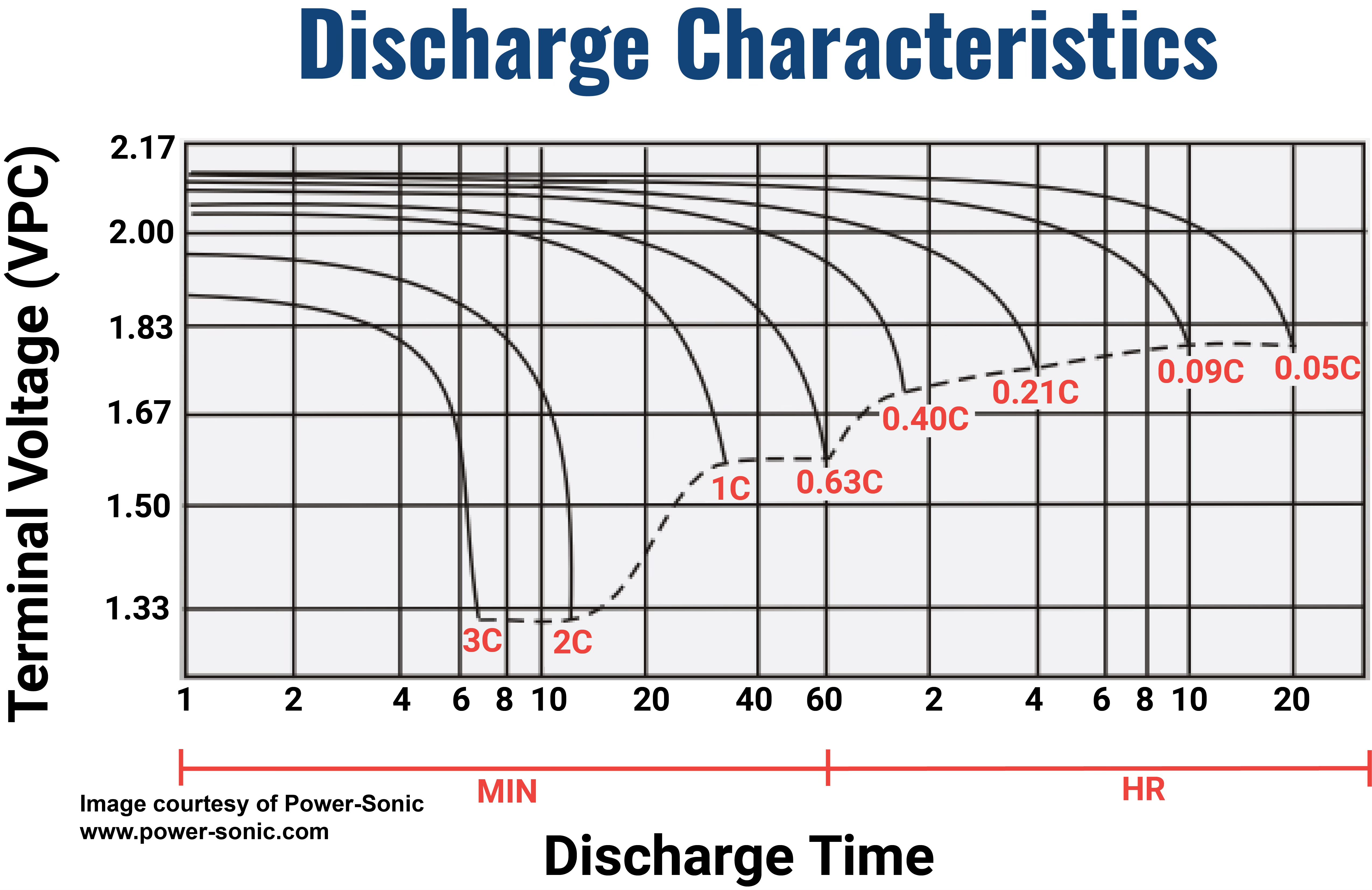
The graph below shows this relationship with a particular 100 Ah lead-acid battery, using the term “C” for its rated capacity (100 A). This means that with a 20 Ah battery, C is 20 A, and with a 55 Ah battery, C is 55 A, so with our 100 Ah battery, “1C” means a 100 A discharge rate.
For our 100 Ah battery, a discharge rate of 5 A (0.05C or C/20) means it takes about 20 hours to drop to 1.75 v/cell (10.5v), giving us 100 Ah (5 A * 20 h) while a 200 A (2C) discharge takes about 13 minutes to drop to 1.30 v/cell2 (7.8 v), giving us only about 43 Ah according to the graph. Note that a LiFePO4 battery is ‘stiffer’, losing less capacity (in Ah) as discharge rate C increases...but the fundamentals are very similar. So your 20 Ah battery will only be delivering about 9.5 volts after 33 minutes of delivering 20 A, around half of what you might expect.
OK, so now that we understand that battery ratings might be far more optimistic than we thought, we need to do some calculations to determine just what we need for our battery system, a process known as sizing. In essence, we multiply how many Amps of DC current we need by the number or hours we might need it for, and use that value to drive the needed battery capacity.
For a simple example, an LED light uses 120 mA (0.12 A). I want to be able to use it for 16 hours a day. For each day I need it, I need a (real, not rated) capacity of (0.10 * 16 =) 1.92 Ah.
A more complex example is a radio: It uses 600 mA in standby (receiver ready but no signal received), 800 mA with a received signal at typical volume, and 8.5 A during transmit. We estimate that it will be in standby 30% of the time, receive 50% and transmit 20%. For your estimates, try to be accurate for your actual usage, but keep in mind that your usage pattern might be different than when the mains power is on.
Doing the math, this radio typically uses (0.6 A * 0.3) + (0.8 A * 0.5) + (8.5 A * 0.2) = 0.18 + 0.4 + 1.7 = 2.28 Amps on average. If we operate for 1 hour we need 2.28 Amp-hours of real capacity. If we want to power the radio for 10 hours, we need 22.8 Ah of real capacity.
You need to do your own math and figure out how many Ah you will actually use. I recommend actual current measurements, not relying on manufacturer ratings. If you have equipment that must be powered by 120 volts AC, you also have to consider the conversion efficiency of your inverter, typically around 80%, with high-quality equipment approaching 95%.
Using a PowerSonic DCG12-100 12 V 100 Ah lead-acid battery as an example, the data sheet (available at < https://www.power-sonic.com/product/dcg12-100/?preview=true >) shows that at a discharge rate of 16.4 A one can expect a capacity of 82 Ah to a terminal voltage of 10.2 v. This means that if we draw around 16 A, the manufacturer says the battery voltage will remain at least 10.2 volts for five hours.
If five hours (and 10.2 v) is enough, we’re golden. If, say, 15 hours is needed, you need three of those batteries. 50 hours? Ten batteries. Higher minimum voltage than 10.2? Use the spec sheet and graph to determine actual capacity for a given discharge rate and end voltage, then do all the math again. Pretty simple, but not so inexpensive. Of course, as the batteries age, their capacity diminishes. And it would be a best practice to up-rate your current requirements by 20% or so, to ensure you have enough capacity available over time.
Once again: If you have a charging source for your batteries – generator, car, waterwheel, whatever – independent of the power mains, your battery need is reduced and your operating time can increase.
Care and charging for your batteries is absolutely required. You would be wise to limit the charging rate to that specified by the manufacturer, typically 0.2C for lead-acid. A lower charging rate does less harm to the battery, but we have to balance that with time to fully recharge. Manufacturers often specify a charger, or one can use a good quality constant voltage power supply, keeping the voltages within the limits defined by the manufacturer (13.5-13.8 V for a lead-acid battery in standby). For other battery chemistries, constant voltage (which is cheap and simple) is typically not an option: Use what the manufacturer says to use, and especially with all lithium-chemistry batteries, as these need special charging characteristics. No sense setting the shack on fire.
If you want to use solar power, similar calculations are needed, as is a solar power battery charge controller. I’ve consumed too much space here already, but I’ll write about that in part 2. Let me know if you find this info useful and interesting.
Endnotes:
While there are many testing standards, for similar batteries (size, chemistry) the test methods are the same or comparably similar. For small lead-acid batteries, a 20 h discharge is typical, at controlled temperature (around 68F/20C) with a final voltage of 10.5 V (1.75 v/cell – a 12 V lead-acid battery has six cells in series). LiFePO4 batteries are typically tested to a final voltage of 2.5 V/cell
As the discharge rate increases, the final voltage decreases, so for a 2C discharge a typical standard is 7.8 V (1.3 v/cell)for a lead-acid battery. The graph shows the differing final voltage standards used.
Editor’s Postscript: I’m grateful to Zero Retries Pseudostaffer N2IRZ for this article. He wrote it as a detailed response to my “lightly researched” statements about run time, etc. in my article in Zero Retries 0226 - My New 2025 Standby Battery Power System. N2IRZ took me to task on several assumptions I stated in the article and I largely defer to his much greater experience with this subject, and his professional engineering background. That said… I remain slightly skeptical that it’s not quite a direct comparison between the performance characteristics of SLA / AGM batteries versus LiFePO4 batteries such as the Bioenno Power BLF-1240A. But “empirical research” such as putting together and learning the capabilities of my new 20262 Standby Battery Power System is part of the fun of Amateur Radio.
I was recently asked for speaking points for a requested presentation in early 2026, and that caused me to write down some “top of mind” trends for 2026.
Linux Handheld Transceiver (LinHT)
The LinHT is a Software Defined Transceiver in the form factor of a handheld (portable) radio. For the proof of concept phase, LinHT is designed as a replacement circuit board for a popular, inexpensive handheld radio (Retevis C62), though there is nothing unique about that particular radio; it was chosen solely as a proof of concept vehicle. LinHT runs Linux as its internal operating system, and incorporates GNU Radio for creating new types of radio technology (and replicating existing radio technology).
I expect the LinHT project to remain the most important, impactful project currently in development within Amateur Radio in 2026. The impact of the LinHT eclipses new commercial products such as the FlexRadio Aurora, Kenwood TM-D750A, or the Icom IC-7300MK2 despite the huge engineering and development budgets of those products for a single and simple reason - the LinHT is targeted at NewTechHams, and those other (expensive) products are not. Despite the fact that LinHT is funded only through donations and is being developed by three talented individuals, it’s simply too good and powerful an idea; it will inevitably become mainstream when one brave manufacturer offers a LinHT, and many others quickly follow.
The impact of the introduction of packet radio on Amateur Radio has faded somewhat now. Most Amateur Radio Operators who were active at the introduction of Amateur Radio Packet Radio in the mid-1980s have forgotten how much of a step change Packet Radio was in Amateur Radio. The introduction of Packet Radio was dramatic, one of those seminal before / after moments. It wasn’t like the introduction of SSB (just another voice mode), or solid state components (more reliable, but not really different).
When LinHT completes its development phase and begins to get deployed as a mainstream technology in Amateur Radio, everything will change, like it did when Packet Radio was first introduced. We’ll finally have that “universal radio” that the concept of Software Defined Radio has promised. New modes, new capabilities, will happen at the speed of software because unlike proprietary Software Defined Radio embedded in “mainstream” Amateur Radio units, the NewTechHams will be driving the evolution of the LinHT and its successors.
While development on M17 continues, some of that development work is being subsumed into LinHT as “just another mode” that LinHT will be capable of.
Zero Retries reference pages for LinHT and M17… and Packet Radio… are in progress.
New Packet Radio for 2m, 70cm, and 23cm Bands
New Packet Radio (NPR) is a high speed data communications radio system designed by Amateur Radio for the unique environment and requirements of Amateur Radio. NPR fills a niche between higher speed packet radio systems that use conventional FM radios (top speed, 25 kbps with VARA FM), and repurposed commercial microwave units (10s of Mbps). NPR achieves 100 kbps - 1 Mbps on Amateur Radio VHF / UHF bands.
NPR debuted in 2019, and is in use, but not widely in the US (my perception only). I think that situation will change in 2026 thanks to new versions of NPR now available from Localino - New Packet Radio NPR-H 3.0 (2m), New Packet Radio NPR-H 3.0 (70cm), and soon, New Packet Radio NPR-H 3.0 (23cm).
These units are data radios. The Localino units are reasonably priced (<US$300), are assembled and tested, with transmit power of 7 watts (2m and 70cm; 23cm power is not stated). NPR has a minimum bandwidth of 100 kHz (for 100 kbps raw data rate) up to 1 MHz (for 1 Mbps raw data rate) and can be used “simplex” (Point to Point) or “digipeater” (Point to Multipoint / “Master”) networks.
A Zero Retries reference page for New Packet Radio is in progress.
AREDN Local Area Networks / Extensions on 902-928 MHz Using 802.11ah / Wi-Fi HaLow
AREDN is modern (multi-megabit TCP/IP) radio networking, but is “limited” (depending on local topology) by the requirement of placing network hubs on high locations with an optical line of sight between user and network hub.
In my opinion, the ability to use AREDN technology on the (mostly, North America) 902-928 MHz band is a game changer for AREDN networking. While it’s not “absolute”, this band does not require an optical line of sight between nodes (some tree penetration is achievable). The AREDN capability means gateways between 5 GHz AREDN nodes and 902-928 MHz nodes can easily be implemented by connecting Ethernet ports between two (or more) units. Thus local area AREDN networks can now be formed in areas that have extensive tree cover.
A Zero Retries reference page for AREDN, including 802.11ah / Wi-Fi HaLow units, is in progress.
NewTechHams as an Increasingly Visible, and Influential Bloc Within Amateur Radio
After several years of promoting a new “type” of Amateur Radio Operator for which I created the term NewTechHams, this new “bloc” in Amateur Radio is becoming more visible, and more influential within Amateur Radio.
There was a beloved and oft-quoted phrase amongst the early Internet builders:
The Internet treats censorship as damage, and routes around it.
The equivalent among NewTechHams is:
NewTechHams treat legacy Amateur Radio attitudes, activities, and self-imposed restrictions as irrelevant, and are establishing their own version of Amateur Radio of the 21st century.
In 2025, I saw a lot more NewTechHams influence within Amateur Radio, and expect that to accelerate in 2026.
A Zero Retries reference page for NewTechHams is in progress.
An FCC Petition for Rulemaking for Deletion of VHF / UHF Bandwidth Limits and Symbol Rates
Various FCC Requests For Comments in the past two years have resulted in well-reasoned comments, with standing, to the FCC with the recommendation that current bandwidth limits for Amateur Radio VHF / UHF bands, and symbol rates, be deleted.
But those are mere recommendations… advice… to the FCC, with no mechanism for changes to the FCC Part 97 regulations for Amateur Radio to actually commence.
To change the FCC Part 97 regulations requires a formal Petition for Rulemaking from an outside party to be submitted to the FCC.
In 2026, there will be two “enabling” factors for such a Petition for Rulemaking:
An ongoing FCC initiative to … eliminate certain outdated, obsolete, and unnecessary rules.
With the Localino units, Amateur Radio can effectively demonstrate that its ability to experiment with technological innovation in Amateur Radio is being directly hampered by the bandwidth and symbol rate limitations. The Localino units can only operate with a minimum of 100 kHz bandwidth. That’s not a limitation for other countries such as Canada, which don’t have bandwidth and symbol rate restrictions. But, it prevents the New Packet Radio 2 meter version from being used in the US as the current maximum bandwidth limit on 2 meters is 20 kHz.
If Amateur Radio carefully crafts a Petition for Rulemaking that is compliant with the the FCC initiative (also known as Delete, Delete, Delete) in “surgically” removing mentions of bandwidth limitations and mentions of symbol rate limitations for the Amateur Radio VHF / UHF bands…
The FCC may be receptive to such a Petition for Rulemaking because such deletions would “count” towards the FCC’s ongoing effort to remove unneeded regulations.
Some key elements to such a Petition for Rulemaking:
Citation that other countries’ Amateur Radio regulations, especially Canada, do not have bandwidth limits or symbol rate limits applied to the VHF / UHF bands, with no adverse effects.
Citation of the previous comments in FCC proceedings that support such changes.
Citation of the innovation to be gained within Amateur Radio that can proceed with such changes.
The results from testing done via a Special Temporary Authority test of the use of the Localino units on 2 meters and 70 centimeters with no adverse impact.
(Hopefully) widespread support from a number of “name brand” organizations within US Amateur Radio.
As a possible extended effort for the above might be to “surgically” remove mentions of onerous notification requirements for use of the US 219-220 MHz Amateur Radio band, as well as removing the 100 kHz channelization for this band, allowing the full 1 MHz to be used as one block. That removal of channelization won’t change the nature of this band as used exclusively for point-to-point operation. Between this much more usable 219-220 MHz band and the US / Canada 1.25 meter (222-225 MHz) band, it may be possible for Localino to create another variant of New Packet Radio hardware for 1.25 meters and thus finally realize the potential of 219-220 MHz for high speed (1 MHz channel with 1 Mbps raw data rate) point to point links.
A Zero Retries reference page for this Petition for Rulemaking is in progress.
Interesting Projects to Follow in 2026
GTDATA (also known as MMDVM-TNC) is a project to implement faster speeds on Amateur Radio VHF / UHF bands using some advanced techniques such as improved waveform and integral Forward Error Correction (FEC). GTDATA continues the paradigm of using FM radios with “flat audio” connections. Another feature of GTDATA is that it is implemented for MMDVM units, and thus can be used with FM repeaters. Some modes of GTDATA are interoperable with modes available on NinoTNC. Jim Mclaughlin KI6ZUM of ZUMRadio and Steve Stroh N8GNJ of Zero Retries are collaborating to test, document, and promote more use of GTDATA in 2026. A Zero Retries reference page for GTDATA is in progress.
RADE over Baseband FM (BBFM) is a project to apply the Radio Autoencoder (RADE) technology developed for FreeDV to use on VHF / UHF FM. Basically, BBFM is next generation digital voice technology, and is entirely open source. The voice samples on the linked page are compelling; superior to current algorithm-based (and especially proprietary) vocoders.
ka9q-radio is a innovative use of Software Defined Receivers to create a virtual, multichannel receiver that can effectively receive all channels in a VHF / UHF band simultaneously, limited only by the receive bandwidth of the SDRx. What’s been needed for more widespread use of ka9q-radio in VHF / UHF is to create a ka9q-radio appliance application - ka9q-radio plug and play. To date, ka9q-radio has been more widely adopted for use on HF SDRx units, but for various reasons, ka9q-radio is needed on VHF / UHF. For example, to use a Localino New Packet Radio unit on 2 meters requires a 100 kHz (minimum) channel. Using ka9q-radio to simultaneously receive all 2 meter channels can find 100 kHz portions of 2 meters that are not currently in use, and thus a NPR transmission could commence. A Zero Retries reference page for ka9q-radio is in progress.
Movement towards an Amateur Radio Geosynchronous Earth Orbit payload or satellite for the Western Hemisphere… or giving up on the idea. I can’t quantify this perspective very well, but 2026 seems like the closing of a window for this idea. Either there will be some substantial movement towards this goal in 2026, with some organization or group to “go public” with some goals and progress… or simply give up on the idea. I think this quote, attributed to W.C. Fields, applies: If at first you don’t succeed, try, try again. Then quit. There’s no point in being a damn fool about it.
If an Amateur Radio GEO for the Western Hemisphere doesn’t seem like a realistic prospect in 2026, what may well “take its place” for higher bandwidth satellite experimentation, is the use of Starlink, especially the Starlink Mini user terminal. This is no different conceptually than the widespread use of Internet for Amateur Radio Over Internet activities, with some interesting differences:
Starlink is much more reliable than typical consumer Internet because of lack of dependencies on terrestrial infrastructure that is easily damaged (power outages, fiber cuts, fires / floods / hurricanes / earthquakes, etc.) This is especially true with Starlink Mini being able to be powered by 12 volts or USB-C.
Starlink, especially Starlink Mini is highly portable. If you develop a small, portable peer to peer infrastructure node (example, VOIP server), you can just “pick up and move” your infrastructure - mini rack, power (battery), and Starlink Mini.
Each Starlink user terminal automatically assigns a number of unique, semi-static (?) IPv6 addresses, both WAN and LAN. Thus peer to peer networking can be established between individual Starlink user terminals.
Starlink is steadily deploying inter-satellite links so that wide area networking can be effective and not necessarily dependent on Internet infrastructure. Thus a number of users in a region using Starlink Mini user terminals can build out the equivalent of an AREDN radio Wide Area Network (WAN) using Starlink.
Starlink has become “experimenter-friendly” with its Standby service tier - 500 kbps with no transfer caps, for only $5/month. I’ve experimented a bit with my new Starlink Mini set to Standby service, and it’s amazingly usable, including being able to watch YouTube videos.
Starlink, because it isn’t Amateur Radio, can be used by network / satellite / radio experimenters, not just Amateur Radio Operators, with no restrictions on encryption, commercial use, music, rebroadcast, and other Amateur Radio restrictions.
Starlink can provide all modern communications methods via peer-to-peer - voice, video, web, chat / messaging, email, etc. - no real dependence on Internet infrastructure.
Zero Retries reference pages for Amateur Radio GEO for Western Hemisphere and Starlink are in progress.
Again, the above are just some of “top of mind” trends for Zero Retries Interesting Amateur Radio in 2026. I’ll have a more complete overview of my expected trends in 2026 in one of the January, 2026 issues of Zero Retries.
The Ham Radio Science Citizen Investigation (HamSCI) is seeking operators and monitors to participate in a series of upcoming meteor scatter (MS) experiments. Operations will take place on December 12 - 13, 2025, over a 48-hour period — during the Geminids meteor shower. This is a combination ‘special event’ and a contest to generate contact data during meteor scatter events using 10 meters (28.145 MHz) and 6 meters (50.260 MHz). Suggested operating procedures can be found at www.hamsci.org/msqp. No special station equipment is required but the experiment uses the MSK144 operating mode as part of the WSJTX suite. The functionality is much like using FT8 and is easy to use. For more information on the operating guidelines for the activity, visit www.hamsci.org/msqp-rules.
HamSCI continues to do interesting work that makes Amateur Radio relevant in the 21st century.
I’m the developer of Pycom Radio Controller - https://pycom.stevendodd.net; software that allows you to control an Icom 9700 radio remotely via a USB serial connection. There is a focus on remote full duplex doppler control for satellite tracking with integrations for Hamlib rigctl, Gpredict, CSN S.A.T, SatPC32 and WSJT-X. it’s available for both Windows 10/11 and MacOS.
Making Amateur Radio Accessible
Although there are many reasons why you might want remote control, the motivation for creating this software was a desire to operate satellites specifically linear satellite and finding a lack of support from currently existing software on the market.
In 2018 I had a surfing accident and was pulled out of the sea by a lifeguard from RNLI https://rnli.org/find-my-nearest/lifeguarded-beaches/chapel-porth-beach. I was left paralysed with a spinal cord injury from the neck downwards. I’ve recovered sufficiently to be able to use a trackpad awkwardly with the middle finger on my left hand however turning dials and pushing buttons on a radio is a little bit beyond me. Using Pycom Radio Controller remotely allows me to operate successfully without limitations.
I’m a fellow trackpad fan. To me it’s so much more intuitive and fluid to use a trackpad than a mouse or trackball. Apple’s trackpads are especially usable.
My thanks to Zero Retries Pseudostaffer Jeff Davis KE9V for pointing out this mention. Pycom Radio Controllers sounds pretty cool!
Early in the history of the internet, the powers that be granted amateur radio operators over 16 million IPv4 addresses. Now a proposal has emerged suggesting the same community be granted a substantial chunk of the IPv6 numberspace.
The proposal to give amateur radio operators some IPv6 addresses emerged in an IETF draft that appeared in early November. It’s not an official IETF position because anyone can propose a draft policy.
Sole author Preston Louis Ursini, who operates the Paducah Internet Exchange and participates in internet policy development processes, points out that amateur radio operators need an addressing system and the IPv4 bloc assigned to the community has done the job for years.
…
In his IETF draft, Ursini points out that amateur radio operators have built practices and procedures around 44/8, and that for various reasons it would be impractical for the community to use RIRs to acquire IPv6 for its future needs.
He nonetheless suggests that the Internet Assigned Numbers Authority (IANA) should reserve the 44::/16 bloc of IPv6 addresses and work with the RIRs to develop “a coordinated global policy framework” to make it all work.
…
In conversation with The Register, Michaelson said Ursini’s draft doesn’t represent a huge chunk of the IPv6 numberspace, which covers 2128 addresses. Ursini’s proposal asks for a mere 2112 addresses – five nonillion of the 340 undecillion addresses available under IPv6.
The suggestion is, however, unusual.
Michaelson thinks it’s nonetheless worth considering this idea, because the amateur radio community has a long history of doing interesting things that later become useful in other contexts. He also told us he thinks Ursini’s idea is running ahead of debate, and that the internet community will soon need to consider some matters – especially as humanity builds more networks in space and needs to consider how radio networks with lots of latency will interact with the rest of the internet.
Wow… Amateur Radio got (credibly!) mentioned in that bastion of information technology journalism, The Register 🤣
This suggestion - reserving a bloc of IPv6 addresses for Amateur Radio use, similar to 44Net for IPv4, keeps coming up repeatedly. To date, ARDC has gently demurred.
Becoming more knowledgeable about the nuances of IPv6 (the least I need to know to be an effective user of my IPv6 capabilities with my two Starlink user terminals), is on my list for 2026.
My thanks to Zero Retries Pseudostaffers Ren Roderick K7JB and Steve Monsey N0FPF who both mentioned this to me nearly simultaneously.
This issue is really an eclectic collection of useful tidbits for those of us who love to experiment and build as part of our Amateur Radio activities.
I’m grateful to Hot Iron Technical Editor Peter Thornton G6NGR for having made a number of references to recent Zero Retries issues. Once I got my email for the new issue, I realized where a number of new subscribers to Zero Retries in the UK had come from.
Amateur Radio Handheld Radio as a modular option of a new electric car
I’m a fan of Marques Brownlee, a well-spoken and refreshingly non-hyperbolic YouTube creator and tech reviewer. His latest review was of an Xiaomi electric car that’s currently unavailable (for purchase) in the US. I recommend the video - draw your own conclusions about the quality of this vehicle, and the implications.
Brownlee makes an interesting point that the overall software and user-facing tech of this vehicle is excellent. Prior to expanding to electric vehicles, Xiaomi made mobile phones, so the vehicle designers really embraced good user interface design, including tactile controls such as switches for common functions.
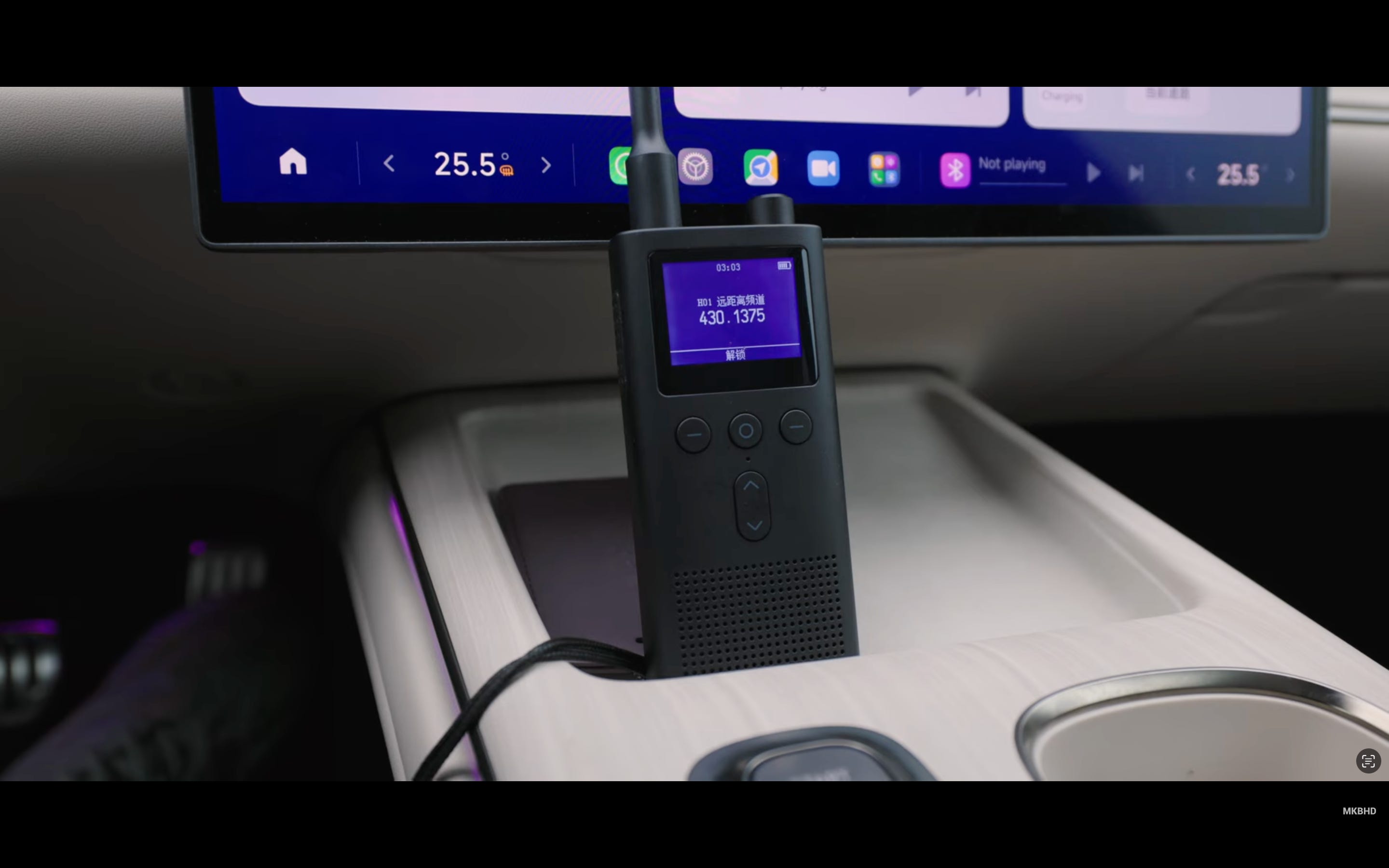
One of the funnier bits of the video was Brownlee explaining the various modular options of the vehicle… including a handheld UHF two way radio (7:22):
Image courtesy of Marques Brownlee
Really… as Brownlee explains it, this handheld radio is just one of many different modular options available for this vehicle.
(Brownlee is apparently not an Amateur Radio Operator as he didn’t recognize the significance of the displayed frequency given that he was doing his vehicle testing in the US. If I wanted to have a bit of fun, I’d reach out to Xiaomi public relations and thank them for supporting Ham Radio… and enjoy the confusion on their part.)
One of the nice aspects of this vehicle is that there are apparently a number of magnetic docking points on the interior for mobile phones. But they could probably also support a wireless control head for a two way mobile radio. Or maybe Xiaomi will offer a mobile radio as another modular option for this vehicle.
Amateur Radio humorist3 and Zero Retries Pseudostaffer Jeff Davis KE9V:
Fred: I heard you check into the Possum Trot Net on 40 meters this morning. Didn’t know you hung out there. Odd thing, I could copy you fine, you’re practically local. But I couldn’t hear anyone else on the net. Propagation must be pretty poor today? How many folks regularly show up?
Tom: We had about thirty check-ins this morning. But you won’t have much luck copying everyone directly. We’re spread out over about 2000 miles.
Fred: Really? 2000 miles is pretty impressive for 40 meters phone at 9am. What’s this about not being able to hear everyone directly?
Tom: We all use remote receivers. You log onto a Web page that lists a bunch of remote receivers that can be streamed over the internet. We all are connected via a net logger application that lets us make a list of check-ins so everyone knows who’s next. For instance, when it gets turned over to Sylvia in Chattanooga we all switch to a remote receiver in southern Tennessee to listen to her transmission. After her we might switch to Dale in Phoenix and listen via a receiver in Arizona, and so on. The system works really well so long as you have a solid net connection. Band conditions don’t really matter much for us.
Fred: Seems to me it might be easier with that large a crowd that you would all move to GoTo Meeting or something like that. You could even see each other using video that way!
Tom: Whoa! Hold on there Fred, that doesn’t sound like a suggestion fit for a “real ham”. We want to communicate using our radios, not the internet. You start doing that and next thing you know, ham radio is dead and everyone will be talking to each other online using computers. We’re real hams, we use our radios and the ionosphere to communicate!
Fred: Uhhh, yeah…but… Never mind. See you down the net logger…
Amateur Radio Over Internet! It’s not just for those durn NewTechHams 🤣
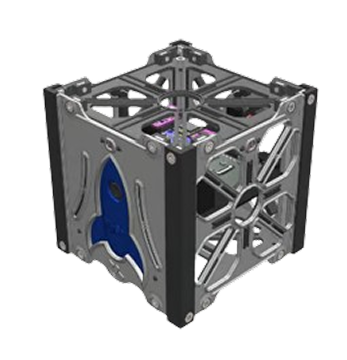
MySat is a fully functional small satellite (CubeSat) STEM kit for space fans.
Meet MySat Kit, your first personal satellite. The simple operation and step-by-step assembly allows even non-technical users to work with their satellite.
Understanding space technology is vital for the future of humanity. It’s also a way to have fun exploring new tools and technologies.
Why did we create the MySat Kit?
My Sat Kit is your personal 2-in-1 satellite: a construction set and a model of a real 4x4x4 inch satellite that can be assembled without any special knowledge. We want to show that space technology is available not only to billionaires, but also to amateurs, students and space fans.
All production is in-house. We keep all operations under control to ensure high quality and perfect production time. Our small laboratory has everything you need for production and testing, as well as people who do their job professionally and with love.
This is pretty cool! Not cheap, but at least all the parts are available for purchase and it looks like it can be easily assembled and shown off as just another cool radio technology thing, relevant in the 21st century, that Amateur Radio Operators can do.
I discovered ClubExpress from researching New England Sci-Tech (NEST) mentioned in this issue’s Request To Send section.
ClubExpress makes it easy to bring people together. Manage membership, events, communication, payments, and your website — all in one platform designed to help clubs and associations thrive.
I have no background with, or any additional knowledge of ClubExpress other than New England Sci-Tech seems to make very good use of it to support their makerspace and ancillary activities. ClubExpress seems to handle the most troublesome aspects of managing non-commercial organizations such as Amateur Radio clubs in the 21st century:
Website, especially specialized activities (such as the radio organizations as just one part of NEST). NEST’s website seems modern-looking, responsive, phone-friendly.
Organizational calendar(s)
Finances / dues
Membership management
Member communications including email
Social media
What makes ClubExpress different is that it’s an integrated service platform, not just a web host with some services grafted on. Thus (I’ll guess…) there is real support available when the “update the website” duties inevitably have to transition to a new volunteer within the club and the club isn’t hostage to a member’s second cousin who offered the club cheap (and inexpert) website design and hosting.
Dues handling is another issue that I’ve seen really screw up Amateur Radio clubs that would benefit from a clean “collect the dues by a neutral party, deposit them directly into a club account” capability.
ClubExpress seems to have thought out the support experience for non-commercial organizations and would seem to be a great help to Amateur Radio clubs who are flailing to manage the overall club experience… mostly online… in the 21st century.
Fold in being the ability to distribute specific areas of responsibility to multiple individuals, effective calendaring for a range of activities, email management (no more using a volunteer’s personal email to bcc all of the club members for email bulletins) and integrated social media, and ClubExpress seems to be an effective solution to many of the headaches and frustrations of keeping members of a non-commercial organization connected and informed using the norms of the 21st century.
Ku & Ka bands satellite bands (12–18 GHz & 26.5–40 GHz)
VARA and VarAC use is very utilitarian
GEO satellites should (?) use active regeneration and Time Division Multiplexing
Neighborhood kids… are interested in digital comms, space comms and anything that looks like a cell phone.
Further discussion of Amateur Radio renting a commercial GEO transponder.
Umbrella organization that helps to tie all the various specialty modes / products / innovation together?
VarAC Clusters can integrate multiple instances of VARA.
Ham Radio elevator pitch.
To receive new issues of Zero Retries every week via email, become a free subscriber. To support Zero Retries, paid subscriptions are appreciated, but entirely optional.
Zero Retries Boilerplate
The Zero Retries Store is now open for business with quality Zero Retries branded merchandise and items being retired from Steve’s N8GNJ Labs.
See the Zero Retries Boilerplate page for significant acknowledgements and other information relevant to Zero Retries. For new readers of Zero Retries, that page, and the About Zero Retries page has useful information to check out.
My ongoing Thanks to: Tina Stroh KD7WSF for, well, everything! Jack Stroh, Late Night Assistant Editor Emeritus Fiona and Shreky Stroh, Late Night Assistant Editors In Training Annual Founding Members who generously support Zero Retries financially: Founding Member 0000 - Steven Davidson K3FZT (Renewed 2025, 3rd year!) Founding Member 0001 - Randy Smith WU2S (Renewed 2025, 3rd year!) Founding Member 0002 - Chris Osburn KD7DVD (Renewed 2025, 3rd year!) Founding Member 0003 - Don Rotolo N2IRZ (Renewed 2025, 3rd year!) Founding Member 0004 - William Arcand W1WRA (Renewed 2025, 3rd year!) Founding Member 0005 - Ben Kuhn KU0HN (Renewed 2025, 3rd year!) Founding Member 0006 - Todd Willey KQ4FID (Renewed 2025, 3rd year!) Founding Member 0007 and 0010 - Merik Karman VK1DF / VK2MKZ (Renewed 2025 x2, 3rd year!) Founding Member 0008 - Prefers to Remain Anonymous 08 (Renewed 2025, 3rd year!) Founding Member 0009 - Prefers to Remain Anonymous 19 (Renewed 2025, 2nd year!) Founding Member 0011 - Rick Prelinger W6XBE (Renewed 2025, 2nd year!) Founding Member 0012 - Ryan Tolboom N2BP (Renewed 2025, 2nd year!) Founding Member 0013 - Newton White N4EWT (New 2025) Founding Member 0014 - Joe Hamelin W7COM (New 2025) Founding Member 0015 - Rich Stocking N7OP (New 2025) Founding Member 0016 - Prefers to Remain Anonymous 77 (New 2025) Founding Member 0017 - Phil Karn KA9Q (New 2025) Founding Member 0018 - Prefers to Remain Anonymous 95 (New 2025) Founding Member 0019 - Prefers to Remain Anonymous 0108 (New 2025) Founding Member 0020 - Prefers to Remain Anonymous 110 (New 2025) Founding Member 0021 - Prefers to Remain Anonymous 111 (New 2025) Founding Member 0022 - Prefers to Remain Anonymous 112 (New 2025)
Numerous Annual and Monthly subscribers who also generously support Zero Retries financially!
You thousands of readers of Zero Retries without which there would be little point in publishing this newsletter.
Permission for Reuse of Zero Retries Content
Blanket permission is granted for Amateur Radio use of any Steve Stroh content in Zero Retries for Amateur Radio newsletters and distribution via Amateur Radio such as (but not limited to) Packet Radio Networks, Packet Radio Bulletin Board Systems, Repeater Nets, etc. Specific blanket permission is granted to TAPR to use any Steve Stroh content in Zero Retries for the TAPR Packet Status Register (PSR) newsletter (I owe them from way back).
In such usage, please provide appropriate authorship credit for the content (especially for guest authors) and mention that it was first published in Zero Retries newsletter, preferably in this format:
This article is reprinted with permission. It was first published in Zero Retries newsletter, issue Zero Retries (number), (date) - (include full web link of the specific issue).
It’s appreciated (a courtesy, but not required) to notify Zero Retries Editor Steve Stroh N8GNJ of any reuse of Zero Retries content - editor@zeroretries.net
If you’d like to republish an article in this issue for other uses, just ask.
All excerpts from other authors or organizations, including images, are intended to be fair use. Unless otherwise noted in the article, there are no paid promotional items in any Zero Retries articles.
Amateur Radio, Data Communications, Digital Communications, Digital Voice, DV, Ham Radio, N8GNJ, Packet Radio, Radio Technology, Software Defined Radio, Software Defined Receiver, Steve Stroh, Zero Retries, Zero Retries Digital Conference, ZRDC 2025
Keywords in Bold are regular mentions in each issue.
My wife Tina KD7WSF and I tried to do a similar thing with the local makerspace, and we weren’t able to overcome the… inertia… of the (then) leadership to support a new Amateur Radio organization associated with the makerspace. Thus we’re a bit envious of New England Sci-Tech’s success with forming affiliated radio technology organizations.
I had fully intended to update my Standby Battery Power System in November 2025, with the procurement of the new battery and new charging system. But November went by very quickly, and December will be completely saturated. Thus this will be the 2026 Standby Battery Power System.
Battery Backup Power Basics: If you want to experiment, used AGM batteries are fine as you can get them cheaply: There are many emergency lights or USVs using them, where they must be replaced every three years. In our typical low-power installations you might get another 5 years of useful life out of them. In the end scrap metal dealers will pay you for these batteries.
But otherwise there is hardly any alternative to LFP batteries: Not that much more expensive than lead batteries, but you can use full capacity much more often and for a much longer times. My two 150 Ah LFP batteries show no degradation after 3.5 years of constant use and after nearly 1 MWh have gone through them. You can save money by building your LFP battery your self. See for example https://www.youtube.com/@WillProwse
In battery systems the best energy is energy you do not consume. Most ham radio software is not very power hungry. Therefore you can select the shack computer for low power consuption, e.g. a system with 12 V input and a N100 CPU. See for example https://www.dl4no.de/thema/compute0.htm . My complete station, consisting of IC-705, N100 computer, and WLAN accesspoint, consumes less than 0.5 kWh/day.
Depending on the sunshine situation at your location, solar installations can greatly extend your off-grid time. See for example https://www.dl4no.de/thema/configur.htm . My station ran nearly 24/7 completely off-grid from late FEB 25 to end of NOV.


Commenting for this issue is now moved to the Zero Retries email list:
Send email to zeroretries@groups.io with Subject: #zr0231
mailto:zeroretries@groups.io?subject=%23zr0231
Battery Backup Power Basics: If you want to experiment, used AGM batteries are fine as you can get them cheaply: There are many emergency lights or USVs using them, where they must be replaced every three years. In our typical low-power installations you might get another 5 years of useful life out of them. In the end scrap metal dealers will pay you for these batteries.
But otherwise there is hardly any alternative to LFP batteries: Not that much more expensive than lead batteries, but you can use full capacity much more often and for a much longer times. My two 150 Ah LFP batteries show no degradation after 3.5 years of constant use and after nearly 1 MWh have gone through them. You can save money by building your LFP battery your self. See for example https://www.youtube.com/@WillProwse
In battery systems the best energy is energy you do not consume. Most ham radio software is not very power hungry. Therefore you can select the shack computer for low power consuption, e.g. a system with 12 V input and a N100 CPU. See for example https://www.dl4no.de/thema/compute0.htm . My complete station, consisting of IC-705, N100 computer, and WLAN accesspoint, consumes less than 0.5 kWh/day.
Depending on the sunshine situation at your location, solar installations can greatly extend your off-grid time. See for example https://www.dl4no.de/thema/configur.htm . My station ran nearly 24/7 completely off-grid from late FEB 25 to end of NOV.