2026-05-01 - Amateur Radio Removed From Linux Kernel, The Perceived Irrelevance of Amateur Radio Networking, Announcing Project Argus, The Quiet Resurgence of RF Engineering, FM RX with one FPGA pin
Zero Retries is an independent newsletter promoting technological innovation in and adjacent to Amateur Radio, and Amateur Radio as (literally) a license to experiment with and learn about radio technology. Radios are computers - with antennas! Now in its fifth year of publication, with 3500+ subscribers.
My thanks to Prefers to Remain Anonymous 72 for one year of being a Paid Subscriber to Zero Retries as of this past week!
My thanks to Prefers to Remain Anonymous 125 for becoming a newAnnual Paid Subscriber to Zero Retries this past week!
Financial support from Zero Retries readers is a significant vote of support for the continued publication of Zero Retries.
Amateur Radio Drivers Removed From Linux Kernel
By Steve Stroh N8GNJ
Drivers for Amateur Radio Packet Radio and various Amateur Radio Packet Radio hardware (generally no longer used) have been included in the Linux kernel since the early days of Linux. Unfortunately, those drivers have not been maintained, and thus were slated for removal.
That there are multiple perspectives about this situation is yet another example of my humorous explanation to those outside Amateur Radio that three hams could get together to discuss something, and emerge with five different opinions.
See next article for my analysis of the bigger picture of why this happened and a proposed solution for that situation.
Earlier today Linus Torvalds merged a pull request to remove AX.25 and hamradio subsystem support from the Linux kernel. While the headline sounds ominous, most modern AX.25 implementations occur in software at the user level without relying on the kernel level implementation. Direwolf, for example, does not require kernel level AX.25 support. Other software relying on AX.25 may take advantage of dedicated AX.25 Python libraries.
The change comes as a result of AI based bug detection services capable of identifying critical issues among code that may no longer be maintained or utilized by end users. Torvalds stated that the amateur radio related code in the Linux kernel no longer had any active maintainers:
Amateur radio did have occasional users (or so I think) but most users switched to user space implementations since its all super slow stuff. Nobody stepped up to maintain the kernel code.
According to typesense the last Linux kernel commit related to AX.25 was 6 years ago.
Additional code removed includes ISDN support, bus mouse support, and various network drivers including support for old 3Com devices.
Linus Torvalds did it! He merged the pull request to rid the Linux kernel of the old Integrated Services Digital Network (ISDN) subsystem and various other old network drivers largely for PCMCIA era network adapters. This was the code suggested for removal given the recent influx of AI/LLM-generated bug reports against this dated code that likely has no active upstream users remaining.
It's been a fast-paced week with the patch series to remove old network drivers due to AI-driven bug reports now making these drivers for outdated network hardware a burden. Drivers for old/obsolete hardware has remained in the upstream kernel as long as there are active users and keeping the code around hasn't been a burden on developers or there are developers actively interested in maintaining the code. But now with the large language models and increased code fuzzing finding potential issues with these drivers for obsolete hardware, it's easier to just get rid of these drivers if no one is actively using the hardware from decades ago.
This merge lightens the kernel by 138,161 lines of code with ISDN gone and numerous old network adapters and also getting rid of legacy ATM device drivers as well as the amateur ham radio support. The main networking drivers removed affect the 3com 3c509 / 3c515 / 3c574 / 3c589, AMD Lance, AMD NMCLAN, SMSC SMC9194 / SMC91C92, Fujitsu FMVJ18X, and 8390 AX88190 / Ultra / WD80X3.
In the ARDC community discussion (linked below), this is attributed to Linus Torvalds:
Old code like amateur radio and NFC have long been a burden to core networking developers. syzbot loves to find bugs in BKL-era code, and noobs try to fix them.
If we want to have a fighting chance of surviving the LLM-pocalypse this code needs to find a dedicated owner or get deleted. We've talked about these deletions multiple times in the past and every time someone wanted the code to stay. It is never very clear to me how many of those people actually use the code vs are just nostalgic to see it go. Amateur radio did have occasional users (or so I think) but most users switched to user space implementations since its all super slow stuff. Nobody stepped up to maintain the kernel code.
We were lucky enough to find someone who wants to help with NFC so we're giving that a chance. Let's try to put the rest of this code behind us"
Modules Removed
Specific deletions from the merge request (manually parsed by me for recognizable Amateur Radio drivers / hardware / utilities, etc.):
The code deletion is probably final but a lot of other elements in that post is just wrong. The primary reason the code was because there wasn't any active maintainer giving guidance and a Q/A blessing and secondarily because many people felt that protocols like this shouldn't have been serviced by the kernel in first place and should have been in userland. That typesense tool is wrong as there have been plenty of patches over the recent years coming from other contributors to deal with clean ups, fix race conditions, etc. It's not about any landslide of AI-based reported bug and there are plenty of in-Linux AX.25 users. What didn't happen in time is anyone with kernel development expertise willing to take on the real maintenance and enhancements to cover this rather premature revocation patch being submitted before there was a real consensus.
- All ATM network drivers - All ISDN network drivers
I'm personally very disappointed here as this marks the end for tools like the FBB BBS, the FPAC node with ROSE support, the Linpac terminal program, a Linux native Winlink server and many more. I've been chatting with some people over at the ARDC to see if a new grant could be considered to rewrite the libax25 library to redirect I/O from the kernel and send it to something like an AGW interface but it's very early days there.
Marius Petrescu YO2LOJ:
The good question is if there is a real need for such an effort.
The main reason the ax.25 stack needs to be at kernel level is the fact that it was intended to allow using ax.25 as the L2 transport layer for TCP/IP, while integrating with other L2 protocols. As we stand now, that specific application has lost its usefulness, since basically nobody uses it for that. The other use, together with Netrom and Rose, are mainly supported by userspace stacks, like the xNOS packages, with the most outstanding exception of node softwares, like uronode & other similar applications.
Since the decisions related to Linux kernel support are quite unilaterally and tend to be final at the moment of their publication (I have never seen any of them ever reversed), there are not many options available to us in this regard.
We will loose the classical ax, netrom and rose interfaces, and the use of (mostly obsolete), and hardware drivers (like baycom and scc cards, but I don’t think that there are to many of those in use anymore). But the big problem is the KISS line discipline, which would prevent the creation of virtual ax25 interfaces, even if it would be implemented in userspace.
So IMHO, what needs to be done is a complete rewrite of the ax25 library to allow the same upper level API for the applications, while implementing the whole low level part as a server component, and this is not a trivial effort (I would estimate such an effort at around 1 man-year, with all the needed documentation and testing), without even trying to port the existing hardware drivers to it.
Or, as a second option, we can let go of the kernel support completely, and switch exclusively to NOS for native AX.25 usage. What should be noted is that the most popular applications using ax.25, more specifically APRS, is not impacted at a significant level, since most implementations can already work in userspace only while also being able to use the original kernel support (direwolf, aprsd & family).
So we need to make a decision here. Support a complete userspace stack implementation, or just let it slide into history.
Decide wisely, since this is a thing that really needs ARDC support to be successful.
Jonathan Naylor G4KLX:
I agree that we don’t need a kernel level AX.25 (or NET/ROM or ROSE) stack these days. When I wrote it back in 1995-97, I wanted to create something akin to BPQ but for Linux. A way to share a KISS TNC with multiple applications without problems, and the sockets interface was chosen. The alternative would have been even more abuse of the ioctl system call.
It worked well in those days, and I’m still rather proud of what I, and others, achieved. You could create some pretty wild system by judicious use of pseudo-ttys and other mechanisms.
If we’d had decent middleware available at the time, something like MQTT, then I would probably have developed it outside of the kernel, and developed a set of libraries to interface to the middleware in a transparent way.
If I were to write it now, I would have the protocol stacks as a separate unit communicating with the chosen middleware, and on one side a library that mimics the socket interface to make porting of open source programs relatively easy. The other side would be another interface that would allow the AX.25 packets to be encapsulated to whichever physical hardware that you have. This would be clean and free of too much legacy code and general bloat.
It’s not rocket science, and would be quite a fun little project. I wouldn’t mind doing it myself…..
and later…
I’m not too worried about my work dying. In its prime, the kernel AX.25 code was used extensively, and the linux-ax25 mailing list was very active indeed. I was happy to be a part of that.
However that was then, and this is now. Looking at the kernel code, I still see a lot that is recognisable from its original development.
I would recommend people who want to run full fat AX.25 and NET/ROM with some great enhancements, then I would point them to LinBPQ which is both open source and fully maintained. You would lose ROSE, but that was always a minority interest compared to the other protocols. If there was enough interest then I am sure it could be added to LinBPQ.
Running in kernel space has the one advantage of making the protocols to numerous user level programs simultaneously, with the downside that even a small bug could cause a spontaneous reboot. I have the mental scars from those days.
So let the kernel code die. I’m not a huge fan of repurposing NOS to replace it, it’s good at what it does for sure, but a user level implementation should be done differently I believe. As for AGW, it’s an abomination of a protocol.
That one ARDC Linux Packet Radio grant back in 2022 was returned as the person who accepted the grant later rescinded the project and evidently returned the money. The only person I know who was doing any real work on repairing some of the random kernel commits that broke the AX.25/NETROM/ROSE kernel code was Bernard Pidoux F6BVP and some additional assist from Lee Woldanski VE7FET on the libax25/ax25-apps/ax25-tools repos at https://github.com/ve7fet?tab=repositories .
I think it will take a few days for any serious pushback to happen but it's really not clear if that's going to happen. If this is permanent, we're all going to lose the very powerful glue for AX.25 being Linux. :-( NOSes like Linbpq can do a lot of the same things but I'm not familiar enough with it to know if the same level of flexibility is possible.
Changes to the Linux kernel over the years have improved and modernized the kernel, but have also made existing AX.25 implementations incompatible and turned preexisting issues into bugs. This can make systems unpredictable or even unusable. Linux kernel development is complex, requiring deep specialized knowledge, and bugs are hard to trace. This may be one of the reasons, why the Linux kernel AX.25 stack is currently in such a bad state.
This ARDC grant funds will allow the Deutscher Amateur Radio Club to hire software developers who can create a stable Linux AX.25 implementation and prevent Linux distributions from dropping pre-compiled AX.25 support. The fixed and functional Kernel-AX.25 stack will improve global amateur radio infrastructure. Professional kernel development can bring Linux AX.25 back to life.
Update
After careful consideration, the Deutscher Amateur Radio Club (DARC) decided to return the total grant amount of $150,445 to ARDC. This decision was made as the project encountered unforeseen difficulties that prevented it from being carried out. However, the club did make some progress on the AX.25 kernel as part of the effort before ultimately concluding that they would not be able to complete the project.
From the more active software developers of Amateur Radio software I’ve talked to over the past few years is that they made no use of the Linux Amateur Radio utilities. One reason I’ve heard for that is many developers wanted their software to be as cross-platform as possible and so embedded AX.25 functionality into their software. I’ve also heard that the only hardware interface of any importance for Amateur Radio in this era is KISS for TNCs and audio adapters.
Amateur Radio Linux Distributions
This development seems to be the moment to shine for the various distributions of Linux that are optimized for Amateur Radio use such as:
Hibbian (mentioned last week in Zero Retries 0248)
All of which could (re) provide these drivers as standard.
But… Maintenance…
Even if the Amateur Radio distributions were to re-incorporate the Amateur Radio drivers into their distributions… those drivers are apparently not being maintained, and they were (apparently?) designated as a security threat (attack vector) for Linux systems that are connected to the Internet, which is more common than not (in my observations).
In an email discussion with David Ranch KI6ZHD, I asked him about the maintenance issues:
My understanding is that the Amateur Radio utilities were added into Linux very early in the life of Linux, when vetting such additions wasn’t so rigorous… nor were the stakes as high as they are now with Linux sometimes being life safety critical. I think an accurate measure of this situation is whether in the Linux update processes of 2026, would the maintainers be willing to add Amateur Radio utilities into Linux?
My guess is no.
I think if it were to be done properly and securely, I don’t know why they would say no. The biggest issue I see here by moving the stacks out of kernel space is the loss of flexible routing. Linux is VERY powerful and you can basically configure anything you want and if it’s not there, you can code it up yourself if you have the skillset. I know external userland programs like BPQ are quite powerful too but they are their own vertical solution (NOS or Network Operating System) and aren’t Linux.
Any of the big issues have come in over the years have been created by random kernel developers trying to modernize / fix some aspect of the code but they don’t compile it, they don’t test it, yet the code gets committed. It’s been an eye opener to see how some of this open source code is developed. I suppose you can call it “fail fast” but the problem is, some Linux distros might branch their release on a bad kernel and then it takes months or even quarters to get things fixed. It’s really annoying (to be polite).
There are a couple of repositories where there is some work being done:
Another factor is, that as I understand it, the “fix something in the kernel” administrative process is so onerous that few Amateur Radio Operator (as in inexpert) coders are willing to do the rigorous work to get all of the Amateur Radio code fixed. There are those that CAN fix it - they just can’t get their (inexpert) fixes through the kernel vetting process.
I’ve asked and asked different people if there is a place to setup a regression testbed so when commits come in, the code could be tested in an official way. I’ve never heard a single response.
…
I do get that the kernel continues forward and old kernel mechanisms need to be phased out but this isn’t the way to do it.
In a concluding email, KI6ZHD said:
I don’t agree with all of your perspective. For example, to exploit a kernel bug in say the AX.25 could be very convoluted, etc. Maybe the technical risk is present but I personally didn’t think it warranted the outright removal of all this code. I’ve also heard they have ripped out a bunch of PCI nics like the 3Com 3c905, etc. I know that there has been recent efforts to remove 486 code along with these other recent removals of ISA and PCMCIA drivers but I fee removing PCI drivers is going too far.
I understand KI6ZHD’s sentiment, but in my opinion, “Amateur Radio” had ample warning that “it might come to this” (excising Amateur Radio drivers from the Linux kernel) for years now, and no one, no group stepped forward to put in the effort required to maintain these drivers, or to “speak for Amateur Radio” that drivers for the deprecated hardware were no longer useful and could (gracefully) be removed from the Linux kernel.
Another correspondent said:
Well, now it’s done [Amateur Radio drivers removed from the Linux kernel] and there’s no ambiguity or uncertainty about the situation. Now we have the opportunity for a reset and a do-over. If we collectively want Amateur Radio capability back in Linux, we’ll have to do it right. That includes up-to-date, vetted code, including the current AX.25 [Version 2.2] and KISS as you mentioned recently in ZR. Almost certainly we’ll have to have an active maintainer, if not a group. It will be interesting to see who steps up to that challenge, if any.
Conclusion
Now it’s time to see if the collective, worldwide community that’s interested in having standardized support for Amateur Radio networking in Linux steps up and organizes to “fix” this problem and modernize Amateur Radio drivers for potential (re)inclusion into “mainstream” Linux. In my opinion, this effort will fail unless there is a substantial effort to create an organization, even if informal and virtual, to coordinate such work.
I agree with YO2LOJ when they said:
Decide wisely [about whether to start work on modernizing the Amateur Radio kernel drivers], since this is a thing that really needs ARDC support to be successful.
In the thread, Bdale Garbee KB0G (ARDC President) said:
What I think is missing from the discussion so far is an inventory of programs and their user communities actually using these kernel capabilities in 2026, if any.
The best path forward and what role, if any, ARDC can play to “fill the gap” depends a lot on that information.
In this potential involvement of ARDC for this issue, it might be useful to revisit its stated mission (emphasis mine):
Amateur Radio Digital Communications (ARDC) is a California-based foundation with roots in amateur radio and the technology of internet communication. Our mission is to support, promote, and enhance digital communication and broader communication science and technology, to promote amateur radio, scientific research, experimentation, education, development, open access, and innovation in information and communication technology.
The Perceived Irrelevance of Amateur Radio Networking
By Steve Stroh N8GNJ
I believe that there’s a bigger picture perspective of the removal of Amateur Radio drivers from the Linux kernel - the widespread lack of knowledge of Amateur Radio networking.
I posit that promotion of Amateur Radio Networking is a reasonable and defensible proxy for the relevance of Amateur Radio in the 21st century. The capacity to build and operate radio-based networks (that are higher capacity, more capable, and more scalable than Meshtastic, MeshCore, MeshCom, etc.) that are independent of other infrastructure is a significant and defensible reason of the relevance of Amateur Radio, and its continuation in the 21st century.
One of the most interesting aspects to this development (see previous article) is how many people rose to the defense of maintaining the Amateur Radio drivers in the Linux kernel, indicating that they are in active use for Amateur Radio networking. For example, several mentions of the Amateur Radio ROSE Network protocol, which I had not heard of any active use in decades.
And that basic issue, writ large, is fundamentally at the heart of this issue…
No organization, no publication is talking about… promoting… evangelizing, in a substantive way about Amateur Radio networks that are in active use in the 2020s. Thus it’s completely understandable that the overwhelming perception is that “no one uses these drivers any more” and thus there’s no reason to continue them in the Linux kernel”.
The Torvalds Statement
The statement by Linus Torvalds explains this situation well:
It is never very clear to me how many of those people actually use the code vs are just nostalgic to see it go. Amateur radio did have occasional users (or so I think) but most users switched to user space implementations since it’s all super slow stuff. Nobody stepped up to maintain the kernel code.
That perspective is completely understandable. In my experience, Torvalds’ perspective is typical of the vast majority of techies in this era. They know that Amateur Radio still exists, that there are some people active in it, but aren’t aware2 about what Amateur Radio is actually doing, especially “modern” networking over Amateur Radio spectrum.
AREDN is the Shining Exception to Lack of Promotion of Amateur Radio Networking
The sole exception to the lack of recognition and promotion of the relevance of Amateur Radio networking in the 21st century is AREDN - Amateur Radio Emergency Data Network. Commendably and consistently, AREDN does a great job of developing (and maintaining) Amateur Radio networking technology that’s relevant in the 21st century.
Techies can look at what AREDN is doing and immediately grasp what AREDN is:
Real mesh networking via radio that works
Reasonable range - miles
Reasonable speeds - 10s of Mbps
Minimizes frustrations - manages complexities of IP address assignment
Easy to get started
More commendable is AREDN’s consistency at promoting AREDN as relevant and interesting networking via radio. Kudos for this are owed to AREDN Evangelist Orv Beach W6BI, and to one of the AREDN Lead Developers Tim Wilkinson KN6PLV.
Promotion of Amateur Radio Networking in ARRL’s New Book Digital Networking for Ham Radio
But, as I detail in that article, it has some significant omissions, such as no coverage of Amateur Radio Packet Radio. Thus this book doesn’t offer any authoritative reference (that could be quoted to the Linux community) to the importance of Amateur Radio drivers in the Linux kernel. While the book does cover AREDN (and HamWAN), it can be argued that those systems are “Amateur Radio overlays” on top of microwave communication units developed for microwave networking in unlicensed spectrum.
Thus it’s unfortunate that networking systems that are unique to Amateur Radio, such as New Packet Radio, Icom’s D-Star Digital Data (DD), and other network systems unique to Amateur Radio weren’t discussed in the book.
But AREDN and the new ARRL book, laudable though they are, don’t make a substantive enough case for Amateur Radio networking to techies, the general public, or regulators.
The Need for a Substantive Publication, Reference of Record, or Organization to Promote Amateur Radio Networking
There is no substantive publication3, reference of record, or organization that techies can reference to learn about modern Amateur Radio technology, especially Amateur Radio networking. There is no Amateur Radio equivalent of, for example, The Internet Protocol Journal:
The Internet Protocol Journal (IPJ) is a quarterly technical publication containing tutorial articles (“What is…?”), as well as implementation/ operation articles (“How to…”). The journal provides articles about all aspects of Internet technology. IPJ is not intended to promote any specific products or services, but rather is intended to serve as an informational and educational resource for engineering professionals involved in the design, development, and operation of public and private internets and intranets. In addition to feature-length articles, IPJ contains technical updates, book reviews, announcements, opinion columns, and letters to the Editor.
IPJ is supported by the Internet Society and other organizations and individuals around the world dedicated to the design, growth, evolution, and operation of the global Internet and private networks built on the Internet Protocol. Previously published by Cisco Systems from 1998 until 2013, the journal was relaunched in September 2014 with the help of numerous supporters and sponsors.
There used to be…
TAPR’s Packet Status Registerused to be such a resource, but it no longer serves that role. TAPR has not been substantively involved in Amateur Radio networking for decades.
ARRL used to be substantively involved in Amateur Radio networking, including substantive articles in QST and QEX, and a dedicated newsletter - Gateway for the worldwide Amateur Radio Packet Radio community.
For a brief period we even had Packet Radio Magazine which did an even better job of covering Amateur Radio Packet Radio and networking in depth than PSR and Gateway combined (and, for a few months, incorporated both of those publications).
But in the 21st century, there’s no organization, no substantive reference, no publication that promotes Amateur Radio networking in a substantive way to the rest of the world.
In my opinion, that is to the ultimate, long term detriment of Amateur Radio as a whole.
Simply, despite the incredible technological innovation (including Amateur Radio networking) that is occurring in Amateur Radio… it’s not being recognized by techies, and it’s especially not being recognized by the general public.
Most dangerously to Amateur Radio, the relevance4 of Amateur Radio in the 21st century is not being recognized by regulators such as the FCC.
One only need ask your techie friends what comes to mind when asked this question - “Have you heard of Meshtastic?”. Universally, the answer is Yes, because it’s being widely, actively, supported and promoted. If you ask the similar question - “Have you heard of Amateur Radio networking?”, the most typical answer will be a blank look, if not a laugh followed with “Is ham radio still a thing?”
What’s my point in raising this issue?
Simply, that kind of organic support and promotion is “good enough” for Meshtastic, etc. because Meshtastic, etc. does not depend on dedicated spectrum and continued support from regulators. Meshtastic operates in portions of spectrum designated for unlicensed devices.
“Organic support and promotion” is not sufficient for Amateur Radio because it does depend on continued support from regulators.
In the US, there is ARRL, and a part of ARRL’s mission is to promote and defend Amateur Radio and continued access to, and enhanced privileges in, designated portions of spectrum.
Amateur Radio is subject to regulation at the international and national levels with regard to telecommunications and at the state and local levels with respect to land use regulations. ARRL advocates on behalf of Amateur Radio at all of these levels.
But… in the 2020s, ARRL, other than the Digital Networking for Ham Radio book, is not discussing or promoting Amateur Radio networking.
What Amateur Radio Needs to Do Differently, Soon
As I try to make the case in this article, Amateur Radio (writ large), really needs to begin promoting Amateur Radio networking in at least one of these ways:
A new organization focused on Amateur Radio networking - Amateur Radio Networking Group (?) that would promote Amateur Radio networking technology, and especially, promote existing Amateur Radio networks.
A substantive reference - Amateur Radio Network Reference (?) - An authoritative web page with substantive references to Amateur Radio (specific) network technology, and a directory of existing Amateur Radio networks. A techie, or Amateur Radio Operator, or a regulator should be able to reference this page to “get up to speed” on Amateur Radio networking. I’m not minimizing that organizing such a page would be a huge amount of work. Fortunately, a lot of the references can be pointers to articles, books, etc. that exist in Digital Library of Amateur Radio & Communications.
A substantive publication - Amateur Radio needs some kind of reference publication that’s dedicated to Amateur Radio networking, or perhaps just narrowly focused on Amateur Radio technologies relevant in the 21st century. Something on the scale of ARRL’s QEX… but again, focused on networking.
In my opinion, there are two organizations that could be parts of the solution, especially if they combined forces to implement all of the above.
The Potential Organizations for Doing Something Differently, Soon
ARRL
ARRL has a history of convening working groups within Amateur Radio that involve not just individual Amateur Radio Operators and ARRL personnel, but also Amateur Radio industry personnel. One example was the ARRL Future Systems Committee, which tried to look ahead a decade or more about technologies that were relevant to Amateur Radio, such as Spread Spectrum and Digital Signal Processing. Another example was that (if memory serves), ARRL convened the committee which developed the AX.25 protocol. TAPR was involved in later versions of AX.25 (including Version 2.2?).
The most recent example of ARRL convening a working group to tackle a significant issue in Amateur Radio is the ARRL Clean Signal Initiative:
ARRL’s New Program to Improve Amateur Transmissions
The Clean Signal Initiative (CSI) builds on ARRL’s roles in amateur radio education and technology. Key objectives of the CSI are developing specifications and test procedures that will influence equipment design and manufacturing, and educating amateurs regarding signal purity (avoiding and overcoming poor-quality signals).
CSI brings together ARRL Laboratory staff with member-volunteers, manufacturers, and independent technical advisors with extensive amateur radio design and testing expertise. Together, their work will drive improvements to transmitter and amplifier signal purity, and to help educate amateurs on their use.
In addition, ARRL has dedicated editorial staff that could publish an Amateur Radio publication similar to Internet Protocol Journal, but targeted specifically at Amateur Radio networking. Unlike other ARRL publications, an “Amateur Radio Networking Journal”5 should be published outside of the ARRL paywall. See below for the financial aspects of such a publishing model.
Lastly, ARRL has a long term program / role of interaction with the FCC. If there was a dedicated new organization, substantive reference, and a substantive publication, that would be a powerful “tool” with which to engage the FCC about the continuing relevance of Amateur Radio in the 21st century, rather than just “Amateur Radio, when all else fails” that has been the primary justification for Amateur Radio for the past century.
ARDC
Disclaimer: I am a volunteer for ARDC on one small committee, focused solely on one task - see Grants Communications Team. In mentioning ARDC in this section, I’m not “speaking” for ARDC. The discussion below about involving ARDC in this potential project is solely my own perspective.
ARDC also has a history of convening working groups within Amateur Radio that involve individual Amateur Radio Operators and ARDC personnel. This is most notable in the significant evolution of 44Net, and the creation of 44Net Connect over multiple years, guided by ARDC’s Technical Advisory Committee (TAC).
There are multiple potential points of involvement by ARDC on “Doing Something Different, Soon”.
First, ARDC’s entire orientation is right in the organization’s name - Amateur Radio Digital Communications. ARDC’s “DNA” is entirely about Amateur Radio communications created in the 21st century (and late 20th century). The genesis of ARDC was the potential to integrate (then new) Amateur Radio Packet Radio technology and networks with the (then) newly emerging Internet. Thus ARDC’s involvement would bring the perspective of modern Amateur Radio communications, specifically networking, to a partnership to “Do Something Different, Soon”.
ARDC as a grantmaking organization has the ability to financially support a project to “Do Something Different, Soon”, such as:
Financially support the publication of an “Amateur Radio Networking Journal” by the editorial staff of ARRL. For example, the editor of QEX is a contract employee specifically for that role.
Financially support the expenses of in-person meetings of an Amateur Radio Networking Working Group6 (typically in conjunction with Amateur Radio events such as Hamvention, Hamcation, Pacificon, etc.).
Financially and technically support the creation and operation of an independent website reference for Amateur Radio networking.
Financially and organizationally support Amateur Radio Networking media relations / outreach that would be independent of both ARRL’s and ARDC’s specific missions.
With ARRL and ARDC jointly supporting an Amateur Radio Networking Working Group, they could jointly invite other Amateur Radio organizations or projects in, such as TAPR, APRS Foundation, Open Research Institute, MMVDM, IP400, New Packet Radio, etc.
Jointly, ARRL and ARDC could publicize, to their respective audiences, including regulatory agencies, that Amateur Radio remains relevant in the 21st century with examples of progress from “Do Something Different, Soon”,
I welcome anyone to contact me to discuss these ideas, including at Hamvention 2026, Zero Retries Digital Conference 2026, and Pacificon 2026.
I am privileged that KJ6VU offered Zero Retries the opportunity to be the first to publicly discuss Project Argus - a real scoop! This will be a very interesting capability to provide “ground truth” of repeater activity for repeaters.
Image courtesy of Sierra Radio Systems
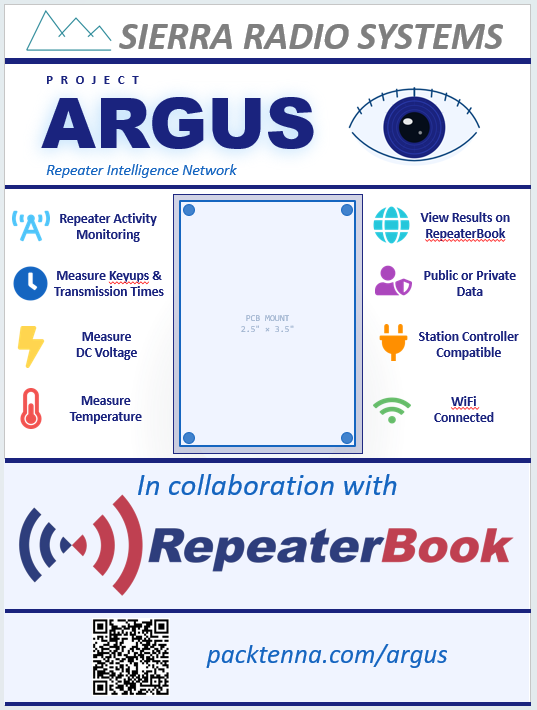
At Hamvention 2026 in a few weeks, Sierra Radio Systems (SRS), in conjunction with RepeaterBook will unveil a new SRS product and and a new capability for RepeaterBook to display realtime statistics of a particular repeater.
Project Argus is a hardware monitoring solution that you can connect to your repeater or, alternatively a monitoring radio, that observes when the repeater is keyed up. The device sends the keyup date/time stamp and unkey date/time stamp to the RepeaterBook database and the repeater owner can either see the data privately or post the activity on the public RepeaterBook web site.
Why do this?
This will provide a repeater activity metric so when you go to a location you can see on RepeaterBook what repeaters are active.
When a module is installed at a repeater, in addition to the keyup info, a DC voltage and temperature can also be monitored and provided to the repeater owner.
The hardware is like a mini-station controller module. It is also compatible with other SRS Station Controller modules so you can use it for that as well. We will be demonstrating the system and selling the hardware at Hamvention 2026.
Graphic for display at Hamvention 2026 - courtesy of Sierra Radio Systems
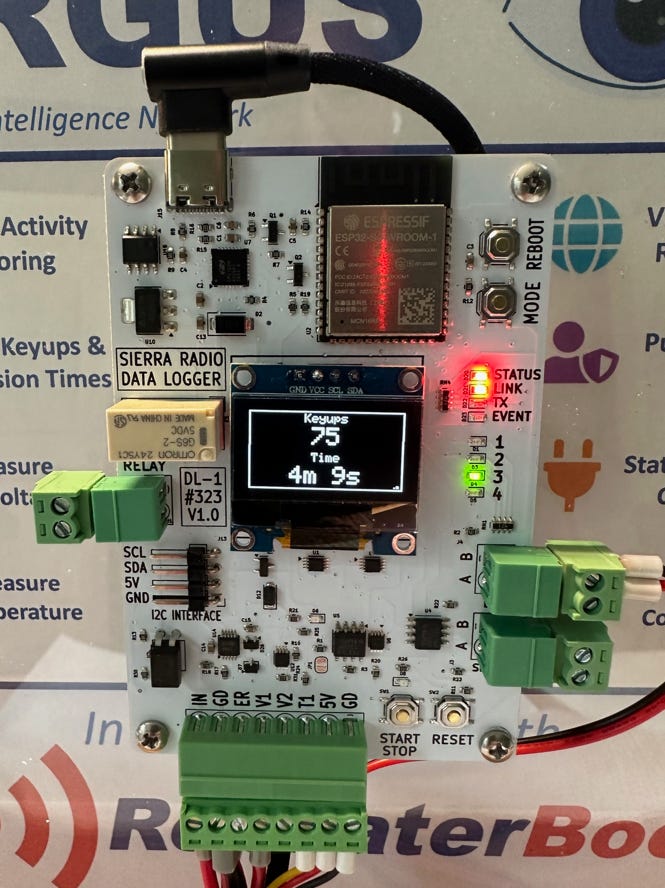
Here is a picture of the board:
Please visit our demonstration at Hamvention 2026 at Booth 3012 (Sierra Radio Systems / PackTenna / Ham Radio Workbench Podcast) in Building 3 (Marconi).
Garrett Dow KD6KPC from RepeaterBook will be demoing RepeaterBook and Project Argus at RT Systems in Booth 3804-3805 in the same building.
Editor’s Postscript
This is a really unique capability. We’ve had bits and pieces of such a capability since we’ve had microprocessor controlled repeater controllers, but no way to make that info easily, publicly accessible, so kudos to SRS and RepeaterBook for this powerful collaboration.
What makes this possibility really interesting is the possibility of integrating it with a ka9q-radio receiver system that can be configured to receive all channels on a VHF / UHF band simultaneously. That would create the possibility of an “area repeater activity map” such as “222-225 Repeater Activity in Bellingham, Washington”. Such information would be really useful for new Amateur Radio Operators to see, at a glance, where the active repeaters are instead of having to monitor for themselves (and often, with only an inexpensive portable radio with the included (poor) antenna.
I followed up with some questions for KJ6VU:
Q1. Could this capability be also used for a website, like a club’s website, other than RepeaterBook?
A1. Yes. RepeaterBook is developing APIs that could allow an external web site to subscribe to the data that we are gathering from an Argus unit. They could then take that data and display on their own web site. More to follow on this capability in the coming months.
We will be expanding this to supporting other station controller modules as well.
Q2. For remote monitoring, I assume this just makes use of audio output of a speaker? So it would work equally well with digital voice, as long as you have a compatible radio?
A2. The sensor inputs are...
Digital input (pull to ground on an optoisolator)
DC voltage measurement from 0-60 volts
Temperature (digital temp sensor on a cable)
By default when the digital input pulls to ground this is an event that is sent to the RepeaterBook server, and the unkey as well.
For remote monitoring the easiest thing would be to take a radio like just about any Yaesu with a [10] pin MiniDIN and wire the digital input up to the COS output and you are good to go.
On a digital radio as long as you get a pull to ground indication, that will work. It’s possible to configure another input like the voltmeter to also trigger the event which can be useful to measure a high logic state going to a digital radio’s LED or whatever to sense carrier presence.
Q3. It would be cool to provide a “big picture” view of, say, a website like “Bellingham Area Repeater Activity” that uses a ka9q-radio “receive all channels simultaneously”.
A3. Your description is what we hope will happen with RepeaterBook. When you look up Bellingham repeaters, you’ll see the relative activity of all the repeaters listed there (assuming they’re all instrumented with a Argus unit). The difference from your idea is that each repeater will be reporting their activity individually (and independently) instead of with just one ka9q-radio.
In addition to the repeater activity application, the Argus unit can be used to monitor and control just about anything. If more sensors and of different types are needed, the other station controller modules can be used.
We are also developing two energy monitoring modules (not available until later this year) to monitor AC power (voltage, current, kWh, frequency) and DC power (Voltage, current, state of charge for SLA and LiFePo4 batteries).
…
I think Project Argus is a very cool new capability for repeaters, and I look forward to seeing it demonstrated at Hamvention 2026.
I rarely excerpt an entire article in Zero Retries. I endeavorer to adhere to fair use principles and excerpt only small parts of content from other authors. In such excerpts, I encourage Zero Retries readers to visit the author’s site to read the entire article. In this case, I consider this article to be the rare exception of exceptional relevance to the mission, and the readership, of Zero Retries.
This article, and Templeton’s overall perspective on radio technology careers is a rare example of distilled wisdom on a subject.
In my opinion, Templeton’s observations, and analysis is entirely accurate about the situation about US industry and government’s need for more radio technologists.
The Quiet Resurgence of RF Engineering
14 Apr, 2026
I’ve worked in the aerospace industry for the past 8 years, and for most of that time I felt like I could confidently say that RF engineering felt like it was a quiet, non evolving field. The advice I heard early on, and that I watched a lot of other people follow, was to go into software. Machine learning, cloud infrastructure, web development. That’s where the growth was, that’s where the money was, and honestly, that’s where most new graduates went (myself included at the time). I studied Information Systems in college, not electrical engineering. RF was nowhere on my radar.
But aerospace has a way of pulling you into hardware whether you planned on it or not. I started my career at NASA, building telemetry platforms, ETL pipelines, and spacecraft visualization tools. Pure software work. Then I moved to a private aerospace company. Much smaller than NASA (approx 130 employees at the time I joined), and it required me to wear a ton of hats to work on ground systems. That’s where things shifted. When you’re responsible for ground station services, even when most of it now is software defined you can’t stay in the software lane entirely. I found myself doing link budget analysis, troubleshooting RF anomalies, and developing a working understanding of the RF hardware chain that I never expected to need.
That experience is part of why I’ve been paying attention to what’s happening in RF more broadly. I’ve been feeling a shift over the past several years — more demand, fewer people, and more urgency from the companies I talk to. RF engineering is not only alive, it’s rebounding in a significant way. I wanted to dig into whether my gut feeling here is actually backed by data, or if I’m just seeing what I want to see from inside the aerospace bubble.
What Actually Happened to RF
To be fair to the people who called RF a shrinking field, they weren’t wrong, at least for a stretch. After the dot-com bust in the early 2000s, the telecom industry consolidated hard. Companies merged, manufacturing moved offshore, and a lot of RF design work either disappeared or got absorbed into a handful of large defense contractors. The broader electrical engineering job market stagnated. Electronic Design has documented this trend not just for RF, but across EE as a whole. I feel confident that if the field as a whole is shrinking, then the subfield of RF was also in decline.
And then software exploded. The engineers who might’ve gone into EE or RF design a generation earlier went down the software “FAANG” route instead. University enrollment in RF specific coursework drifted down. Though I’ll be honest, hard numbers on this are annoyingly hard to find so this is more of my gut assumption. What we do know is that today, companies openly describe the difficulty of recruiting RF engineers, pointing to a generation that chose software over EE.
But here’s the thing that gets missed in the narrative: it never actually went away. The defense sector has been keeping it alive this entire time. Raytheon, Lockheed Martin, Northrop Grumman, these companies never stopped hiring people who understand beam patterns, power amplifiers, and antenna design. The majority of RF engineering job postings have historically come from aerospace and defense. RF didn’t die. It just receded from the civilian sector while quietly remaining essential to national security and defense.
So What Changed
The resurgence didn’t come from one place. It’s coming from several industries all hitting the same wall at roughly the same time; a shortage of engineers who can work at the hardware level.
The Space Boom
This is the one I see most directly in my work, and it feels the most dramatic. In 2015, roughly 260 spacecraft were launched into space globally. By 2024, that number hit approximately 2,695. A 10x increase in under a decade. The overwhelming majority of that growth came from commercial constellations, with SpaceX’s Starlink deploying over 1,500 satellites in 2023 alone.
Every single one of those satellites needs RF hardware. Starlink operates in Ku-band for user links and Ka-band for gateways, with V-band planned for Starlink V2. Kuiper and OneWeb follow similar architectures in Ka-band. Each spacecraft carries transceivers, antennas, filters, and amplifiers — and each ground station that talks to them needs the same. The amount of RF hardware per spacecraft adds up fast, and the launch cadence isn’t slowing down.
The money tells the same story. The global space economy hit a record $613 billion in 2024, with commercial making up roughly 78% of that. The space based RF market alone was valued at $18.6 billion and is projected to nearly double by 2033.
And it’s not just commercial. On the defense side, the Space Development Agency is building the Proliferated Warfighter Space Architecture — a LEO constellation targeting 500+ satellites. Only a few dozen are on orbit today, but nearly $35 billion has been committed through 2029. Even with the growing push toward optical links, these spacecraft still carry RF communications hardware and telemetry payloads, and that is unlikely to change anytime soon.
5G Wide Adoption
I think 5G’s impact on RF demand is genuinely understated. A typical 4G base station has 2 or 4 transmit-receive chains. A 5G MIMO radio integrates anywhere from 64 to 256. That’s an 8x to 16x increase in the power amplifiers, low-noise amplifiers, and antenna switches needed per installation. Multiply that across 642 operators and 374 commercial launches, and you start to see why the RF component market is pushing toward $50 billion with no signs of stoppage.
The design challenges make it worse. Millimeter wave frequencies introduce path loss that demands arrays with manufacturing tolerances at the millimeter scale. Additionally, thermal management, ex. dissipating 300+ watts from tower-mounted hardware with passive cooling, isn’t something you can solve reliably in software.
6G Is Already In The Works
It’s early, but 6G isn’t vaporware. 3GPP has been actively working on 6G study items since 2024, with first specifications targeted for late 2028 and commercial deployments expected around 2030. The EU, South Korea, and major telecom players like Ericsson, Nokia, and Samsung are all investing heavily into this research.
The RF challenges are genuinely new territory. Sub-terahertz frequencies and integrated sensing and communication (ISAC), which 3GPP officially scoped into 6G in the middle of last year, push well beyond what current design tools can handle. Worth noting though — the original vision for sub-THz has already been scaled back from outdoor cellular to mostly short-range indoor use cases like data centers and factories. But even with a narrower scope, all of this research eventually has to become hardware, and the people who know how to do that are already stretched thin.
The “Drivers” That Don’t Get Headlines
Space and cellular seem to dominate the conversation, but there are quieter contributors that I think are what make this feeling more durable rather than cyclical.
Automotive radar is a sneaky one. The EU now mandates automatic emergency braking in all new vehicles and, while the regulation is technically sensor-agnostic, most implementations rely on radar. Every new car with adaptive cruise control or collision avoidance has RF hardware running on board. That market alone is projected to hit $7+ billion this year. Then there’s Wi-Fi 7, operating across three bands simultaneously, and the ever expanding IoT landscape with over 21 billion connected devices as of 2025. Anything that communicates wirelessly needs RF work behind it, and that list just keeps growing.
The Talent Shortage
What makes this an interesting pattern, is that the supply side is genuinely broken. IEEE survey data shows 73% of EE employers can’t fill positions within six months, up from 45% five years ago. EE Times has reported specifically on the RF talent gap and its growing demand.
And it’s not just direct competition for RF roles either. RF and semiconductor careers often pull from the same shrinking pool of EE graduates, and right now the semiconductor side is in a hiring frenzy of its own. The CHIPS Act has poured billions into domestic fab expansion, AI chip demand is exploding, and the semiconductor industry is projecting a 67,000 worker shortfall by 2030. All of that competes directly with RF employers for the same talent. When everyone is fighting over the same small group of EE grads, RF companies, which tend to be smaller and less visible than the big chip fabs, often lose out.
Salaries reinforce this. Average RF engineer comp is pushing past $130K, with top-end design positions listing above $200K.
The real signal to me is what companies are doing about it. Mini-Circuits and Keysight are investing directly in university partnerships because they can’t wait for the academic pipeline to refresh itself. Baylor launched a new Graduate Certificate in Microwave/RF Engineering in 2024, one of the few new programs I’ve seen pop up, but I imagine it won’t be the last. When industry starts building its own talent pipeline, that tells me the shortage isn’t a blip.
Looking Forward
I don’t want to oversell this. I don’t think RF is going to become a field with an insane growth pattern. The BLS projects 7% growth for EE broadly, faster than average sure, but not a hockey stick. The demand is real, it’s coming from multiple directions at once, and the supply is genuinely constrained.
My own path is a small version of this story. I came in as a software engineer and had to learn RF on the job because there wasn’t someone else to hand it off to. I say this as someone who made that transition, you absolutely can learn enough RF to be effective in your role, and I’d encourage anyone in aerospace or wireless to do it (honestly it’s a fun niche to get into anyway). But there’s a difference between understanding link budgets and SDR anomalies versus designing a phased array from scratch. The latter takes years of dedicated focus. The underlying physics (electromagnetics, thermodynamics, materials science, manufacturing tolerances) don’t reduce to algorithms. You have to build intuition for it, and that’s not something you can shortcut.
I may one day expand on learning this stuff on the job and on the fly, but I do want to shoutout PySDR. It’s a free resource built exactly for software engineers. It uses Python as the bridge between hardware and software concepts, and starts with no RF knowledge assumptions from the beginning and doesn’t spend a ton of time over explaining the math.
The people who stuck with RF through the lean years are now some of the most sought-after engineers I’ve come across. And for anyone trying to figure out where to focus, either as a primary discipline or as a secondary skill set like it was for me, I think RF is worth a serious look right now.
Who Am I?
Anthony Templeton is a software engineer passionate about high-performance computing and aerospace applications. You can connect with me on LinkedIn or check out more of my work on GitHub.
One small portion of the radio technology industry that I think Templeton missed (though he mentioned Internet of Things) was the embedding of radio technology into things that just weren’t possible even a decade ago. Two examples in my own life is my BiPAP machine has an embedded cellular modem that I don’t pay anything for - the service costs were apparently embedded into the purchase price. Another is the Bluetooth radio that’s embedded into my Continuous Glucose Monitor, which I replace every two weeks (and I’m instructed to throw away). Another is wireless transfer of low power which will eventually allow the embedding of sensors into situations where batteries or external power aren’t practical… such as strain gauges embedded into critical walls to monitor for excessive stress or impending failure, or monitor for water ingress, or air quality in complex ductwork. Lastly… I can’t wait for the radio (RADAR) equivalent of a thermal scanner so a DIY homeowner can finally see what’s inside a wall before cutting into it.
While I agree with the author’s mention of PySDR, I was surprised that he also didn’t mention the GNU Radio framework for learning about Software Defined Radio. If an early or mid career Electrical Engineer wants to get a crash course in SDR, I don’t think you could do better than attending one of the annual GNU Radio Conferences.
This is a slide from a recent presentation I gave at LinuxFest Northwest trying to “evangelize” Amateur Radio to (Linux, in this case) techies:
So… Why Bother With Amateur Radio?
It gives you hands on experience with radio technology
Radio isn’t magic, and it’s not just an API call or a library
Radio is weird, much weirder than wired networks
If you understand how radio works at the physical level, you can do a better job with your software and your systems
Wi-Fi, Bluetooth, NFC, LoRa, cellular are all black boxes
Amateur Radio lets you really learn about radio technology
I think that Amateur Radio could have a substantive role in cultivating interest in young techies about radio technology, potentially leading to a career in engineering, and hopefully radio (RF) engineering. We’re making some progress on that score, but nothing systemic, at scale, yet. Perhaps my proposal in my earlier article will be a start at such systemic promotion, at scale.
Amateur radio has always been a pursuit of contrasts—venerating the past while racing toward the future. This issue celebrates that duality from cover to cover.
We begin with history: Harry Melville Dowsett, the architect of practical radio, and the curious case of author Zane Grey’s on-air adventures in Tahiti. Then pivot sharply to the present—AI’s creeping influence, TETRA digital tech, California’s controversial Bill AB 1043 that may affect you, and a look at the ARRL’s struggle in the digital age.
Our technical deep dives range from the IC-9700’s capabilities for digital modes to rebuilding the Icom IC-PW1 amplifier to building a vertical HF antenna without radials. For the space-minded, we track LEO satellites, pico balloons, and the mysterious Judica-Cordiglia recordings (fact or fallacy?). And don’t miss the Baker Street walkie-talkie heist or British Columbia’s 2026 QSO Party wrap-up,
Need something lighter? Check page 13’s News You Can Lose, try using a bluetooth speaker IKEA-style, exploring POTACat, or enjoying a classic Spam fritter and mash recipe (yes, really).
Don’t miss the run-up to the FIFA World Cup Special Event Stations and learn how to participate.
I cannot say enough about this (in my opinion, exceptional) issue of The Communicator. There are about ten articles in this issue that I want to read, thoroughly, to learn about Zero Retries Interesting topics. This issue is now queued into my tablet reader for a block of time that I can read, slowly and carefully, to learn more (that I didn’t write) about technological innovation in Amateur Radio.
I wrote this to a correspondent explaining why I think so highly of The Communicator:
Many think “magazines” are something whose time has passed, but The Communicator is an Amateur Radio magazine reimagined for the 21st century - free, easy to read and portable between devices PDF format, and an overall mix of good articles about operating, technical topics. The Communicator imparts an overall sense that Amateur Radio is fun and interesting.
I consider the length, and the content, and the overall quality of The Communicator to be a remarkable achievement. Thus it’s my go-to recommendation when I encounter someone who’s curious about Amateur Radio. I refer them to the Communicator website to download a current issue for them to have a better idea of what Amateur Radio is about.
Each issue of The Communicator seems to get better, and better. Kudos, again, to The Communicator’s stellar and capable Editor John Schouten VE7TI. That said, this issue is exceptionally Zero Retries Interesting (disregarding that I’m one of the contributing columnists).
Rick, W7WC, recently emailed me with this impressive example of RADE v SSB during an electrical storm:
I thought you would like to hear a comparison of RADE V1 vs. SSB reception during a recent noisy evening on 80 meters.
We had a line of thunderstorms a few hundred miles long, creating an intense impulse noise environment. Communication is via an NVIS path between my station and a friend about 70km away.
Quite remarkable! Thanks for making all this possible.
I was unable to embed the audio clip, so click the title link for that. The first half of the recording is analog and barely understandable. The second half is FreeDV and it’s slightly robotic, which I attribute to the Forward Error Correction having to be used extensively, but it’s perfectly understandable.
FreeDV RADE is an open source digital voice mode specifically designed for communications via HF and its vagaries - atmospheric noise, fading, etc. RADE is Radio Autoencoder - machine learning techniques applied to digital voice for HF.
I think it’s notable that this is using FreeDV RADE v1, and the FreeDV developers are working on more advanced versions.
One input pin receives the RF. The FPGA threshold turns it into a transition stream. Four-phase sampling recovers quadrature structure. XOR logic handles mixing. A CIC filter downsamples. A cross-product demodulator recovers FM. Sigma-delta output produces audio.
What disappears?
No strong external local oscillator spraying around the board. No conventional analog mixer front end. No RF/IF amplitude-preserving ADC. No sine/cosine lookup tables. No atan2 phase extractor.
The question was not “can I make a toy FM receiver?” The question was:
How much of radio is actually necessary?
Turns out: less than the inherited stack tells you.
Full writeup in the comments
Talk about digital radio technology…
I met Greenforest after my presentation at LinuxFest Northwest here in Bellingham last Sunday. He told me this story in passing, and I was agog, but now you can be too.
Apparently Greenforest’s LinkedIn post is the only place their accomplishment is written up, so click the title link for more detail.
Amateur radio operators will participate in the Department of Defense’s Armed Forces Day (AFD) Crossband Test on May 9, 2026. The annual event will not impact any public or private communications.
For more than 50 years, military and amateur stations have participated in this interoperability exercise between the amateur and government radio services. The AFD Crossband Test provides a unique opportunity to conduct two-way communication between military communicators and stations in the Amateur Radio Service (ARS), as authorized in 47 CFR 97.111. These tests present both opportunities and challenges for radio operators to demonstrate individual technical skills in a tightly controlled exercise scenario.
ARRL The National Association for Amateur Radio® hails the Armed Forces Day Crossband Test as an example of the core principles of the US Amateur Radio Service, with its volunteers contributing technical proficiency and readiness in support of public service and national needs.
Military stations will transmit on selected military frequencies and will announce the specific ARS frequencies they are monitoring. All times are ZULU (Z), and all frequencies are upper sideband (USB) unless otherwise noted. An AFD message will be transmitted using the Military Standard (MIL-STD) Serial PSK waveform (M110), followed by MIL-STD Wide Shift FSK (850 Hz RTTY), as described in MIL-STD 188-110A/B. Technical information regarding these waveforms is available at drive.google.com/drive/folders/1pYDj7kQbm-QAyY4RPtx0dOXKohjaEjq9?usp=sharing.
The US Naval Academy Amateur Radio Club, W3ADO, will activate the historic NSS call sign during the Crossband Test. Several Naval Academy midshipmen and members of the Potomac Valley Radio Club (PVRC), including team leader Frank Donovan, W3LPL, will be operating on the grounds of the former US Navy radio transmitting facility in Annapolis, Maryland. PVRC is an ARRL Affiliated Club.
This annual exercise / test is a unique opportunity to demonstrate that Amateur Radio and US military can interoperate in emergency communication situations.
It’s notable (and Zero Retries Interesting) that the communications between Amateur Radio are apparently data communications rather than legacy CW or analog voice communications.
John E. Ross KD8IDJ, Editor in the 2026-04-30 issue of ARRL Letter:
The ARRL Foundation’s 2025 Bill Orr, W6SAI, Technical Writing Award has been awarded to Dr. Ethan Miller, K8GU, and Dr. Nathaniel A. Frissell, W2NAF, for their August 2025 QST article, “About Traveling Ionospheric Disturbances.”
The editors of QST nominated Miller and Frissell in August 2025, the ARRL Foundation Board approved the awards in January 2026, and the award plaques were distributed to Dr. Miller and Dr. Frissell last week. The award is an annual honor presented by the ARRL Foundation to recognize outstanding technical writing in the amateur radio community.
See the title link for the bios of the two winners.
Zero Retries congrats to K8GU and W2NAF for doing great technical writing (and technological innovation…) in Amateur Radio!
Info on Reporting Interference from AST SpaceMobile on 420-450 MHz (70cm) Band
John E. Ross KD8IDJ, Editor in the 2026-04-30 issue of ARRL Letter article:
adds some information about what to do to report any interference that’s experienced from AST SpaceMobile in the 420-450 MHz (70cm) Amateur Radio band.
After considering the filed comments, the FCC narrowed the requested authorization to emergency TT&C only and further provided that:
Use of these frequencies is permitted only in emergencies when no other spectrum is available
Each emergency event is limited to no more than 24 hours
Transmissions are restricted to five specific center frequencies (430.5, 432.3, 434.1, 435.9, and 439.5 MHz), each with no more than 50 kHz bandwidth
…
In the US, reports of suspected interference to amateur spectrum can be shared with the ARRL Regulatory Information Manager, email reginfo@arrl.org.
Thus, if there is any use of those frequencies by AST SpaceMobile that are outside those specific frequencies, with a bandwidth greater than 50 kHz, that would be notable to record and report.
It’s solely my impression, but I think it’s a reasonable inference that those limits were imposed because several Amateur Radio Operators in Europe recorded the transmissions of AST SpaceMobile’s test satellites, and made that info public. From that public reveal and that info filed with the FCC, it seemed obvious that AST SpaceMobile wasn’t attempting to minimize interference, and were routinely using the 420-450 MHz band (430-440 MHz in Europe).
Thus that “record” part, if anything outside what they’re authorized to do is observed, is critical to be able to effectively protest against AST SpaceMobile’s unauthorized use of 420-450 MHz.
But in the coming years, that’s finally going to change. Just last week, the tenth GPS III satellite was placed in orbit by a SpaceX Falcon 9 rocket. Once it’s properly configured and operational, it will join its peers to form the first complete “block” of third-generation GPS satellites. Over the next decade, as many as 22 revised GPS III satellites are slated to take their position over the Earth, eventually replacing all of the aging satellites that billions of people currently rely on.
…
While modern GPS receivers are more sensitive than those in the past, there’s simply no getting over the fact that signals coming from a satellite more than 20,000 kilometers away will be by their very nature weak. So not only is it relatively easy for adverse environmental conditions to block or hinder the signal, but it doesn’t take much to override the signal with a local transmitter if somebody is looking to cause trouble.
As such, one of the key goals of the GPS III program was to deliver higher transmission power. This will lead to better reception for all GPS users across the board, but the new satellites also offer some special modes that offer even greater performance.
In addition to the backwards compatible signals transmitted by GPS III satellites, there’s also a new “Safety of Life” signal. This signal is transmitted at a different frequency, 1176 MHz, and at a higher power, so compatible receivers should hear it come in at approximately 3 dB above the “classic” signal. It’s intended primarily for high-performance applications such as aviation, but as compatible receivers get cheaper, it will start to show up in more devices.
…
The new signals being transmitted by GPS III satellites won’t just be louder than their predecessors, they’ll gain some new features as well.
For one thing, GPS III satellites will transmit a standardized signal known as L1C which offers interoperability with other global navigation systems such as Europe’s Galileo, China’s BeiDou, the Indian Regional Navigation Satellite System (IRNSS), and Japan’s Quasi-Zenith Satellite System. In theory a compatible receiver will be able to process signals from any combination of these systems simultaneously, improving overall performance.
The new satellites will also support the L2C signal. While this signal was technically available on earlier generation satellites, it’s still not considered fully operational and its adoption is expected to accelerate as more GPS III satellites come online. Compared with the legacy GPS protocol, L2C offers improved faster acquisition of signal, better error correction, and a more capable packet format.
This is a great article about the enhanced capabilities of GPS III, which will inevitably affect, and eventually improve Amateur Radio such as improved time synchronization and likely eventually embedding GNSS capability into every radio… because it’s so (increasingly) capable and practically free.
This is further justification that the substantial disruption proposed by NextNav’s radical, incredibly disruptive, and proprietary reconfiguration of the 902-928 MHz Band is unwarranted and unnecessary. See Zero Retries 0193 - The Threat to the US 902-928 MHz (33 cm) Band from NextNav. (Disclaimer - it’s very long and very detailed, but there is a detailed “skip to the relevant parts” table of contents.)
Thank you to Christian Ebner from ebcTech, who has submitted news about his newly released Android app RTL-SDR 433, which lets you run the rtl_433 decoder directly on your phone using an RTL-SDR dongle connected via a USB OTG cable.
The app bundles rtl_433 as a native Android library and supports all 258 device protocols out of the box, including weather stations, TPMS, wireless doorbells, PIR motion sensors, energy meters, door/window contacts, and remote sockets. Decoding runs entirely on-device with no internet connection required, no root, and no special drivers. It uses the standard Android USB Host API together with a libusb Android port.
The UI is built with Jetpack Compose and Material 3, and shows a live list of unique sensors with expandable cards (temperature, pressure, RSSI, raw JSON) plus a full history log. The app is free to try with a decreasing per-session reading limit, and a one-time purchase for a few dollars removes the limit permanently.
We note that the GPL-licensed native layer (rtl_433, rtl-sdr, libusb Android port and EBC’s integration glue) is published openly at github.com/ebc81/rtlsdr433-native-gpl in compliance with GPL-2.0, while the UI layer remains closed-source.
This seems like a cool app, more approachable than some “radio hacking” tools. It would be fun and useful to show off the number of radio-based “radio gadgets in daily life” are in your household, such as car unlock “clickers”7 and all the other devices named in the article. In fact it could be useful for troubleshooting. For example, I have a “garage door opener keypad” that I cannot make work. I’ve changed batteries, I’ve reprogrammed it with the garage door opener, and cannot make it work. It would be useful to see if the unit actually is transmitting. With this you could be a hero to friends and neighbors to be able to do some basic troubleshooting of their household wireless devices. (And, learn what you might disable of your friends and neighbors if you transmit at reasonable power on 433 MHz.)
Also, instead of using a phone for this app, there are low-cost Android tablets that might make using this app easier.
“Husky” is the mascot (yes, the dog breed) of the University of Washington.
Cherry blossoms are in full bloom ver in these parts and with them an exciting new chapter for the Husky Satellite Lab (HSL). As campus wakes up for the season, our team is already in motion, pushing forward on some wickedly cool projects and missions.
Before we charge full speed into Spring, we’ve got some major updates to share from our latest endeavors and recent milestones heading into Spring 2026.
From NASA programs to new membership applications, let’s jump right in!
HS-2: Spring Interim Review and F’
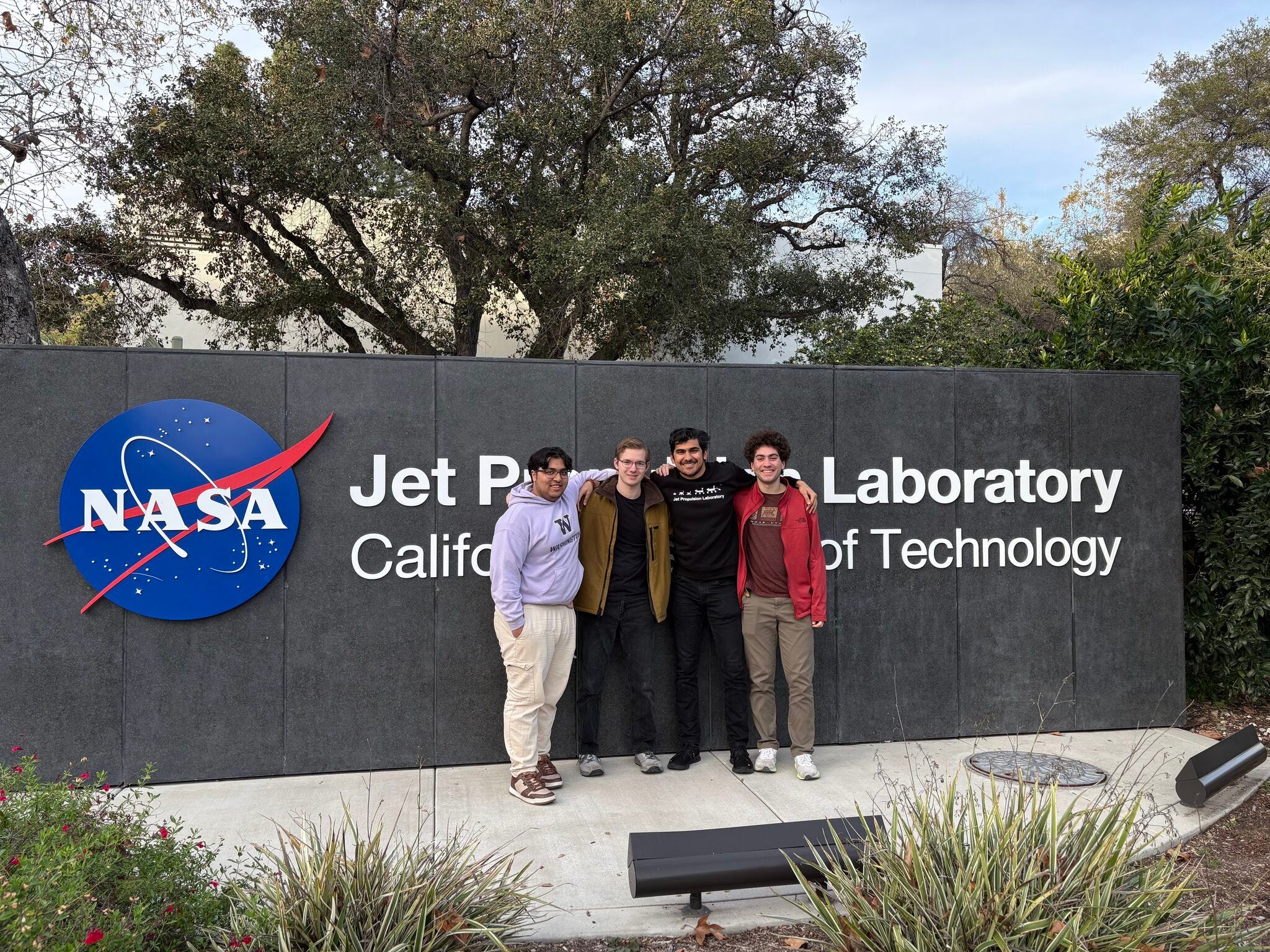
Image of HS-2 Members (from left to right) Arin Kharkar, Henry Adams, David Magidson, and Yaj Jhajhria, at NASA’s Jet Propulsion Laboratory as part of the F’ Workshop.
Though HS-2 finished their PDR review in the fall, the team has not been slowing down! Throughout Spring quarter, HS-2 has been preparing for The Spring Interim Review (SIR), an interim review with our sponsors and mentors at The University Nanosatellite Program. In this presentation, the Payload, Electrical Power System (EPS), and Communications subsystems shared their current progress and received valuable feedback on key questions and areas for improvement.
In addition to these reviews, members of the HS-2 Division (as seen in the image above) had the opportunity to attend the NASA Jet Propulsion Laboratory Flight Software/F´ Development Workshop in Pasadena, California. There, they developed key skills in F´, a software framework designed for the rapid development and deployment of spaceflight, embedded systems, and instrumentation. The HS-2 team has since been sharing this knowledge with subsystem members and has begun implementing the framework across CubeSat software systems.
As Spring continues, much of their hardware is arriving, which means lot more activity in the lab as testing and system design for summer test assemblies.
I’m not so much highlighting the details of the University of Washington (though… they are the “home team” for collegiate Microsats)… as I am highlighting the method / communication methodology of the HuskySat team. They’re making brilliant (effective) use of Substack for communicating with their fanbase / supporters.
That said in my (objective, as I can be), the accomplishments of the HuskySat program have been impressive, in my opinion. Admittedly, I’m a bit biased for the home team.
Chris Bolton M0KNF via Amateur Radio Daily 2026-04-28:
The TinyDX is a miniature FT8/4 QRP ~1W transceiver designed to be powered and operated via a USB connection to a smartphone/tablet running an FT8 app such as FT8TW for android or IFTX for IOS. It is able to operate on any 2 of the HF “high” bands, 20M, 17M 15M, 12M, 10M which are defined by the builder during the software configuration process. The TinyDx does not have CAT control but uses the transmit audio signal to switch the PA and receiver during the transmit/receive cycle. Band and mode are selected via 2 hardware switches on the main board.
Designer Barbaros (Barb) Asuroglu WB2CBA has shared the design on GitHub with all of the necessary fabrication files for the boards to be built and populated by the PCB manufacturer JLCPCB. The cost of having the boards built by JLCPCB is around £30 per set for an order quantity of 5 sets plus shipping. Choosing this option just leaves the individual to connect the pre-built boards together and load the bootloader and firmware as per the instructions on Barb’s blog.
The use of an AI as the “endlessly patient and knowledgeable Amateur Radio tutor” to figure out the problem with his unit(s) was instructive, and indicative of how useful AI can be.
I think that one of the “killer apps” for Amateur Radio will be a small radio like this that is connected to a “screen device” and powered and communicating via a USB-C cable and allows operation on an Amateur Radio exclusive band like 222-225 MHz (in North America). We have a similar capability with being able to flash AREDN firmware onto small travel routers, but that’s not quite as fun as being able to operate VHF / UHF. I had such a unit for the 420-450 MHz band once upon a time, but it was a prototype project by the manufacturer that wasn’t refined into a product.
My thanks to Amateur Radio Daily for mentioning this for inclusion in Zero Retries.
The zBitx community is buzzing with the release of the v2 software and hardware update by Ashhar Farhan (VU2ESE).While the new version promises to solve long-standing issues like receiver “chuffing” and the 24 kHz spur, the migration for v1 owners has proven to be a technical challenge. If you are seeing a “white screen” or unresponsive touch controls, you are not alone.
zBitx v2 Migration
Based on the latest discussions from the BITX20 Groups.io forum, here is the comprehensive guide to a successful upgrade.
…
What’s New in zBitx v2?
The v2 update is both a hardware revision and a software overhaul designed to decouple the user interface from the core radio.
Wi-Fi Architecture: The Raspberry Pi Zero 2W now acts as an Access Point (SSID:zbitx), and the front-panel Pico W connects via Wi-Fi.This replaces the old$I^2C$ link, eliminating the I2C “hogging” that caused CW keying lags.
Hardware Upgrades: The new retail units include a power switch, an in-built EFHW transformer, a passive FET mixer, and high-efficiencyAFT05MS004N LDMOS transistors.
24 kHz Spur Fix: By shifting the clock and adding a center_bin parameter in hw_settings.ini, the BFO is moved outside the crystal filter’s passband.
Click the headline link for all update procedures.
This is a good, comprehensive overview of the process of updating a zBitx V1 to a “V1.5”8. In my opinion, this kind of compilation (kudos to VU3DXR for doing so) is something that HF Signals should be providing on their website (and direct email to [known to HF Signals] zBitx V1 owners that bought direct from HF Signals) rather than forcing zBitx V1 owners to wade through the email list to pick up all the little nuggets that VU3DXR has assembled in this article.
A mild caution about the DXR Electronics Bits website - you might want to turn on “Reader Mode” or some other kind of ad filter because the popup ads can be overwhelming and frustrate you trying to read the content. MacOS Safari’s “Hide Distracting Items” feature worked pretty well for me to create a clean printout of the procedure for tackling my zBitx V1 to “V1.5 upgrade” later this summer.
Michelle Thompson W5NYV on Open Research Institute:
For the upcoming inferior conjunction of Venus and Earth, there is a growing community of amateurs that are bound and determined to get a communications signal bounced off Venus and received here on Earth. This is EVE. The inferior conjunction is when Venus and Earth are the closest together.* This is the right time to attempt this feat, and it happens only once every 18 months or so.
The channel is daunting. So, ORI, SBMS, and others, have put together a link analysis.
This includes the current link analysis Jupyter Notebook, and all the support files to make it run, and more. Such as, all the documents used to propose observing sessions at the “really big” dishes at Green Bank and Effelsberg.
What can we do now to help make good things happen?
We have a modulation and coding scheme designed especially for this channel.
But we need to test it BEFORE Venus whooshes by in October of 2026. We need to test it now. We’ve tested in simulation, sure, but we all know that’s not good enough.
We need to test it with the Moon. EME is a close enough channel. It doesn’t have the same Doppler spread that Venus has, because the Moon is “locked” to the Earth, but it does wiggle around a bit, and it is a very hard microwave channel.
The following is a press release from the Amateur Radio Software Award:
The Amateur Radio Software Award (ARSA) committee is proud to announce that the Hamlib project has been selected as the recipient of the 2026 Amateur Radio Software Award. This year’s award honors the outstanding work of the current core developers: Nate Bargmann (N0NB), George Baltz (N3GB), Daniele Forsi (IU5HKX), and Mikael Nousiainen (OH3BHX).
The annual ARSA award recognizes software projects that enhance amateur radio and promote innovation, freedom, and openness in amateur radio software development. Hamlib was selected for its long‐standing and essential role in enabling software to interface with transceivers and other controllable devices. For more than a quarter century, Hamlib has provided a unified, reliable way to send control commands and read device status. Despite its age, the project remains actively maintained, with new radios and devices added regularly. Hamlib continues to be the go-to library for both established and emerging amateur radio applications.
About Hamlib
Hamlib provides stable, flexible shared libraries that simplify the development of amateur radio equipment control applications. Many modern transceivers include serial (RS‐232, USB, etc.) or Ethernet/Wi‐Fi/Bluetooth interfaces that allow software‐based control. Hamlib abstracts these interfaces, making it significantly easier for application developers to interact with radios, rotators, amplifiers, and other controllable devices. From WSJT‐X and Fldigi to JS8Call, Log4OM, and CQRlog, today’s widely used amateur radio applications are built on Hamlib.
Nate Bargmann (N0NB) notes that “over the lifetime of the project there have been several principal developers. Its founder is Frank Singleton, VK4FCS. Stéphane Fillod, F8CFE, and until about a year ago Mike Black, W9MDB (SK), were successive principal developers.”
Bargmann reports that the current long‐term support branch will receive the 4.7.1 release in the coming weeks, adding support for new radio models and improving existing ones. Work on Hamlib 5 is also underway. The new major version will introduce some backward‐incompatible changes to isolate internal structures and align with modern best practices, including breaking the C ABI. Discussions are ongoing regarding potential API changes, and feedback from client developers is encouraged.
“There is no set date for a release of Hamlib 5.0.0,” Bargmann adds, “but hopefully within the next year seems possible.”
To celebrate Hamlib’s selection as the 2026 award recipient—and to encourage nominations for the 2027 Amateur Radio Software Award—the ARSA committee will operate the special event station K7A from November 27 through December 7, 2026.
About the Amateur Radio Software Award
The Amateur Radio Software Award is an annual international award recognizing software projects that enhance amateur radio and promote innovation, freedom, and openness in amateur radio software development.
Award Committee
Claus Niesen, AE0S (since 2020)
Kun Lin, N7DMR (since 2020)
Rich Gordon, K0EB (since 2021)
Sebastian Delmont, KI2D (since 2026)
For nomination guidelines, event schedules, and information about past winners, visit https://arsaward.com.
When you really look at what Hamlib is, it’s a remarkable accomplishment that is one of the primary technical underpinnings of Amateur Radio, rarely noticed, lurking in the background of software interaction with radios.
Hamlib is a perfect illustration of the XKCD comic Dependency:
Image courtesy of xkcd.com - https://xkcd.com/2347/
With this award, the Hamlib developers have now been publicly thanked.
My thanks to Amateur Radio Daily for mentioning this for inclusion in Zero Retries.
Eric Grumling K0JEG on his Grand Valley Aviation newsletter / website:
I’ve been watching Starlink build out their satellite constellation over the last few years. I’ve also been hearing plenty of good things about the company and the service. But the hardware price was always a little too much, and the data limits were a little too low. Well, this month that all changed. They dropped the price of the Starlink Mini terminal to $199 and increased the monthly usage limit on the $50 Roam plan to 100GB, a 50% increase. With my life hopefully settling into a little more normal routine compared to the last year (and getting my tax refund) I thought it was time to try them out.
…
I’m Bored.
Satellites used to be the stuff of science fiction (in fact the geosynchronous satellite concept was first proposed by Arthur C Clarke, and because of that the orbit where it takes 24 hours to complete on orbit is called the Clarke Belt). Today we not only take them for granted, we pretty much think they’ve been supplanted by superior, (under)ground based technology like fiber optics. Where the fiber runs it’s great. If you’re at home or work, having fiber is the best communications solution bar none. But if the fiber isn’t available then what? Wireless works but is hard to set up and limited in bandwidth. Starlink works pretty much anywhere with a clear view of the sky.
The fact that anyone who does ‘brainwork’ for a living can work pretty much anywhere on the planet is still a game changing event. The idea of cruising through Glenwood Canyon while downloading lossless music or live-streaming 4K dashcam footage (at the same time) is something that we almost expect but is still a little bit magical to those of us who remember the massive gaps in cell service between cities. Bringing a little piece of “the grid” to places where it wasn’t before will level up the rural access gap, lower prices through competition and open up new ideas that weren’t possible in areas that couldn’t get service without an expensive plant extension.
I made a phone call from one hand to the other, through a network of satellites moving overhead at 17,000 miles per hour. It worked exactly as expected. No drama, no delay, no sense of wonder. Just another day in the life. For fifty years we’ve been solving the same problem—how to make a scarce resource feel abundant. The only difference now is that we don’t notice when the problem’s solved.
This is a great Zero Retries Interesting casual explanation the evolution of satellite communication technology framed in the context of his purchase of a Starlink Mini (now priced at $199 in the US). Like K0JEG, satellites have always been part of my life (though I’m old enough to remember “Live via Telstar” banners on some television programs).
Two additions to K0JEG’s discussion:
You can “dial back” your Starlink Mini subscription to Standby service for $5 / month with (unmetered) 400 kbps connectivity and back to full speed on a month to month basis. It’s amazing how useful 400 kbps is.
He gives the impression that the Iridium system is outmoded, but that’s not the case any more as the entire satellite constellation was replaced several years ago with vastly more capable satellites, including new data modes and digital voice services.
I concur with K0JEG’s recommendation in the footnotes of the book Eccentric Orbits: The Iridium Story. I couldn’t put it down. It tells the astonishing story of how close Iridium came to being completely killed, and why Motorola pretty desperately wanted to kill it.
Michal Zalewski9 on his newsletter / blog Icamtuf’s thing:
Many of you follow this blog because of the regular features about electronic circuit design. Today, I’m happy to announce that I’ve been working with No Starch Press on The Secret Life of Circuits:
Image courtesy of No Starch Press
I think it’s an exceptional book. It’s the reference I wish I had earlier in my life: an accessible, in-depth exploration of how circuits really work, from the motion of electrons to the dark art of embedded system programming.
The book is meant for the inquiring hobbyist, including those who have tried to learn the craft and hit a brick wall. With 420+ pages and 290+ meticulously-crafted color illustrations, The Secret Life of Circuits focuses on modern problem-solving and emphasizes intuition over cryptic formulas.
It’s a reasonable assumption that this book will be of the same high quality as the author’s blog articles such as Radios, how do they work?.
I think books are still relevant in the 2020s and beyond. A well-written, tightly focused book, written from depth of knowledge of a subject, offers distilled wisdom that lets you get up to speed on a subject10.
Video - K7RAW MagNoodLoop DIY Antenna for 20-10m
I have been in awe of Rudi Wiedemann K7RAW’s encyclopedic knowledge of antenna theory that he shares so freely on his YouTube Channel Antenna Whisperer - K7RAW.
K7RAW came to my attention last October at Pacificon with his innovative Drone Scan 3D project / product. I’ve stayed in touch with K7RAW since then, and this is his latest project. It’s made mostly of PVC, pool noodles (yes, really) and conductive adhesive copper foil tape.
When I realized that the “plunger” at the top of the assembly is the tuning control… I thought that is completely ingenious, and yes, makes for a very inexpensive tunable magnetic loop antenna. (Making a mag loop antenna tunable is the hard, expensive part.) When I discussed this antenna with K7RAW, he revealed that not only is his “plunger” a tunable element, but its action is linearized. I’m looking forward to the next video where he describes how that’s done.
My talk last Sunday at LinuxFest Northwest went well, and seemed well received. My goal was to expose the attendees to aspects of Amateur Radio that would be most relevant to them such as Software Defined Radio (being able to transmit in wider portions of spectrum than the unlicensed bands) and that there are many aspects of Amateur Radio that were open source.
There were < 10 attendees that were Amateur Radio Operators, and only five or so Zero Retries subscribers. I’ll post my slide deck here on the Zero Retries website after a bit of reorganizing to create a dedicated page for my presentations.
Hamvention Ho!
2 weeks until Hamvention 2026 in Xenia, Ohio, USA... Zero Retries / DLARC booth 1506 in Building 1 / Maxim
Weekends Are For Amateur Radio!
Vintage Computer Festival Pacific Northwest (VCF PNW) 2026 is this weekend in Tukwila, Washington (greater Seattle area). I had hoped to exhibit a working Packet Radio system to showcase vintage TNCs (such as TAPR TNC 2s), including radios. But it’s been an intensive couple of weeks and I just haven’t been able to put in the time necessary in N8GNJ / Zero Retries Labs to put together a working system. Thus my exhibit will just show a collection of “vintage” TNCs as a static display.
Post Publication Update - I developed a health bug of some kind on Friday. Out of an abundance of caution that I might be contagious, I decided at the last minute not to attend VCF PNW 2026. Apologies to those who were coming to see the Packet Radio exhibit.
Have a great weekend, all of you co-conspirators in Zero Retries Interesting Amateur Radio activities!
My ongoing Thanks to: Tina Stroh KD7WSF for, well, everything! Jack Stroh, Late Night Assistant Editor Emeritus Fiona and Shreky Stroh, Late Night Assistant Editors In Training
Founding Members who generously support Zero Retries financially: Founding Member 0000 - Steven Davidson K3FZT (Renewed 2025, 3rd year!) Founding Member 0001 - Randy Smith WU2S (Renewed 2025, 3rd year!) Founding Member 0002 - Chris Osburn KD7DVD (Renewed 2025, 3rd year!) Founding Member 0003 - Don Rotolo N2IRZ (Renewed 2025, 3rd year!) Founding Member 0004 - William Arcand W1WRA (Renewed 2025, 3rd year!) Founding Member 0005 - Ben Kuhn KU0HN (Renewed 2025, 3rd year!) Founding Member 0006 - Todd Willey KQ4FID (Renewed 2025, 3rd year!) Founding Member 0007 and 0010 - Merik Karman VK1DF / VK2MKZ (Renewed 2025 x2, 3rd year!) Founding Member 0008 - Prefers to Remain Anonymous 08 (Renewed 2025, 3rd year!) Founding Member 0009 - Prefers to Remain Anonymous 19 (Renewed 2025, 2nd year!) Founding Member 0011 - Rick Prelinger W6XBE (Renewed 2025, 2nd year!) Founding Member 0012 - Ryan Tolboom N2BP (Renewed 2025, 2nd year!) Founding Member 0013 - Newton White N4EWT (Renewed 2026, 2nd year!) Founding Member 0014 - Joe Hamelin W7COM (Renewed 2026, 2nd year!) Founding Member 0015 - Rich Stocking N7OP (New 2025) Founding Member 0016 - Prefers to Remain Anonymous 77 (New 2025) Founding Member 0017 - Phil Karn KA9Q (New 2025) Founding Member 0018 - Prefers to Remain Anonymous 95 (New 2025) Founding Member 0019 - Prefers to Remain Anonymous 0108 (New 2025) Founding Member 0020 - Prefers to Remain Anonymous 110 (New 2025) Founding Member 0021 - Prefers to Remain Anonymous 111 (New 2025) Founding Member 0022 - Prefers to Remain Anonymous 112 (New 2025) Founding Member 0023 - Prefers to Remain Anonymous 116 (New 2026) Founding Member 0024 - Rob Bowser (SPOOLTENNA) (New 2026)
Numerous Annual and Monthly subscribers who also generously support Zero Retries financially!
You thousands of readers of Zero Retries without which there would be little point in publishing this newsletter.
Fair Use - All excerpts from other authors or organizations, including images, are intended to be fair use and are fully attributed generally by author and link (URL).
Paid Promotional Content - Unless otherwise noted in the article or item, advertisement, or sponsorship notice, Zero Retries does not include paid promotional content. Exceptions:
Advertisements in Zero Retries,
Sponsorships in Zero Retries,
Zero Retries products,
Zero Retries events
Features and content exclusive to paid subscribers.
Realistically, and I’m not being self-deprecating in this statement, Zero Retries, as the product of a single individual with no substantive organization behind it. Thus Zero Retries cannot really be considered an authoritative resource.
The relevance of Amateur Radio is what’s in question, as in “what does Amateur Radio do in the 21st century?”. The utility of Amateur Radio, in this era, is largely perceived as the potential for emergency communications. But I consider Amateur Radio’s utility for emergency communications to be increasingly in question - see Zero Retries Perspective on Emergency Communications (EMCOM) Capability in Amateur Radio.
I remember that there was one situation where I parked my vehicle and I could not unlock it remotely (which turns off the built-in security system) and I thought that the battery in the “clicker” had died. It turns out that there was a security system in the building that I was parked next to that was swamping the low power signal from the “clicker”. When the vehicle’s security system was alarmed, the ignition was disabled and the horn blared. As soon as I pushed the vehicle away from the building about ten feet, the “clicker” worked again. Kudos to the engineer who designed the security system of the 1997 Dodge Dakota - I’ve never found a way to disable it.
Brief story best offered as a footnote: After I was suddenly thrown into a job to administer a department of more than one hundred users, I was given the task of transitioning them to Windows 3.0 in a matter of months. I was completely out of my depth in administering Windows, and especially the nuances of networking Windows in a server environment. My salvation (and I mean that very literally) to be minimally competent for that project, was the book Windows 3.0 Secrets by Brian Livingston. I spent a two week vacation reading that book cover to cover. I learned the basics of what I had to do to successfully complete the transition of the department to Windows 3.0. Good books by good authors on a very specific subject are distilled wisdom. I still have that book - dog eared, with many Post-It tags, and highlighted portions of pages.