2026-05-22 - Zero Retries Hamvention 2026 Recap (Photos!), RepeaterBook Project Apollo, Flipper One — we need your help, AI is killing the cheap smartphone, N8GNJ ImaginizeWorld Interview Now Online
Zero Retries is an independent newsletter promoting technological innovation in and adjacent to Amateur Radio, and Amateur Radio as (literally) a license to experiment with and learn about radio technology. Radios are computers - with antennas! Now in its fifth year of publication, with 3500+ subscribers.
My thanks to Rich Stocking N7OP for renewing as Founding Member 0015 to Zero Retries in the past two weeks (2nd year)!
My thanks to Dave Stewart K7XST for upgrading from a free subscriber to Zero Retries to Founding Member 0025 in the past two weeks !
Founding members are listed in every issue of Zero Retries!
My thanks to Andrew Herrington KG5JNC for renewing as an Annual Paid Subscriber (three years!) to Zero Retries in the past two weeks!
My thanks to Prefers to Remain Anonymous 27 for renewing as an Annual Paid Subscriber (three years!) to Zero Retries in the past two weeks!
My thanks to Prefers to Remain Anonymous 28 for renewing as an Annual Paid Subscriber (three years!) to Zero Retries in the past two weeks!
My thanks to Ed Wilson N2XDD for upgrading from a free subscriber to Zero Retries to a Paid Subscriber in the past two weeks!
My thanks to Prefers to Remain Anonymous 126 for becoming a Paid Subscriber to Zero Retries in the past two weeks!
PRTA 126 included this nice note: I think we need to keep up writing to advance the hobby. YouTube is not the answer.
I replied: I agree that YouTube is not the answer. It certainly has its uses and I’ll be making more use of YouTube in Zero Retries, but Zero Retries will remain mostly text.
Financial support from Zero Retries readers is a significant vote of support for the continued publication of Zero Retries.
Lots of Photos This Issue
This is the most use of photos I’ve ever done in Zero Retries and I have no idea how well it will work given that this is a newsletter that’s nominally distributed via email. I made no attempt to reduce the file size or resolution of the photos, thus this issue will be big (as in file size). Please let me know (via comments) on how well it worked out for email subscribers.
Hamvention 2026 is in the rear view mirror, and I reflect on what I saw from the Zero Retries perspective.
Hamvention Is FUN!
In this article, I do a tiny bit of grousing about the new experience, and minor inconveniences and discomforts of being a first time exhibitor at Hamvention this year. It’s important to disclaim in advance, for this techie being intensely interested in all things involving radio technology, Hamvention is a very fun, involved, full immersion experience in Amateur Radio and radio technology. I had many stimulating conversations at Hamvention, some for the benefit of Zero Retries, and some for the benefit of making connections between others that might not have known about each other. I recommend attending Hamvention at least once, because it’s fun!
Hamvention 2026 is now in the history books. The two big changes for me from previous visits to Hamvention was that I was a first time (co-)exhibitor and for the very first time I didn’t set foot in the flea market area… I just didn’t have the time. Similarly, for the first time, I didn’t have the time to attend any of the forums. A future note to self is to recruit a full time booth staffer so that I can spend some time away from the booth while reasonably representing Zero Retries.
And… N8GNJ / Zero Retries Labs is already full-to-bursting with waiting projects, thus I wasn’t compelled to seek out any new acquisitions and treasures in the flea market. Despite having ample projects in queue, I did pick up a few new treasures which I’ll mention at the end of the article.
Like at Hamvention 2025, within minutes of entering Building 1, my shoulder worn continuous glucose monitor, tethered to my iPhone via Bluetooth, went offline for most of my time inside the five Hamvention buildings. There’s apparently a pretty large buffer in the unit as no data was lost, and within a few minutes of leaving Hamvention buildings, it returned to normal functionality. I attempted to report this behavior to the manufacturer after Hamvention 2025, but they didn’t follow up with me.
Exhibiting is a Different Experience
Friday morning got off to a bit of a rough start with a flat tire on the rental car. We discovered the flat when we stopped for reasonable coffee at Starbucks. As luck would have it, there was a Discount Tire store across the street from Starbucks. When they opened at 08:00 we were the first customer and they handled our flat tire gracefully and efficiently. When they pronounced that the tire was not repairable, the good news was that they had a corporate contract with the rental car company and authorization for a replacement tire and all labor costs were handled with no out of pocket expense on my part. With that delay, we ended up being only thirty minutes late in staffing the booth for Friday morning’s opening. If you live in the Dayton area, I can strongly recommend seeking out Jared S. at the Beavercreek Discount Tire store for all your tire needs.
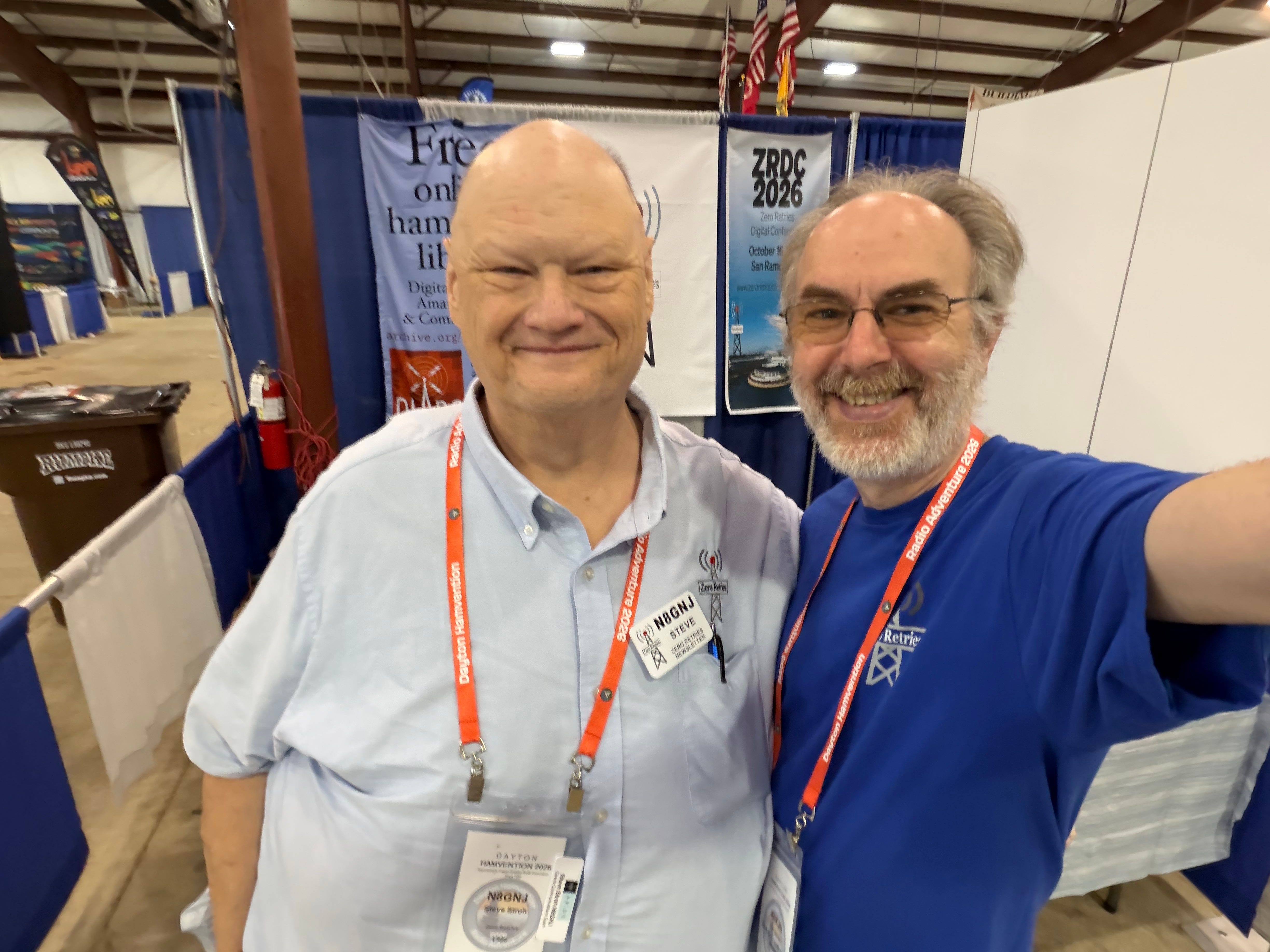
Steve Stroh N8GNJ and Kay Savetz K6KJN at Hamvention 2026, at the ZR / DLARC booth. Image courtesy of Kay Savetz K6KJN.
(K6KJN is a better selfie taker than I am.)
The Zero Retries / DLARC booth was a joint effort of wanting to promote Zero Retries and my friend and Amateur Radio colleague Kay Savetz K6KJN to promote Digital Library of Amateur Radio & Communications. I think that DLARC gained significant exposure as we explained to passerby using the pitch Free online Ham Radio library and handed them a DLARC postcard. The postcard format works incredibly well, and that’s a primary lesson learned. One interesting bit was that more than a few passerby were skeptical of the “free” aspect until we explained that DLARC was funded by a grant from ARDC (and pointed to their booth just down the aisle). Many people recognized Internet Archive, so that helped in explaining DLARC.
In contrast, my 4-page 8.5 x 11 inch handout with a ZRDC 2026 flyer stuffed inside… not so much. K6KJN was able to get many hundreds of DLARC postcards into folks hands. I barely managed to give away the slightly less than the one hundred handouts I had made.
In hindsight, I didn’t really have enough “pizazz” (or good signage) to explain, tersely enough, what Zero Retries was about, appropriate for the five second pass-by typical at Hamvention (despite our great location in Building 1 between the Kenwood booth and the DX Engineering section). But I also observed that when someone did stop by, perhaps five percent expressed any interest in digital / data communications. Folks attending Hamvention are, in my observation, mostly interested in “MMA” - microphones, Morse Code keys, and antennas… obviously with some exceptions. There were a number of manufacturers of Morse Code keys exhibiting, and I confess some of those “paddles” felt temptingly comfortable for my very rusty Morse Code skills. Playing with a few units sized and weighted for my large hands and fingers, I can genuinely appreciate the visceral feel of using a Morse Code key to transmit “the original data mode”.
One “note to self” that K6KJN and I agree on is have padded floor mats to ease the burden on feet and knees from so much standing. Another is to bring your own chair if possible as the flimsy plastic chairs provided by Hamvention are wretched. Another “note to self” is that there has to be some physical “hook” at any future Zero Retries booth. Next time I will bring a demo of some Zero Retries Interesting project / product with a sign that “If you know what this is, you’ll be interested in the Zero Retries newsletter”.
Special Thanks to Don Rotolo N2IRZ
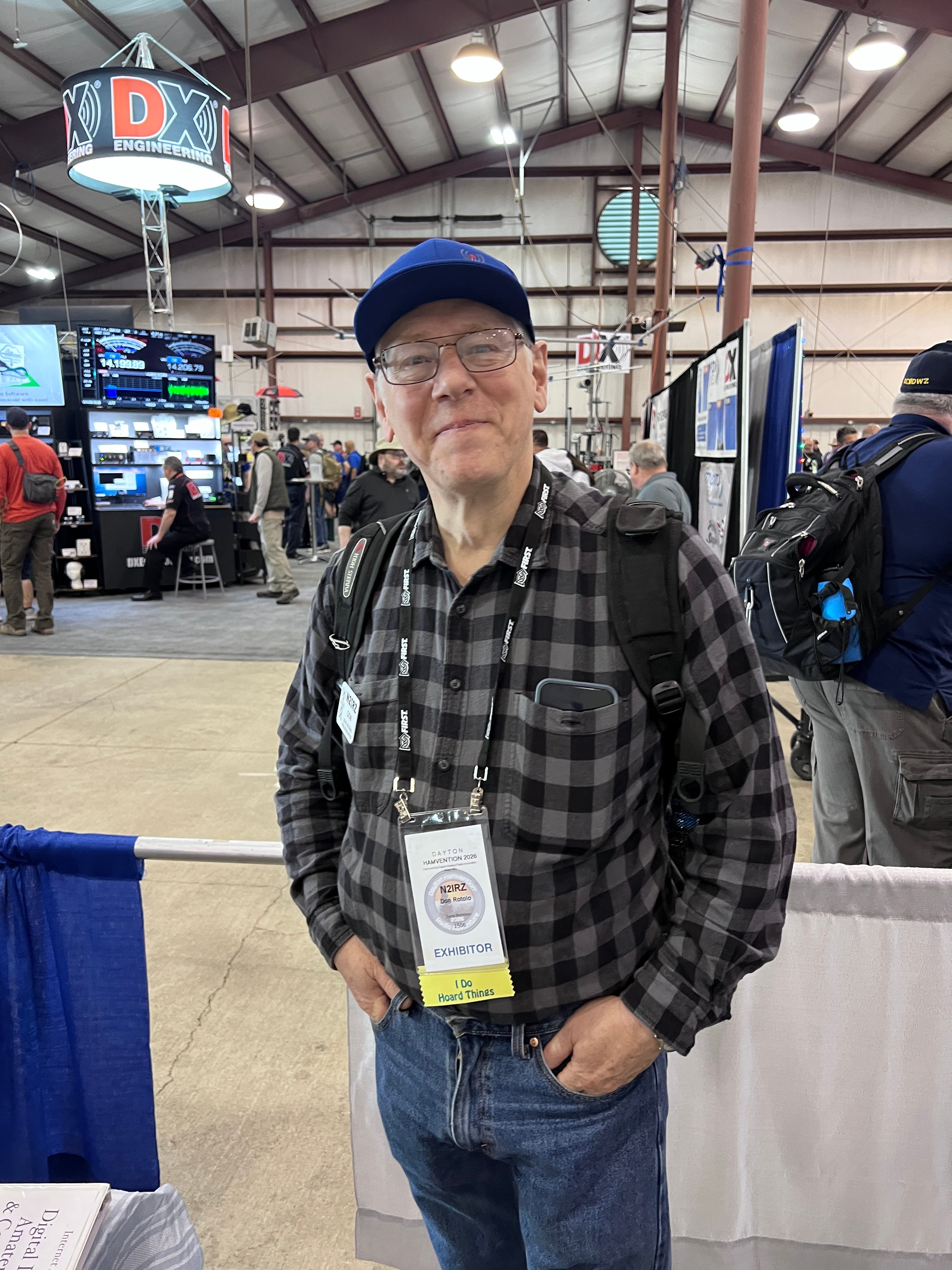
Don Rotolo N2IRZ at Hamvention 2026. Image courtesy of Steve Stroh N8GNJ.
My thanks to Zero Retries Pseudostaffer and Zero Retries Founding Member 0003 Don Rotolo N2IRZ. He helped with the expenses of the Hamvention 2026 booth and helped staff the booth part time, ably assisting and capably representing both Zero Retries and Digital Library of Amateur Radio & Communications to all the passerby that were interested in either. N2IRZ is a fellow author of Zero Retries Interesting content, having written the Digital Connections column that ran for decades in CQ and CQ VHF Magazines. N2IRZ’s articles are now being regularly added to DLARC - Don Rotolo N2IRZ articles.
Zero Retries Readers Said Thanks
I was hoping for a reasonable “bump” of perhaps one hundred new email subscribers to Zero Retries, but as I write this issue, there were perhaps ten. Thus my marketing of Zero Retries at Hamvention 2026 wasn’t that great.
Though I didn’t have many new readers for Zero Retries at Hamvention 2026, the best part of Hamvention for me was face to face conversations with dozens of existing Zero Retries readers, some of whom were casually passing by and saw my Zero Retries material and then suddenly made the connection that the writer and Editor of Zero Retries was standing in front of them. Every one of those ZR readers I met profusely thanked me. Several readers mentioned that their ritual on Saturday mornings was reading the latest Zero Retries with their morning coffee. I hadn’t considered the advantage of publishing Zero Retries late on Fridays, for (presumably, extended) reading on a weekend morning.
At Hamvention 2025 I noted dozens of folks walking around with video gear, engaged in (narrating) recordings or livestreaming. This year, despite seeing dozens of “News Media” badges (distinct color from general attendees), I saw just a handful actually doing video. I haven’t yet taken the time to check out YouTube to see the video coverage of Hamvention 2026, and it will be interesting to compare their impressions with mine.
Another observation is that wearing one’s Hamvention ticket identifying themselves (and as a paid attendee) is apparently now optional. At least a third of folks were not wearing any identification (that I could see).
Four Days In May
A persistent “buzz” that I heard at Hamvention 2026 was references to the Four Days In May (FDIM) Symposium that’s an ancillary event held mostly on the Thursday prior to Hamvention. FDIM is a one-day conference focused on low power (QRP) operation on the HF bands. There is significant emphasis on new hardware, and the event is sponsored by QRP Amateur Radio Club International (QRP ARCI). In addition to the Symposium held on Thursday, as part of FDIM, QRP ARCI holds casual evening events on Thursday, Friday, and Saturday evenings which are open to anyone.
The first of two big “buzzes” I heard from FDIM 2026 was about the LARCSet (video link), web page link, a $29 (apparently $39, per the web page) 5-watt SSB / CW Radio that fits on one PCB and can be built in a weekend. That was a project from the prolific Ashhar Farhan VU2ESE of HF Signals. Given that the LARCSet is entirely analog - no digital in it at all, it would be a fun (for me) dichotomy to operate a data mode like FT8 or JS8Call with a LARCSet, especially with something like a smartphone app.
I did manage to make at least a couple of passes of all the commercial exhibits in the five buildings and I’ll discuss the Zero Retries Interesting exhibitors and developments below.
Product Announcements
Carlson Tower Lift – Model 25 This was easily the coolest new product I saw at Hamvention 2026. The Carlson Tower Lift is a “shuttle” that rides on the outside of a Rohn 25 tower that conveys the antenna(s) to the top of the tower via a cable and pulley mechanism. When you need to service the antenna (or add one), you lower it to the ground and do the work safely at ground level. This seems much more practical to me than collapsing towers or tilt-over towers. I told one of the reps that this product makes it worth buying a Rohn 25 tower. One minor product gap I noted was that there didn’t seem to be a way to contain the trailing cables - they seem to be left “free” to dangle to the ground and blow (and get abused / chafed) by the wind. But given Carlson’s ingenious mechanical design capabilities, I’m sure this issue will be addressed. Amusingly, at Hamvention 2026, the Carlson booth staff discovered a new customer base for this unit that they weren’t expecting - wives of hams who continue to climb their towers despite their wife’s concern. I overheard one wife saying “look - now you don’t have to climb the tower”. Apparently a Tower Lift - Model 45 is in development for Rohn 45 towers.
Software and Services - General Theme There were three new software “products” and four new services announced at Hamvention 2026. Thus collectively it’s notable that software and services were most of the Zero Retries Interesting significant products this year, rather than the more usual new hardware.
FreeDV RADE in FlexRadio It wasn’t mentioned by Flex, and I wasn’t able to check in at the FreeDV booth (which was very busy when I did my passes by their booth) to see if they mentioned this, but I consider it a significant product that FreeDV RADE v1 can now be installed in the radio of FlexRadio’s current units. That’s a Zero Retries Interesting development of 21st century technological innovation for Amateur Radio! Once you do so, FreeDV RADE is just another mode selection such as SSB. None of the other major Amateur Radio HF radio manufacturers have taken such a step. This capability took significant work both by FlexRadio and FreeDV developers, but finally there is “plug and play” of a digital mode that was developed in 21st century by a major Amateur Radio manufacturer. I hope other Amateur Radio developers (such as Mercury) will follow this lead as this “load it into the radio” capability is now available for use in the current (8000 series and Aurora) FlexRadio units, not a special arrangement unique to FreeDV. (Notably, such “user apps” are “sandboxed” in a current FlexRadio unit.)
Digital Signal Processing Improvements in Elecraft Radios I’m only aware of this software improvement in Elecraft radios from an article by Jeff Davis KE9V - Spectral Subtraction Noise Reduction where noise is significantly reduced digitally via software improvements, resulting a much more pleasant experience monitoring HF bands. This seems akin to the same approach as West Mountain Radio’s CLRspkr ClearSpeech® DSP Noise Reduction Speaker, but implemented internally in the Elecraft radios.
Sierra Radio Systems iShareRadio Service The iShareRadio service was demonstrated at the Sierra Radio Systems booth. I did a big article on iShareRadio in Zero Retries 0248 - iShareRadio Remote Radio Sharing Service. I dragged a few folks, including one ARDC staffer, over to the Sierra Radio Systems booth to see that demo. (ARDC grants have paid for a lot of FlexRadio units for shared use by Amateur Radio clubs). iShareRadio was another collaboration with FlexRadio that created new capabilities in sharing remote FlexRadio units for clubs and individuals. Notably, in user accounts on iShareRadio, granular permissions can be set per each user’s license class, such as Technicians only having unrestricted capabilities on a shared FlexRadio unit on 50-54 MHz (6m).
Sierra Radio Systems Project Argus Hardware / RepeaterBook Reporting Zero Retries was privileged to get the “scoop” on Project Argus in an article by George Zafiropoulos KJ6VU in Zero Retries 0249 - Announcing Project Argus. “Argus” is a board that’s installed on repeaters. It monitors some parameters of the repeaters such as “start of repeat” and “end of repeat” and then “phones home” to RepeaterBook where that acquired data can be displayed on the repeater’s individual page on RepeaterBook. While “Argus” was developed in conjunction with RepeaterBook, it can be used independently of RepeaterBook.
RepeaterBook Project Apollo
RepeaterBook’s Project Apollo is easily the most Zero Retries Interesting development that I saw at Hamvention 2026. For consistency, I’ll mention RepeaterBook’s Project Apollo here, but it’s such a significant development that I wrote a separate story about it later in this issue. Tersely, Project Apollo is a project to place radio receivers to monitor the activity of repeaters and report that (passively) observed activity on RepeaterBook. You’ll be able to see the level of activity on each repeater on RepeaterBook.
ARRL QST Product Review Comparison Tool (website)
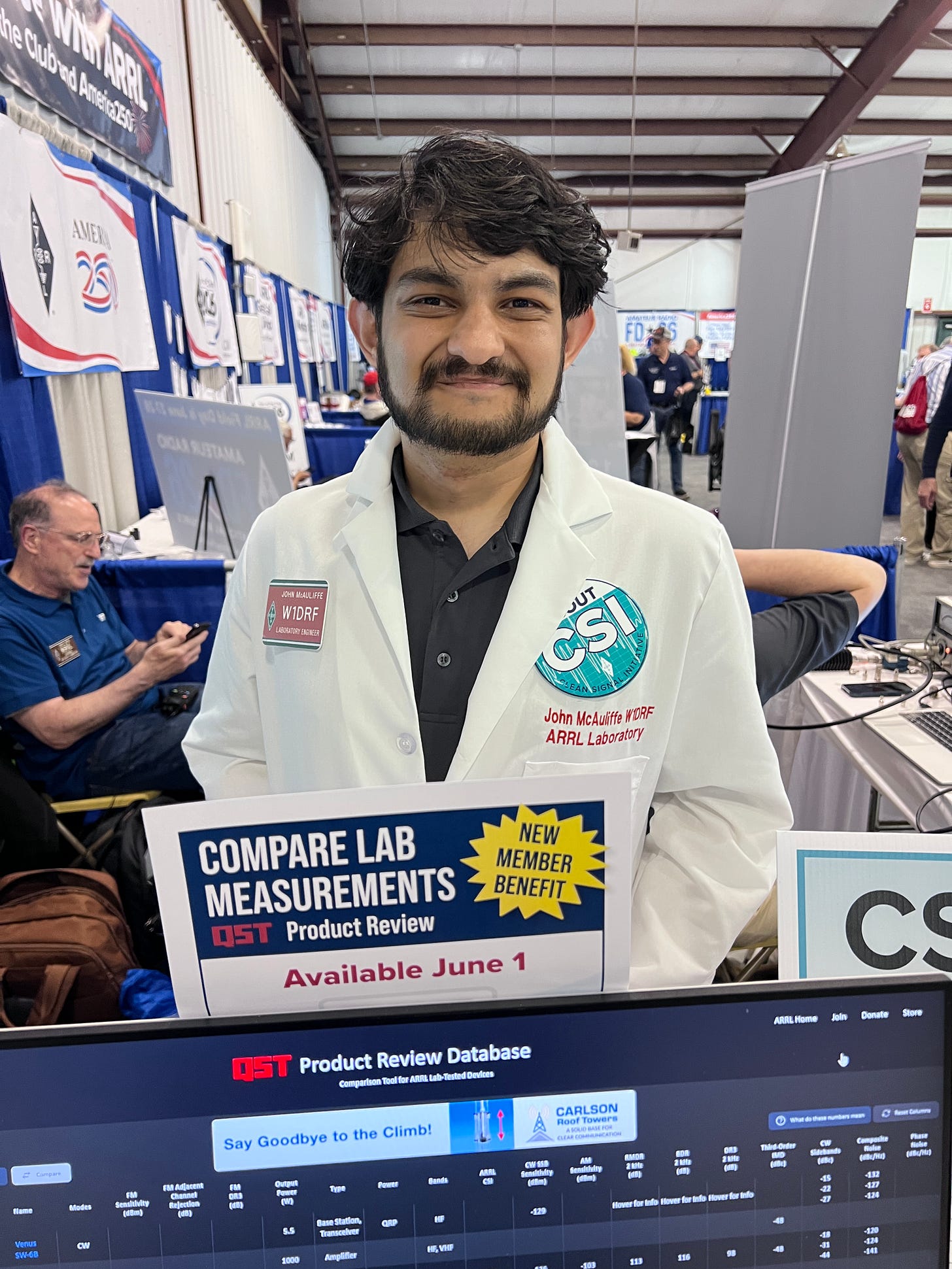
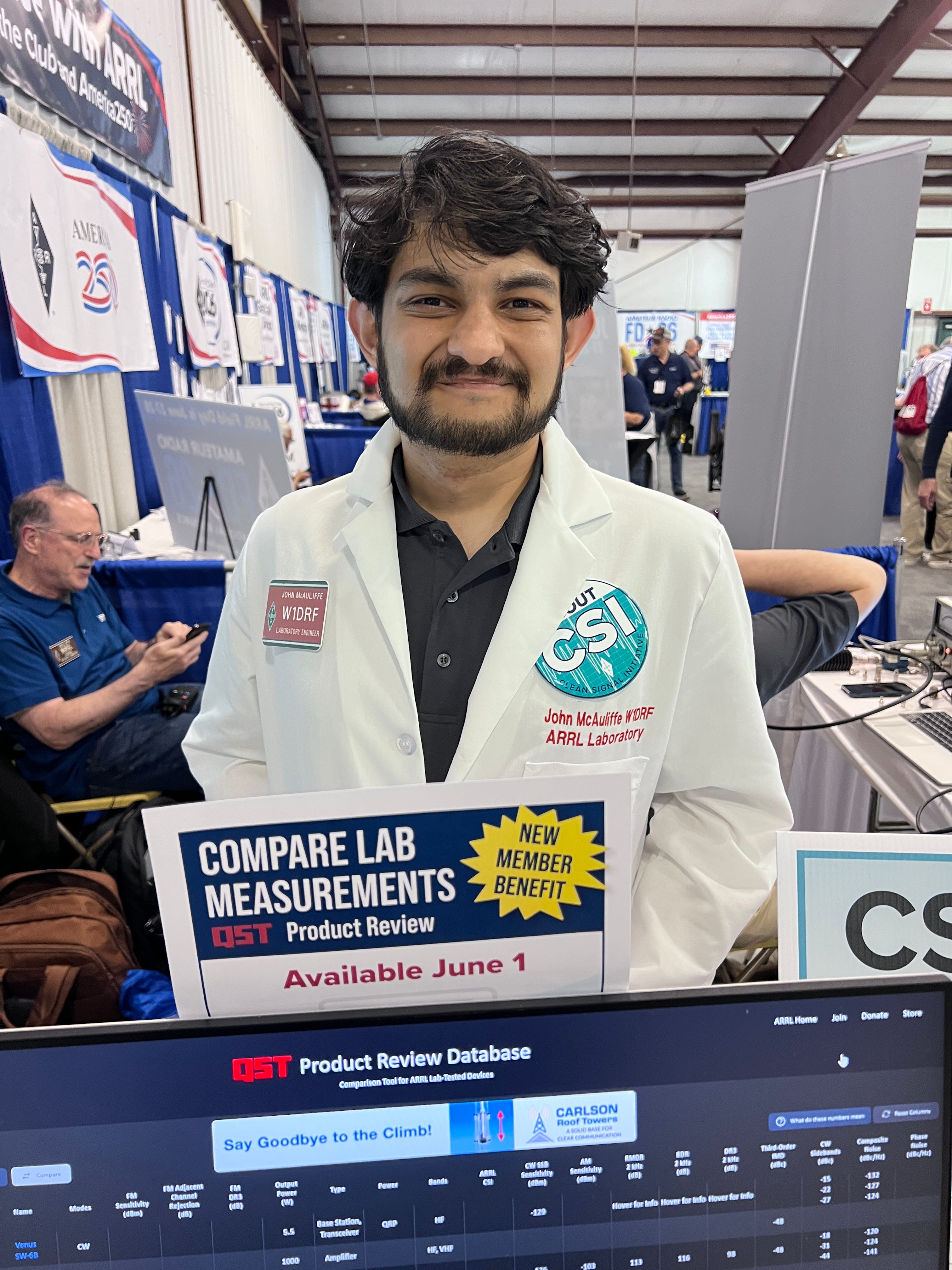
John McAuliffe W1DRF at Hamvention 2026, demonstrating the forthcoming QST Product Review Database website. Image courtesy of Steve Stroh N8GNJ.
In the ARRL section of Building 2, ARRL Lab Digital RF Engineer John McAuliffe W1DRF demonstrated a new service (available 2026-06-01) that consolidates information from products reviewed in ARRL’s QST magazine for easy reference and comparative (A vs B vs C) evaluations of many aspects of those reviewed products. For example, selecting several HF radios, you can sort by power output or any other feature. As demonstrated, this is a really impressive service and despite the only mention I found of it online by ARRL, some features of this service will be accessible without ARRL membership. It provides objective data on a number of products reviewed in QST by ARRL Lab measurements, and there’s been nothing like it to date (that I’m aware of). This will be a really valuable service to Amateur Radio by ARRL. Per the signage at the booth, when it goes online, its web page will be compare.arrl.org.
Icom ID-5200 Icom displayed the Icom ID-5200 at Hamvention 2026. It has some Zero Retries Interesting features such as a KISS TNC and (future update) APRS capability, and 1200 and 9600 bps modes. While there isn’t a flat audio connection, there is a USB connector on the rear of the radio with the functionality of that to be determined. Notably, it includes Wi-Fi and Bluetooth connectivity, implying there’s a TCP/IP stack in the radio. The ID-5200 is not yet available for purchase.
Kenwood TM-D750 Like all previous in-person displays of the TM-D750, at the Hamvention 2026 Kenwood booth, the TM-D750 unit was kept under a “don’t touch… really… don’t ask” glass cube. Like the ID-5200, the TM-D750 features Bluetooth and Wi-Fi (er, “Wireless LAN”) implying there’s a TCP/IP stack in the radio. The TM-D750 is not yet available for purchase.
Yaesu DR-3X Repeater The Yaesu DR-3X Repeater(s) provide improved higher power, full duty cycle performance - 85 watts for the 144-148 MHz (2m) unit, and 65 watts for the 420-450 MHz (70cm) unit. Other new features of the DR-3X include “IES - Interference Evasion System” and “ASP - Audio Digital Signal Processor”. My impression is that both of those new features depend on corresponding features in newer Yaesu mobile / base radios. Also, both DR-3X units can receive the other band, but only transmit on the stated band. The DR-3X(s) are not yet available for purchase.
Zero Retries Interesting People At Hamvention
Of course, the ultimate joy of an in-person conference is seeing lots of folks in person. Here are a few “people highlights” for me.
Kay Savetz K6KJN K6KJN (a Zero Retries Pseudostaffer) is the Program Manager, Special Collections at Internet Archive for Digital Library of Amateur Radio & Communications. K6KJN and I have been friends for years now. I’ve been a contributor in promotion and material to DLARC, and of course K6KJN is a monthly contributor to Zero Retries. Spending this many hours in close proximity allowed us to swap even more interesting stories and observations about Amateur Radio.
Don Rotolo N2IRZ N2IRZ and I have known each other for decades by now, and we share a common history of the glory days (and promising future) of Amateur Radio Packet Radio. While he was assisting at the booth, N2IRZ suggested several potential articles for Zero Retries, and I eagerly agreed to all of his ideas.
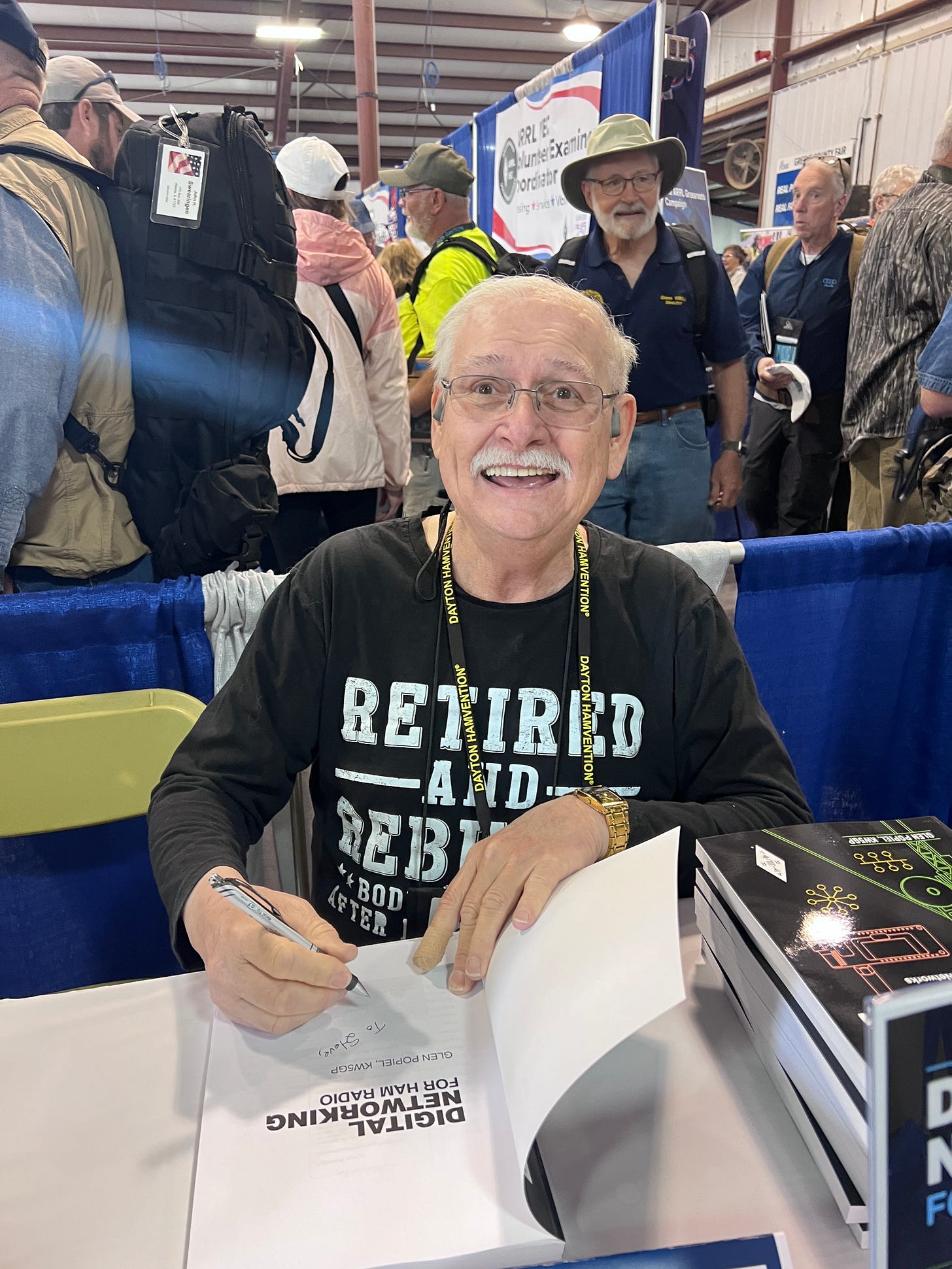
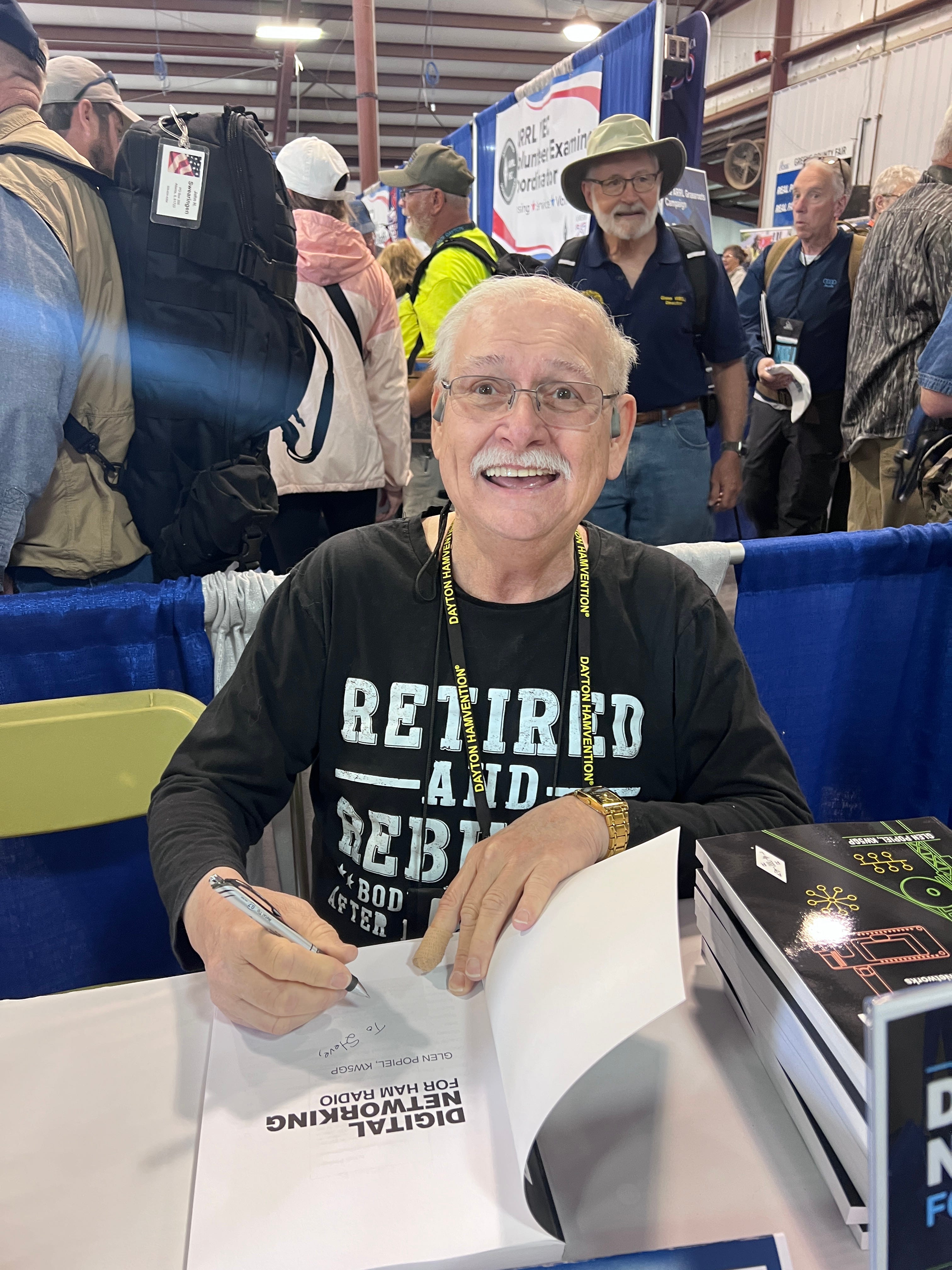
Glen Popiel KW5GP
Glen Popiel KW5GP at Hamvention 2026 autographing my copy of his new book Digital Networking for Ham Radio book. Image courtesy of Steve Stroh N8GNJ.
Meeting KW5GP, author of the new ARRL book Digital Networking For Ham Radio was a highlight for me. At a “Meet the Author” session at the ARRL section in Building 2, I bought a new copy of the book specifically to get autographed by KW5GP and that one will go into my autographed books collection. KW5GP and I got to talk a bit more at length when he visited the Zero Retries booth and we talked more about his book and the overall subject matter and all things Amateur Radio networking. KW5GP promised a followup discussion about my impressions of the book from Zero Retries 0240.
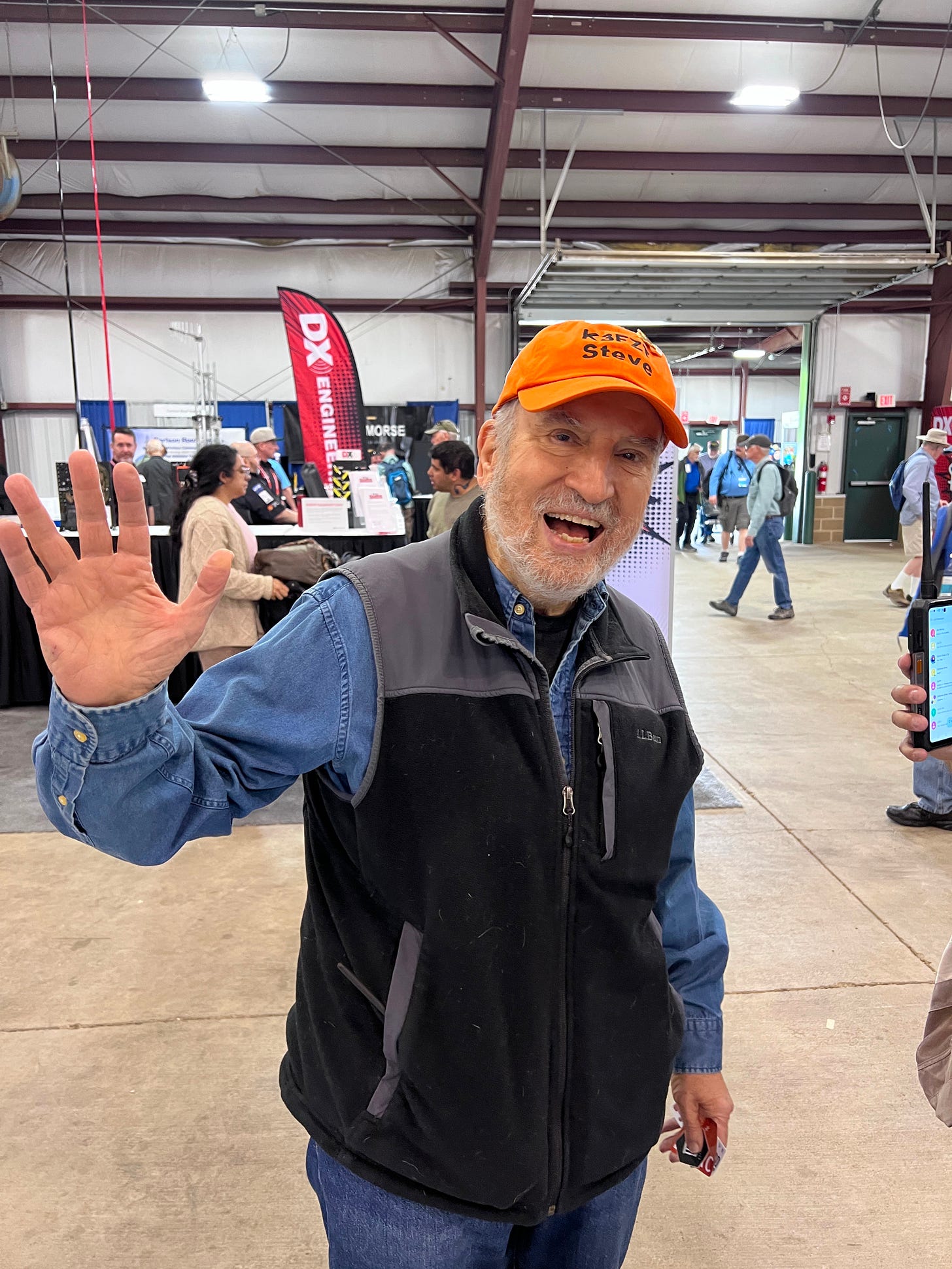
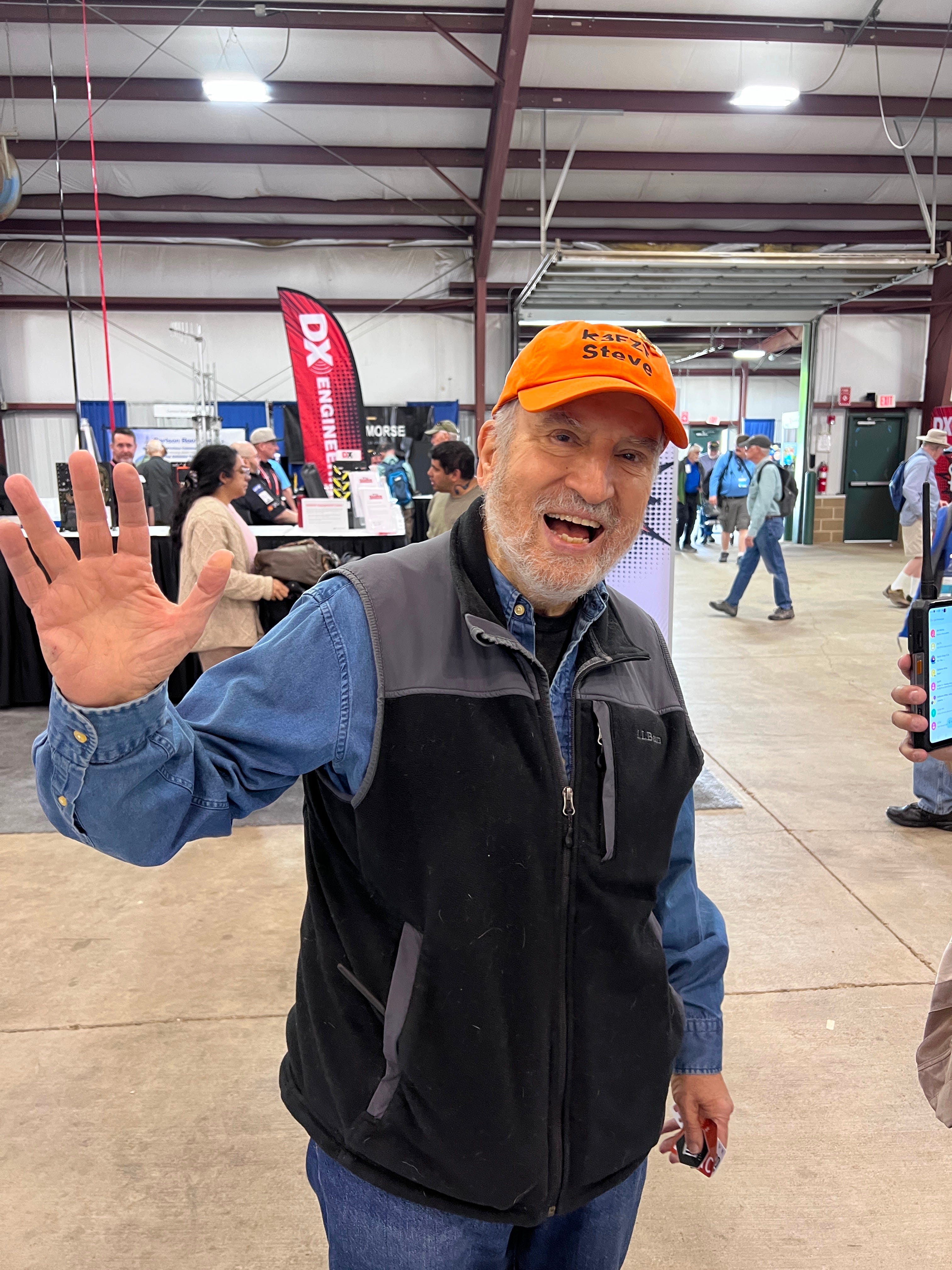
Steve Davidson K3FZT
Steve Davidson K3FZT at Hamvention 2026. Image courtesy of Steve Stroh N8GNJ.
K3FZT is Zero Retries Founding Member 0000. K3FZT has provided great feedback on Zero Retries and is unfailingly encouraging. He’s always a delight to talk to and catch up with
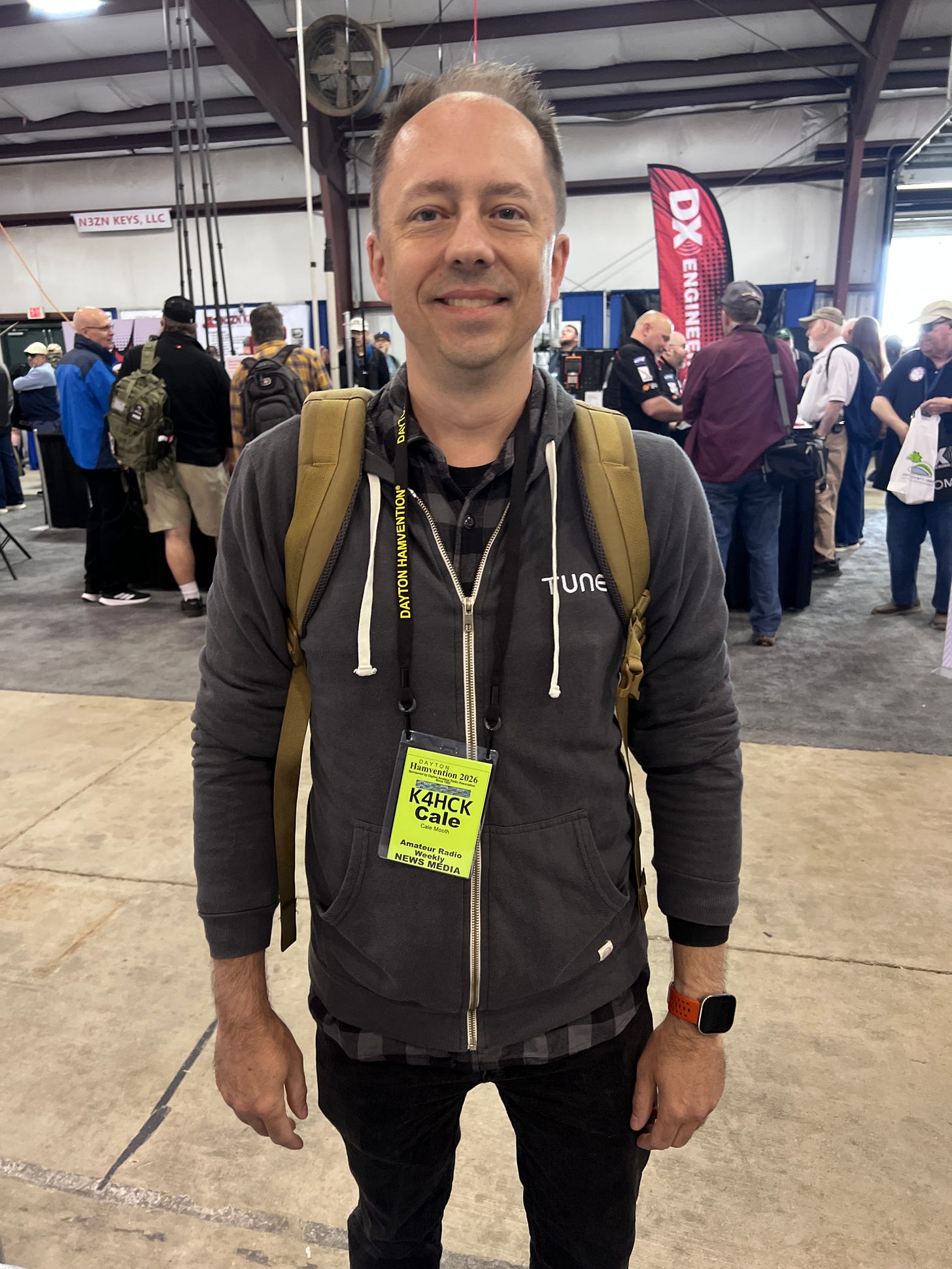
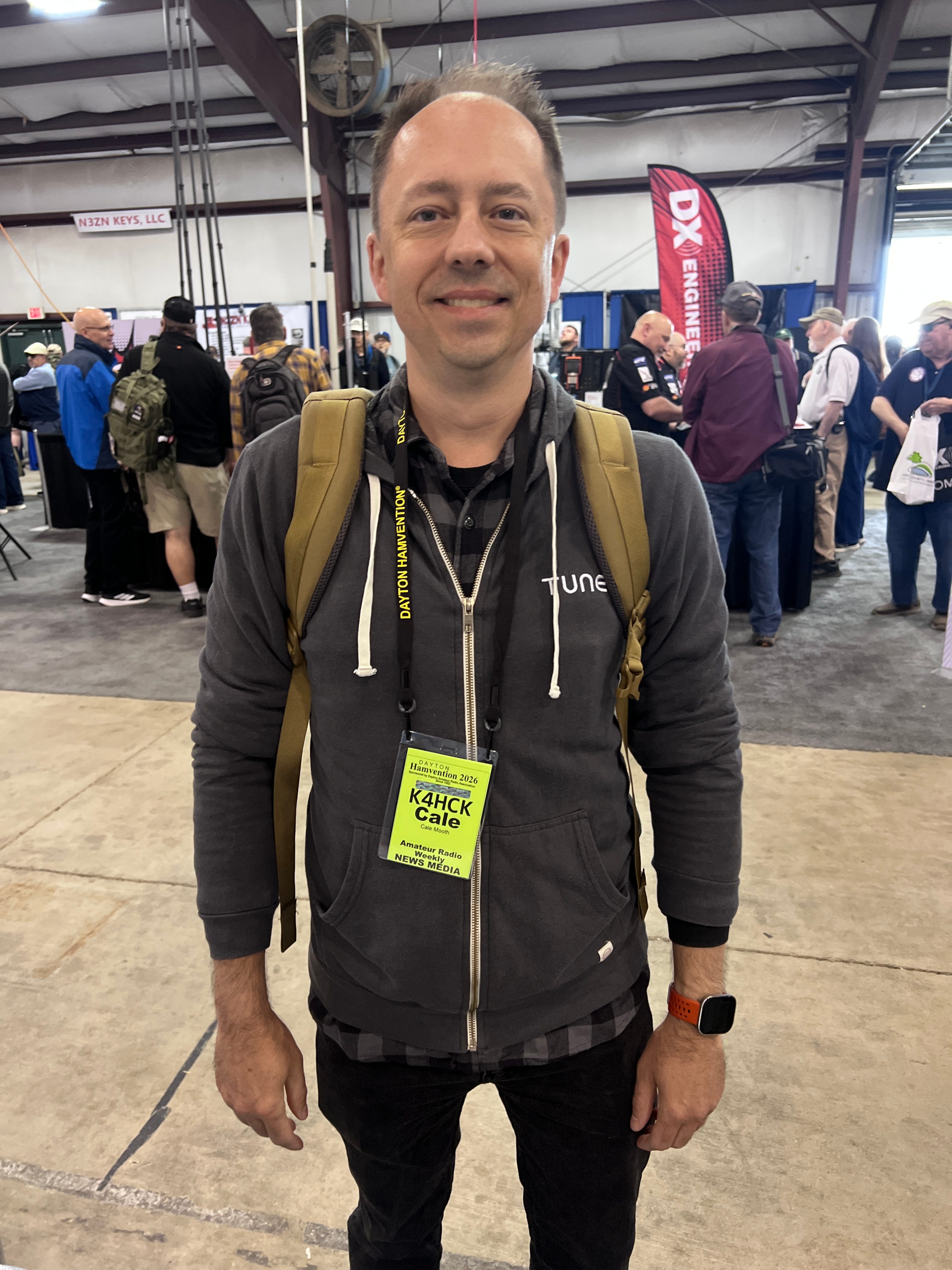
Cale Mooth K4HCK
Cale Mooth K4HCK at Hamvention 2026. Image courtesy of Steve Stroh N8GNJ.
K4HCK is a Zero Retries Pseudostaffer and Editor of Amateur Radio Daily and Amateur Radio Weekly. K4HCK and I enjoy comparing notes about our respective publications and projects, but our paths didn’t sync up for very long at Hamvention 2026.
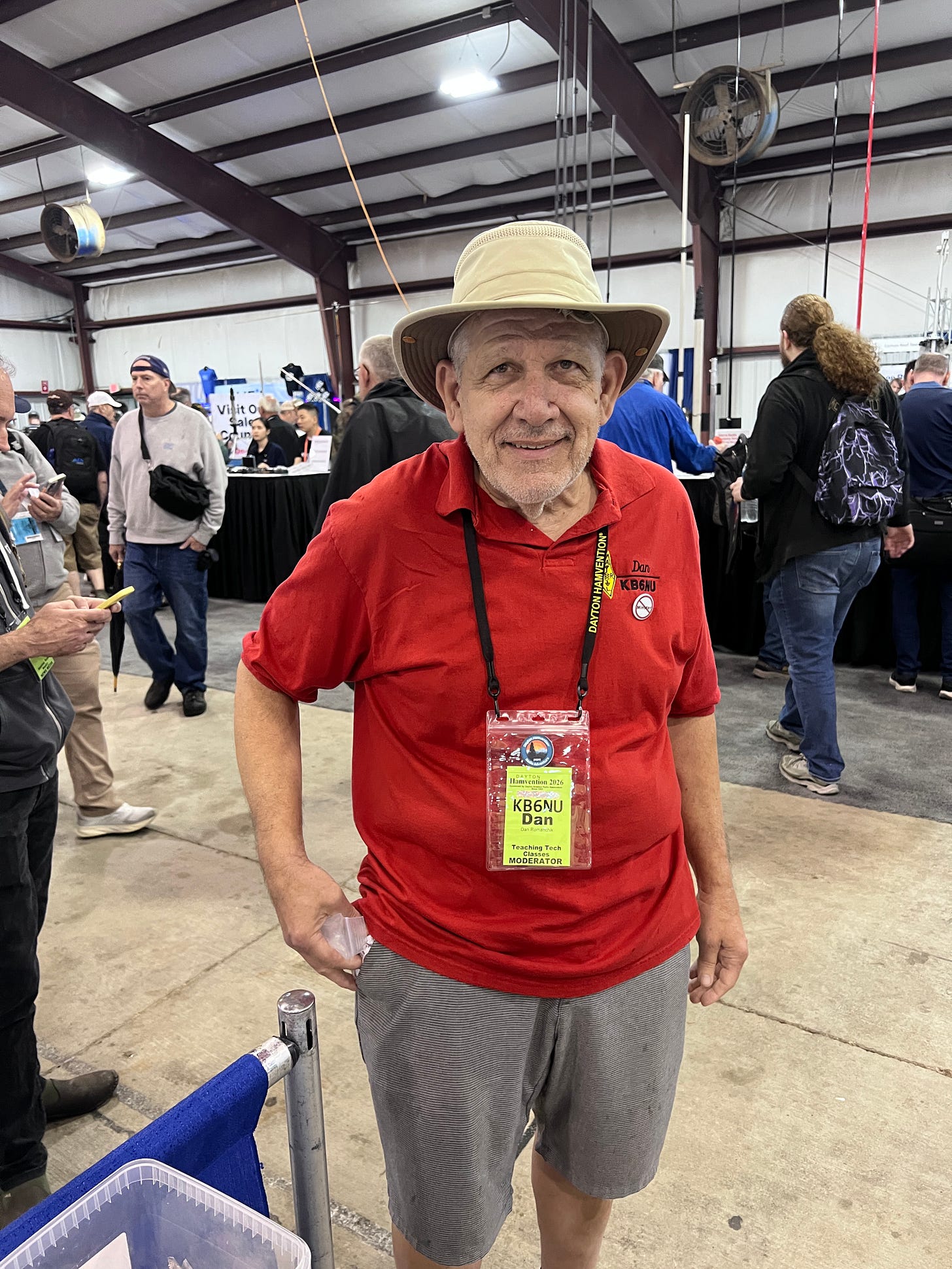
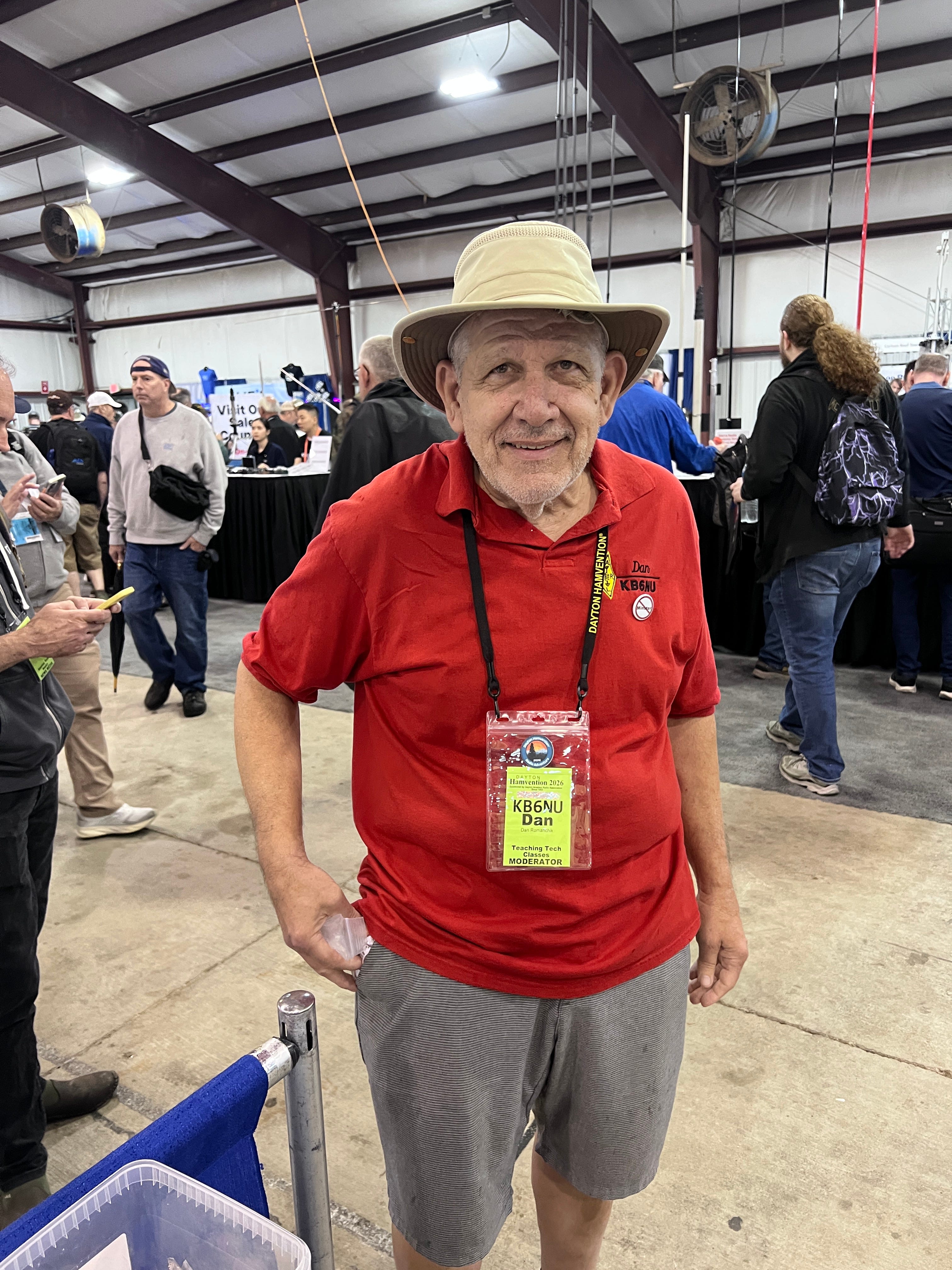
Dan Romanchik KB6NU
Dan Romanchik KB6NU at Hamvention 2026. Image courtesy of Steve Stroh N8GNJ.
John McAuliffe W1DRF is the ARRL Labs Digital Engineer and is a fan of Zero Retries. Now that it’s been made public, I reveal that W1DRF gave me an early peek at the ARRL QST Product Review Comparison Tool when I visited ARRL Headquarters earlier this year. Thus I was looking forward to the formal unveiling at Hamvention. It was great reconnecting with W1DRF briefly at Hamvention (he was very busy demonstrating the “Tool” to passerby).
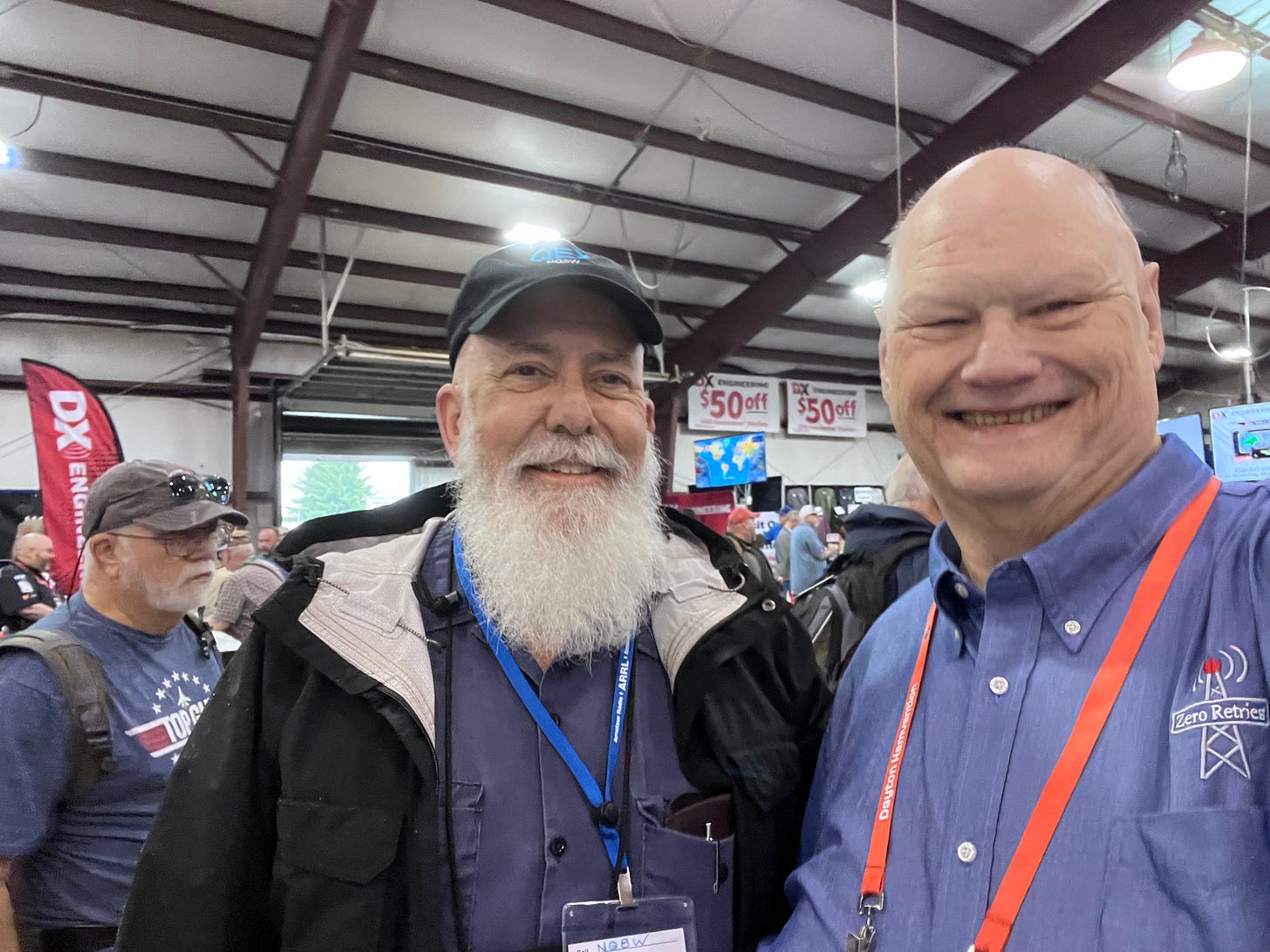
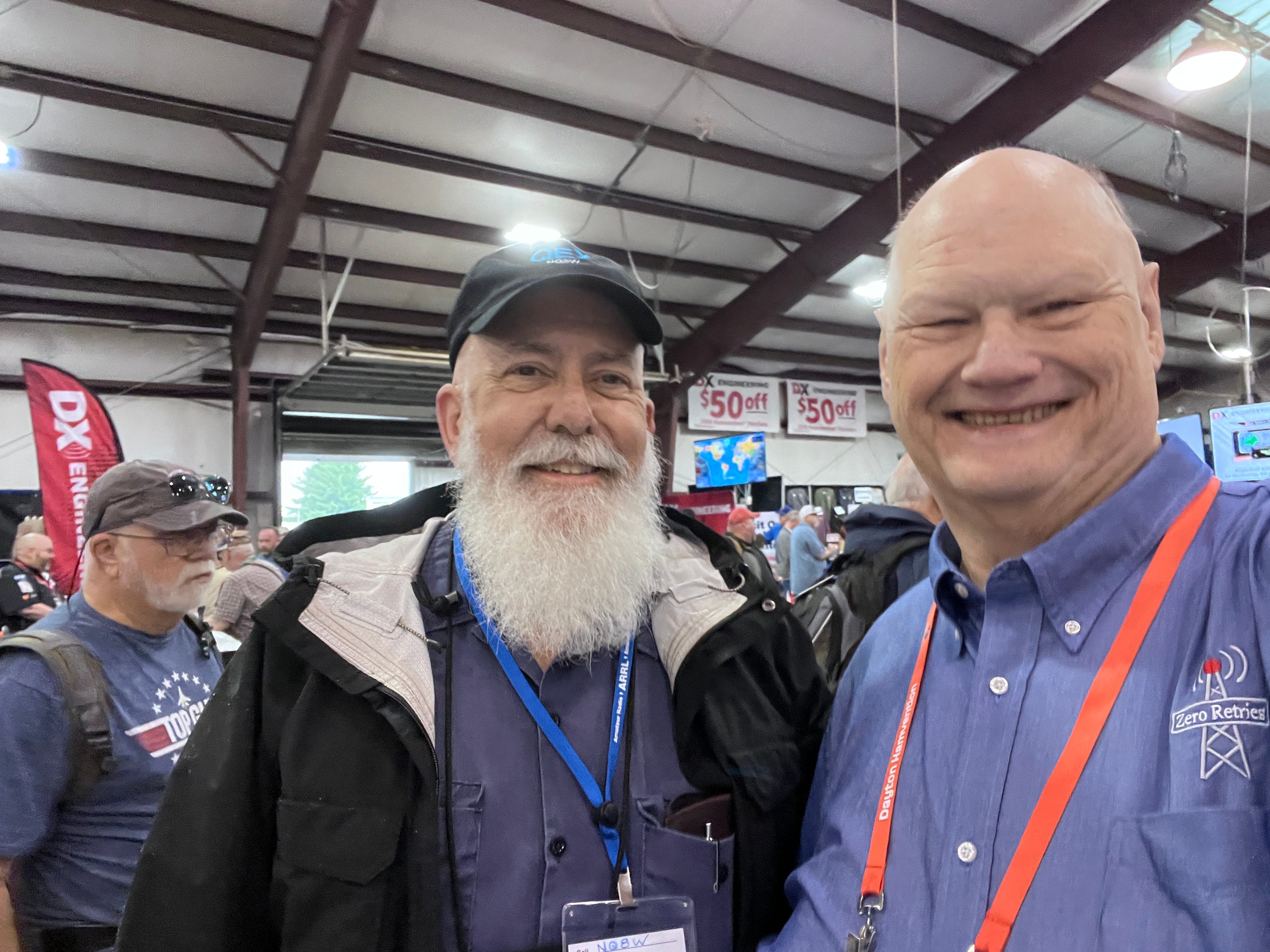
Ron Diehl NQ8W
Ron Diehl NQ8W and Steve Stroh N8GNJ at Hamvention 2026. Image courtesy of Steve Stroh N8GNJ.
NQ8W is Editor of ARRL’s QEX Magazine. We first connected at HamSCI 2026 earlier this year and we had a fun conversation at Hamvention 2026. He gifted me with an exclusive QEX hat that can’t be purchased, only gifted by him, and he also had one for me to bring back home to Tina KD7WSF.
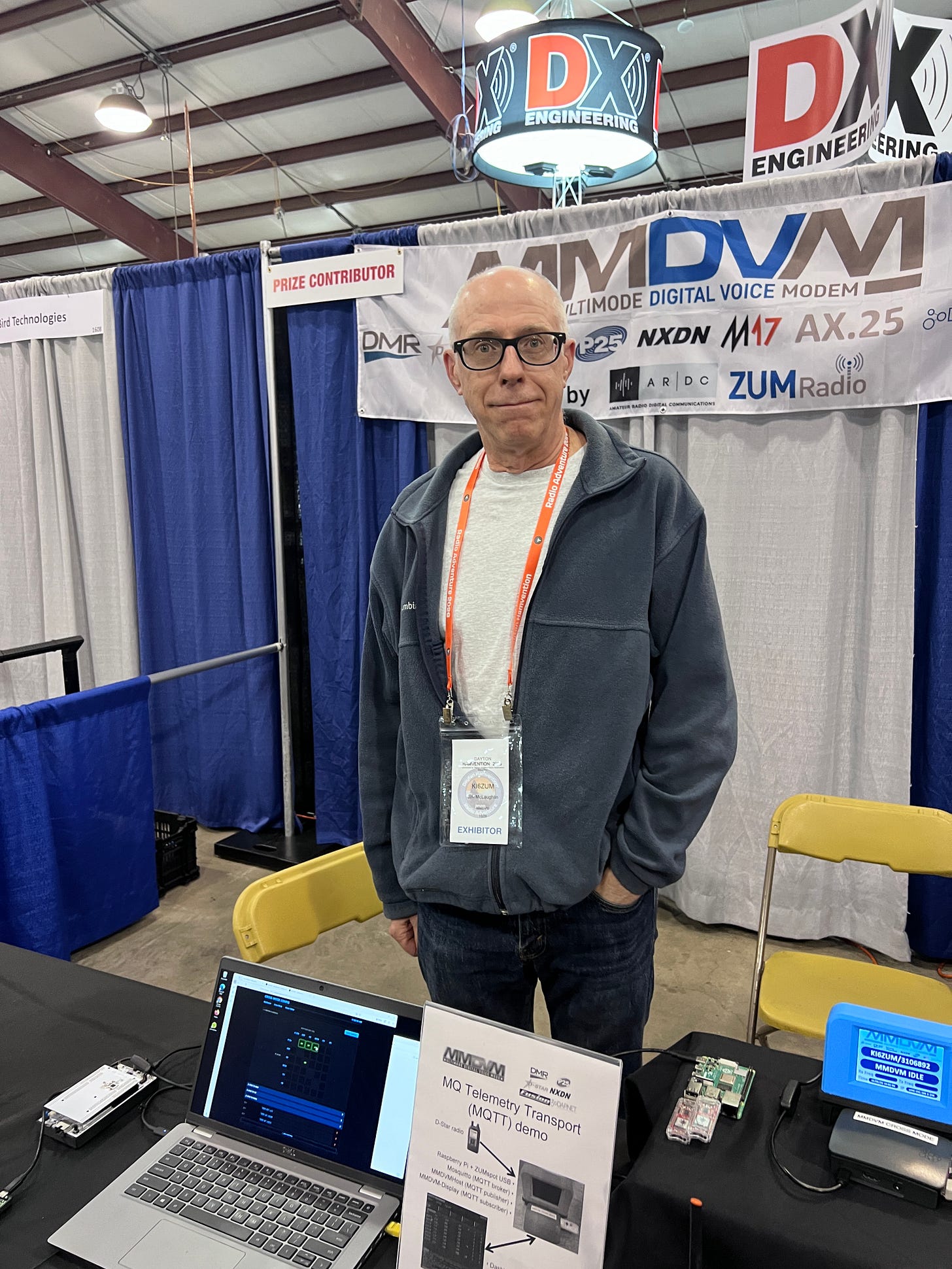
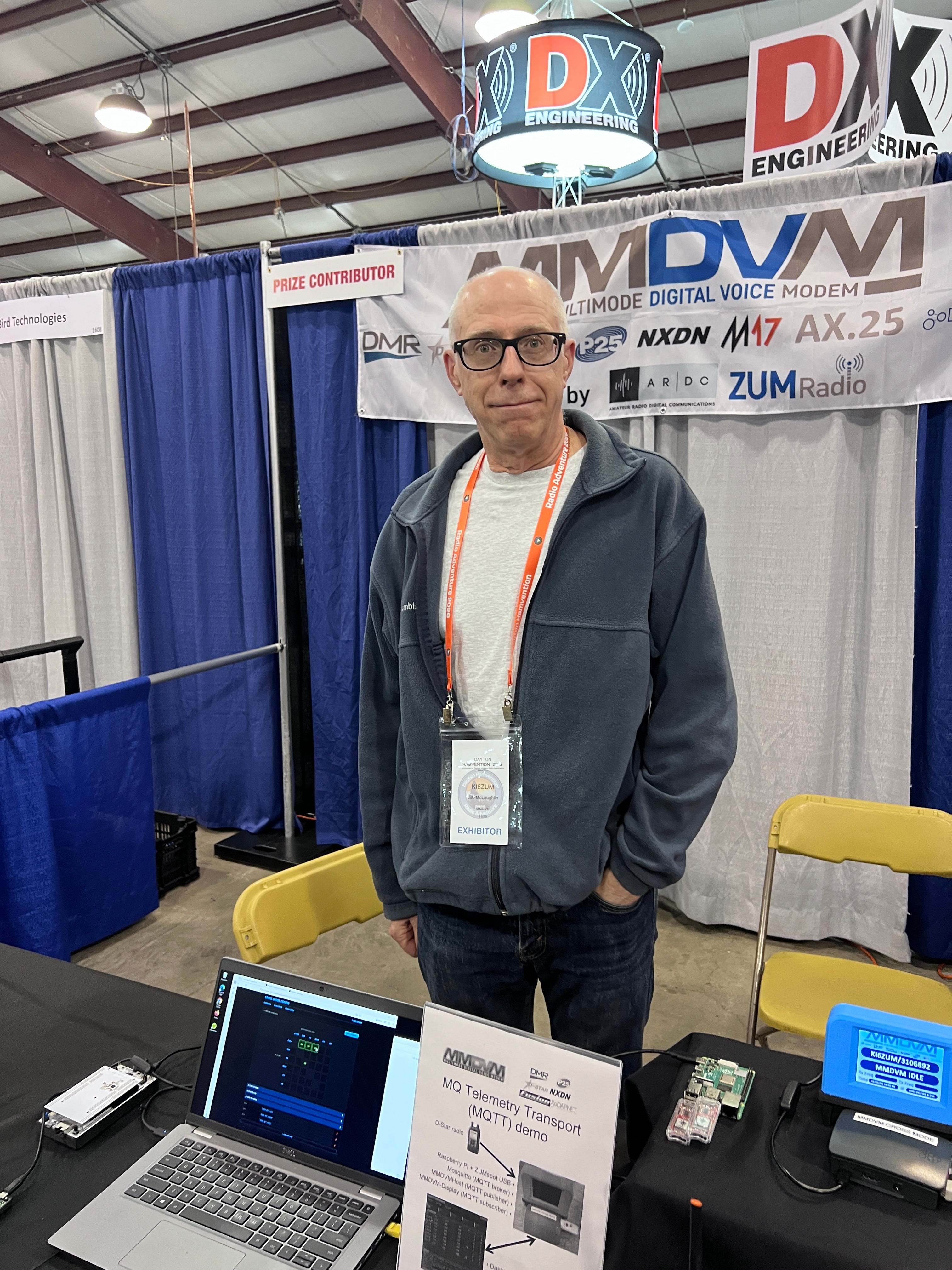
Jim McLaughlin KI6ZUM
Jim McLaughlin KI6ZUM at Hamvention 2026. Image courtesy of Steve Stroh N8GNJ.
KI6ZUM is proprietorof ZUMRadio and the is one of the principals of the MMDVM Project. We were only able to talk briefly prior to the opening; once the attendees were present, the MMDVM booth was mobbed. At the MMDVM booth, KI6ZUM was showcasing the new MMDVM units that provide full transcoding between digital voice modes (MMDVM-Cross Mode).
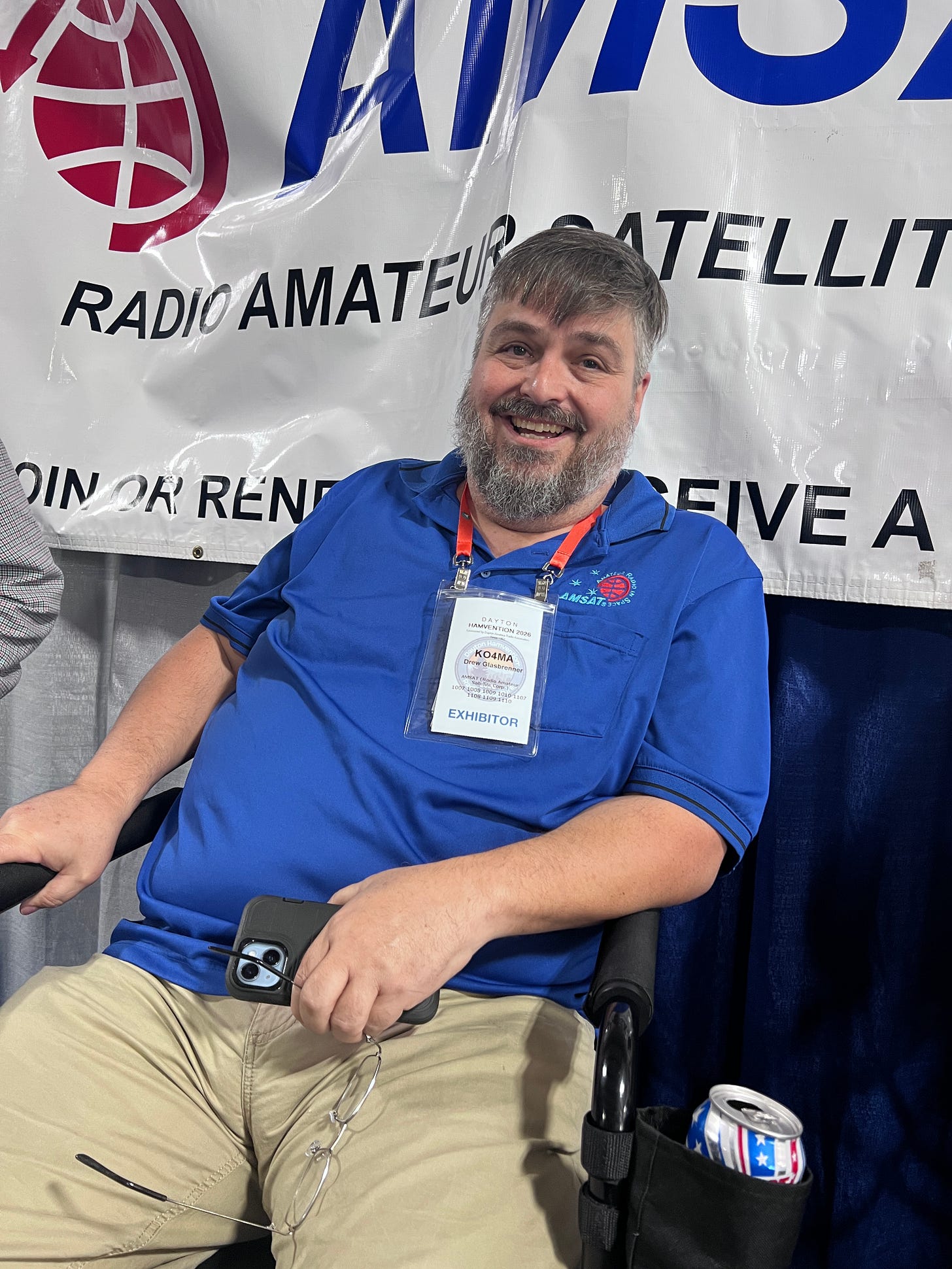
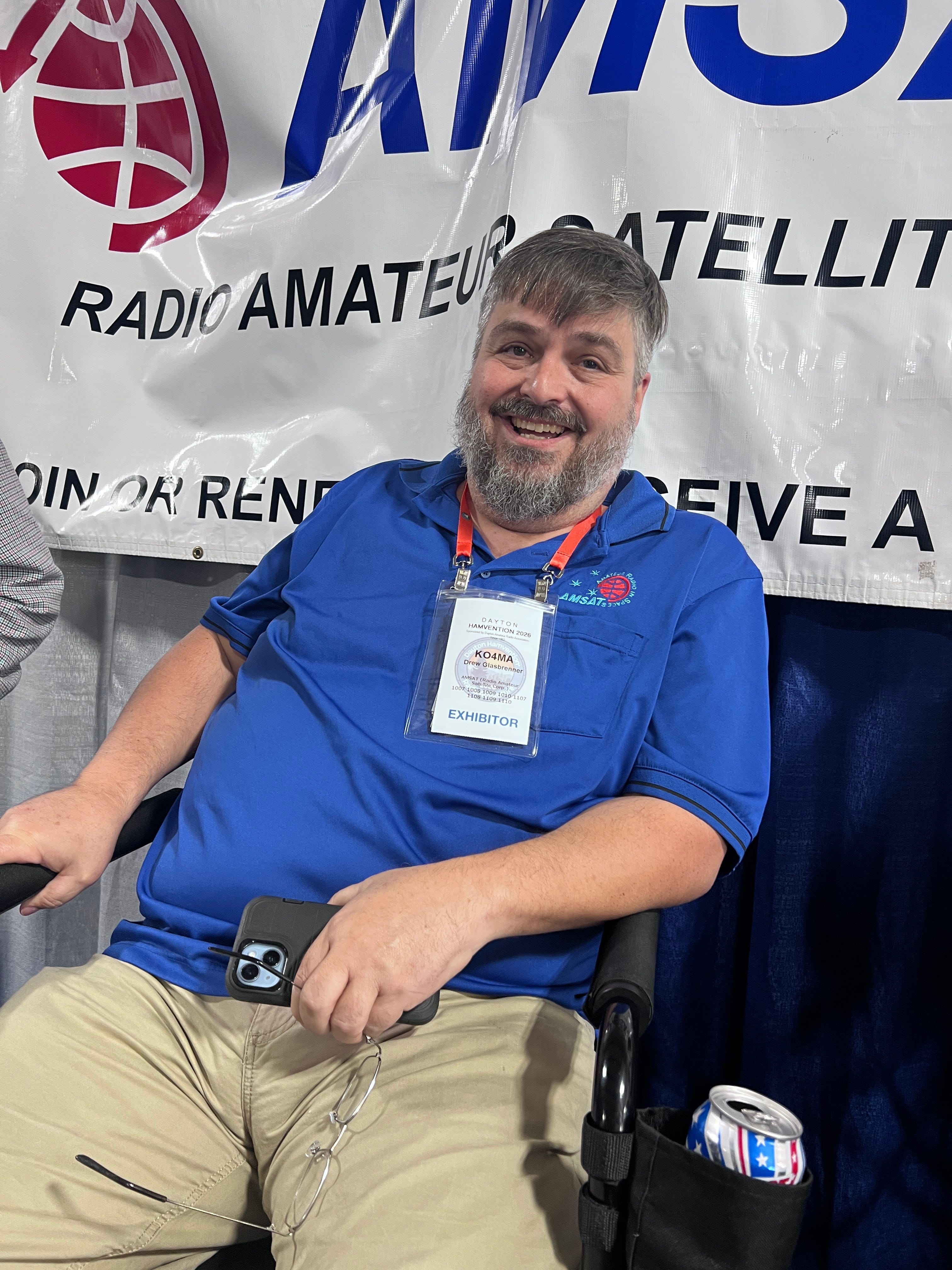
Drew Glasbrenner KO4MA
Drew Glasbrenner KO4MA at Hamvention 2026. Image courtesy of Steve Stroh N8GNJ.
K04MA is President of AMSAT. We were able to have a good conversation at the AMSAT booth and exchange our respective views about the future AMSAT projects that are Zero Retries Interesting, including PACSAT, an SDR / microwave payload, and especially the (disappointing, to date) progress on an AMSAT Amateur Radio payload (or satellite) at GEO to provide service to North America. I suggested that the PACSAT board would be useful and interesting for terrestrial use, and KO4MA seemed surprised at that suggestion, but had an alternate suggestion that I can’t yet talk about.
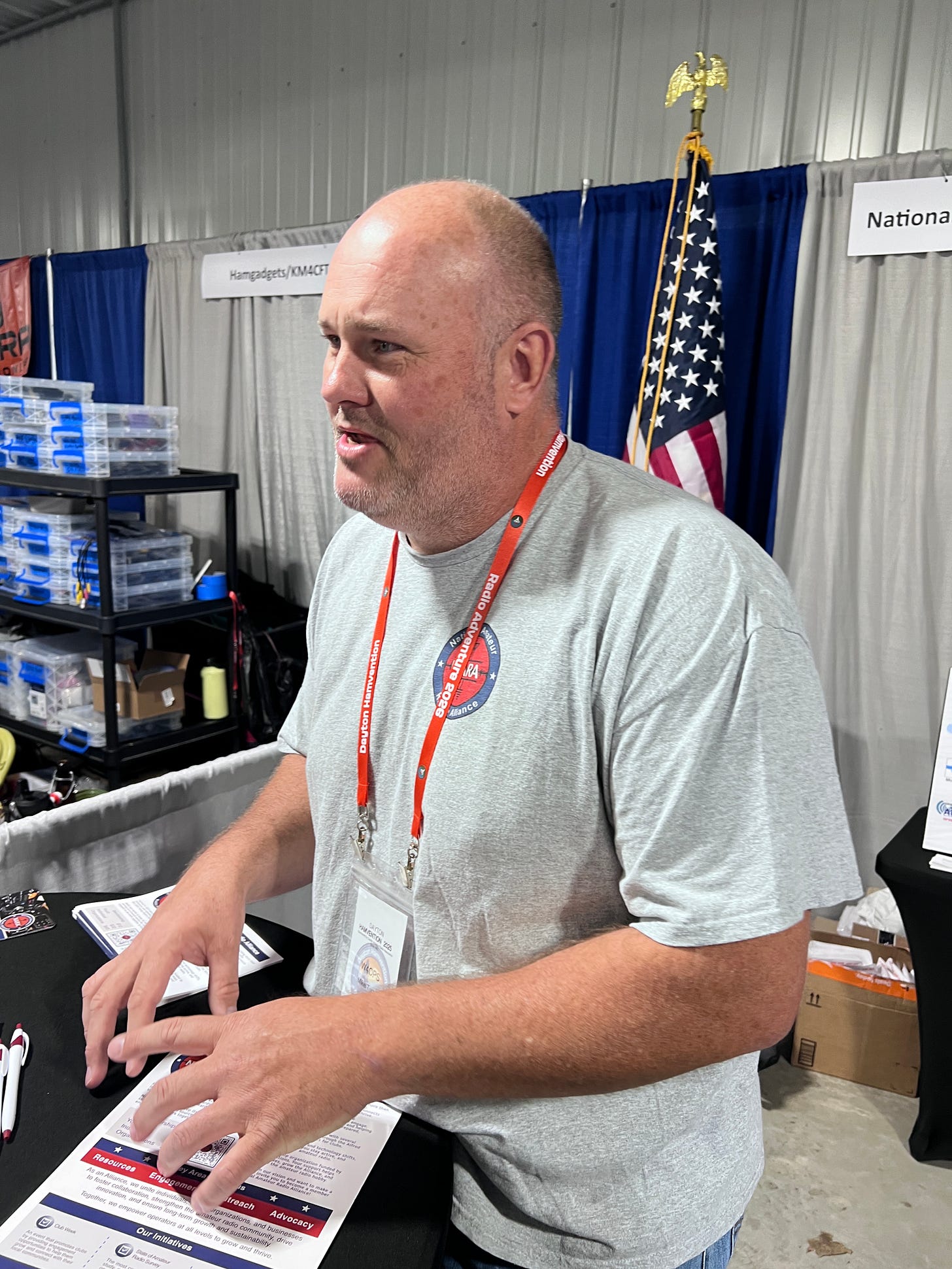
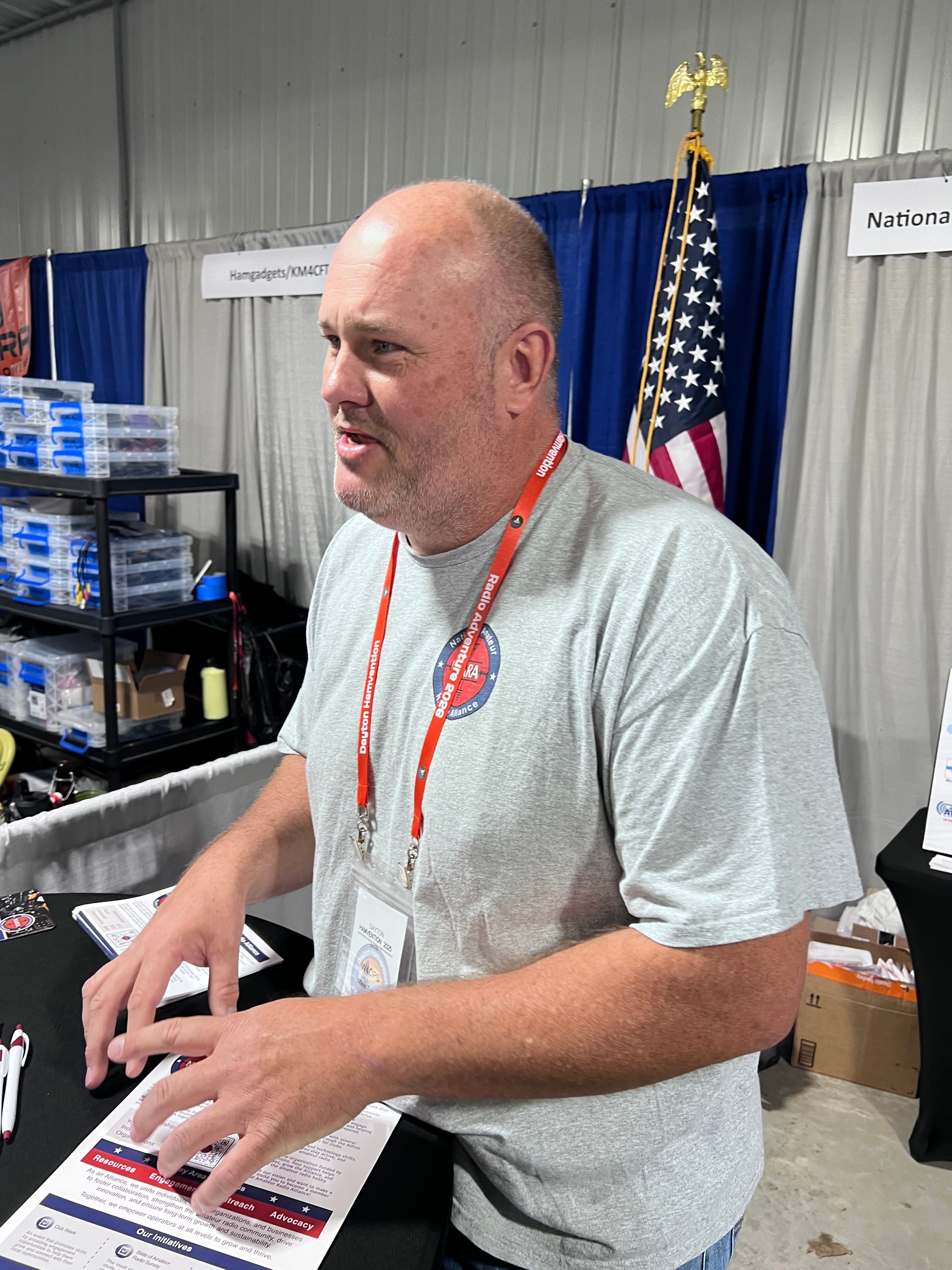
Mikel Turner W4OPS
Mikel Turner W4OPS at Hamvention 2026. Image courtesy of Steve Stroh N8GNJ.
W4OPS is President and Director of Operations & Logistics of National Amateur Radio Alliance (NARA). It was good to put a face to the name. W4OPS and I have exchanged a number of emails that, in my opinion, NARA would be more interesting to NewTechHams if it acknowledged the growing role of digital / data modes in Amateur Radio.
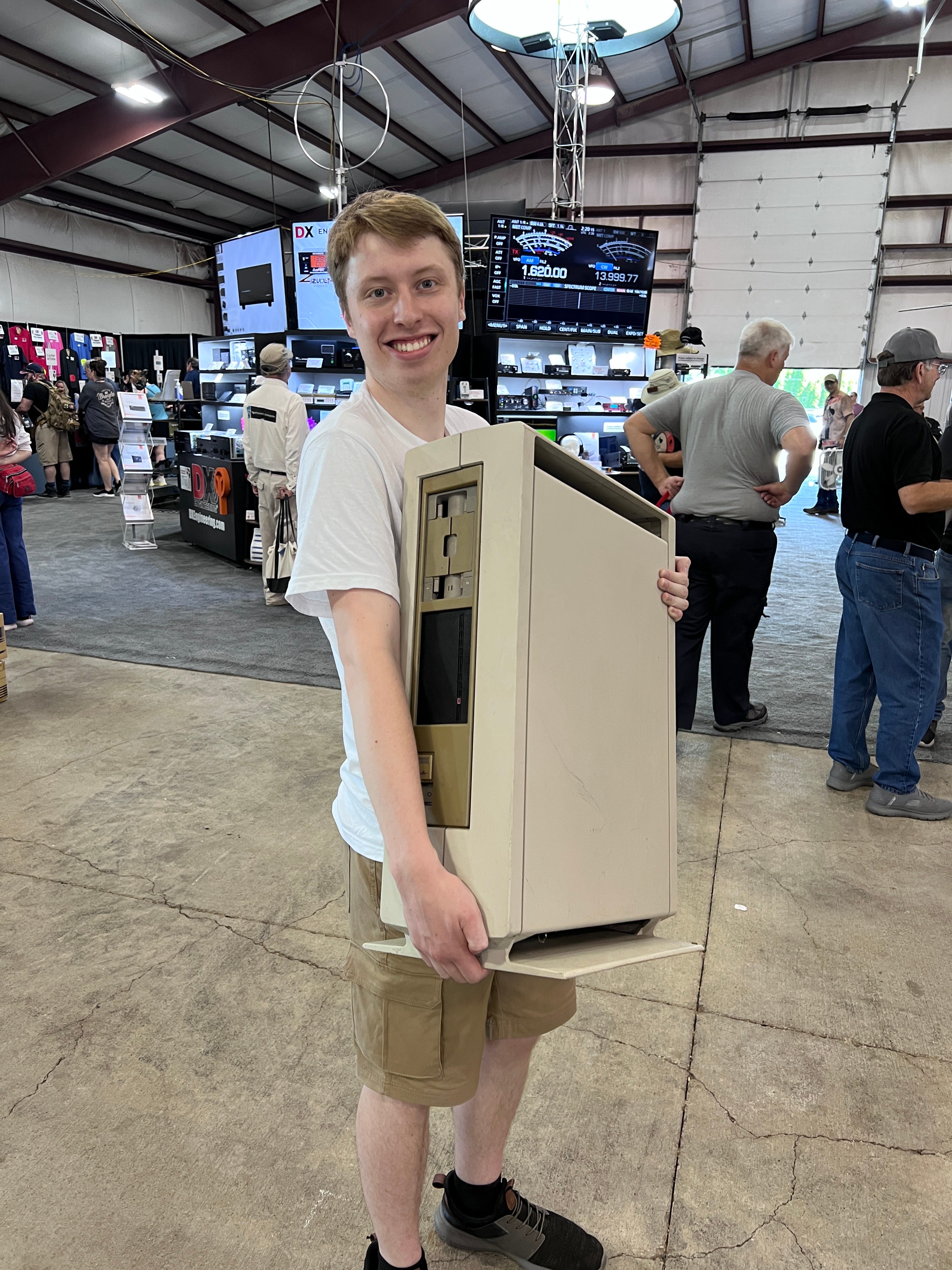
Adam Zimmel W0ZML
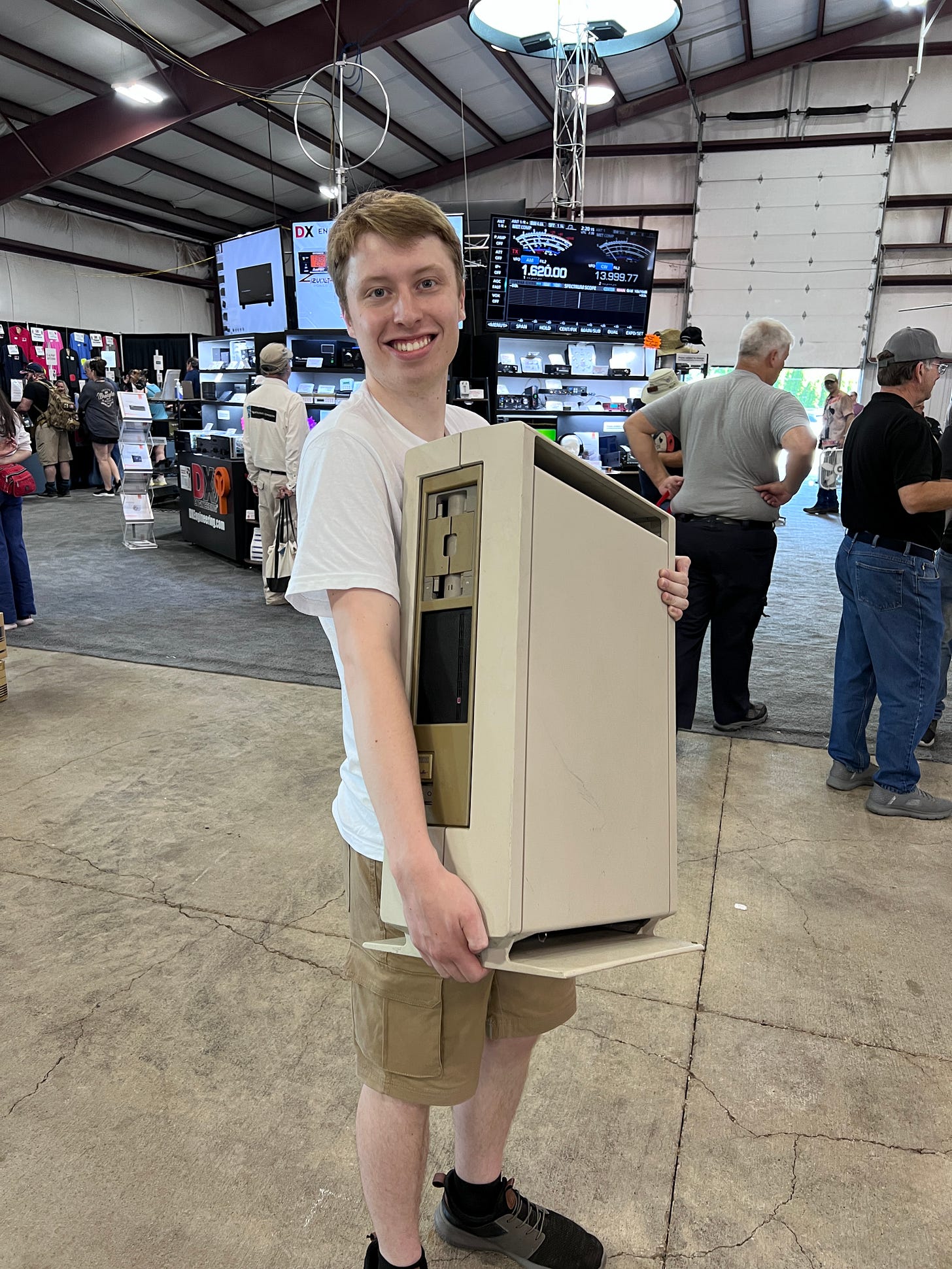
Adam Zimmel W0ZML and a new treasure at Hamvention 2026. Image courtesy of Steve Stroh N8GNJ.
W0ZML is the ARDC Grants & Admin. Associate and the staff lead of the ARDC Grants Communication Team. W0ZML is a classic NewTechHam and is an enthusiastic collector of vintage computer tech. He acquired some interesting, and heavy new computer hardware (DEC Rainbow?) at Hamvention 2026. He also provided a “slideshow” at the ARDC booth on a vintage VT-102 dumb terminal (what he had to do to make the demo work was impressive).
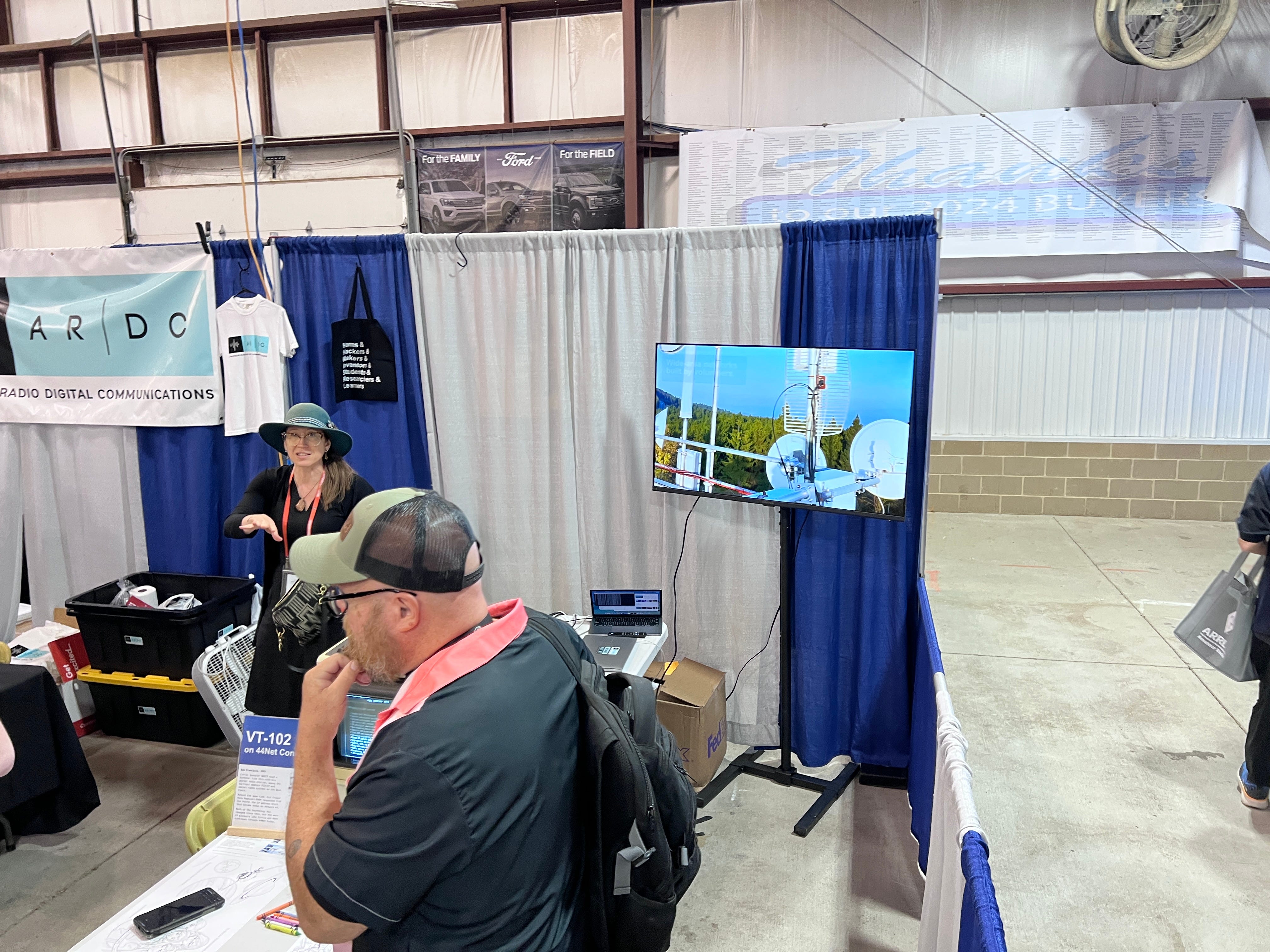
Rosy Schechter KJ7RYV
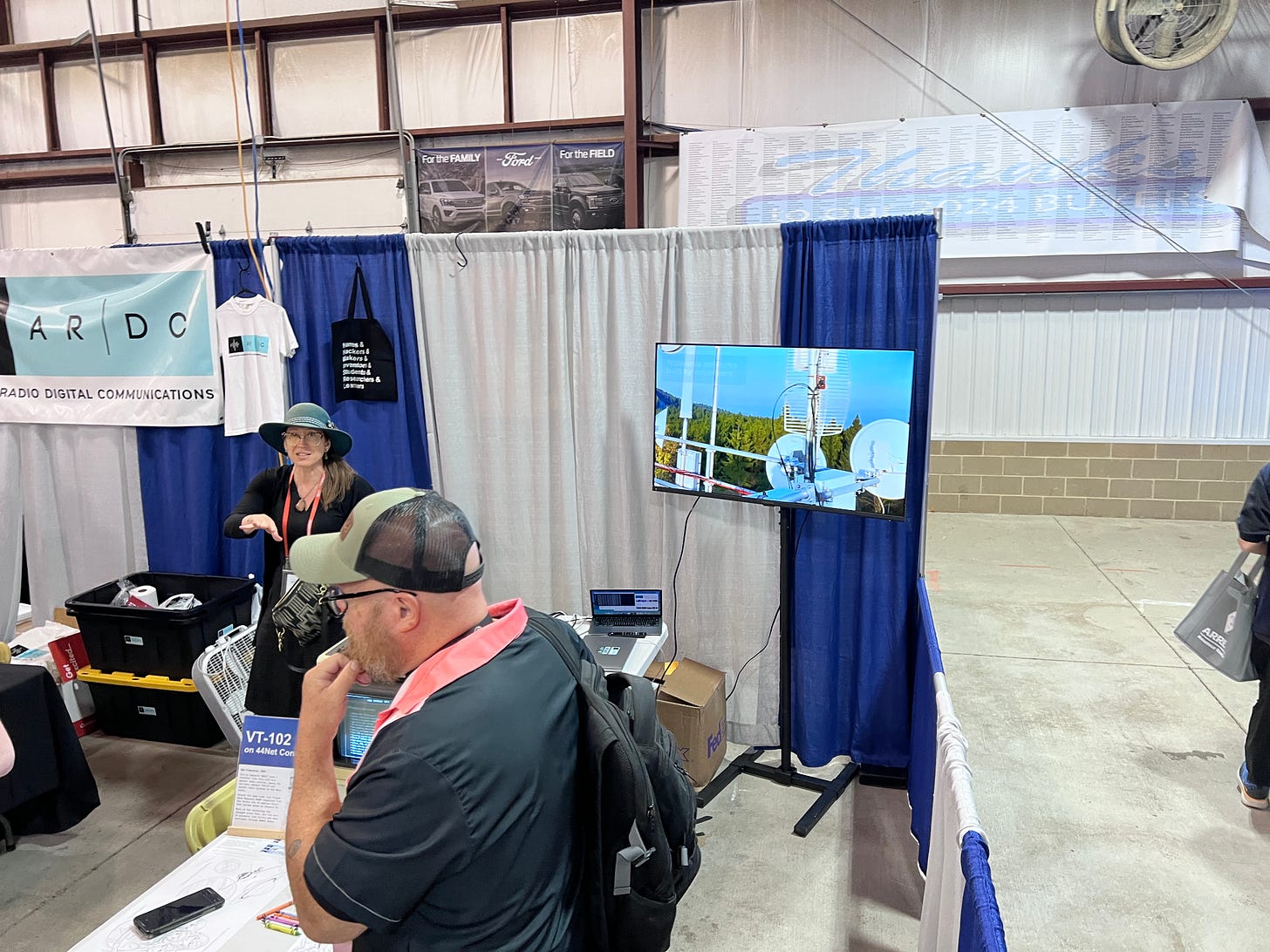
Rosy Schechter KJ7RYV at Hamvention 2026 at the ARDC booth, with (unknown) in foreground. KJ7RYV really rocks the hats! Image courtesy of Steve Stroh N8GNJ.
KJ7RYV is ARDC’s Executive Director / CEO and is always a delight to catch up with when we’re at the same conference.
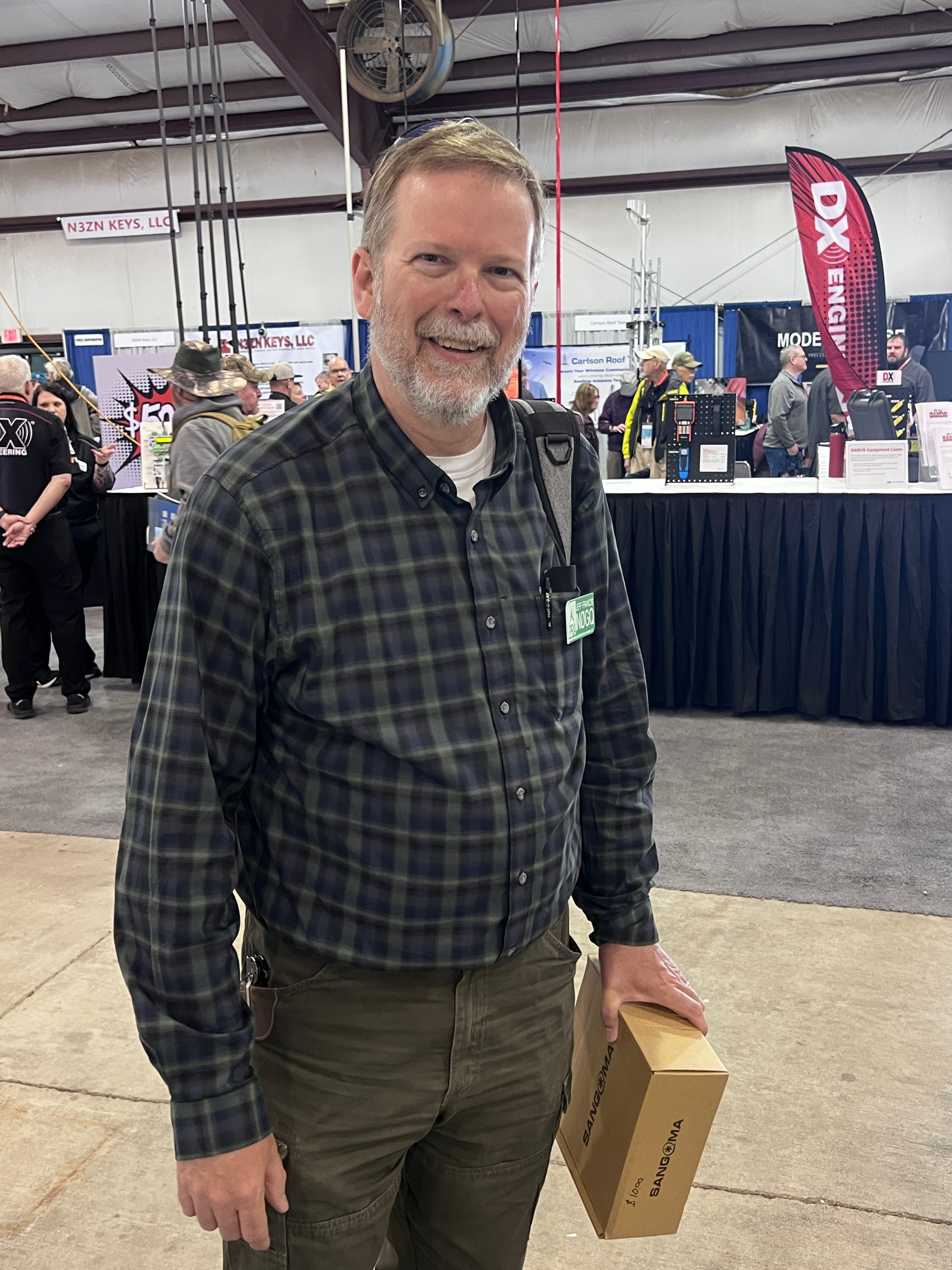
Jeff Francis N0GQ
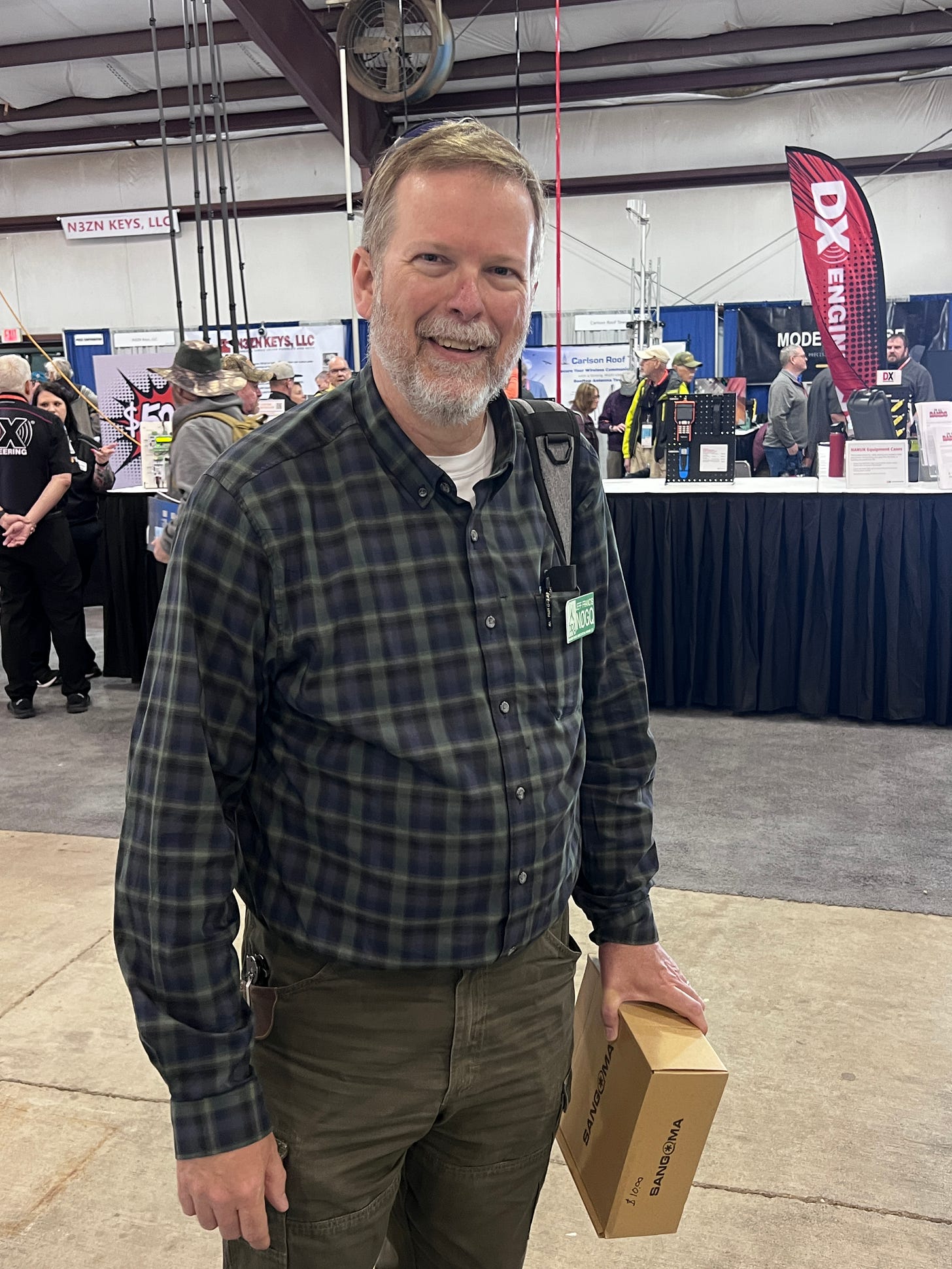
Jeff Francis N0GQ at Hamvention 2026. Image courtesy of Steve Stroh N8GNJ.
N0GQ is a long time Zero Retries Interesting friend from the Seattle area, but now lives in Colorado. He has a lot of projects in progress - see his QRZ page.
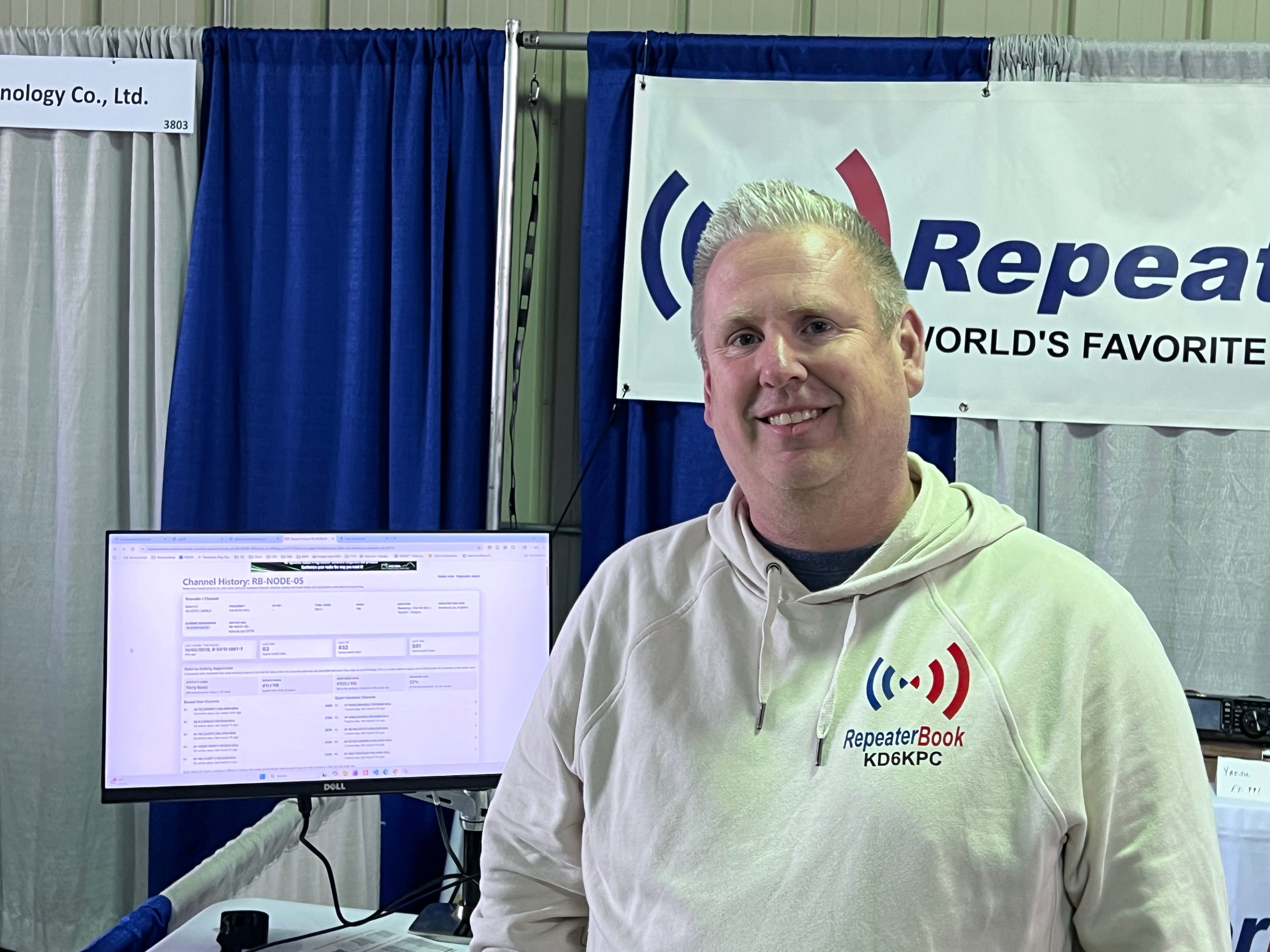
Garrett Dow KD6KPC
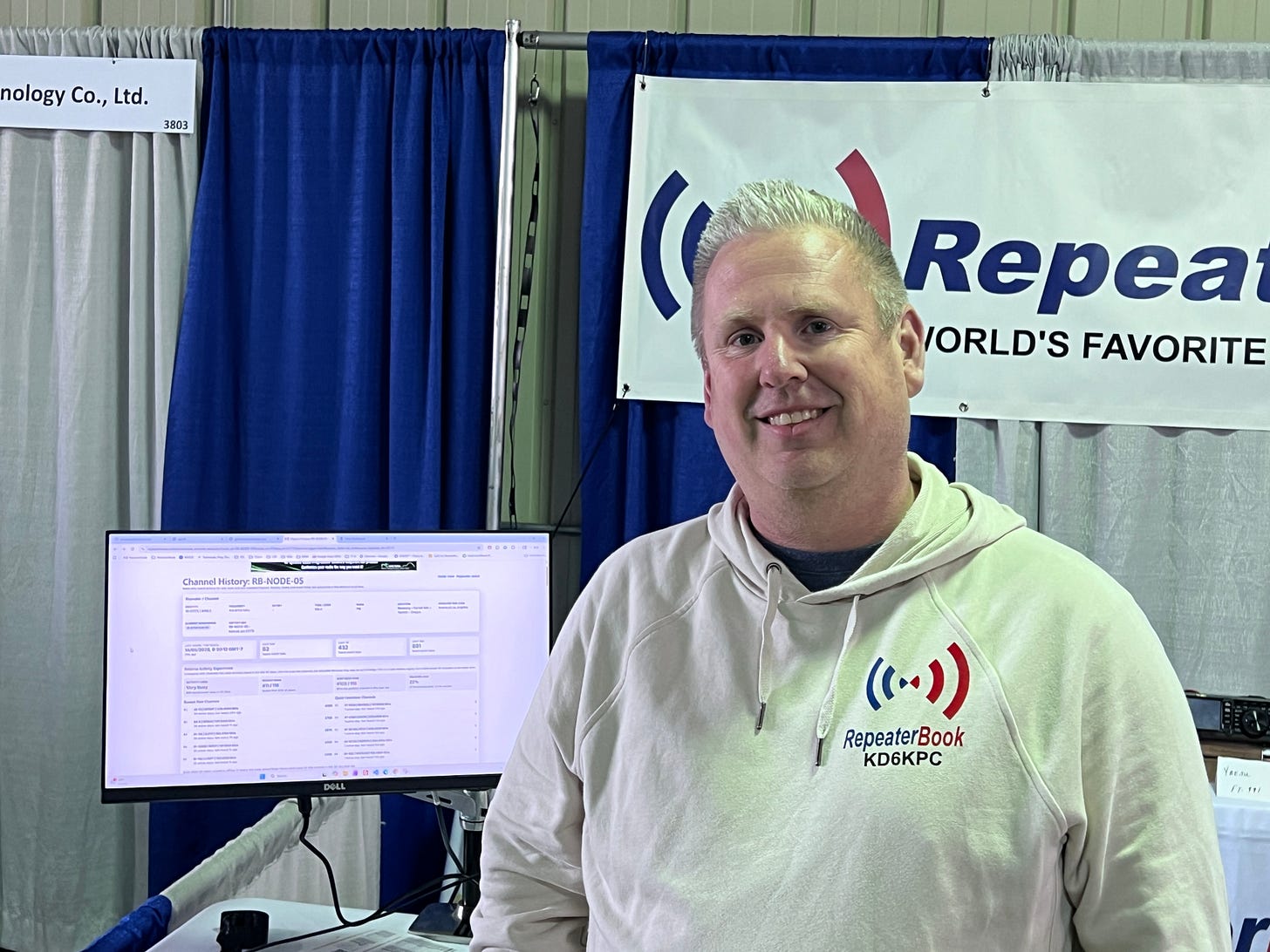
Garrett Dow KD6KPC at Hamvention 2026. Image courtesy of Steve Stroh N8GNJ.
KD6KPC is the principal of RepeaterBook. Turns out he’s yet another Amateur Radio entrepreneur now located in the greater Portland, Oregon area, and I hope to catch up with him and talk to him at length about future RepeaterBook enhancements that came to mind on a future visit to the Portland, Oregon area.
George Zafiropoulos KJ6VU is host of Ham Radio Workbench (HRWB) podcast and the principal of Sierra Radio Systems (SRS). In seeing KJ6VU at least five Amateur Radio conferences, I’ve never seen him not engaged in a conversation with a customer. I made an introduction for a potential guest on HRWB and had to verbally elbow my way in to do the very brief introduction. Life KD6KPC, he’s also located in the greater Portland, Oregon area and now the close collaboration between SRS and RepeaterBook makes a lot more sense. (Alas, no photo…)
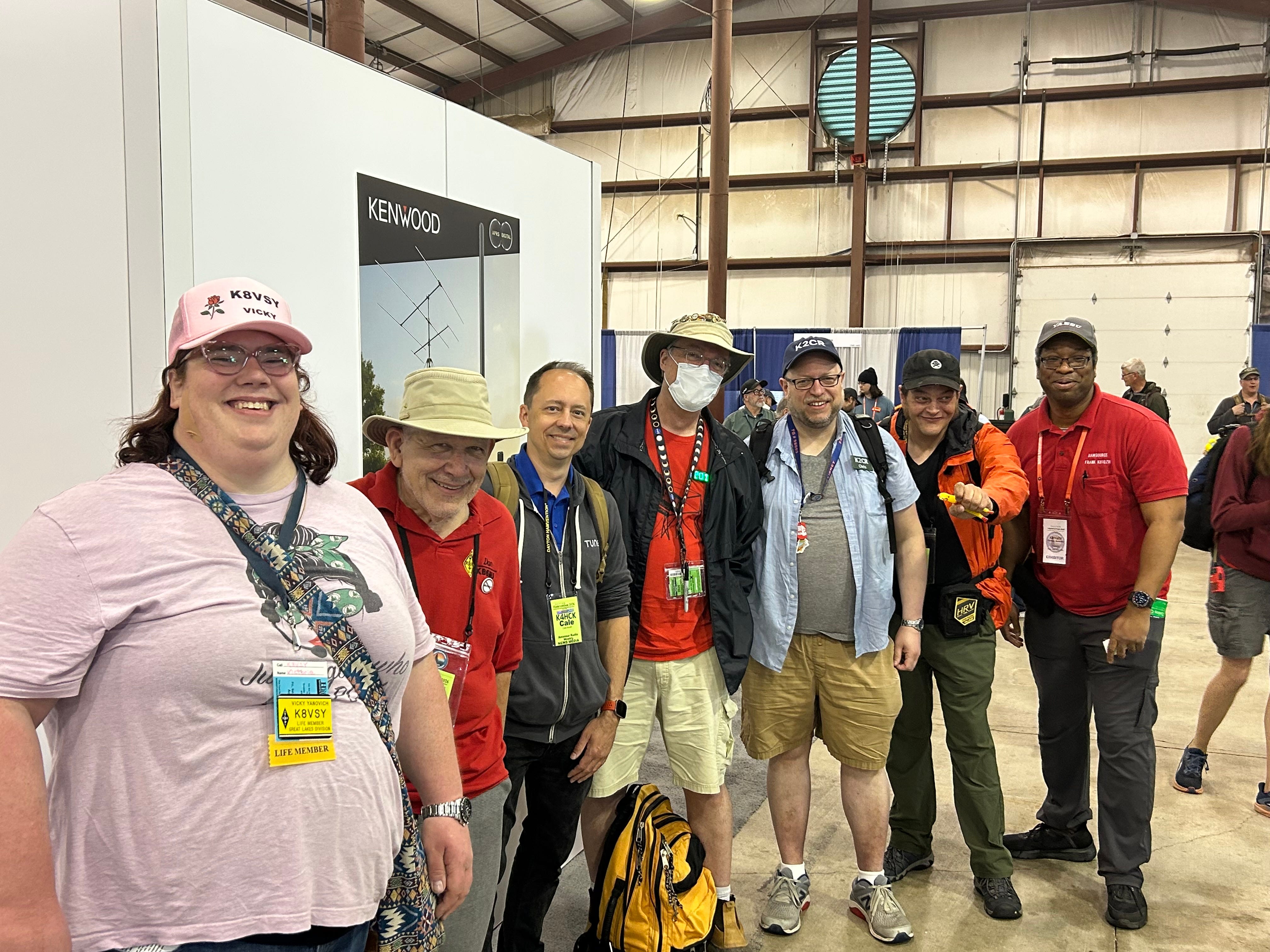
Amateur Radio Fediverse Meetup
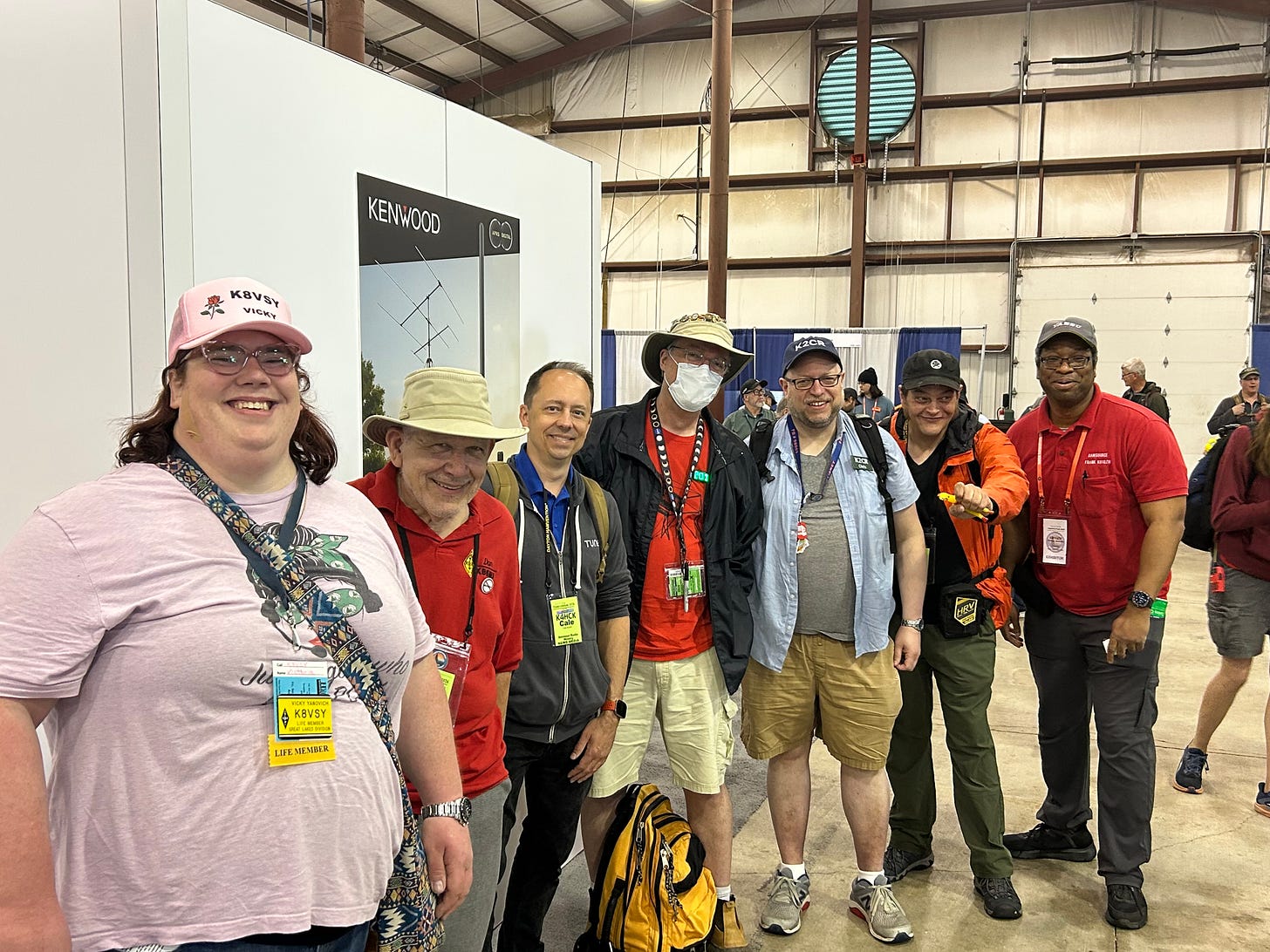
Amateur Radio Fediverse Meetup at Hamvention 2026 (partial). Pictured L-R are Victoria Yanovich K8VSY, Dan Romanchik KB6NU, Cale Mooth K4HCK, (unknown), Chris Ruvolo K2CR, Terry Schanno NV0O, and (unknown). Image courtesy of Steve Stroh N8GNJ.
Apologies to the two “unknowns” in the above photo. Please reach out and I’ll update the web version of this photo. Cale Mooth K4HCK and Dan Romanchik KB6NU arranged a meetup of ten or so folks involved with Amateur Radio on the “Fediverse” (generally, the Mastodon social network) at the Zero Retries / DLARC booth on Saturday morning. That was fun meeting folks, including some Zero Retries readers that are active on Mastodon. In researching this item, I discovered fediverse.radiowhich is a great roundup of Amateur Radio themed Fediverse servers. I particularly enjoyed meeting K8VSY who is a longtime, enthusiastic fan of Zero Retries and is a Paid Subscriber of Zero Retries.
Dozens of Zero Retries Readers - Thanks to all of you Zero Retries readers who stopped by the Zero Retries / DLARC booth, many of whom I enjoyed meeting that I didn’t remember to record names and callsigns if they weren’t present from the photos I snapped. I’ll post those photos in a future Photo gallery.
Zero Retries Interesting Commercial (Indoor) Vendors
This is just a quick roundup of Zero Retries Interesting vendors / booths, partially for my own future recall. It’s notable that there were a number of vendors for Meshtastic / MeshCore / LoRa products (indicated in bold).
Amateur Radio Digital Communications (ARDC)
AMSAT
ARISS-USA
Carlson Roof Towers
Digirig - Not listed as an exhibitor, but they had a table on Saturday.
DX Engineering - The array of widgets, accessories, and products was easily the most comprehensive vendor at Hamvention, far eclipsing Ham Radio Outlet.
DZKit - This was cool - take a QRP Labs low power radio, and wrap an HF radio around it with a full featured front panel, power amplifier, and power supply, and it’s all a kit.
FlexRadio Systems
FreeDV
Halibut Electronics
HF Signals
HamSCI
Icom America
JVC Kenwood USA
Japan Amateur Radio League - Rats! Missed that they were at Hamvention.
Libre Space Foundation - Double rats! I didn’t get to visit their booth.
LowMesh
MMDVM
National Amateur Radio Alliance
QRP Labs
Radio Club of America
Rockland Tech - Rats! Missed that they were at Hamvention.
RT Systems - Provided booth space for RepeaterBook.
SPOOLTENNA
Seeed Technology - I didn’t get to visit their booth.
Sierra Radio Systems / PackTenna / Ham Radio Workbench Podcast
SpecFive
TAPR (Tucson Amateur Packet Radio)
Whistler Group - They now manufacture portable and mobile scanners, at least one of which covers the 222-225 MHz (1.25m) band.
Acquisitions
I bought three items:
SPOOLTENNA PARKS - To accompany my HF Signals zBitx for portable HF operation. They sold out of their stock on hand, but sold me one at Hamvention price with free shipping.
LowMesh Outdoor PoE Node v1 - I had been looking for a rugged outdoor 902-928 MHz “mount on pole” MeshX unit with an antenna connector and Power Over Ethernet. This unit was the first one I’ve seen that I liked and looked and felt well built. It seems well supported, including LowMesh’s nice looking and well organized website. The antenna connector is a Type N, and thus I can use a better high gain antenna for better range in my suburban / rural county.
Quick Strip automatic adjustment wire stripper - By the pressure exerted, it seems to cleanly strip nearly any wire between phone cord and large gauge electrical wire. The demo was impressive, and the demonstrator claimed that $25 was the “special show price” (turns out that’s the same price as the website), so I bought one and look forward to testing it out myself.
RepeaterBook’s Project Apollo was the most impressive new product I saw at Hamvention. This is a badly needed capability for Amateur Radio to really understand what is actually happening with VHF / UHF repeater activity on a regional basis.
It’s notable, and indicative of the overall quality of RepeaterBook that they, of all the vendor announcements and developments from Hamvention 2026, were the only vendor that I saw to provide a dedicated summary of their (thirteen!) announcements from Hamvention 2026. This article focuses on only one of those thirteen announcements - Project Apollo, only one of those thirteen announcements.
Project Apollo
Project Apollo adds listening nodes for repeater activity and verification in the field to strengthen the quality of the information RepeaterBook already receives every day from users, admins, and repeater owners.
Public Apollo scanner-node views are live for Oregon and Idaho, with a UK node coming soon.
Why it matters: it adds another layer of confidence and helps keep repeater information more accurate and up to date.
…
What we plan to show at the booth.
Project Apollo preview
Booth conversations will also introduce Project Apollo as an automated repeater activity and verification initiative alongside the daily community input RepeaterBook already receives.
…
DAY 2 RECAP
Project Apollo became the hot topic
Project Apollo listens for repeater activity in an area and reports back activity signals that can help hams choose which repeaters to try based on their preferences. Many visitors from across the country volunteered to host nodes for this community-driven effort.
I met up with Garrett Dow KD6KPC at the RepeaterBook (RT Systems) booth at Hamvention 2026 and we had an interesting conversation.
In my opinion, Project Apollo is a badly needed capability for “ground truth” of what Amateur Radio repeaters are actually doing in a given area or region. Or, more importantly, not doing, as in objective observation of repeaters that are little used (quiet) or actually not on the air for extended periods. Personal / individual observations of repeater activity / inactivity suffer from the potential of (accusations of) individual bias, and questions about methodology / accuracy. Example - in reporting a quiet repeater, the repeater owner would likely protest that “You must have a really bad radio or antenna because our repeater is on the air!” (whether it actually is, or not). The independent, objective nature of RepeaterBook with reporting from Project Apollo, coupled with PA’s requirement of a “certified receiver” would considerable reduce accusations of bias and methodology / poor equipment in individual’s observations of repeater activity.
Project Apollo, offered by RepeaterBook, is an independent, impartial methodology of repeater activity and thus is a significant improvement of situational awareness of overall Amateur Radio repeater activity in an area.
This adds the same kind of capability for Amateur Radio repeaters as monitoring local and regional Amateur Radio APRS, Marine AIS, or Aviation ADS-B activity with a (eventual) local, regional, national, and worldwide network of receivers feeding a “dashboard” page via Internet.
KD6KPC had started Project Apollo with scanners, but then moved to (less extensive, but still very capable) Software Defined Receivers with his own software to emulate a scanner, as in sequentially, briefly, monitoring activity on each repeater channel. There is also some software that’s part of Project Apollo for extended situational awareness such as decoding repeater identification using CW (Morse Code) and Continuous Tone-Coded Squelch System (CTCSS) tones used for accessing (analog FM) repeaters. The Project Apollo software will continue to be in active development for the foreseeable future to add as much situational awareness as possible.
I was eager to mention ka9q-radio to KD6KPC as a “receive all channels, simultaneously” capability instead of the sequential scanning paradigm which can’t be as accurate about what’s happening when scanning, for example, the time it takes to sequentially scan 10 MHz from 440-450 MHz. Not only was KD6KPC already aware of ka9q-radio, but Phil Karn KA9Q himself had found the RepeaterBook booth, introduced himself, and suggested that Project Apollo make use of ka9q-radio. If implemented, that would be a big deal for Project Apollo’s capabilities in being able to provide long term, high resolution situational awareness. For example, monitoring a DMR repeater channel full time using ka9q-radio would allow parsing of who is using the repeater (parsing the DMR ID that’s transmitted at the beginning of every transmission), not just that the repeater is active for x amount of time resulting from successive scanning sweeps.
KD6KPC’s original plan to gradually expand Project Apollo’s footprint was deploy a private or “trusted partner” network of receivers, initially in major metro areas, using a “certified” combination of radio, antenna, antenna height, reasonable Internet connectivity, and always-current Project Apollo software. To his surprise, individual Amateur Radio Operators volunteered to use their own equipment to contribute to project Apollo. That change in direction would allow Project Apollo to scale much faster than the original approach of using only private or “trusted partner” network of receivers. Multiple receivers in an area would also allow for redundancy.
Project Apollo monitoring is will expand to cover General Mobile Radio Service (GMRS) repeaters.
It’s an interesting capability that Project Apollo will monitor all portions of Amateur Radio VHF / UHF spectrum that’s allocated for repeaters. Thus activity from repeaters that are “private” or uncoordinated, or intended as “stealthy” will be reported impartially.
I would hope that Project Apollo would eventually be extended from repeaters to other portions of Amateur Radio spectrum, such as the monitoring activity on the ten simplex channels used for packet radio from 144.91 to 145.09 MHz.
It will also be very interesting to view the overall activity of all of the VHF / UHF bands - 10m, 6m, 2m, 1.25m, 70cm, 33cm, and 23cm to see if, for example, it’s worth investing in a 6m radio to participate in local 6m activity. Monitoring 33cm will be a bit tricky given that it’s 100% shared with unlicensed users. For example, it would be useful to understand the overall use of Meshtastic / MeshCore on that band.
I’m also imagining the synergy between RepeaterBook and the KK7NQN Transcriber Service Node to enable realtime transcriptions of (selected) activity on various repeaters, as well as selective alerting based on (audio) callsigns. For example, with the incorporation of Transcriber Service Node into Project Apollo, it might be possible to type in a callsign such as N8GNJ and then see a summary of which repeaters, and when, that callsign has been heard. This is easy on digital voice repeaters with the user transmitting an embedded callsign or DMR user ID. Doing that on FM (analog) repeaters (no embedded callsign or user ID) is tougher, but the Transcriber Service Node capability would bridge that gap.
Just as an example of why the combination would be so useful is a potential, or new Amateur Radio Operator could go to RepeaterBook, select Bellingham, Washington, and query which repeaters have recent conversations about “digital” or “packet radio" or “Hamvention”, and then choose to operate on, or monitor that repeater as having interesting (to me) conversations.
In summary, I think that Project Apollo offers very exciting potential to enhance the appeal of Amateur Radio voice repeaters for greater visibility of repeater activity in a given area. If KD6KPC can work out the particulars of the specifications for “certified” Project Apollo by individual users, Project Apollo could scale very rapidly.
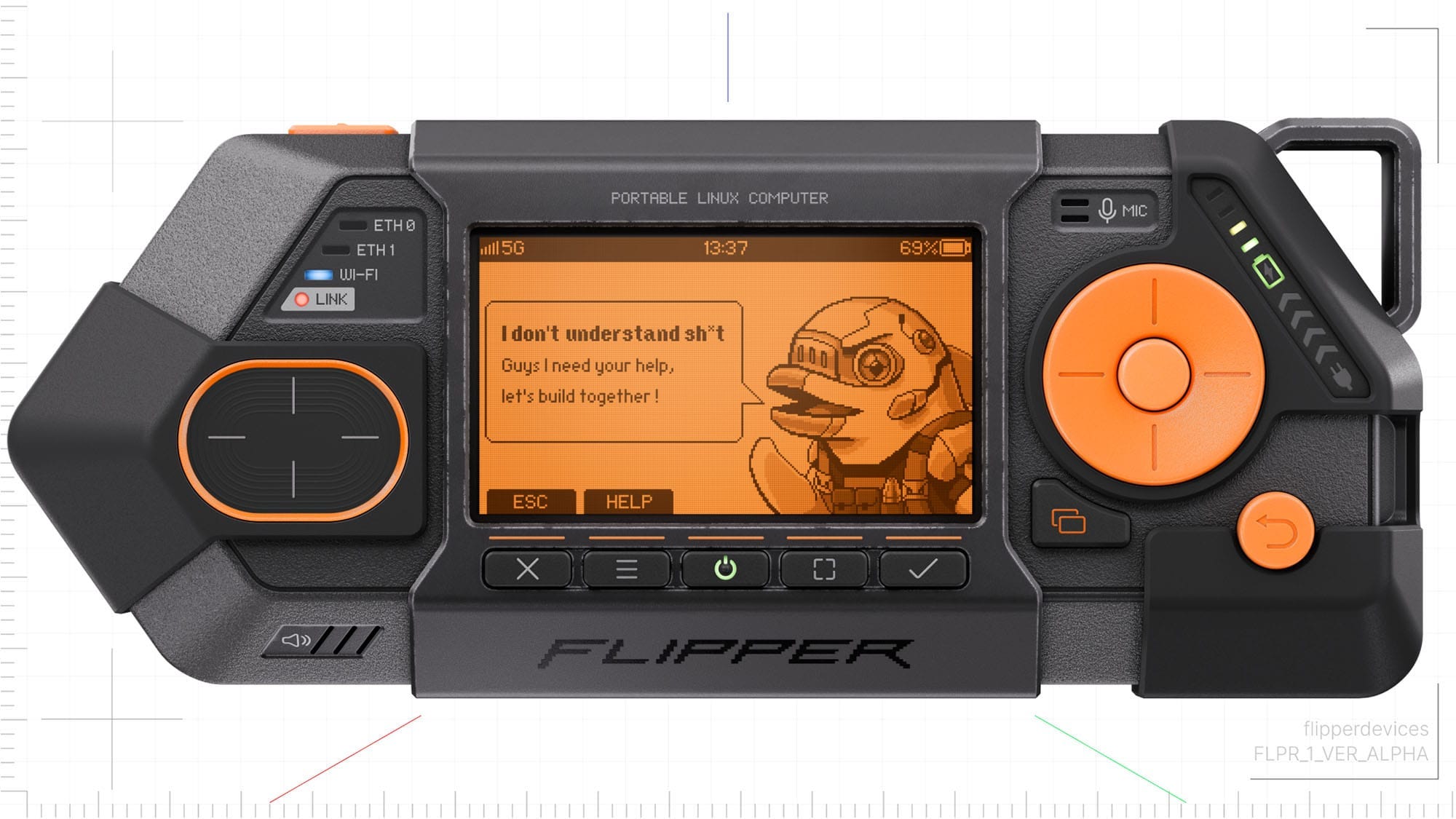
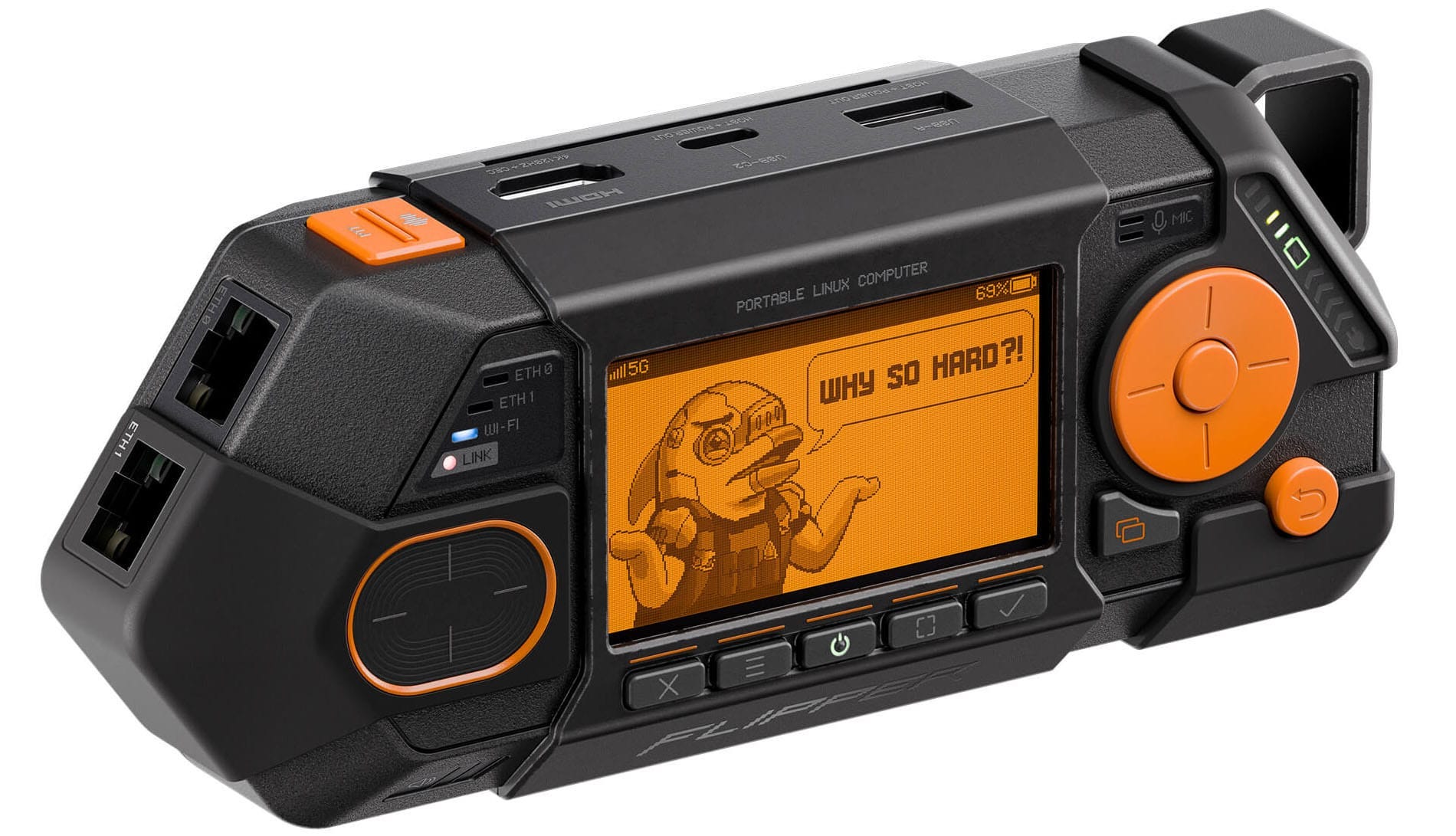
Flipper One - Image courtesy of Flipper Devices, Inc.
Pavel Zhovner on the Flipper Blog:
We’re finally ready to talk about Flipper One — a project we’ve been grinding on for years and have rebuilt from scratch several times. It’s an incredibly hard project, both financially and technically. So today we’re going public not with a big shiny announcement, but to tell the whole story straight. Honestly? We’re genuinely terrified, and we need your help.
TL;DR With Flipper One, we’re reimagining what a Linux cyberdeck can be — it’s a huge project. We’re opening up the development process and asking the community for help.
With Flipper One, we’ve set ourselves a list of ambitious goals:
Build the most open and best-documented ARM computer in the world, with full mainline Linux kernel support.
Push vendors to open up their existing closed-source code and ditch binary blobs entirely.
Build an unconventional hardware platform based on a co-processor architecture that pairs a microcontroller with a CPU, and port tons of low-level MCU code.
Rethink how people use Linux and develop our own GUI framework with wrappers around existing CLI utilities.
Many of these goals come with a lot of uncertainty, which is scary. But we believe this is the only way to make a truly meaningful contribution to the open-source community and to education.
What is Flipper One?
Flipper One isn’t an upgrade to Flipper Zero — it’s a completely different project with its own goals. Flipper One is an open Linux platform you can build almost anything on: from a 5G-enabled IP network analyzer to an SDR-powered radio signal analyzer with local AI. We focused a lot on the hardware expansion system. You can connect high-speed modules to Flipper One over PCI Express, USB 3.0, and SATA interfaces. Add an SDR, a fast SSD, or a cellular modem — just plug in the right module.
Flipper One comes with several network interfaces: 2x Gigabit Ethernet, USB Ethernet (5 Gbps), and Wi-Fi 6E (2.4/5/6 GHz). You can add 5G connectivity by plugging in an M.2 modem. That means you can use Flipper One as a router, a VPN gateway, or a bridge between wired and wireless networks.
“Help” referenced in the title seems to be this section:
Developer Portal – let’s build together
Openness has always been our thing. With Flipper One, we want to go further — not just open-source code, but an open development process. We’re publishing our task trackers, internal discussions, half-finished docs, and architectural debates. All the messy stuff companies usually keep behind closed doors.
This is uncomfortable. We’ve never been this open before, and there’s a real instinct to hide the unfinished work, the wrong turns, and the arguments. But we believe the educational value of building openly is worth more than the polish of pretending it was easy.
What is the Developer Portal?
Flipper One Developer Portal is a public wiki with all the development documentation for Flipper One, and anyone can edit it. The portal describes the project’s structure and ways you can participate in development.
Flipper One seems like an ideal Amateur Radio “Cyberdeck” / radio technology multi-tool. It’s an intriguing possibility of an Amateur Radio data communications radio with an M.2 interface and form factor. There’s lots more detail in the article, with a lot of detail on how they’re trying to be accommodating towards radio modules (such as Amateur Radio) that they’re not currently imagining.
I’m going to try to follow the progress of Flipper One and feature regular updates on it in Zero Retries.
The global memory crunch and the great repricing of consumer electronics.
One of the most remarkable things about the last few decades is how cheap computers have gotten.
In 1985, if you were a reasonably affluent American, the best computer that you could afford was the IBM PC AT. The PC AT would cost you about $6,000—$19,400 in 2026 dollars—and thus represented about a quarter of the median American’s annual income; and it ran on an Intel 80286 processor, capable of something like 900,000 instructions per second. Today, if you find yourself in a market stall in Nairobi or Lagos, you’ll be able to find a cheap smartphone—like the Tecno Spark Go, manufactured by China’s Transsion—for somewhere between $30 and $120. That phone will run on a processor capable of billions of calculations per second.
In other words: you can buy a computer thousands of times more powerful than the best consumer device from 40 years ago, for something like 0.3 percent of the price. No other good in history has experienced a decline in cost on that scale: poor people can now carry around in their pockets computers many orders of magnitude more powerful than what the richest slice of the world’s population could afford a few decades ago. And that great cheapening of consumer electronics has enabled a diffusion of computing power to the world’s population that is nothing short of miraculous. Hundreds of millions of the world’s poorest people are able to access the internet because of cheap smartphones like the Tecno Spark Go.
That era is now coming to an end.
This article is interesting for the stated subject, but it’s also a cautionary tale for Amateur Radio as well given that we’re now firmly and irrevocably in the Software Defined Radio (SDR) era. For SDR, large amounts of RAM is the second most critical component behind the SDR chips themselves. It’s going to be a rough few years for Amateur Radio as prices for some of our favorite Amateur Radio gadgets will inevitably rise… if not become unobtainium because the increased prices aren’t reasonable for the overall value of the device. One example is of such an embedded device, besides the Flipper One in the previous story, is the really cool SharkRF M1KE Wi-Fi Amateur Radio. Or perhaps Amateur Radio devices will become largely a front end interface to move the SDR processing into commodity devices like our (expensive and capable, but already paid for) Android phones and iPhones.
Jane McConnell is an accomplished writer, and now an interviewer who runs Imaginize World. She interviews people from widely varied backgrounds about the near term future. McConnell had reached out to a distant acquaintance of mine looking for writers who were making productive use of AI. I replied to her that I was using AI “lightly” in doing research for “my small newsletter, Zero Retries” and my use of Google’s NotebookLM AI tool as essentially a “smart index” of my five years of weekly newsletters. I also mentioned that AI was becoming increasingly useful in Amateur Radio in embedded roles for many different activities. Apparently I was one of the few that contacted her about the use of AI that had an overall positive view of using AI.
McConnell contacted me back and seemed fascinated with Amateur Radio, which she had never heard of. In preparation for the interview we exchanged extensive emails. She did a lot of her own research in reading archival Zero Retries material. Thus she was well-prepared, asked a lot of interesting, informed questions in the interview, and I really enjoyed talking to her. She uses the same model for interviews that I wish I could do - just research, talk, and hand over editing, production, and posting to a capable (human) video / audio / website Editor.
I really appreciated that McConnell goes to the trouble and expense of paying for and posting a full transcript of our conversation for faster absorption of the discussion for those of us who prefer text input.
I hope that McConnell and I talk again at some future point. I’m now a fan of her work and will slowly work through her back catalog of interviews and other material on her website.
Weekends Are For Amateur Radio!Assembling Shed Kits!
A couple of months ago Tina and I bought a small shed “kit” at Costco that was two very large, very heavy flat packs that when assembled would be a nice “garden shed”. It looked neat at the store already assembled and we needed a bit more storage that wasn’t in the shop, or the attached garage, and this seemed like a reasonable solution.
But wow, was it hard to move - very heavy, large, and awkward! It was all we could do to slowly push it out of the back of my pickup truck and stand it up on edge in our attached garage to await a reasonable time after six weeks of various travels, when we could arrange enough time to assemble it, arrange for help from friends, and have reasonable weather. The weather issue was if we put it out too soon, and it got rained on, the cardboard would disintegrate and oh, what a mess it would be to have to move all those pieces separately.
One of our neighbors just happens to have an outdoor forklift! Thus he’s going to bring his forklift up to our attached garage and we’ll “just push out” the two big boxes out of the garage and lay them over onto the forks. He’ll then do the (literal) heavy lifting to place the two boxes several hundred feet away, behind N8GNJ / Zero Retries Labs (our detached shop). He’s a great neighbor - he had a snowplow attachment made for his forklift to keep our private street accessible in the very occasional snowstorms. Two other friends love to help with projects like this. Thus this week, tomorrow (Saturday) won’t be Amateur Radio time, but instead will be devoted to shed assembly with help from these three friends. Tina will supervise (it’s her shed), and Tina will enjoy having an excuse to be an event hostess and feed the crew.
Of course… this detached shed will be a great excuse to “technify” it, with a solar panel, some kind of radio and antenna, and various other electronic and radio gadgets.
Have a great weekend, all of you co-conspirators in Zero Retries Interesting Amateur Radio activities!
My ongoing Thanks to: Tina Stroh KD7WSF for, well, everything! Jack Stroh, Late Night Assistant Editor Emeritus Fiona and Shreky Stroh, Late Night Assistant Editors In Training
Founding Members who generously support Zero Retries financially: Founding Member 0000 - Steven Davidson K3FZT (Renewed 2025, 3rd year!) Founding Member 0001 - Randy Smith WU2S (Renewed 2025, 3rd year!) Founding Member 0002 - Chris Osburn KD7DVD (Renewed 2025, 3rd year!) Founding Member 0003 - Don Rotolo N2IRZ (Renewed 2025, 3rd year!) Founding Member 0004 - William Arcand W1WRA (Renewed 2025, 3rd year!) Founding Member 0005 - Ben Kuhn KU0HN (Renewed 2025, 3rd year!) Founding Member 0006 - Todd Willey KQ4FID (Renewed 2025, 3rd year!) Founding Member 0007 and 0010 - Merik Karman VK1DF / VK2MKZ (Renewed 2025 x2, 3rd year!) Founding Member 0008 - Prefers to Remain Anonymous 08 (Renewed 2025, 3rd year!) Founding Member 0009 - Prefers to Remain Anonymous 19 (Renewed 2025, 2nd year!) Founding Member 0011 - Rick Prelinger W6XBE (Renewed 2025, 2nd year!) Founding Member 0012 - Ryan Tolboom N2BP (Renewed 2025, 2nd year!) Founding Member 0013 - Newton White N4EWT (Renewed 2026, 2nd year!) Founding Member 0014 - Joe Hamelin W7COM (Renewed 2026, 2nd year!) Founding Member 0015 - Rich Stocking N7OP (Renewed 2026, 2nd year!) Founding Member 0016 - Prefers to Remain Anonymous 77 (New 2025) Founding Member 0017 - Phil Karn KA9Q (New 2025) Founding Member 0018 - Prefers to Remain Anonymous 95 (New 2025) Founding Member 0019 - Prefers to Remain Anonymous 0108 (New 2025) Founding Member 0020 - Prefers to Remain Anonymous 110 (New 2025) Founding Member 0021 - Prefers to Remain Anonymous 111 (New 2025) Founding Member 0022 - Prefers to Remain Anonymous 112 (New 2025) Founding Member 0023 - Prefers to Remain Anonymous 116 (New 2026) Founding Member 0024 - Rob Bowser (SPOOLTENNA) (New 2026) Founding Member 0025 - Dave Stewart K7XST (New 2026)
Numerous Annual and Monthly subscribers who also generously support Zero Retries financially!
You thousands of readers of Zero Retries without which there would be little point in publishing this newsletter.
Fair Use - All excerpts from other authors or organizations, including images, are intended to be fair use and are fully attributed generally by author and link (URL).
Paid Promotional Content - Unless otherwise noted in the article or item, advertisement, or sponsorship notice, Zero Retries does not include paid promotional content. Exceptions:
Advertisements in Zero Retries,
Sponsorships in Zero Retries,
Zero Retries products,
Zero Retries events
Features and content exclusive to paid subscribers.