2026-05-29 - LinHT Rev B – Hardware Testing Status [2026-05-23], M17 Packet Mode Data, rpitx-ui: Fork Of The RPITX Raspberry Pi Transmitter Software, Packet Radio is Making A Strong Comeback
Zero Retries is an independent newsletter promoting technological innovation in and adjacent to Amateur Radio, and Amateur Radio as (literally) a license to experiment with and learn about radio technology. Radios are computers - with antennas! Now in its fifth year of publication, with 3500+ subscribers.
LinHT is Linux Handheld Transceiver. It is an open source Software Defined Radio transceiver operating on the Amateur Radio 420-450 MHz (70cm) band. Three primary characteristics of LinHT are that it’s designed to be used as a handheld radio (initially based on the Retevis C62 portable radio), it runs GNU Radio 3.x flowgraphs, and it runs on Linux. You can shell into your LinHT.
BTW, it would be awesome to have CARI support for such things in LinHT at some point!
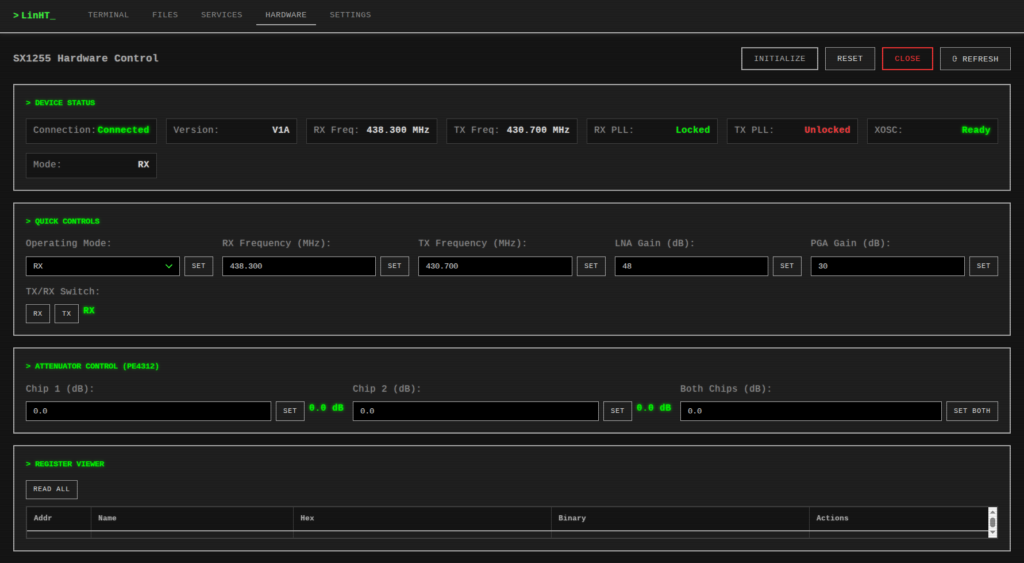
With the flowgraph running, I toggled the RF switch and adjusted the attenuators while observing signal levels.
Editor’s Note - The image of a spectrum plot, illustrating the above paragraph, was too large for Substack. See this link for the image or the original article by clicking on the title link.
TX path
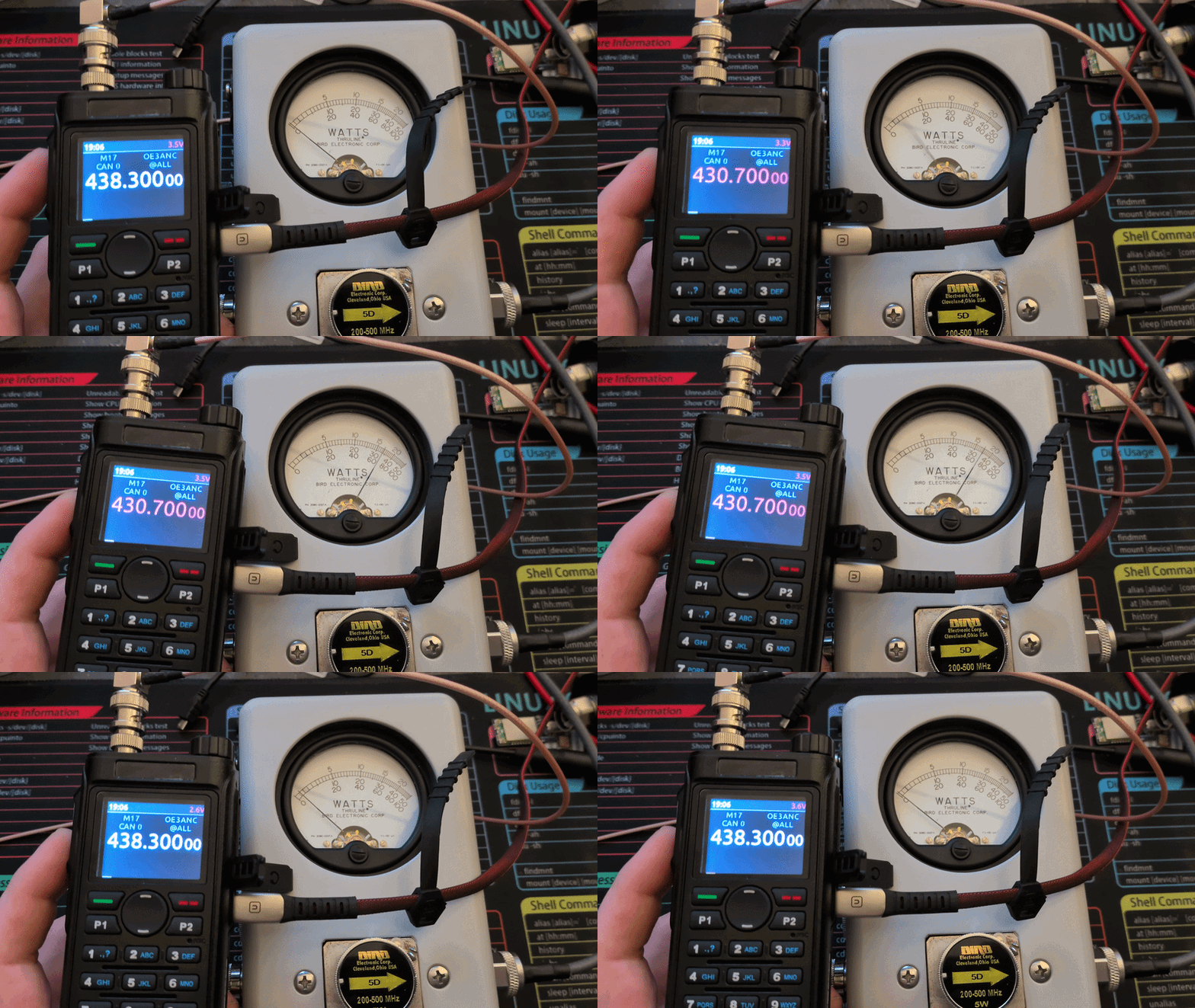
For the TX path test, I kept it simple. I’ve set the RF switch to “transmit” using the new controls of the web UI and transmitted M17 with the gui_test program (included in the LinHT image).
Transmitting M17 at 3.5W
I was able to hit my repeater OE3XOR with the M17 RF transmission.
Software changes
There were some required software changes to get the new hardware components working.
It’s exciting to read this update! The Rev B hardware version of LinHT sounds like there aren’t any “showstoppers”, just straightforward additional development and debugging.
A number of Zero Retries readers stopping by the Zero Retries / DLARC booth at Hamvention 2026 commented that they’re looking forward to the LinHT, and hoped that M17 / LinHT could be exhibited at Hamvention 2027.
It’s the nature of ambitious open source hardware projects such as LinHT to have extended development cycles when the developers can only work on such projects “as we have time and resources available”.
If you’d like to help the development of LinHT, the project is sponsored by the M17 Foundation, and you can donate to M17F (donate link in upper right corner) and add a note that you’d like to support the development of LinHT.
In this issue: Laser power in space, scanning thousands for hidden weapons, batteries from nuke waste; asteroid mining, burritos, broadband, speech without talking, shortwave stations: hints of what’s next – and a plea for peace through Bluetooth jamming.
One of the things I most appreciate about every new issue of Experimental Radio News is that ERN Editor Bennett Z. Kobb (AK4AV), in parsing through the gamut of experimental radio licenses issued by the US FCC, features many uses of radio technology that aren’t about communications. In Amateur Radio, we think of radio technology in the context of communications. But there are a myriad of other uses for radio technology such as power transmission, which is featured prominently in this issue of ERN.
Louis Law on the PocketPD project website on Crowd Supply:
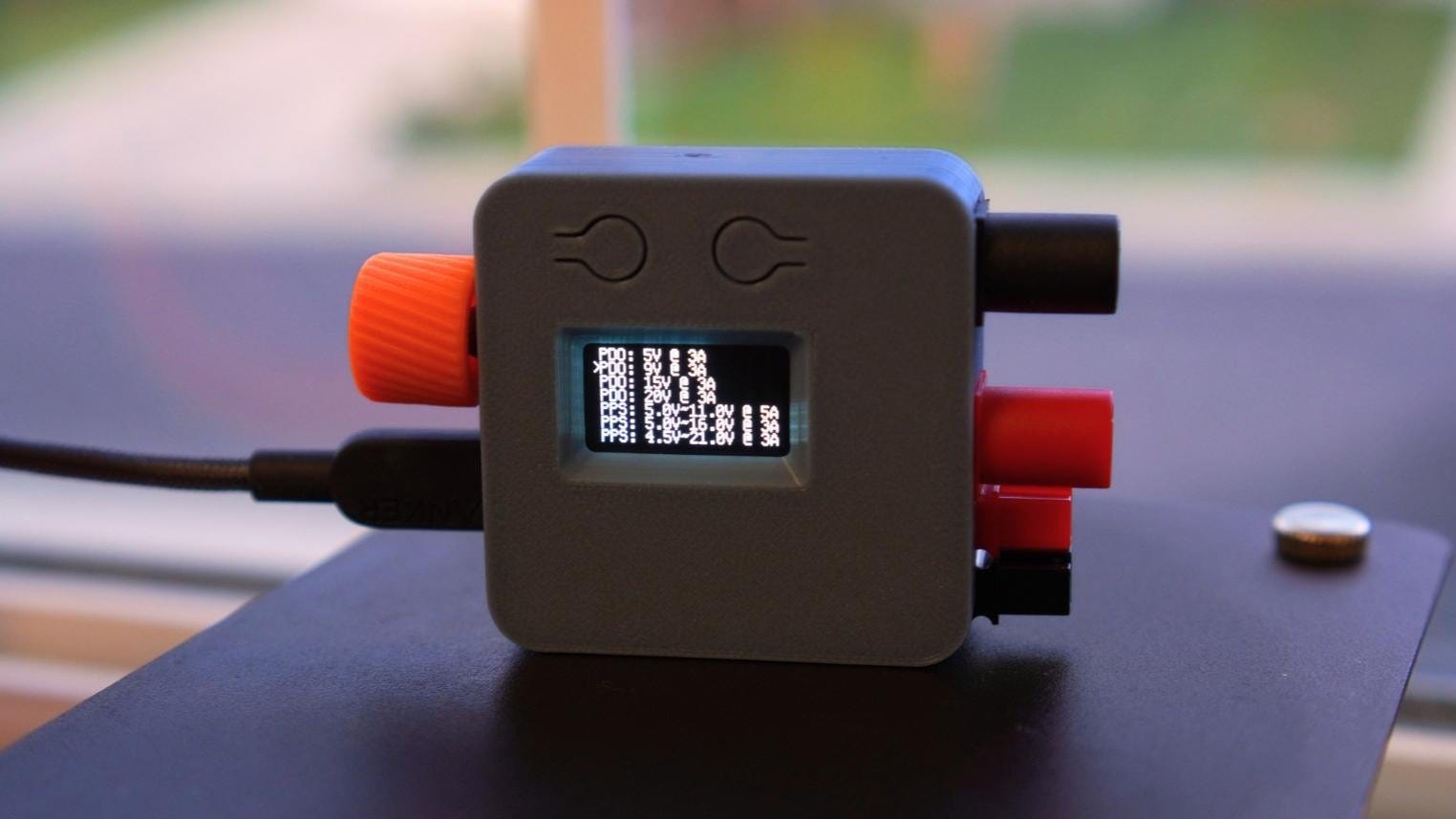
We just released V2.0.0 of the PocketPD firmware, a complete rewrite from the ground up. PocketPD turns any PPS-capable USB-C charger into a pocket-sized bench power supply, with a rotary encoder and two interface buttons for precise V/I control and monitoring. The V2 update keeps all that functionality while adding a slew of improvements and bug fixes that address long-standing user pain-points.
Why a Rewrite?
Firmware support for PocketPD started as a small open-source demo and outgrew itself fast. Due to its monolithic nature, adding features meant adding branches, and adding branches meant breaking unrelated ones. Unit testing was non-existent because everything imported Arduino headers. Simply put, V1 was painful to develop on and just wasn’t feasible long-term.
V2 splits the firmware into three layers:
HAL adapters own the hardware APIs,
Stages own local views and environment,
Tasks own I/O cadence and general-purpose logic.
At a high level, it’s a state machine + cooperative scheduler + event bus. Each layer can be replaced or mocked, and the codebase today has over 150 unit tests and counting.
On screen, it looks similar, but you’ll notice much improved overall responsiveness and, most importantly, many bugs fixed.
What’s New?
Multiple PPS Profile Detection Fixed
Modern PD chargers often expose multiple PPS bands. For example, a low-voltage, high-current band around 3.3–11 V at 4 A alongside a high-voltage, low-current band like 3.3–21 V at 3 A. Until now, a bug in the PD controller library prevented detection of multiple profiles. We’ve fixed that, and V2 now surfaces every PPS profile the charger advertises.
Simplified Profile Picker
V1 split the charger’s capability list across two screens, CapDisplay and Menu, with subtly different rules for which button did what. V2 combines them into a single screen. The encoder scrolls through the profile list, and long-pressing the encoder confirms the selection. You can reach the Profile Picker at any time by long-pressing the "L" button.
Added Safety When Switching Profiles
Switching to a different PDO profile now disables the output automatically by default. We think this is a good default behavior, as different profiles have different V/I capabilities, and a sink device configured for the old profile could end up drawing more current than the new profile is capable of, which can lead to an unexpected power reset.
Input Lock
Long-press both "L" and "R" buttons together to freeze the screen against accidental presses. You’ll notice a padlock icon now appears in the top-right corner. To unlock the device, long-press both buttons again.
Redesigned Energy Screen
The previous energy screen lacked screen real estate for the padlock icon, so we took this opportunity to redesign it while keeping the functionality. The new layout provides a more focused view for the Watts reading. From the Normal screen, long-press the "R" button to show the energy view; the same gesture takes you back.
More Stable Live Readouts
We’ve applied oversampling and EMA smoothing to reduce jitter on small deltas, while larger changes still snap to their new values quickly.
Snappier Buttons
Buttons now run at 30 ms debounce and 500 ms long-press, down from V1’s 50 ms and 1500 ms. You no longer have to wait an eternity for long-presses and the experience is now closer to using a smartphone, it’s just snappier overall!
Tina and I are very proud that Zero Retries Digital Conference 2025 was the public debut of the PocketPD. With this update, the two cofounders are well on their way to future success in their next project(s).
In my MSeven app, I have added support for SMS messaging in packet mode. I am also adding NTS RadioGram support. I am wanting to do several things with other data types. I’d like to solicit comments/ideas around the use of OpenTrac data packaging as one of the available packet mode data types. I am using the leading byte pair, 0x24, 0x42 to designate my specific use of OpenTrac. OpenTrac is already something in use and in different devices, and so I think it’s an interesting choice for packing multiple data values into packet mode frames.
Any thoughts on this would be appreciated.
Jim Ancona N1ADJ replied:
Your email inspired me to check out MSeven even though I don’t have an iPhone. I was pleasantly surprised to see that it runs pretty well on my MacBook.
How do you envision NTS RadioGram support working?
I don’t understand what you mean when you say you’re using the leading byte pair, 0x24, 0x42 to designate your specific use of OpenTrac. Is that the M17 Packet Mode Protocol Identifier (section 3.3.2) or something else?
I’m curious how you see OpenTrac being used. AFAIK, there’s no broader network infrastructure in place for Opentrac. Do you envision M17 becoming a transport layer, the way AX.25 is for APRS, with M17 reflectors taking the place of APRS-IS?
W5GGW replied:
Currently, what I am providing is the ability to craft an NTS radiogram, and transport it using the M17P packet mode. The idea behind using OpenTrac, which has been supported in a few different devices, is to use something that already has support and documentation for encapsulating various details that I will add to MSeven support through BLE interfaces.
Where I am going with MSeven, is to provide a very capable first responder application, that will allow certain scenarios to play out, readily. Much like any support effort using ARES resources or just people on the scene with HAM radio equipment, I want to enhance information gathering and forwarding through MSeven’s capabilities.
Today, it does voice and messaging. In addition, I have a contact mapping feature set so you can see where people are “from”. I include QRZ navigation information so that you can find out more about a contact through the use of their callsign on QRZ.com or callook.info web services (when available). What I am really thinking through, is someone rolls up to a disaster with a starlink dish, some batteries, and erects an AP routed through starlink. If they have a reflector setup that they can put on that network, local traffic can start right away with just a WiFi AP and a reflector and external comms can come later.
The radiogram support allows people to go out and collect information that can be received by another device, which could be taken, carried or just forward the radiograms once internet, or some other connectivity (I will add winlink support soon too), so that we have a path and a system for using our devices.
Still to come in MSeven will be photo transport and as I said, winlink transport. Also, I am working on Mobilinkd TNC4 use for M17 transport out of the iPhone to an RF deck. This would allow you to have your phone connected to an HF link out of an area local to you. I am also working on another application that is providing FT8 use from my phone as well to see how that might work out (no CAT/PTT controls without MFi or external BLE connected serial port etc.)
DVSwitch and other such systems that can cross M17 over to Vara FM or other transports is what we would want to flesh out.
This is really about how to make M17 and Codec2 something that can become very useful and attractive to many more ideals so that manufactures can start to think more about how can they support more advanced features.
There’s a lot of things in here that are still just ideas, but there is quite a bit that I have working and not yet visible in the Apple Store version.
Anyone interested in helping me test the TNC4 integration in particular can let me know their iCloud email address and I can set them up for TestFlight access to the things I am testing.
This sounds like a really fun, Zero Retries Interesting project!
The M17-Users email list is sponsored by Zero Retries, and that offsetting that (admittedly minor) expense is thanks to Zero Retries readers who are paid subscribers.
The past several weeks have been extremely busy for me as development continues on my new project called WaveWatch. I am not quite ready to reveal all the details publicly yet, but I can say that the project has been moving forward rapidly, especially with the help of modern artificial intelligence development tools.
Recently, I attended meetings with the Henderson Amateur Radio Club and had the opportunity to talk with fellow amateur radio operators about the WaveWatch project. The response was very positive, and several members suggested that I create a dedicated Discord server where I can post updates, technical discussions, development progress, and eventually coordinate testing with members of the ham radio community.
That idea makes a lot of sense because projects like this benefit greatly from collaboration between radio operators, SDR experimenters, software developers, and electronics enthusiasts. Amateur radio operators have always been at the forefront of experimentation, innovation, and emergency communications, and I believe AI-assisted software development will become an important part of the future of ham radio technology.
To encourage collaboration and technical participation, I have also posted portions of the WaveWatch source code to GitHub. At the present time, however, access is intended primarily for individuals who are genuinely interested in helping contribute to the project and assist with development, testing, experimentation, and improvement of the system. My goal is to build a collaborative technical community around WaveWatch consisting of radio enthusiasts, SDR experimenters, programmers, and researchers who share an interest in advanced communications technology and AI-assisted development.
For background on Draper, and why he’s Zero Retries Interesting, see Draper’s Wikipedia page. I believe that Draper is KK7YQS.
Just a quick web search found wavewatch.io which says:
Remote RF Spectrum Analysis
Access your equipment from anywhere, collaborate with your team, and never miss critical RF events. WaveWatch is open source and free to use.
Sounds like an interesting project, and KK7YQS is an interesting character, so I hope to learn more about WaveWatch when more info is made public.
Thank you to Ihar Yatsevich for writing in about his release of rpitx-ui, a modernized fork of F5OEO’s popular rpitx project. If you were unaware, rpitx is software that turns a Raspberry Pi (most Pi hardware apart from the Pi 5 is supported) into a low cost RF transmitter by generating signals directly on a GPIO pin, requiring no extra hardware beyond a wire antenna. Ihar writes:
rpitx-ui started as a fork of F5OEO’s rpitx and has evolved into a modernized, easier-to-use version of the original Raspberry Pi RF transmitter project. The goal is to make rpitx easier to build, install, use, and extend on modern Raspberry Pi OS systems.
In rpitx-ui, the build system has been migrated to CMake, the project installs system-wide, and it has been adapted for 64-bit Raspberry Pi OS (Debian Trixie). Most transmitter binaries have been rewritten in modern C++20 with shared DSP, audio, and CLI libraries. SSB and AM now use an internal DSP chain with direct DMA output instead of shell pipelines (removing the large SSB startup delay), NFM is a standalone transmitter with wide/narrow deviation presets, WFM with RDS has configurable PI, PS, RadioText and 50/75 us pre-emphasis, CW/Morse has safer parsing with adjustable WPM, and a new RFgen mode supports noise, sweep, and multitone generation. Audio modes also now accept any libsndfile compatible format rather than only WAV.
The UI itself has been improved with file selection for common modes, loop or once playback, custom messages for POCSAG/RTTY/CW, Opera call sign input, SSB sideband selection, NFM deviation selection, and RDS parameter setup. Full source and build instructions can be found on the rpitx-ui GitHub page.
Wow - I wasn’t aware of all those different modes. This is one of my most oft-cited examples of Zero Retries Interesting radio technology that’s easily accessible to those who want to experiment with radio technology without obtaining an Amateur Radio license. (Obviously, with the disclaimer of “don’t do stupid things with this”.) Like
The WWV ARC is an amateur radio club based in Fort Collins, Colorado. The club was created in January 2019 to help facilitate the 100th Anniversary of radio station WWV, which is located just north of Fort Collins.
Our Mission Statement:
The WWV Amateur Radio Club (WWVARC) exclusively promotes and celebrates the historic, scientific, and cultural importance of radio station WWV and amateur radio by conducting club educational programs and activities related to WWV, time and frequency measurement, and amateur radio.
The club re-organized in April 2021 and now has an international membership. We look forward to sharing our knowledge of WWV and the NIST Time and Frequency services in addition to taking part in current research utilizing the WWV and WWVH HF broadcasts.
The next meeting for the WWV Amateur Radio Club is on Thursday, May 28, 2026, at 6pm MDST via Zoom.
The May 28 meeting will feature Dr. Oren Eliezer. His talk reviews the history and technical details of the enhanced WWVB broadcast, which was introduced by NIST in 2012 to allow for more reliable reception of the station’s broadcast throughout North America. It will include the background for the enhancement, the communication theory behind it, the speaker’s personal experiences leading the engineering effort and interacting with NIST, the architecture of the receiver IC for the enhanced broadcast, photos from the station, and some entertaining stories.
The Zoom meeting will open at 5:30pm MDST for shooting the breeze for about 30 minutes until our meeting STARTS OFFICIALLY AT 6PM MDST.
The above… is the entirety of official information available (that I’ve been able to find) about the impending shutdown of time reference radio transmitter CHU located near Ottawa, Ontario.
This follows on the heels of the termination of Environment Canada’s shutdown of the VHF Weatheradio Canada transmitter network and the “Hello Weather” telephone service (March 16, 2026). As a former Canadian government employee (35-1/2 years), I’ve seen the budgetary spending of my one organization, where over 75% was for salary and associated expenses at just one centre, and only 25% was devoted to the actual equipment and maintenance/upgrades. As a result, well into the 21st century, we were still using 1990’s radio and computer technology. Many of the services we were providing to the public, at great expense, were essentially obsolete, unknown or little used. Maintaining analog systems, archaic computers and operating systems (new ones couldn’t be interfaced with the out-of-date equipment), and landlines is very, very expensive. Another fact was that replacement technicians coming out of college had no training on Harris kilowatt (tube) transmitters (or any tube-based training) or how to use and program archaic MSDOS, IBM O/S 2.1 and PL/M-80. The looks they gave us. Needless to say, most moved on as fast as they could get their technologist’s tickets punched. Our nearing retirement technicians were sourcing NOS parts from eBay to keep things working! Long story short, 44 centres became 22, then 11 and the public couldn’t care less. But the savings to the federal government (and taxpayers) were in the billions. I suspect that, like our service was, CHU is in bad need of a “makeover”. But makeovers are expensive. Be it AES weather radio, NRC CHU, or CBC services, reducing spending on climate change research, or simply ending AES in-person training for the Canadian Weather Amateur Radio Network (CANWARN), and switching to a remote (Zoom) training, all those nickels and dimes saved add up. Especially more so now, when AI will reduce redundant staff and their salary benefits to the bone. So 11 centres eventually become 1, and can we reduce the clerical, technical and operational staff by 90%! If I’m a Canadian superintendent in charge of, say, NRC, and told by the Minister (my boss) to cut expenses or else find a new job, do I really care about low-handling fruit like CHU? Does the Canadian taxpayer really care about CHU (99% don’t even know what a “CHU” is)? Will their world be any different on June 23rd?
VA3ROM also hosts an interesting website - www.va3rom.com (but, alas, no RSS feed to be able to easily keep up with new postings). Several of VA3ROM’s archived articles for The Canadian Amateur such as The Road to Radio series (all parts not yet posted), Telemetry Over WSPR, and FM Voice & Data & the ISS look Zero Retries Interesting. Be sure to browse the link bar on the left side of the page - I found links there to a number of small Amateur Radio manufacturers (mostly kits) that I’d never heard of.
VA3ROM’s perspective rings true. While I’ve never worked for (US) government, I did briefly work for on a military project. Some of that project’s technology was decades old (and the equipment we used outlived the manufacturer). The expense to maintain “archaic” equipment and technology, as it ages out of widespread use, is significant. And no, updating the decades-old technology wasn’t as simple as “port it to Linux”.
One Zero Retries reader noted that CHU is often easier to receive in the Eastern portion of North America than WWV’s transmissions from Fort Collins, Colorado.
UberSDR is a free, super powerful, web-based Software Defined Radio platform for amateur radio enthusiasts, providing real-time access to the entire HF spectrum and multi-band WSJT-X skimming. Support for third party software via SoapySDR as well as a native desktop client. Based on the affordable RX-888 MKII and generic PC hardware. Powered by ka9q-radio.
I took a glance at the Zero Retries 2026 Index and I don’t seem to have mentioned UberSDR, at least in 2026. Update - It was mentioned in late 2025, but it’s been a few months, thus it’s worth a repeat.
This mention was triggered by VA3ROM’s mention on his web page:
May 4, 2026
May the Fourth be with you! “ Added link to the new & amazing UberSDR. If you hate Linux, as I (still do, but...) this Linux-based SDR platform (standalone or cyberspace shared) is something for you to check out! It’s not your usual browser-based SDR because you do some serious radio science with it. If you can never get enough TMI then UberSDR is for you!
Fellow hams, if you think packet radio is a relic of the 1980s and 90s BBS era, it’s time to tune in again. This resilient digital mode is experiencing a notable resurgence, driven by its proven reliability in off-grid scenarios, modern software tools, and renewed interest in resilient emergency communications.
For operators who remember connecting to distant nodes with clunky TNCs, everything is now done with software. All you need is a computer with a sound card, free modem / TNC software such as Direwolf, and you are good to go. I have several Packet stations running on Raspberry Pi’s. My WB8ERJ-1 packet BBS runs on a Raspberry Pi 3B+ and a USB sound card.
Why The Comeback?
Packet radio, built on the AX.25 protocol, breaks data into packets for efficient transmission over VHF/UHF (and sometimes HF). While the internet boom reduced its everyday use, recent events—natural disasters, infrastructure concerns, and a broader focus on grid-independent operations—have highlighted its value.
Modern implementations use sound card modems like DireWolf, and software such as BPQ32, making setup far easier and more powerful than the hardware-heavy days of old. Clubs and regional networks are reviving or expanding packet infrastructure, with active BBS systems and forwarding links.
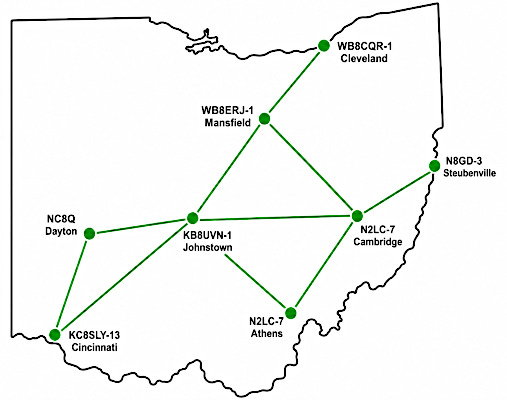
Here is a map of some of the Packet BBS nodes in Ohio. For a complete list, OhioPacket.org has a list by county.
Packet Radio Is Making A Strong Comeback
Operators report renewed activity on traditional frequencies like 145.010 MHz for BBS traffic. High-profile emergencies have demonstrated packet’s role when cellular and internet services collapse. The WB8ERJ-1 BBS is on 145.030 mHz in the Mansfield Ohio area with a backhaul link on 223 mHz to KB8UVN-1 in Johnstown as well as to KD8FTR-1 in Ashland Ohio.
Be sure to click on Page 2 at the bottom of the page where WB8ERJ discusses BBS forwarding.
It’s heartening to see the map in this post as when Tina and I relocated from the Cleveland, Ohio area to the Seattle, Washington area in late 1987, a statewide packet radio network in Ohio was barely in discussion. And, argh, I was just in the Mansfield, Ohio area (passing through); had I seen this post prior to Hamvention 2026, I might have been able to stop and meet WB8ERJ.
In my review of ARRL’s new book Digital Networking for Ham Radio, in my conclusion, I said:
Similarly, a book that’s a fresh treatment of Amateur Radio Packet Radio and Packet Radio networking in the 2020s is badly needed, including the use of Winlink. Although VARA FM, Icom DD Mode, and (again, in development) MMDVM-TNC aren’t Packet Radio, they would fall within the overall scope of such a book. Such a book would be mostly about VHF / UHF operation.
I received some knowledgeable feedback about this idea. Apparently ARRL considers Amateur Radio Packet Radio to be old, tired, and largely irrelevant at least when it comes to justifying a dedicated book on (modern aspects of) Amateur Radio Packet Radio. After all, ARRL has already published the most up-to-date book on Packet Radio available on Amazon - Your Gateway to Packet Radio… albeit being published in 1989.
But as WB8ERJ posits, Amateur Radio Packet Radio is making a comeback (and follow-on technologies for data communications on VHF / UHF bands) and it continues to be relevant.
Thus I posit that there is an opening for such a book. Such a book is on my list of writing projects1, if someone else doesn’t beat me to it.
Eric Grumling K0JEG on his Grand Valley Aviation newsletter:
ARRL Field Day is June 28, 2026. Part One
…
Site Communications
As Field Day operations have become more computer-driven, the site itself has started looking less like a few radios under pop-up tents and more like a temporary communications campus. This year we’re finally going to do what I’ve wanted to do for about a decade, but never had enough time or motivation. We’re going to have a network for all the tents to use. We set up 3 primary stations based on operating mode: CW (Morse code), SSB (Voice) and Digital (sound card tones). We also set up two auxiliary tents, the “Get On The Air” (GOTA) tent and a VHF tent. In the past we’ve not paid much attention to either, because the rules say that the GOTA tent is worth 100 points and the VHF tent is “free” in that we don’t need to include it in our normal exchange and report. But points is points, and we want to make sure to get the most possible1.
In years past we’ve used a computer logging program called N1MM+. It’s an old workhorse of a program that has gathered hundreds of features that most people never touch. One of these features is to share logs across a LAN as both a real-time way to back up the logs and so each station can keep a real time status of how we’re doing. The logs can also be used to run a dashboard that can show everyone how we’re doing. This year I’ll be leading the buildout of a site-wide WiFi network that will tie all the tents together.
Network Requirements
One of the surprisingly difficult problems at Field Day is keeping all the computers synchronized. In the high country, temperatures range from the upper eighties during the afternoon to below freezing at night. The extreme shift will cause computer real time clocks to drift, leading to problems. N1MM+ wants a fairly accurate real time clock, especially when running in network mode. The digital modes require precision timing to work properly. As clocks drift with temperature they need to get back in line. Luckily I have a stratum 1 NTP time source available, thanks to my Starlink Mini. In years past we’ve had issues with keeping clocks accurate as temperatures changed, so just having accurate time available is probably worth the effort.
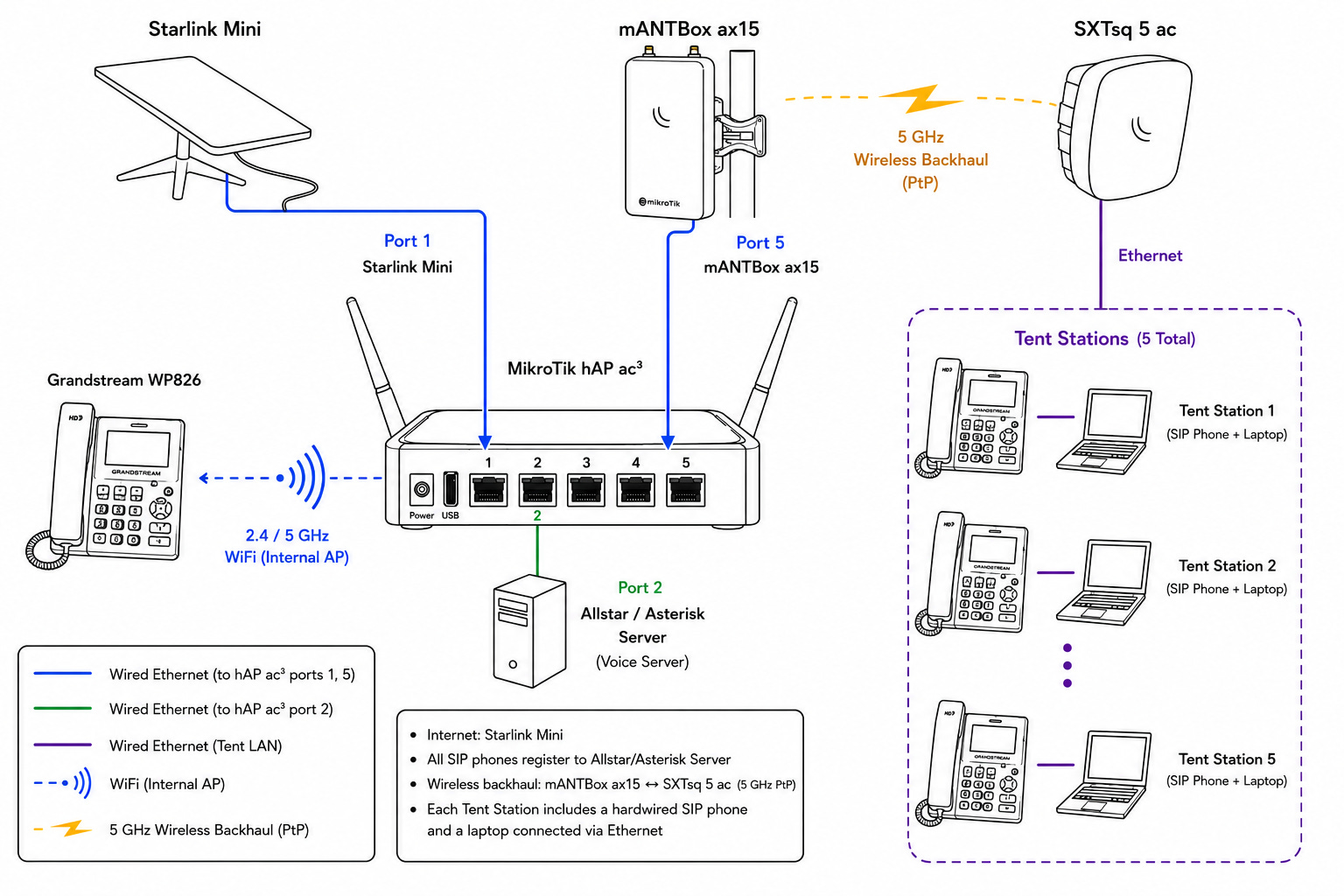
Tent-to-tent communication is also something that has been lacking in years past. N1MM+ has a chat service built in, and I set up a portable PBX using Asterisk and Allstar. The tents will have SIP phone extensions that can call each other, call out to other Allstar nodes such as the club repeater, and even get dialtone if they want that late night pizza delivery. This traffic will all be isolated on its own VLAN and separate SSID, so we shouldn’t have any issues with interlopers interloping.
In addition, I’ll set up another VLAN/SSID for the public to provide information about field day, our club and links about ham radio. This will probably be where the dashboard application lives too. It will run over Starlink so I will probably put some serious access controls on the VLAN to make sure we’re being good netizens and not burning up my monthly data allocation.
Finally I’ll have my own VLAN/SSID for my devices, because… well, I built the thing so why not? I’ll have both an HT and my WiFi SIP phone on my belt so tents can call me to help coordinate fixes to problems and vice versa.
Basic network diagram (ChatGPT)
Hardware
I’ve been working with MikroTik routers and switches for years (time flies). Their hardware isn’t necessarily the fastest for moving packets around, but it is pretty great for amateur use and still at a great price. I will be using the same hAP ac3 I installed in my camper van but with the addition of an external WiFi radio (MikroTik mANTBox ax 15s). This will be the access point for the tents. Each tent will have a MikroTik SXTsq 5 pointed back to the access point, and supplying Ethernet to the laptop and a SIP radio. These will be powered by a small DC UPS that will keep the connections up while refueling. The primary router and other network gear will be stationed at my camper van and should run on my Ecoflow Delta Max the whole time -and if not I’ll have the Ecoflow Smart Generator available too.
Overkill? Probably. But also gives me a chance to stretch my networking skills. Not only that but I’m now pretty familiar with MikroTik’s RouterOS operating system, which is widely used in ham radio for repeater linking, point-to-point networking and other general use. They aren’t the fastest routers out there, but they’re extremely capable and at a price point that’s extremely ham friendly. Normally the hAP ac 3 can also use my iPhone tethered to its USB port for a backup but T-Mobile service at the Field Day site is pretty much nonexistent.
Network Topology
I’m building in three separate VLANs. First will be my normal VLAN that has access to everything. This way I’ll be able to monitor and troubleshoot any issues that may come up. This is also where the Allstar/Asterisk/dashboard server lives, and it will have full access to the Starlink feed. It is basically unchanged from my normal set up, using the hAP ac3 integrated WiFi and switch. The second VLAN will be the tent network as described above. And the third subnet will be for the public to get information about Field Day, the Ski Country ARC and some of the nuts and bolts of the site. I will probably include limited Internet access to a few websites like APRS.fi and the ARRL.
Now that is a Zero Retries Interesting kind of Field Day. VOIP phones at each tent? Cool! If I was located near K0JEG, I’d show up just to learn more about the temporary networking.
I’m beginning to think that there should be a Meadow Day 2 using my Starlink Mini operating at 500 kbps.
Starlink Standby Mode Price To Double to $10/month
Speaking of Starlink and Amateur Radio, I received an email from Starlink stating that price increases for Starlink service coming in June. The price increase that is most Zero Retries Interesting is Starlink’s Standby Mode pricing will increase from $5/month to $10/month. That’s a non-issue for me - at 500 kbps2, Standby Mode at $10/month remains a great deal especially for Internet connectivity that I can dedicate / firewall solely to Amateur Radio activities.
On December 28, 1964, a Thor-Able-Star rocket lifted off from Vandenberg Air Force Base in California and put a small US Navy satellite into a low polar orbit.
On December 28, 1964, a Thor-Able-Star rocket lifted off from Vandenberg Air Force Base in California and put a small US Navy satellite into a low polar orbit.
The satellite was called Transit 5B-5. It weighed about 70 kilograms. It was part of the first satellite-based navigation system in human history — the predecessor to GPS, designed to help American submarines fix their position anywhere in the world. It was given a working lifetime of a few years. Maybe five, if everything went well.
That was sixty-one years ago.
Transit 5B-5 is still up there. It’s still in orbit. It’s still transmitting. And somewhere right now, an amateur radio operator with a backyard antenna is listening to a signal that was first beamed down from space when Lyndon B. Johnson was president.
Nobody at the US Navy has been in charge of this satellite for nearly thirty years. The program that launched it was officially retired in 1996, when GPS took over the job. The Navy walked away. The satellite did not stop working.
How it’s still alive
The reason Transit 5B-5 has lasted this long is genuinely remarkable.
Most early satellites ran on chemical batteries or basic solar panels that degraded quickly. Transit 5B-5 carried something different: a SNAP-3 radioisotope thermoelectric generator — a small nuclear power source that converts the heat from decaying plutonium-238 into electricity.
Plutonium-238 has a half-life of about 88 years. That means a SNAP-3 RTG launched in 1964 should still be producing somewhere around 65% of its original power output today. The satellite isn’t using sunlight. It isn’t using a battery. It’s using a small lump of slowly decaying radioactive material that simply continues to give off heat, year after year.
The radio transmitter on board doesn’t need much power. Just enough to keep broadcasting a signal at around 136.65 MHz — a low-frequency telemetry beacon that, against all reasonable expectation, has never stopped.
There are no moving parts left to wear out. No fuel to run dry. No on-board computer to crash. The whole satellite is essentially a power source connected to a transmitter, drifting along in an orbit that itself doesn’t require maintenance. It just works. It has worked for sixty-one years.
Fascinating story! On a previous job that predated Global Navigation Satellite System (GNSS) technology, passes of the Transit satellites were received several times per day as one element of a custom precision navigation system. That would be cool to set up a SatNOGS station to receive Transit 5B-5 when it’s not otherwise in use.
Ever wanted to operate amateur radio satellites but thought tracking the “birds” was too complicated—or weren’t sure you had the right equipment? This book is for you. Written in a clear, engaging style, Satellite Operating for Amateur Radio shows just how exciting, approachable, and fun satellite operating can be.
Your journey begins with the simple act of listening—the first step to every successful satellite contact. With just a handheld radio, you may already have everything you need to get started. From there, author Tony Milluzzi, KD8RTT, guides you through making your first satellite contact, sharing practical tips and proven advice to build confidence as you explore new modes of operation.
For experienced operators, the book dives into digital modes like FT4 and D-STAR®, plus roving, award chasing, and advanced techniques to sharpen your skills and become a stronger satellite operator.
Explore antennas, modern tracking and operating apps, and the vibrant amateur satellite community. Whether you’re just getting started or ready to take your skills to the next level, Satellite Operating for Amateur Radio will help you get on the air and point your antenna at the sky.
Inside You’ll Discover: Listening to Your First Amateur Satellite Pass Making Your First Satellite Contact Digital Satellite Operations Linear Transponder and Digital Satellite Operations Antennas for Satellite Operating Ground Station Considerations Software and Mobile Applications Connecting with the Amateur Radio Satellite Community
ARRL is on a roll in 2026 with a couple new Zero Retries Interesting books. Arguably they’ve hit all three of the Zero Retries trifecta (data communications and microwaves in the same book, and now space).
Completeness requires me to note that if you’re really interested in Amateur Radio satellite operation, AMSAT is an entire organization focused on Amateur Radio satellite operation and membership is pretty reasonable. I’ve seen a lot of good progress at AMSAT of late, and when I joined AMSAT earlier this year, a “signing bonus” was a free download of their excellent book, revised annually - Getting Started with Amateur Satellites (PDF), otherwise $15.
As ARDC’s grants program continues to evolve, understanding the outcomes of funded projects remains an important part of our work. The Grants Evaluation Team (GET), now in its third year, helps support this effort by reviewing completed projects and evaluating how well grantees achieved their stated goals. We’re pleased to share highlights from their latest report with the community.
For this year’s report, the GET reviewed 49 final reports submitted between June 2025 and February 2026 from ARDC-funded projects. Throughout their meetings, the team discussed trends, identified recurring themes, and worked collaboratively to evaluate project outcomes and broader program learnings.
As in previous years, the GET approached this work reflectively, looking at projects from multiple perspectives. Their discussions focused on these primary questions:
Were these grant projects successful?
Were they a good use of funds?
Are the process changes we’re implementing having an impact?
What information should we be sharing back with our community?
There were some interesting takeaways from this report such as financial and time estimates from grantees for installing antenna systems are frequently too optimistic about time required, complexity (engineering and organizational), and the expense to install them.
The Sakamoto Laboratory in Tokyo is calling on the global amateur radio community to assist with tracking its Arika 2 CubeSat. Launched in late April, this 2U CubeSat is currently transmitting CW signals on 436.830 MHz and requires signal reports from operators worldwide. While the satellite is focused on capturing Earth and aurora imagery using machine learning, it also aims to demonstrate real-time alerts for astronomical events. Future plans include transitioning to GMSK transmissions, with updates expected via the AMSAT bulletin board and social media. This mission highlights the vital role hobbyist radio operators play in supporting satellite research and space data collection.
Interview with Walter Holmes K5WH of the FreeDV Project. It’s a good basic intro to FreeDV, but this interview is most notable that it was recorded and posted by Ham Radio Outlet, a US Amateur Radio retailer who normally doesn’t promote “experimental” systems that they cannot sell… like Open Source software.
FreeDV is indeed breaking into the mainstream of Amateur Radio!
My thanks to Joe Hamelin W7COM (Zero Retries Founding Member 0014) for bringing this development to my attention for inclusion in Zero Retries.
Per the recommendation below, the above link begins at 6:02.
Wes Plouff AC8JF via email:
Dave Owen G3LRC has just recorded a video titled “Wake Up, Ham Radio — The Revolution Is Already On The Air.” Owen advocates not buying a “Big 3” HF transceiver because the “four horsemen of the amateur radio apocalypse” have arrived, namely:
Polar modulation (SSB with 80% efficient power amplifiers)
Controlled envelope single sideband (CESSB)
Adaptive predistortion
Meaningful firmware updates
Two rigs that you can buy today, at opposite ends of the price spectrum, are the QRP Labs QMX+ and the Flex Radio Aurora. One costs thousands of dollars, the other less than $200, but they have advanced beyond the fairly conservative designs of Icom, Kenwood and Yaesu products.
The video linked below is a bit disorganized, with a kitschy throwaway first minute and a digression into misuse of the Sherwood receiver tables. Around the 6 minute mark, though, G3LRC gets into the meat of his advocacy. He impresses me as knowing his subject well, and he has produced other videos advocating for these new-ish technologies. Do you want creative ferment in amateur radio? Dave Owen does, too.
I haven’t yet taken the time to watch this video but I’d add a fifth and sixth revolutionary changes in radio technology:
Software Defined Radio technology which allows the basic functionality of a radio to be altered entirely in software. The most prominent example of this trend is being able to add the FreeDV RADE digital voice mode into a FlexRadio 8000 / Aurora series radio. Current FlexRadio products are all inherently Software Defined Radio technology.
Artificial Intelligence modules that are small enough to be embedded into radios. There was an earlier “intelligent” radio technology - Cognitive Radio, which was “programmed” to find available (unused, at the moment) portions of spectrum to operate in. Cognitive radio never quite “caught on” as a widely used technology3, at least in the US (as far as I’m aware) largely because use of “vacant, at the moment” spectrum, such as unused television broadcast channels in a given area, was vehemently opposed by spectrum incumbents such as television broadcasters and US Government / military.
Months of drone flights culminated in what can only be described as a remarkable feat in physics. I managed to successfully siphon energy directly out of the atmosphere.
This video demonstrates sending up a drone with a very light wire, and viscerally demonstrates the voltage differential between the atmosphere and ground.
I’d… hazily… known that this effect existed, but this was the most interesting, engaging way to demonstrate it. Turns out there a lot of YouTube videos about “atmospheric electricity.
Mark Rober is a modern day science teaching hero. He calls his techniques to demonstrate (teach) science “hide the vegetables”. This is his presentation at the 2026 TED Conference.
If Rober isn’t already familiar to you, the video will provide you with context before the big reveal:
The world has evolved, and teaching science is long overdue for disruption. I’m happy to report that of the teachers who are assigned to teach the pilot lessons to their students, because of our ability to explain complicated things simply and for our very unique experience in solving the science motivation gap for 15 years, 95 percent of the teachers said that when we’re done, they would want this to be their full science curriculum.
And so the idea is you combine incredible teachers with incredible resources to get this explosive output, sort of like you’d expect to see if you combine this bucket of boiling water with this trash can of freezing-cold liquid nitrogen.
So to all those teachers out there in the trenches, I want you to know reinforcements are on the way.
In fact, a bunch of the videos and lessons are already available right now, and we’ll finish the rest over the next four years, because I know this will be the most important thing I do my whole life.
And even though this is going to cost us $60 million to make, my official declaration tonight is every single lesson plan, every teacher training, every original class demo will cost exactly zero dollars and be 100 percent free for all teachers forever, as we work to ignite those brain fires of curiosity in the next generation of big problem solvers.
There’s nothing radio-related in this video, but if you have an interest / investment in there being more science-literate young people in the coming decades… and every one of you reading this, as part of humanity, you do in fact have such an investment… Rober’s announcement is incredibly good news for humanity.
Seriously… please accept my recommendation to watch this video.
It’s very (very) early days for this group that will be focused on radio technology, and fun, interesting, and relevant ways to learn about it. It feels like this is an ideal way to involve potential NewTechHams from the three colleges in the Bellingham area, and be able to work Zero Retries Interesting aspects of Amateur Radio into the mix of things we’ll be discussing.
One of the biggest advantages of this new group is that it’s just one of a number of Community Groups that are part of Cascade STEAM, which has significant management and organizational depth, and connections with other STE(A)M organizations in Western Washington. Just as one minor example of taking advantage of Cascade STEAM’s infrastructure, they have a mature Code of Conduct, which is an absolute minimum requirement in this era for any group that hopes to attract interest from young folks.
The Spectrum Community Group is a distinct contrast to a group that’s primarily focused on Amateur Radio aspects of radio technology, but rather Amateur Radio as one of many aspects of radio technology. We’re already making plans to do a one-day “teach the Tech test” class, and then a quick (if not the same day) license exam session to get the Spectrum participants licensed to be able to have some Zero Retries Interesting Amateur Radio fun.
We’ve even begun to discuss (again, very early days) the possibilities of building out some SPECTRUM radio infrastructure in this corner of Washington, and perhaps connect with similar efforts in nearby Vancouver, British Columbia.
I’ve agreed to be one of the organizers of Spectrum, and I’m even enthused enough about this to try, again… in my dotage… to get myself on Discord because that’s Cascade Steam’s primary communication channel, and this feels significant enough to justify another attempt at Discord.
Zero Retries - TL;DR
TL;DR is Too Long; Didn’t Read. Statements to that effect were the second4 most heard comment about Zero Retries at the Zero Retries booth at Hamvention 2026. Granted, the sample size was small (< 25 - my best guess) out of 3500+ email subscribers, but it’s visceral to hear that comment repeatedly face to face.
One email commenter who is a marketing professional explained the situation pretty simply to me. Too-lengthy issues of Zero Retries (an average issue) just don’t get read in their entirety. A typical reader reads only so far, stops reading,intending to come back to finish that issue of ZR… and doesn’t. That rings true, because I do the same thing with other lengthy, detailed (text) email newsletters. The email commenter concluded by saying that because much of Zero Retries is unread, that extra work I put into longer issues of Zero Retries is essentially wasted.
What makes it difficult for me is that I’m probably too close to the subject material of Zero Retries. I’m not an impartial Editor “managing” the content to be a certain length, but no longer. Thus it’s hard for me to be objective about what’s appropriate to be included in an average weekly issue of Zero Retries. A problem, for me, is that everything in an average issue of Zero Retries is interesting and relevant to me.
I think part of the problem of too much content in Zero Retries is that I get exposed to that material over the course of a week or two. A Zero Retries reader is getting exposed to all of that content in “a single dose” and at that point the totality of an average issue of Zero Retries can be a bit overwhelming for a reader who just wants an overview of what’s Zero Retries Interesting in a given week. More than that… TL;DR.
That this issue doesn’t have much “long story” content is more of a factor of having traveled for a week around Hamvention 2026 and having to do a lot of catching up afterward.
Zero Retries Magazine?
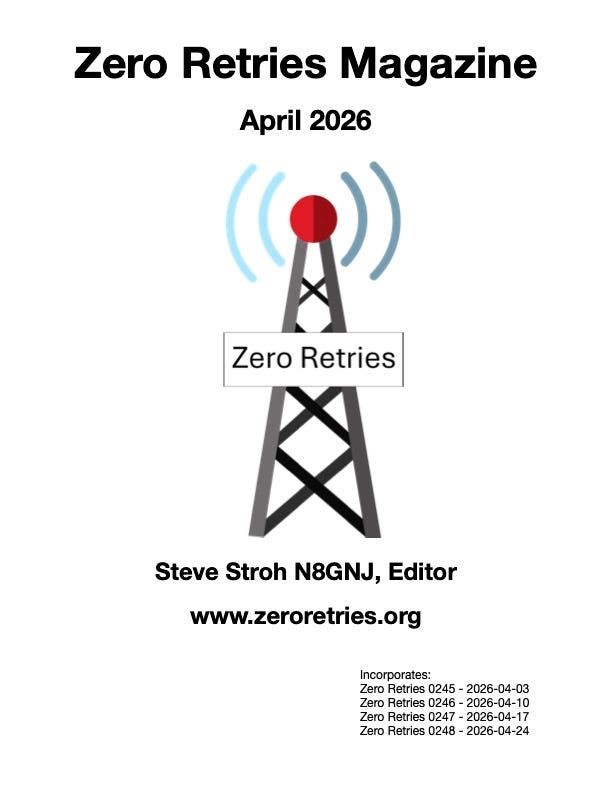
Zero Retries Magazine (prototype) cover. Image by Steve Stroh N8GNJ
At the Zero Retries / DLARC booth at Hamvention 2026, only a very small handful of people noticed the display, or expressed interest in Zero Retries to the point it was worth showing off a prototype printed Zero Retries Magazine. For Hamvention 2026, I compiled and printed a prototype of all of the April, 2026 issues of Zero Retries newsletters into a “Zero Retries Magazine for April 2026”. It kind-of worked - there were 114 pages worth of content. From a quick check into the economics of printing a Zero Retries Magazine on demand via Lulu.com, it could work, especially if some Zero Retries Interesting manufacturers could be persuaded to advertise in Zero Retries Magazine. The idea of Zero Retries Magazine needs a lot more research, and careful business analysis, but it seems at least feasible.
Of course, there would be a version that’s online / text / PDF. To address an observation Cale Mooth K4HCK, a friend and colleague in free, good Amateur Radio content - Amateur Radio Daily and Amateur Radio Weekly, there would be an online version where the individual stories are individually linkable, probably apart from Substack so there wouldn’t be the “Substack Link Dreck”.
A Zero Retries Magazine might “scratch my itch” for the longer, explanatory articles that I tend to write when explaining something new. Plus it could more easily incorporate presentations that I do, and articles for other venues such as The Communicator, and even excerpts from other sources such as, for example, explanatory articles about PACSAT (Packet Satellite) from the TAPR Packet Status Register (PSR) newsletter, originally published decades ago, but still relevant. As has been the case since Zero Retries began, contributions from other authors would be welcome in Zero Retries Magazine.
My ongoing Thanks to: Tina Stroh KD7WSF for, well, everything! Jack Stroh, Late Night Assistant Editor Emeritus Fiona and Shreky Stroh, Late Night Assistant Editors In Training
Founding Members who generously support Zero Retries financially: Founding Member 0000 - Steven Davidson K3FZT (Renewed 2025, 3rd year!) Founding Member 0001 - Randy Smith WU2S (Renewed 2025, 3rd year!) Founding Member 0002 - Chris Osburn KD7DVD (Renewed 2025, 3rd year!) Founding Member 0003 - Don Rotolo N2IRZ (Renewed 2025, 3rd year!) Founding Member 0004 - William Arcand W1WRA (Renewed 2025, 3rd year!) Founding Member 0005 - Ben Kuhn KU0HN (Renewed 2025, 3rd year!) Founding Member 0006 - Todd Willey KQ4FID (Renewed 2025, 3rd year!) Founding Member 0007 and 0010 - Merik Karman VK1DF / VK2MKZ (Renewed 2025 x2, 3rd year!) Founding Member 0008 - Prefers to Remain Anonymous 08 (Renewed 2025, 3rd year!) Founding Member 0009 - Prefers to Remain Anonymous 19 (Renewed 2025, 2nd year!) Founding Member 0011 - Rick Prelinger W6XBE (Renewed 2025, 2nd year!) Founding Member 0012 - Ryan Tolboom N2BP (Renewed 2025, 2nd year!) Founding Member 0013 - Newton White N4EWT (Renewed 2026, 2nd year!) Founding Member 0014 - Joe Hamelin W7COM (Renewed 2026, 2nd year!) Founding Member 0015 - Rich Stocking N7OP (Renewed 2026, 2nd year!) Founding Member 0016 - Prefers to Remain Anonymous 77 (New 2025) Founding Member 0017 - Phil Karn KA9Q (New 2025) Founding Member 0018 - Prefers to Remain Anonymous 95 (New 2025) Founding Member 0019 - Prefers to Remain Anonymous 0108 (New 2025) Founding Member 0020 - Prefers to Remain Anonymous 110 (New 2025) Founding Member 0021 - Prefers to Remain Anonymous 111 (New 2025) Founding Member 0022 - Prefers to Remain Anonymous 112 (New 2025) Founding Member 0023 - Prefers to Remain Anonymous 116 (New 2026) Founding Member 0024 - Rob Bowser (SPOOLTENNA) (New 2026) Founding Member 0025 - Dave Stewart K7XST (New 2026)
Numerous Annual and Monthly subscribers who also generously support Zero Retries financially!
You thousands of readers of Zero Retries without which there would be little point in publishing this newsletter.
Fair Use - All excerpts from other authors or organizations, including images, are intended to be fair use and are fully attributed generally by author and link (URL).
Paid Promotional Content - Unless otherwise noted in the article or item, advertisement, or sponsorship notice, Zero Retries does not include paid promotional content. Exceptions:
Advertisements in Zero Retries,
Sponsorships in Zero Retries,
Zero Retries products,
Zero Retries events
Features and content exclusive to paid subscribers.
While a dedicated book on Modern Aspects of Amateur Radio Packet Radio is on my list of writing projects, it’s down the list quite a bit. Unless some organization could “incentivize” a move up my list of writing projects… just sayin’.
When I first got my Starlink Mini and used Standby Mode, it was 400 kbps. But Starlink’s How does pausing service work? page states: Standby Mode, where available, offers speeds up to 500 Kbps download and upload.
Two exceptions of using “vacant” spectrum in the US, that weren’t true Cognitive Radio, was “Television White Space (TVWS) regulations that allowed for Broadband Internet and wireless microphone use of unused television broadcast channels, and Citizens Broadband Radio Service (CBRS) that allowed spectrum from 3.55 - 3.70 GHz allocated to US military use to be used for Broadband Internet (and private, such as interior enterprise, mobile phone use. When originally proposed, both would have used Cognitive Radio techniques, but spectrum incumbents ultimately forced both services to be “advanced permission” systems (I call it “Mother, May I?) techniques.
As I mentioned in Zero Retries 0251, the most often heard comment on Zero Retries at Hamvention 2026 from existing Zero Retries readers that stopped by the Zero Retries booth was Thanks for doing Zero Retries. That… was most appreciated!