2026-06-13 - ZR Will be biweekly for a few months, What’s New at DLARC - June 2026, The Remarkable, Relatively Unsung Achievement of Integrating FreeDV RADE Into FlexRadio’s 8000 and Aurora Radios
Zero Retries is an independent newsletter promoting technological innovation in and adjacent to Amateur Radio, and Amateur Radio as (literally) a license to experiment with and learn about radio technology. Radios are computers - with antennas! Now in its fifth year of publication, with 3500+ subscribers.
My thanks to Prefers to Remain Anonymous 30 for renewing (three years!) as an Annual Paid Subscriber to Zero Retries this past week!
My thanks to Prefers to Remain Anonymous 73 for renewing as an Annual Paid Subscriber to Zero Retries this past week!
My thanks to Andrew Moskowitz N6AMM for upgrading from a free subscriber to Zero Retries to an Annual Paid Subscriber this past week!
My thanks to Prefers to Remain Anonymous 128 for becoming a newAnnual Paid Subscriber to Zero Retries this past week!
Financial support from Zero Retries readers is a significant vote of support for the continued publication of Zero Retries.
Minor Enhancement - Index Link on Navigation Bar
On the top (navigation) bar of the Zero Retries web page, I’ve added an Index link for easier navigation / search of Zero Retries issues published in 2026. I’ve found this index to be very useful when I remember just one keyword in the title of an article.
Zero Retries Summer 2026 Publishing Schedule - Biweekly
Summer 2026 promises to be unusually busy for our household. For a few details, see this issue’s Request To Send at the end of this issue.
Thus for the remainder of Summer 2026, Zero Retries will be published biweekly. The intended publication schedule is:
What’s New at Digital Library of Amateur Radio & Communications — June 2026
By Kay Savetz K6KJN
Greetings from DLARC World Headquarters, where I still have a stack of business cards from Hamvention to sort through. Your free online ham radio library has added a massive amount of reading material since my last update. Whether it’s for casual reading or deep research, you’re sure to find something of interest in the stacks.
First, an update: In April, I mentioned the addition of many public domain issues of CQ Amateur Radio to DLARC, but listed a bunch of issues that we lacked from that publication’s first four years. Daniel Bateman KK4FOS, at Buckmaster International / hamcall.net, stepped up with the digital goods, delivering all of the missing issues! Now DLARC has a complete set of CQ from its first issue in 1945 through 1963. (A bit of free advertising: If you need issues from 1964 through 2022, HamCall’s CQ Magazine Archive is the only legit place to get them.)
In addition, DLARC has added a new collection of Review of International Broadcasting newsletters. Review of International Broadcasting was a newsletter devoted to the shortwave listening hobby, covering notable content heard on the air, news about legitimate broadcasters and pirate radio stations, program schedules, and radio hardware tips. The new collection includes 107 issues published from 1978 through 1997. 83 of those issues are new to DLARC, thanks to a box of issues generously sent by the publisher, Glenn Hauser.
We’ve added many other electronics and communications magazines to the library as well including 146 issues of Electrical Communication, from issue one in August 1922 all the way through 1961. It began as the journal of the International Western Electric Company, passed through being called the journal of the International Standard Electric Corporation, and ended in 1961 as the technical journal of the International Telephone and Telegraph Corporation. The entire time, though, it was a fascinating journal of “progress in the telephone, telegraph and radio art.”
Also, a collection of 60 issues of Electronic Servicing (well, technically it’s called “P.F. Reporter Including Electronic Servicing” — rolls right off the tongue, doesn’t it?) spanning 1961 through 1967. It was a trade journal covering electronic equipment maintenance, published by Howard W. Sams. Some fun amateur radio content is buried in these pages.
We’ve added 26 issues of FM Bulletin, which was a magazine chronicling early amateur FM on VHF/UHF, was published from 1967 to 1969. Edited by Ken Sessions K6MVK and Mike Van Den Branden WA8UTB, it was renamed to FM Journal sometime in 1968. These scans are courtesy of Florida Amateur Spectrum Management Association.
DLARC has added a small collection of historical documents from the Case Amateur Radio Club (W8EDU) at Case Western Reserve University in Cleveland, Ohio. The club was founded at the Case Institute of Technology in the 1940s. And, we have a new Texas A&M University Amateur Radio Club (W5AC) collection, including newsletters, QSL cards, meeting minutes, and meeting slides. Founded in 1912, W5AC is one of the oldest student organizations at Texas A&M University, and is one of the oldest university radio clubs in existence.
If I was giving out awards for these clubs (which I am not! We don’t play favorites!) they would be to Ole Virginia Hams for sheer number of newsletters to archive — 472; to Cuyahoga for best newsletter name — “Wobbly Oscillator”; and to Rockford for uploading 360 newsletters all on their own. I was delighted to see them show up at Internet Archive, I simply created a collection for them.
So that’s a lot of reading and research material. We’ll finish with a treat for your ears: DLARC has a new collection of Amateur Radio News And Notes, a weekly news roundup by Ed Cabic N2EC for the Mount Vernon (Alexandria, Virginia) Amateur Radio Club, covering DX, contests, propagation, club activities, and notable developments across the hobby. Ed’s been at it since March 2025, and we have all 62 episodes so far.
Digital Library of Amateur Radio & Communications is funded by a generous grant from Amateur Radio Digital Communications (ARDC) to create a free digital library for the radio community, researchers, educators, and students. If you have questions about the project or material to contribute, contact me at kay@archive.org.
The Remarkable, but Relatively Unsung Achievement of Integrating FreeDV RADE Into FlexRadio’s 8000 and Aurora Radios
By Steve Stroh N8GNJ
Introduction
I think that the inclusion of FreeDV RADE, now available as a “just another feature” in FlexRadio’s recent 8000 series and Aurora units (hereafter, 8000 / Aurora), is a remarkable achievement for Amateur Radio as a whole, and deserves more awareness in Amateur Radio than it has received to date.
Amateur Radio began to use SSB for voice communications on the HF bands in the 1950s. At that time, SSB was a considerable improvement over Amplitude Modulation (AM), the primary voice mode then in use on the HF bands. Not only was SSB more spectrally efficient than AM (smaller bandwidth), but it enabled longer range communications for the same amount of transmit power, and enabled smaller, more power efficient transmitters.
In the succeeding seven decades since the introduction of SSB, the primary innovations for SSB was the development of Polar Modulation, and greater receive sensitivity thanks to Digital Signal Processing (DSP).
In contrast SSB, FreeDV RADE is a voice mode that is more spectrally efficient than Single Sideband (SSB) and it’s more reliable than SSB because it incorporates Orthogonal Frequency Division Multiplexing (OFDM) and Forward Error Correction (FEC). FreeDV RADE was developed in the 21st century, in this decade, and incorporates state of the art technology.
FreeDV is software, and most significantly, Open Source software. Thus, FreeDV, as software, can continue to evolve and improve to take advantage of ever greater compute and signal processing technologies embedded into current and future generations of radios… not just endlessly re-implementing seven decades old SSB technology.
FreeDV RADE Development
FreeDV RADE (Radio Autoencoder) is a digital voice mode developed for use on the Amateur Radio High Frequency (HF) bands. There are a number of notable aspects to FreeDV RADE:
It was developed by Amateur Radio Operators,
It was developed specifically for use on the Amateur Radio HF bands,
It is entirely Open Source - software implementation, the algorithms, the training models, etc.
The on-air bandwidth of FreeDV RADE is 1.5 kHz, but the speech bandwidth that is transmitted is 8 kHz. This compares with a typical Single Sideband (SSB) on-air bandwidth of 2.7 kHz.
The speech quality of FreeDV RADE is much better than SSB.
The “noise tolerance” of FreeDV RADE is much better than SSB, because FreeDV incorporates Orthogonal Frequency Division Multiplexing (OFDM) and Forward Error Correction (FEC) techniques.
Because it is entirely created in software, and is Open Source, FreeDV will continue to improve and expand its capabilities, perhaps expanding to incorporate messaging, telemetry, or data1.
FlexRadio’s Refreshing Choice to Provide User Initiated Modifications to its 8000 Series and Aurora Series Radios
There are a number of notable aspects for it to be possible to install FreeDV RADE into 8000 / Aurora, and after installation, FreeDV RADE being “just another mode choice” in those units:
From its founding, all of FlexRadio’s products have been true Software Defined Radio technology. The performance of every FlexRadio product is primarily defined by software, rather than fixed circuitry radio hardware.
FreeDV RADE being able to be installed into 8000 / Aurora was made possible by FlexRadio’s progressive attitude about what a modern Amateur Radio should be. Of the major Amateur Radio manufacturers2, FlexRadio is unique in actively facilitating such features3 by providing an Application Programming Interface (API) and a “container” environment for “external” applications to be run in without affecting the basic (software) functionality of the radio.
FlexRadio was willing to undertake the considerable (and undoubtedly expensive professional software development) work make it possible to add capabilities such as FreeDV into FlexRadio units.
8000 / Aurora uses a standardized “compute engine”4 that is well understood and the easy to program for. A year ago, I was told that the compute engine in 8000 / Aurora is a Raspberry Pi Compute Module 4. As I understand it, if there’s need for more compute capability in the 8000 / Aurora, the Raspberry Pi Compute Module 5 is plug compatible with the Compute Module 4 and provides is even more compute power and up to 16 GB of RAM.
FlexRadio was willing to work with the FreeDV team to work out the issues of its API and container system to enable FreeDV RADE to be installed into 8000 / Aurora and be integrated into the user interface of the radio and use the standard interfaces such as the radio microphone and speaker, with no need for external devices such as separate microphone, speaker, computer, or other hardware.
Apart from FreeDV RADE, FlexRadio’s Aurora series of radios are groundbreaking technology for Amateur Radio, offering incredible power efficiency. By using Polar Modulation, Aurora can transmit up to 500 watts, but only requires a standard 15 amp, 120 volt circuit (or 240 volt outside the US) circuit. Thus the combination of 500 watts of transmit power, combined with the superior voice performance of FreeDV RADE results in an amazing new communications capability using the HF bands.
ARDC Grants Enabled Extensive FreeDV Development
Beginning in 2023, the extensive, and intensive development of FreeDV was enabled by a significant grant from Amateur Radio Digital Communications - Enhancing HF Digital Voice with FreeDV. In my opinion, the grant for FreeDV is one of ARDC’s major success stories. ARDC helped create significant new radio technology:
It was pointed out that RADE V1 is the first known real-world deployment of a neural codec – an important milestone that the Ham community can be proud of.
As Open Source technology, FreeDV RADE can be used anywhere, not just for Amateur Radio. In addition to 8000 / Aurora, FreeDV RADE could also be embedded into other radios and systems, with the only limitation being sufficient computing power in the radio or system.
In addition to the overall FreeDV RADE system for digital voice, FreeDV’s Orthogonal Frequency Division Multiplexing (OFDM) technology has been used in another ARDC grant funded project - Rhizomatica’s Mercury (data) modem:
… uses field-proven FreeDV digital data modes…
ARRL Could Be, Arguably Should Be, Promoting FreeDV RADE
In my opinion, the development of FreeDV RADE, integrated into 8000 / Aurora should be promoted by ARRL as a significant new capability in Amateur Radio. Again, because FreeDV is Open Source, promotion of FreeDV as installed into 8000 / Aurora is not promotion of a company, but rather it is general promotion of significant new technological innovation in Amateur Radio.
ARRL’s promotion of FreeDV could (should?) include:
Any ARRL activity such as contests and Field Day that includes voice modes used on HF - Single Sideband (SSB), Amplitude Modulation (AM), Double Sideband (DSB), etc. could / should be extended to include FreeDV RADE.
ARRL’s W1AW voice transmissions: Frequencies are 1.855, 3.99, 7.29, 14.29, 18.16, 21.39, 28.59, 50.350, and 147.555 MHz.
Voice transmissions on 7.290 MHz are in AM, double-sideband full-carrier. … could (should?) be extended to incorporate some voice transmissions in FreeDV RADE.
FreeDV RADE could (should?) be incorporated into ARRL’s Clean Signal Initiative (CSI) program to promote better performance of HF transmitters. FreeDV should be a “peer” mode to (analog) SSB in all CSI standards, testing, and reporting.
Because FreeDV RADE’s performance is superior to SSB, ARRL Lab’s review criteria could (should?) begin including whether a radio incorporates (or can be updated with, such as is the case with 8000 / Aurora) FreeDV RADE. The result of that “checklist item” should be reported in the new online QST Product Review Database. Finding radios that incorporate (or can be updated to) FreeDV radio should be a “click to compare” item.
ARRL could (should?) promote the development and existence of FreeDV RADE in its communications to FCC staff and its responses to FCC Requests For Comments as a significant example that Amateur Radio can significantly contribute to the state of the art in radio technology, especially HF radio technology where there is little commercial development.
ARRL could (should?) update its guidance of HF band plans by mode to promote that FreeDV RADE is a voice mode, and thus can be used in the (larger) band segments recommended or assigned to voice modes. There is still significant controversy, and at times, acrimony that some consider FreeDV to be a “digital” mode and thus can only be used in the portions of bands recommended / assigned to digital modes. In my opinion, it’s obvious that FreeDV is a mode for transmitting voice… that happens to use a different modulation technique - digital.
Such angst about FreeDV as a voice mode could perhaps be understandable if FreeDV RADE’s bandwidth were wider than SSB, but the bandwidth of FreeDV RADE is nearly half that of SSB. Thus the use of FreeDV RADE for voice communications is a net gain for voice communications - more voice conversations per band, and better quality of voice conversations.
Perhaps a Joint Promotion Between ARDC, ARRL, FlexRadio, and FreeDV?
Disclaimer 1 - I have suggested the following idea via email to some individuals in the named organizations, with only tepid responses. Admittedly my email was long on concept and short on detail. This article is attempting to rectify that shortfall, and if a joint promotion doesn’t happen, at least I have publicly celebrated what I consider a significant accomplishment of technological innovation in Amateur Radio.
Disclaimer 2 - I am currently a volunteer member of ARDC’s Grants Communications Team (GCT). Other than that, I am not involved in ARDC’s decision making processes. In the following, I am not speaking for ARDC, formally or informally. Similarly, ARDC doesn’t speak for me (other than my work on the GCT), or have any influence on the content of this article or Zero Retries.
In my opinion, ARDC, ARRL, FlexRadio, and FreeDV could (should?) work together to jointly promote FreeDV RADE as an example that Amateur Radio can be a source of technological innovation in radio technology in this era. A development such as FreeDV RADE is not a technology that’s suitable only in Amateur Radio - it’s usable for other radio services, even VHF / UHF. The audio quality of FreeDV RADE is remarkably good, easily as good as some Digital Voice systems used on VHF / UHF. If spectral efficiency for voice communications is taken into consideration, D-Star and NXDN the most “narrow channel” Digital Voice systems currently in use for VHF / UHF use a 6.25 kHz channel. In contrast, FreeDV RADE uses a 1.5 kHz channel - more than 4x more spectrally efficient than any Digital Voice system in use on VHF / UHF.
Not only is FreeDV RADE more spectrally efficient than any other system, it’s Open Source, thus there are no proprietary elements of FreeDV RADE, thus even more usable for new voice communications systems than any of the existing Digital Voice systems5.
Promote FreeDV RADE and Mercury Together?
If FreeDV RADE isn’t a “big enough deal” for considering such a joint promotion promotion, then perhaps “make a bigger splash” by incorporating the other recent remarkable achievement in Amateur Radio technological innovation - the Mercury modem developed by Rhizomatica for HF data communications. In my opinion, Mercury is equally significant to FreeDV RADE, with a similar level of commitment going into its development. While it cannot be claimed that Mercury was developed by Amateur Radio for Amateur Radio, Mercury is certainly useable and useful for Amateur Radio. Like FreeDV RADE, the development of Mercury was the result of grants from ARDC, and like FreeDV RADE, Mercury is entirely open source. With further development, Mercury could replace the use of VARA HF, which is currently the most popular data communications mode used on HF for connecting to Winlink and other emergency communications. Unlike VARA HF, being Open Source, Mercury is free to use, Mercury can be enhanced and developed by others, it can be embedded into appliance units6 such as the popular NinoTNC or new OpenTNC.
And, like FreeDV, Mercury could be “just another mode selection” on 8000 / Aurora, or any other HF radio that chooses to be user-modifiable like FlexRadio has chosen to do.
A joint FreeDV RADE / Mercury promotion could deliver more of an impact than FreeDV RADE or Mercury individually. Both were developed as new software-only modes in this era, capable of significantly enhancing HF communications capabilities, not just for Amateur Radio but for other users of HF communications such as government, marine, air transport, etc.
Great essay on the evolution of Amateur Radio… and radio technology in general by Tom Salzer KJ7T on EtherHam:
There’s a smell to a warming vacuum tube that you don’t forget. If you’ve ever powered up an old tube-type radio, you know what I mean. It is somewhere between hot dust and ozone, with a faint suggestion of the RF itself. You see the needles jump. The glow behind the dial steadies. And then you get to work — not by typing a frequency, but by listening, watching, coaxing. Peak the power. Dip the plate. You feel the radio respond.
That’s not nostalgia talking. That’s a description of a relationship between an operator and a machine that required genuine skill to maintain. The radio demanded something of you. You had to meet it halfway to operate it well.
I’ve been thinking lately about how far we’ve traveled from that moment, and about where we appear to be heading. I’m not alarmed, exactly. It is more like that particular feeling of a person watching a landscape change from a moving train — aware that you’re seeing something important, but not quite sure yet what it means.
The Arc
The history of amateur radio hardware follows a pattern reflected in other technologies.
Early systems encoded all their intelligence in physical structure. Wires, tubes, relay positions. The circuit was the logic. Operating skill meant understanding what was happening at the component level, because if something went wrong — or if you wanted to optimize — you had to intervene physically. The operator was part of the circuit. If something broke, you could find it and fix it.
Then transistors arrived, and with them, automation of the tasks that had required the most operator attention. You didn’t have to dip the plate anymore. The radio handled more of its own housekeeping. Skill shifted from manual tuning to understanding the system well enough to configure it. Repairs began to shift away from fixing circuits to replacing modules.
Then software entered the picture — first augmenting hardware, then replacing whole subsystems. The modern Icom IC-7300 runs a sophisticated touchscreen interface and a real-time spectrum scope. It is a fundamentally different object than the TS-520S, even though both sit on a desk and connect to an antenna. The 7300 is more capable by almost every measurable standard. It is also, if I’m being honest, more sterile. More clinical. Something has been gained. Something has also been traded away.
And then came Software Defined Radio, which pushed the logic further still. What is SDR but an antenna connected to an analog-to-digital converter, with everything else — filtering, demodulation, decoding, display — happening in software? The hardware becomes a substrate. The intelligence lives in code. Software has eclipsed hardware.
KJ7T absolutely nails this subject.
I don’t want to “steal his thunder” by reprinting KJ7T’s entire essay here in Zero Retries, tempting as that is. KJ7T’s observations are fantastically on-point for Zero Retries, and he wrote this essay with an admirable conservation of prose.
Frankly, I’m envious of KJ7T’s ability to frame the incredible evolution of radio technology, in text, this well.
From amateur packet radio to CubeSat relay to cislunar networking.
RADIANT brings Delay-Tolerant Networking (DTN) to amateur radio, enabling store-and-forward messaging across disrupted links from terrestrial ground stations to Low Earth Orbit (LEO) and ultimately to cislunar space. Current status: two-node terrestrial DTN operational (Raspberry Pi, Mobilinkd TNC4, Yaesu FT-817, 9600 baud G3RUH GFSK over VHF/UHF). All subsequent phases are in design or planning.
The project implements Bundle Protocol version 7 (BPv7) over amateur radio links using LTP wrapped directly in KISS framing. The architecture is DTN-implementation-agnostic — a common abstraction layer supports multiple DTN engines (NASA Glenn’s HDTN, JPL’s ION-DTN, µD3TN, and Hardy) through a unified interface, allowing operators to select the engine best suited to their platform and mission phase. Station identification is achieved through callsign-embedded DTN Endpoint Identifiers (e.g. dtn://g4dpz/spacecraft) carried in every bundle’s metadata, ensuring regulatory compliance while using numeric ipn:// addresses for efficient routing.
RADIANT — Radio Amateur Delay-tolerant Interplanetary Networking Testbed
With the modest hardware requirements:
Raspberry Pi
Mobilinkd TNC4
Yaesu FT-817
9600 baud G3RUH GFSK over VHF/UHF
(x2 or x3 for a testbed system)
… there seems to be a low barrier to entry for participating in RADIANT experimentation and development.
The primary qualification of the Yaesu FT-817 for experimentation / development of RADIANT seems to be that it provides a “data” (flat audio) connection suitable for 9600 bps G3RUH GFSK transmission and reception. The HF capability of the FT-817 does not seem to be a consideration for RADIANT. Thus any VHF / UHF FM radio with a flat audio connection would seem to be suitable for experimentation with RADIANT. For suitable radios, including those that are currently in production, see Zero Retries Guide to VHF / UHF Radios for Data (now updated to include the FT-817).
Despite the focus on space communications, RADIANT is applicable to terrestrial Amateur Radio use because of the many disparate networks in use in Amateur Radio, from BBS forwarding (latency can run to days between message transfers) to 10 GHz microwave networks operating at hundreds of Mbps (latency could be as short as a few mS). For context on disparate Amateur Radio networks in use, and projected, see Zero Retries 0250 - Networking, Networking, Networking.
Some entity in Amateur Radio will ultimately be in charge of issuing Amateur Radio Network IDs. For example, as the article cites, dtn:// (Delay Tolerant Network) and ipn:// (Inter Planetary Network) network identifiers are already in use.
It may not be too early to start discussion of establishing arn:// (Amateur Radio Network) network identifiers.
As for which entities… perhaps International Amateur Radio Union (IARU) as the most international of all Amateur Radio organizations? Or perhaps Amateur Radio Digital Communications (ARDC) given its history with 44Net?
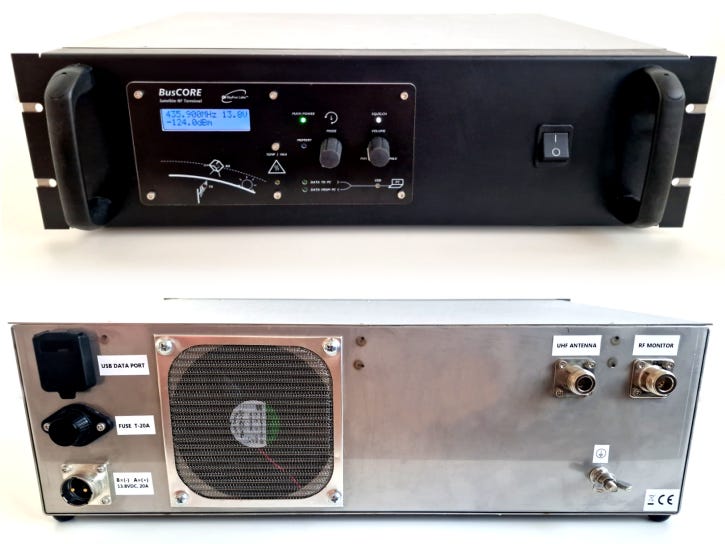
The BusCORE™ Groundstation Terminal is a Full Space-to-Earth, Earth-to-Space Radiocommunication Infrastructure, with 50 W Output Power, Excellent Sensitivity, Variable Bitrate Modulator/Demodulator, Superfast Solid State RX/TX Switch and RF Monitoring Output port for the external Spectrum Analyzer monitoring activities and USB port for a single cable connection to the control PC station.
Change the Bitrate during Pass.
The unit provides data rates in variable settings during the flight over the groundstation from long range 1200 bps up to 38 400 bps maximum, depending on the link quality. Automatic Bitrate Fallback function sets the modem to nominal 4800 bps in case the mutual bitrate negotiation attempt fails. Standard bitrate settings is optimized for LEO operations with 4800 bps.
Upgrade your system to a Brand New Rig and Get your data down!
PRODUCT SUMMARY
State-of-the-art Hardware Accelerated Satellite Communication System
UHF 435.000 - 438.000 MHz, Amateur Radio Band Operations
Volume Settings for audible RF demodulated sound via Embedded Speaker
Squelch Gate with indicating LED
USB status indicating bi-color LED, optically isolated USB interface
Basestation Power Connector + Grounding stud with quickWing Nut
Since March 2026: Full Standalone Hardware support for Bidirectional 9600’s GFSK AX.25 Framing G3RUH Scrambling Legacy Amateur Radio Satellite Systems Support, -106 dBm @ 5% PER
Sensitivity: up to -120 dBm @ 1200 bps 5% PER
Sensitivity: up to -106 dBm @ 38400 bps 5% PER
1/2 Duplex
Input Antenna Port Noise Floor (no antenna connected -133 dBm typical)
Up to 3000 km operational slant range
Intended to: LEO up to h = 1000 km
Power Requirement: 13.8 V @ 8 A (50 W RF Power Out)
1 250 000 bps Virtual COM Port PC Data Interface
Cooling Fan with temperature control
USB Data Port
1x N-Female UHF Antenna Port
1x N-Female UHF Monitor Port
Amphenol Base Station rated 60V/26A Two pole Input Power Connector
Dimensions: Rack Mount 3U 19”
Wide Temperature Range: 0˚C to +70˚C
This… would look really cool in the Radio Rack in N8GNJ / Zero Retries Labs, either above or below a similar sized rack unit for an automatic Azimuth / Elevation antenna controller with a cool display of current antenna pointing status (with an integrated camera with its own display).
As you can see from the photos, despite this product targeted at “Amateur Radio” satellites (based on the frequency range of this unit) in Low Earth Orbit, this is a serious satellite ground station radio. With the big rack mount enclosure and a big fan implies that it’s capable of a reasonably high duty cycle on transmit for data uploading.
Thus this unit seems ideal for an Amateur Radio ground station for organizations that have a research or Amateur Radio satellite in orbit and need to do command and reliable downlinking of telemetry. It also seems a good fit for Amateur Radio clubs that want to get involved in Amateur Radio satellite communications.
See the About page for more interesting detail on the origins and perspective of the company, which is based in Czech Republic.
My thanks to Steve Bossert K2GOG for bringing this development to my attention for inclusion in Zero Retries.
A 4x4 MIMO SDR tile for spatial RF vision and beamforming that scales as a phased array
This project is launching soon.
Coming Soon
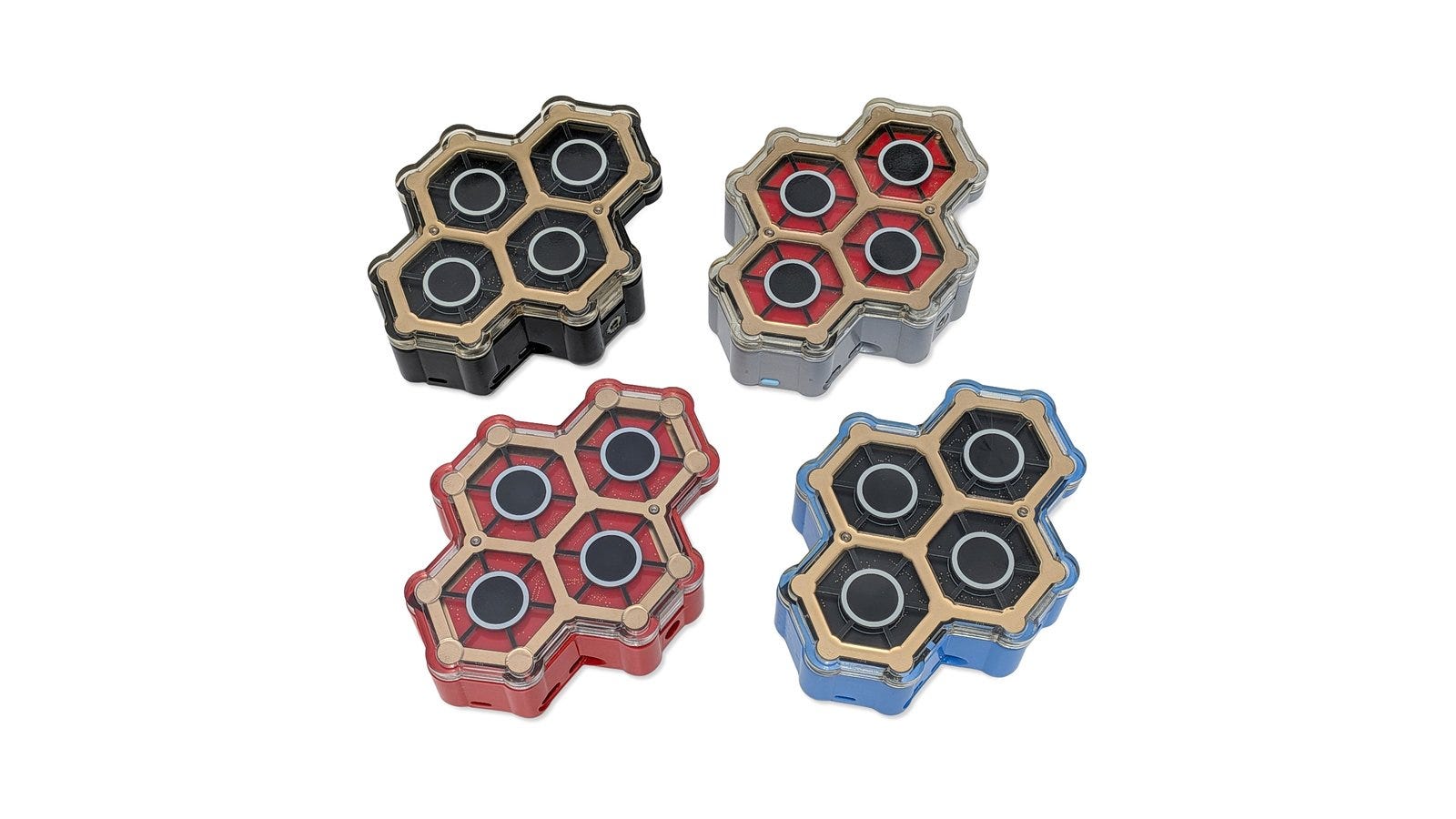
QuadRF democratizes modern phased array technology, bringing it down to Earth in an accessible, hacker-friendly, and programmable kit. At its core, QuadRF is a modular 4x4 MIMO software-defined radio tile with an open antenna architecture. Powered by an integrated Raspberry Pi 5, it functions out of the box as a real-time RF camera, expanding SDR exploration from the traditional time and frequency domains into the spatial domain.
While a single QuadRF is a complete, fully functional phased array development platform, it is also designed from the ground up as a building block for much larger arrays. Beamforming computation is distributed across each tile’s Lattice ECP5 FPGA, meaning users can link boards together to scale into square-meter scale phased arrays, such as our open-source 240-antenna MoonRF design.
Apparently MoonRF has been accepted at Crowd Supply as an official project, thus the crowdfunding campaign will begin soon. Sign up for direct updates on this project via email. I have!
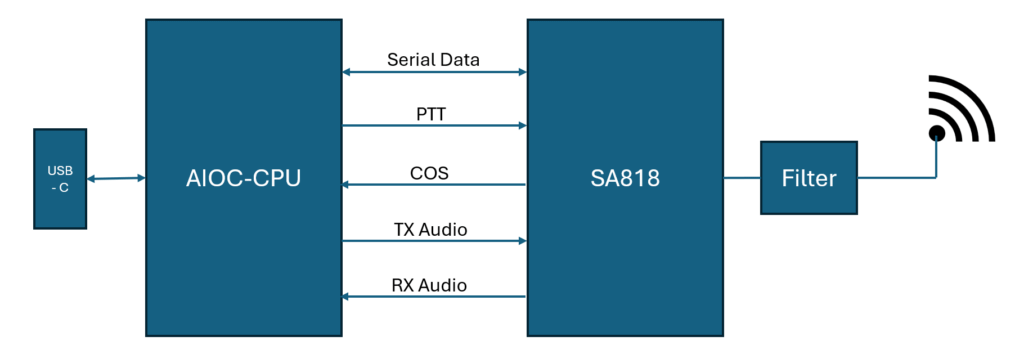
The G1LRO USB Transceiver Model 50 is built around 2 discrete elements:
AIOC Sound card and serial interface
SA818 UHF transceiver module
Both of these need setting up individually before use.
The setup process is :
Flash the firmware into the AIOC processor
Configure the AIOC processor for COS settings
Configure the SA818 for the required frequency and CTCSS settings
Configure ASL3 to easily recognize the AIOC processor.
All of these steps are executed via a PC and Web browser, no command line access is needed.
This gives the impression that the G1LRO USB Transceiver Model 50 is a combined radio transceiver and audio interface (equivalent to an All In One Cable - AIOC).
But there’s no USB Transceiver Model 50 listed as a product in G1LRO’s Shop. I try to follow G1LRO, but perhaps this was a project (that he doesn’t sell as a product) that I’m not aware of.
But if there were (or will be) a USB Transceiver Model 50, it sounds like a really cool product.
DARPA is developing an adaptive military codec that automatically adjusts error-correction methods to keep transmissions reliable across contested networks.
The Defense Advanced Research Projects Agency (DARPA) is pursuing a universal codec that would allow military radios, satellites, and data networks to adapt how they protect transmissions from errors.
Through a special notice, the agency announced the Leveraging Universal Codecs (LUC) program, which seeks to develop a next-gen encoder-decoder pair capable of adapting to different error-detection and correction methods during data transmission.
The effort builds on DARPA’s earlier Guessing Random Additive Noise Decoding (GRAND) research, which works by reverse-engineering interference in a transmission channel to reconstruct the original signal.
Under the LUC program, a GRAND-based decoder will be paired with a new adaptive encoder capable of automatically selecting the most effective error-protection method based on signal conditions and mission priorities in real time.
DARPA said the approach could improve bandwidth efficiency, make adaptable coding methods more difficult to exploit, and allow data to move more reliably across different military communications systems.
In pointing out this article, K0JEG noted:
Looks like hams aren’t the only ones with transcoding issues.
I agree. In imagining how voice (or data) would transit different US military systems, each with their own protocols, error correction, encryption, latency issues, etc. - radio, satellite, wireline, local, wide area, etc. I can easily imagine negotiating all of that, especially for realtime voice or video could begin to increase latency and interoperability issues.
My thanks to Eric Grumling K0JEG for bringing this development to my attention for inclusion in Zero Retries.
Tests Suggest Russian Satellites Can Jam GPS on a Continental Scale
Jeremy Hsu in Ars Technica:
Mystery of GPS interference across Europe raises questions about Russian motives.
Russian satellites have been identified as the cause of mysterious, seconds-long bursts of GPS interference across Europe—a rare example of human-made GPS interference coming from space. But uncertainty still hangs over whether such interference is intentional and if it could be more powerfully weaponized as GPS jamming with continental reach in the future.
The discovery came from an investigation detailed in a June 2 preprint paper by Todd Humphreys and his student Zach Clements at The University of Texas at Austin, along with Argyris Kriezis at Stanford University in California. By sifting through public data from ground-based stations with global navigation satellite system (GNSS) receivers, they identified a pattern of high-powered interference lasting less than 10 seconds each time but simultaneously detectable by ground stations across Europe from Norway to Spain to Poland, and even reaching as far west as Greenland and Canada.
By analyzing the ground station data from January 2019 to April 2026, the researchers found 75 days with at least one widespread GNSS interference event overlapping with the GPS L1 frequency band centered on 1575.42 megahertz. That represents the main band used for signal transmission by the US-made GPS satellite constellation and GNSS constellations from other countries.
Such interference patterns happened mostly on Tuesdays, Wednesdays, and Thursdays during business hours in Europe, Humphreys told the YouTube channel Veritasium. Because such “continental-scale” interference was simultaneously affecting GPS receivers across Europe and beyond, Humphreys and his colleagues calculated that the source had to be at least 1,200 kilometers above the Earth.
By examining which satellites were above the horizon over the affected region during each interference event, the researchers narrowed their search to a handful of suspect satellites. But they couldn’t go further because they only had data processed by the GNSS receivers of the ground stations—they needed to capture the raw radio signal data from the interference source.
Although this article specifically relates to jamming of the (US) Global Positioning System (GPS), the overall issue of susceptibility to jamming and spoofing is applicable to all of the Global Navigation Satellite System (GNSS) implementations.
It was naive of me to not imagine that this was a possibility. I’ve discussed GNSS jamming / spoofing in previous issues of Zero Retries, generally concerning the loss of precision timing from GNSS that is required for many Amateur Radio systems such as Weak Signal Propagation Reporter (WSPR). Of course there would be satellite-based interference, outright jamming, or spoofing of GNSS signals - terrestrial, regional, even aircraft-based (long duration drones) wouldn’t be nearly as effective as a satellite… though as the article points out, any such effects from LEO satellites are only effective during relatively short passes overhead.
I continue to posit that Amateur Radio, as radio technology “experts” (compared to the general public) could have a role to play in detecting GNSS signal interference, jamming, or spoofing. Participation could be as simple as a having highly accurate survey done of the location of a “prosumer” grade GNSS receiver. Then, monitor the position that the GNSS receiver is reporting, and flag any significant deviation of the location reported by the GNSS receiver. IE, if your GNSS reports movement or a different location than where you know it is located, to the meter, ergo something is going on, and not necessarily deliberate interference, etc. Atmospheric conditions can affect GNSS signals, which is the basis for Wide Area Augmentation System (WAAS).
Perhaps an Ad Hoc Amateur Radio GNSS Disruption Detection Network?
Public Knowledge Senior Vice President Harold Feld testified before the U.S. House Energy and Commerce Subcommittee on Communications and Technology. His testimony in the hearing on “Where Are We?: Examining Positioning, Navigation, and Timing Capabilities (PNT) in the United States” urged Congress to preserve the current GPS system while ensuring a basic tier of PNT for free to the general public even as GPS continues to evolve. Public Knowledge contends that next-generation GPS should serve the public interest. View the written testimony for more information.
In the same week as the previous story breaking…
Harold Feld is an expert on regulatory-related radio technology issues. I’ve known of him for decades, from my earlier career writing about the wireless industry and Wireless Internet Service Providers. Feld’s knowledge, and testimony on issues such as this is deeply sourced and rock solid.
With all the other… issues… in play in the US Congress, if it’s having hearings about PNT, and are hearing from Subject Matter Experts such as Feld, that’s ample evidence that there is very serious concern within the US government (not just the US military) over the reliability and day-to-day usability of GNSS systems.
It is one of the best hands-on ways to learn how communication really works. You learn about RF, antennas, propagation, power, troubleshooting, operating discipline, and emergency communication. More than that, you learn by doing.
You test an idea. You make adjustments. You try again. You keep improving.
That same mindset applies to IT, networking, wireless technology, AV, and technical problem-solving. In a world where most communication feels instant and invisible, amateur radio reminds us that understanding the fundamentals still matters.
Ham radio is not just about making contacts. It is about learning, experimenting, and staying curious.
Any other hams, GMRS users, or wireless tech folks in my network?
I’ve been sayin’…
I dropped a brief comment about Zero Retries.
I hope that KR4MBZ begins following Zero Retries and is able to connect with some of the 3500+ other “hams, GMRS users, or wireless tech folks” readers of Zero Retries.
As mentioned in I-Frame, Summer 2026 will be unusually busy in our household. The biggest factor is that Tina and I will be grandparents sometime in September. Thus there is a baby shower (actually, two) to be planned and executed. Complicating the logistics for the baby showers is that Tina had surgery on her foot a week ago. The surgery went very well, but post-surgery, she is not “allowed” to bear weight on her foot for five more weeks, so I’m the legs and arms, and driver, and errand-runner of the family at the moment. Tina is a retired Registered Nurse / Complex Medical Case Manager, and readers who have medical professionals in their family can commiserate with the challenges of being a caregiver for such folks.
In between baby showers, there are the preparations for Zero Retries Digital Conference (ZRDC) 2026 to be kicked into high gear. Expect full details on ZRDC 2026 in the next issue.
I also have a book to complete in time for ZRDC 2026 and that will require more butt-in-chair time than I can otherwise allocate at the moment if I were to continue publishing Zero Retries each week. Thus the decision to change to biweekly publication of Zero Retries for the remainder of Summer 2026.
In my sparse “spare” time this Summer, my dedicated office area in N8GNJ / Zero Retries Labs is long overdue for a major remodel for upgrades on electrical and networking, painting, new shelving, etc. Because this much work will require emptying the entire office, that’s feasible in the good weather of our generally rain-less summers. I can move things around in N8GNJ / Zero Retries Labs and park some of the bigger pieces outside without damage.
And of course there are many, many long-deferred projects for N8GNJ / Zero Retries Labs. I want to get at least a few more antennas up in the air to improve my activity in Zero Retries Labs. Antenna activity is going to include HF and a major investment in an HF radio. More on my plans for HF in a future issue.
There has been a considerable uptick in Zero Retries Interesting activity here in Bellingham / Whatcom County, including MeshCore on 902-928 MHz, 1200 bps Packet Radio (thank you W9CPZ!), and VARA FM / VarAC. There is also some potential on-air activity resulting from the Cascade STEAM Spectrum Community Group (Special Interest Group) that may be Amateur Radio, or perhaps unlicensed - to be determined.
I’m long overdue to connect into the Puget Sound Data Ring (PSDR) microwave network (HamWAN), and I want to get working on creating some connectivity on “AREDN-900” (my terminology for AREDN networks operating on 902-928 MHz using repurposed 802.11ah / Wi-Fi HaLow equipment. I want to get in on all of that activity, and soon. There are also many receivers to put online - I really want to get a SatNOGS and a TinyGS LEO satellite receivers online, as well as my KiwiSDR. All of that will be tied together with 44Net static IPv4 addresses that is made very easy now with 44Net Connect.
But, one of my favorite “Dad Wisdoms” is:
Want to hear God laugh?Explain your plans. 🤣
But, we do the best with what we have, and useful bit of “Dad Wisdom” comes from my dear friend Harold Sprinkle who said:
Plan the work…then work the plan. 🫤
Yep.
ZRDC 2026 Ho!
Zero Retries Digital Conference (ZRDC) 2026 will be here before we (I) know it, especially given the action-packed Summer this one promises to be in our household. It’s useful to me to put the countdown prominently on display in Zero Retries. Thus I am beginning a Hamvention-esque countdown to ZRDC 2026 in this issue.
Well, not this weekend, at least directly. Our shed kit didn’t get assembled as planned a month or so ago due to a bad back. But most factors have aligned - good weather, availability of a handy, strong friend, and an absence of other complicating factors. Perhaps, eventually, the shed will support its own radios and solar panel and other geekery.
And, in between shed-building and a needed gas-powered7 motorized lawn scalping, I was delighted to discover that Project Hail Mary is now available on a streaming service. It’s about $20, but that’s a reasonable price to pay for being able to watch it on my big living room video display8, from the comfort of my recliner. Next to getting the shed-building off my HoneyDo list, watching Project Hail Mary will be the highlight of this particular weekend.
Have a great weekend, all of you co-conspirators in Zero Retries Interesting Amateur Radio activities!
My ongoing Thanks to: Tina Stroh KD7WSF for, well, everything! Jack Stroh, Late Night Assistant Editor Emeritus Fiona and Shreky Stroh, Late Night Assistant Editors In Training
Founding Members who generously support Zero Retries financially: Founding Member 0000 - Steven Davidson K3FZT (Renewed 2025, 3rd year!) Founding Member 0001 - Randy Smith WU2S (Renewed 2025, 3rd year!) Founding Member 0002 - Chris Osburn KD7DVD (Renewed 2025, 3rd year!) Founding Member 0003 - Don Rotolo N2IRZ (Renewed 2025, 3rd year!) Founding Member 0004 - William Arcand W1WRA (Renewed 2025, 3rd year!) Founding Member 0005 - Ben Kuhn KU0HN (Renewed 2025, 3rd year!) Founding Member 0006 - Todd Willey KQ4FID (Renewed 2025, 3rd year!) Founding Member 0007 and 0010 - Merik Karman VK1DF / VK2MKZ (Renewed 2025 x2, 3rd year!) Founding Member 0008 - Prefers to Remain Anonymous 08 (Renewed 2025, 3rd year!) Founding Member 0009 - Prefers to Remain Anonymous 19 (Renewed 2025, 2nd year!) Founding Member 0011 - Rick Prelinger W6XBE (Renewed 2025, 2nd year!) Founding Member 0012 - Ryan Tolboom N2BP (Renewed 2025, 2nd year!) Founding Member 0013 - Newton White N4EWT (Renewed 2026, 2nd year!) Founding Member 0014 - Joe Hamelin W7COM (Renewed 2026, 2nd year!) Founding Member 0015 - Rich Stocking N7OP (Renewed 2026, 2nd year!) Founding Member 0016 - Prefers to Remain Anonymous 77 (New 2025) Founding Member 0017 - Phil Karn KA9Q (New 2025) Founding Member 0018 - Prefers to Remain Anonymous 95 (New 2025) Founding Member 0019 - Prefers to Remain Anonymous 0108 (New 2025) Founding Member 0020 - Prefers to Remain Anonymous 110 (New 2025) Founding Member 0021 - Prefers to Remain Anonymous 111 (New 2025) Founding Member 0022 - Prefers to Remain Anonymous 112 (New 2025) Founding Member 0023 - Prefers to Remain Anonymous 116 (New 2026) Founding Member 0024 - Rob Bowser (SPOOLTENNA) (New 2026) Founding Member 0025 - Dave Stewart K7XST (New 2026)
Numerous Annual and Monthly subscribers who also generously support Zero Retries financially!
You thousands of readers of Zero Retries without which there would be little point in publishing this newsletter.
Fair Use - All excerpts from other authors or organizations, including images, are intended to be fair use and are fully attributed generally by author and link (URL).
Paid Promotional Content - Unless otherwise noted in the article or item, advertisement, or sponsorship notice, Zero Retries does not include paid promotional content. Exceptions:
Advertisements in Zero Retries,
Sponsorships in Zero Retries,
Zero Retries products,
Zero Retries events
Features and content exclusive to paid subscribers.
As I’ve related in previous mentions of FreeDV, in a conversation with David Rowe VK5DGR, he confirmed there is nothing “structural” in FreeDV that precludes FreeDV from incorporating messaging, telemetry, or data. The primary reason for not doing so, to date, is that those capabilities were not in the scope of the ARDC grant, and so no (grant funded) work was done on those additional capabilities.
Major Amateur Radio manufacturers (in my opinion) that manufacture significant Amateur Radio product lines, mostly Amateur Radio HF radios: Alinco, Elecraft, FlexRadio, Icom, Kenwood, Yaesu, and most recently Xiegu.
My descriptions and understanding of exactly how “external” software / features are accommodated in 8000 / Aurora is admittedly vague. My (self assigned) deadline for this article didn’t allow me to vet these descriptions with FlexRadio. If, after publication, I got some significant descriptions wrong, I will update the online version of this article.
What I refer to as the “compute engine” of the FlexRadio 8000 and Aurora radios is the computer that runs the overall functionality of the radio - the display, the controls, etc. The “heavy lifting” of the digital signal processing is done with Field Programmable Gate Arrays (FPGAs).
One of the big differences in perspective between my wonderful wife and I is that she considers mowing the nearly 1 acre of grass with a noisy, fume-spewing lawn tractor to be “relaxing”. I’ve tried to make my case to invest in a lawn mowing robot that keeps the lawn continuously trimmed 24x7, other than rain or recharge cycles. But, Tina doesn’t want to give up her “fun”, so lawn duties fall to me during her recovery (at the peak of grass growing season, of course). Fortunately there’s always the latest Ham Radio Workbench podcast to listen to as I mow.