2026-08-07 - Breaking - OFDM-AB - IP400 Refactored - New IP400 Hardware, New Modulation Makes High Speed Mesh Networking on VHF / UHF Practical - and Cool! ARRL Open Source Contest, New Ham Radio BBS
Zero Retries is an independent newsletter promoting technological innovation in and adjacent to Amateur Radio, and Amateur Radio as (literally) a license to experiment with and learn about radio technology. Radios are computers - with antennas! Now in its sixth year of publication, with 3500+ 3600+ subscribers.
Optional Paid Subscriptions, and especially Founding Member subscriptions to Zero Retries, not only help offset various expenses incurred in publishing Zero Retries, but also are a large portion of the “seed capital” that is needed to host Zero Retries Digital Conference (ZRDC) 2026, and future ZRDCs. Thank You!
My thanks to Steven Davidson K3FZT for renewing as Founding Member 0000 to Zero Retries in the past two weeks (4 years)!
I’m indebted to K3FZT for his early, formative advice on the decision to offer optional paid subscriptions to Zero Retries, and being the first Founding Member (0000) of Zero Retries!
My thanks to Chris Osburn KD7DVD for renewing as Founding Member 0002 to Zero Retries in the past two weeks (4 years)!
My thanks to Don Rotolo N2IRZ for renewing as Founding Member 0003 to Zero Retries in the past two weeks (4 years)!
I’m indebted to N2IRZ for his friendship spanning decades now, his contributions to Amateur Radio from his Zero Retries Interesting columns in CQ VHF and CQ from which I learned much. Most recently, N2IRZ helped staff the Zero Retries / DLARC booth at Hamvention 2026, and has graciously volunteered (launching himself once more into the breach) as Coordinator of the Zero Retries Digital Conference 2026 Proceedings. Don is a true friend of Zero Retries and is a Zero Retries Pseudostaffer.
My thanks to Chuck Hast KP4DJT for renewing as Founding Member 0016 to Zero Retries in the past two weeks!
Founding members are listed in every issue of Zero Retries!
My thanks to Hugh Vance KW5X for renewing as an Annual Paid Subscriber (4th year!) to Zero Retries in the past two weeks!
My thanks to John Simmons NK0K for renewing as an Annual Paid Subscriber (4th year!) to Zero Retries in the past two weeks!
My thanks to Orv Beach W6BI for renewing as an Annual Paid Subscriber (4th year!) to Zero Retries in the past two weeks! W6BI is a Zero Retries Pseudostaffer.
My thanks to Paul Elliott WB6CXC for renewing as an Annual Paid Subscriber (4th year!) to Zero Retries in the past two weeks!
My thanks to Prefers To Remain Anonymous 03 for renewing as an Annual Paid Subscriber (4th year!) to Zero Retries in the past two weeks!
My thanks to Prefers To Remain Anonymous 05 for renewing as an Annual Paid Subscriber (4th year!) to Zero Retries in the past two weeks!
My thanks to Prefers to Remain Anonymous 34 for renewing as an Annual Paid Subscriber (3rd year!) to Zero Retries in the past two weeks!
My thanks to Dave Lounsbury KC1UIX for becoming a newAnnual Paid Subscriber to Zero Retries in the past two weeks!
My thanks to Matt Payne N3PAY for becoming a newAnnual Paid Subscriber to Zero Retries in the past two weeks!
My thanks to Jonathan Brandenburg, KF5IDY for one year of being a Paid Subscriber to Zero Retries in the past two weeks!
My thanks to Prefers To Remain Anonymous 130 for upgrading from a free subscriber to Zero Retries to a Paid Subscriber in the past two weeks!
My thanks to Jana A KV6BCD for becoming a Paid Subscriber to Zero Retries in the past two weeks!
Financial support from Zero Retries readers is a significant vote of support for the continued publication of Zero Retries.
Zero Retries Summer 2026 Publishing Schedule - Biweekly
During Summer 2026, Zero Retries will be published biweekly. The intended publication schedule for the remainder of Summer 2026 is:
This week the Zero Retries email subscriber count incremented to 3600+. The email subscriber count continues to increase incrementally1, most recently from high profile mentions of Zero Retries Digital Conference 2026 and the recent Call for Papers for ZRDC 2026. Thanks to Amateur Radio Newsline, Amateur Radio Weekly, and AMSAT News Service for these most recent mentions.
As always, I disclaim that the email subscriber count is an inexact measure of Zero Retries “circulation” as there are pass-along mentions between individuals, notification via social media, and especially readers who follow Zero Retries via RSS (no email subscription needed).
Thanks for the measure of support represented by so many continued email subscriptions. That continually growing number indicates that Zero Retries is being read widely within Amateur Radio, and I’m grateful to all you Zero Retries readers.
With just about 10 weeks until ZRDC 2026, all operations are in full gear to get this conference off the ground. Once again, we have arranged multiple ways to attend and participate in the conference. The options are as follows:
Attend in-person. Automatically entered into drawings for door prizes.
Live visual/audio feed via Zoom. We have taken on the additional cost of having the conference set for live audio/visual feed via Zoom so that people can be in their own home, Ham shack, etc. and participate with the speakers and audience.
Order a copy of the video recording. Our Video Director states the recording will be available approximately two weeks after the conference. It can be purchased on the registration page.
Download a free copy after 1/2026.
Please take this opportunity to share with other HAMS who might be interested and who might not subscribe to Zero Retries.
Presentations Update
To date, we have confirmed the following speakers on the roster. They are:
Martin Alcock, VE6VH will discuss the IP 400 Project and the exciting new developments explained in the next article.
Glen Popiel, KW5GP will be discuss Microcontroller Communication Technologies and Protocols for Ham Radio.
Mooneer Salem, K6AQ will discuss the FreeDV Project
Craig Lamparter, KM6LYW will present “DigiPi - Data Transceiver Hotspot” and
other packet projects.
Please note, some of these speakers will also be speaking at Pacificon, which is a separate conference. Their presentations will not be the same as Zero Retries focuses on the more techie side of amateur radio.
Sponsors Update
As we have confirmed speakers, we have also acquired some sponsors. With our gratitude, we thank and welcome ARDC and GigaParts at the present time as sponsors for ZRDC 2026. GigaParts once again has graciously sent five Explorer QRZ-1 portable radios to be given away as door prizes. Each in-person admission is given a free ticket to win one of these radios.
Looking forward, in each issue of Zero Retries Newsletter up until the conference, I will be posting updates regarding the conference as well as on the Conference web page. If you have any questions, please don’t hesitate to contact me at tina@zeroretries.net or 206-618-3511.
Image courtesy of Alberta Digital Radio Communications Society (ADRCS)
Breaking - OFDM-AB - IP400 Refactored
The Amateur Radio Data Communications Revolution of the 21st Century
By Steve Stroh N8GNJ
Highlights of This Story - the TL:DR
I’m trying out this new feature for long stories - a TL;DR with five bullet points, max.
This new version of IP400 is based on a new hardware unit - the Advanced Mesh Network Controller (AMNC).
This new system uses a new modulation called OFDM-AB. The -AB is for Audio Band.
OFDM-AB can be used with any VHF / UHF FM radio. If a radio does not have flat audio connections, connecting via microphone and speaker works fine.
On a 12.5 kHz bandwidth radio channel, full quieting, using QAM-256, microphone / speaker connections - potential data rate is 19,360 bps. Using flat audio connections - potential OFDM-AB data rate is 42,353 bps.
Mesh networking is integrated in IP400.
Disclaimers
In my previous coverage, I framed IP400 as “The Packet Radio Revolution of the 21st Century”. Per the above, I’ve modified that phrase slightly, and I think it’s now particularly applicable in this new version of IP400.
I was given advance access to this information, and I’m privileged to present it first here in Zero Retries. Although I’m an Honoured Member of Alberta Digital Radio Communications Society (ADRCS) for my initial contributions to scoping and publicizing IP400, I’m not directly involved with the development, or deployment of this project and I’m not speaking for ADRCS or the IP400 developers.
Some features of UFP, OFDM-AB, and the AMNC described in this article are not yet implemented (Fall 2026). All features described in this article are scoped in the development plan and are well within the capabilities of the hardware and overall architecture of the system.
In this article I’ve chosen not to offer comparisons of this new system with AX.25 1200 / 9600 bps Packet Radio, or to VARA FM, as it would quickly get awkward and lengthy in explaining what is comparable, and what is not.
What follows is an introduction to this new, complex system - a new data communications mode / modulation, a new network paradigm (mesh networking in VHF / UHF spectrum), adding data communications to an existing “voice use” FM repeater, etc. There will be follow-on articles in Zero Retries, and more detailed information available from the Alberta Digital Radio Communications Society (ADRCS). Most notably, at Zero Retries Digital Conference 2026 in October, 2026 in San Ramon, California it is planned to have demonstrations of this system and the latest information on this system will be one of the major presentations.
Terminology
The verbiage in this article can quickly get confusing, thus here is a quick reference:
IP400 - Intelligent Protocol for the 400 MHz band. Despite IP400 no longer being confined to the 400 MHz (actually 420-450 Amateur Radio / 70 cm) band, the system is (still) called IP400. For background on IP400, see ip400.adrcs.org.
Mini Node - The initial radio unit developed in 2025 as a proof of concept and development tool for IP400.
Unified Firmware Platform (UFP) - The firmware for IP400 that runs on both the Mini Node and the Advanced Mesh Network Controller (AMNC).
Orthogonal Frequency Division Multiplexing - Audio Band (OFDM-AB) - The new modulation method.
Advanced Mesh Network Controller (AMNC) - The hardware unit for this newest version of IP400.
Background - 2025 and 1H 2026
Long time readers will recall extensive coverage of the IP400 Project during the first half of 2025. Since then, I haven’t offered much coverage of IP400 - just a few sparse status reports. Out of public view, there was extensive development activity and rethinking… refactoring of the concepts for IP400.
The original goal for the IP400 Project was to create a new radio designed for data communications that would be capable of 100 kbps data rates (minimum) using 4-level Frequency Shift Keying (FSK). That goal was met with the creation of the Mini Node, operating on the Amateur Radio 420-450 MHz (70 cm) band, of which about one hundred were built and distributed.
The Mini Node was successful in proving out the concepts of IP400 mesh networking and as a benchtop development platform.
To be useful for typical terrestrial Amateur Radio use (peer to peer networking), the Mini Node requires a driver amplifier (still in development) and a power amplifier (somewhat expensive) to be usable (25 watts or so). That was going to be expensive. Another issue was for those early IP400 experimenters with IP400 Mini Nodes, the primary barrier to creating new IP400 networks was the “lone node problem”2.
Debut of OFDM-AB - August 2026
During the development in the first half of 2026, it was decided that instead of creating a new IP400 radio capable of OFDM, there would be much wider adoption of IP400 if OFDM could be adapted for use with conventional VHF / UHF FM radios, using OFDM in the audio path of VHF / UHF FM radios3, thus the creation of OFDM - Audio Band (OFDM-AB).
IP400 using OFDM-AB offers compelling attributes:
Every Amateur Radio Operator has a VHF / UHF FM radio (or newly purchased inexpensive radios) that can be used for OFDM-AB.
IP400 networks using OFDM-AB can be created in any of the Amateur Radio VHF / UHF bands - 6m, 2m, 1.25m, 70cm, even 10m - just buy an appropriate radio.
IP400 / OFDM-AB using typical 12.5 kHz FM bandwidth is an easier “fit” in crowded Amateur Radio VHF / UHF bands.
Advanced Mesh Network Controller (AMNC)
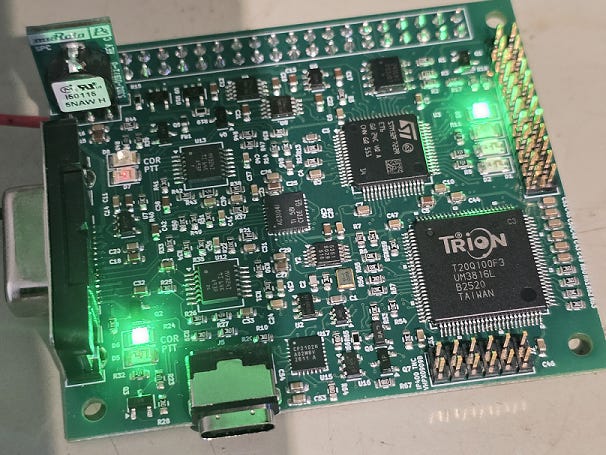
Advanced Mesh Network Controller - prototype. Image courtesy of Alberta Digital Radio Communications Society (ADRCS)
One notable feature of the AMNC is the large chip in the lower right corner (Trion). That is a Field Programmable Gate Array (FPGA) and it’s the unit most involved with the (complex) generation of the OFDM-AB modulation. I’m told it’s currently “lightly utilized”, and thus offers ample expansion capability.
The nature of OFDM is that the task of individually managing many subcarriers is computationally intensive. While OFDM for an audio band can be done in a host computer, it’s arguably better to use a dedicated controller without the latency and overhead of a host computer running a typical desktop multitasking operating system.
Thus the creation of the AMNC.
The AMNC can be used in three scenarios:
An AMNC can operate standalone connected to a host computer, via a serial connection (USB-C), using the well-developed KISS protocol.
An AMNC can be connected to a Raspberry Pi computer (typically a Raspberry Pi 3 Model B+) as a HAT to take advantage of the Raspberry Pi’s capabilities such as Wi-Fi, Bluetooth, Ethernet, general purpose Linux OS, full TCP/IP stack, displays, etc.
Adding an AMNC to an FM repeater is a relatively simple upgrade that adds data communications capability and AllStarLink to existing FM repeaters. An IP400-enabled repeater using an AMNC creates a Wide Area IP400 network.
The AMNC supports up to two radios, so IP400 mesh networks can be created on multiple Amateur Radio VHF / UHF bands by simply connecting two radios on different bands to an AMNC. The existence of such cross-band gateways in the network is a feature of IP400’s mesh networking.
Data Speeds - Any Radio, Up to 57 kbps
Image courtesy of Alberta Digital Radio Communications Society (ADRCS)
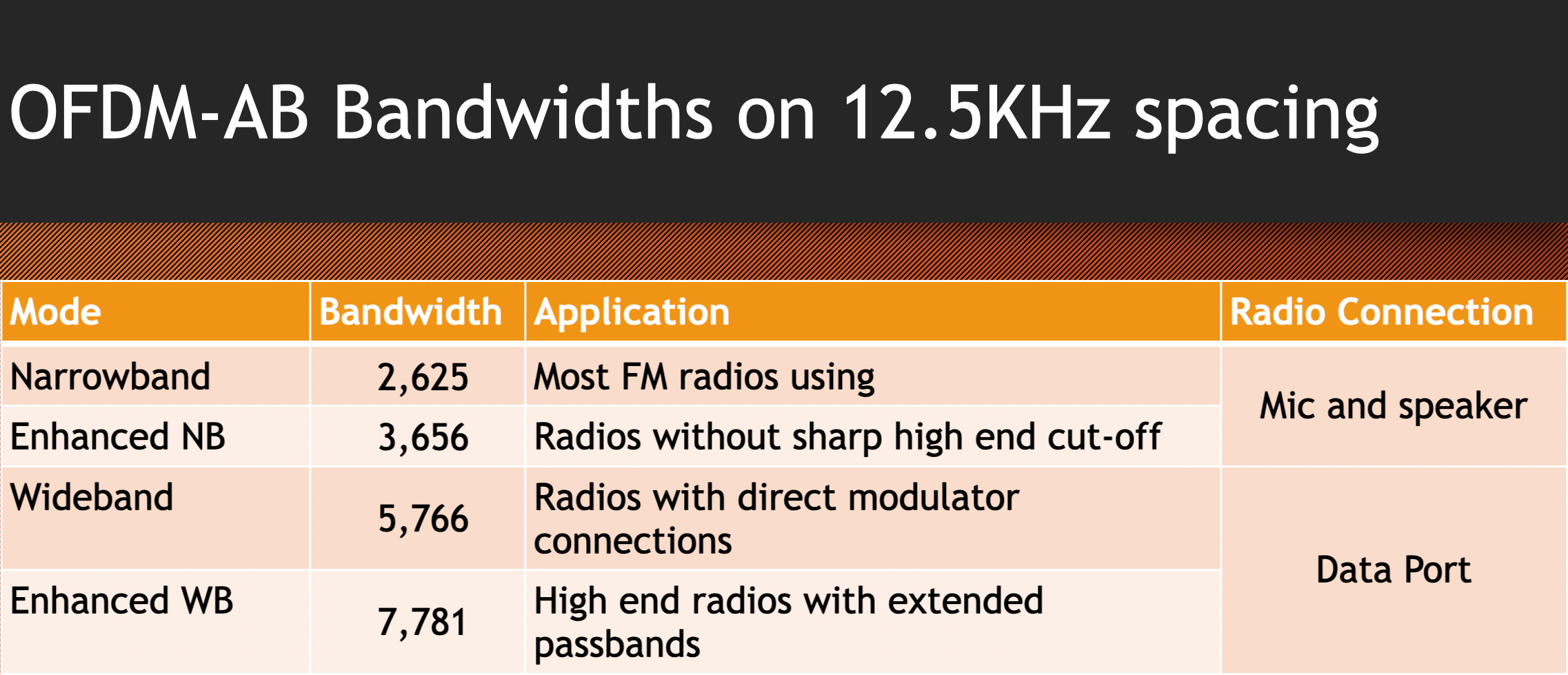
In the above chart, “Bandwidths” refer to a radio’s audio bandwidth path.
Narrowband - Any VHF / UHF FM radio can be used with OFDM-AB using the microphone and speaker connections.
Enhanced Narrowband - Some VHF / UHF FM radios provide “better than minimal” audio bandwidth, via the microphone and speaker connections. Such radios are able to achieve higher data speeds than Narrowband.
Wideband - Radios that provide flat audio4 connections (often better known as the “data connector” or “9600 connector / port” - usually a 6-pin MiniDIN connector on the back of the radio).
Enhanced Wideband - Radios that provide an exceptionally wide audio bandwidth; generally those that are specifically designed as data radios. The best-known such radios are Tait radios that were designed for use with mobile data terminals, now widely available as surplus.
Image courtesy of Alberta Digital Radio Communications Society (ADRCS)
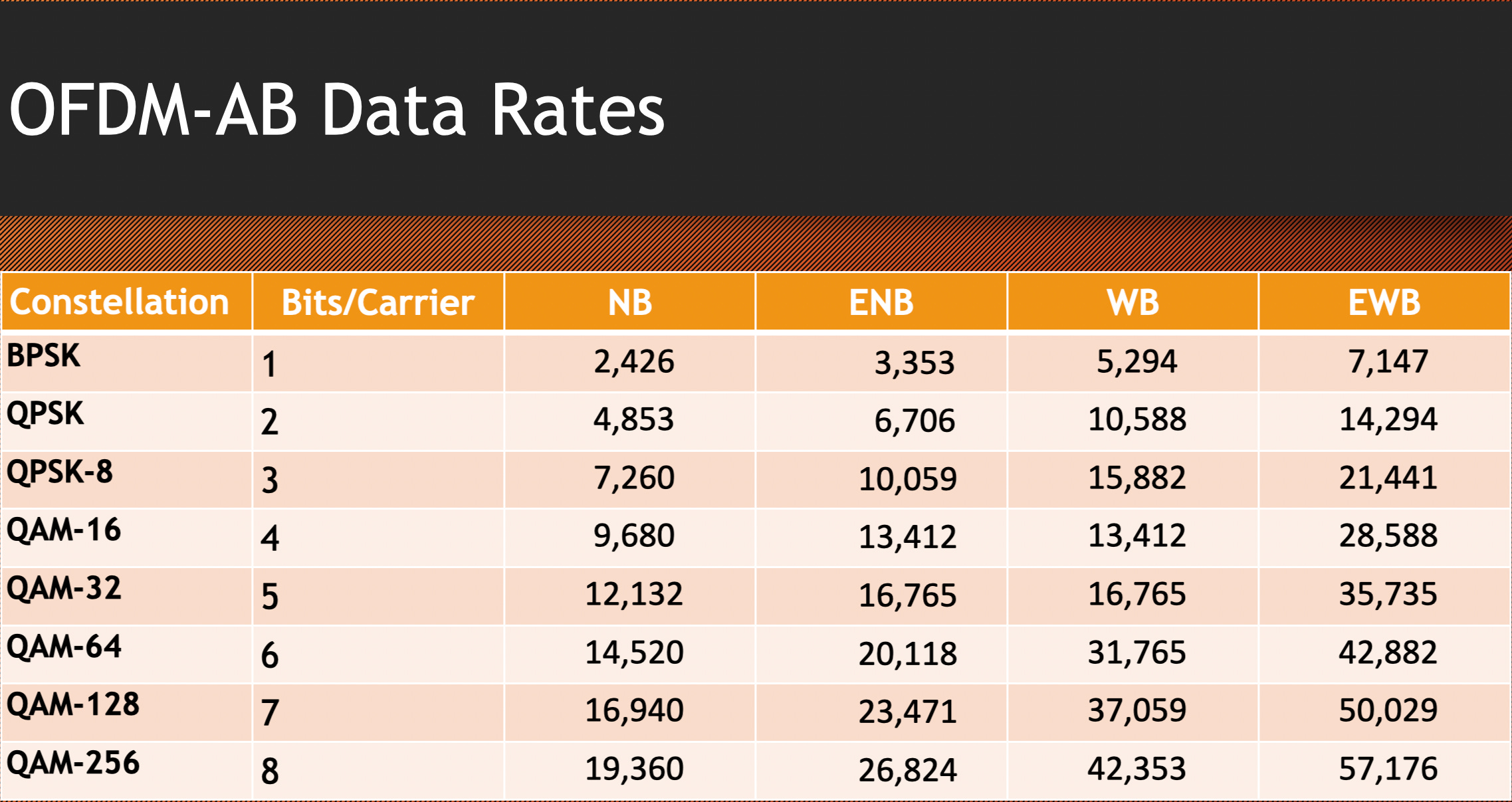
As shown on the above chart, the most ideal case for OFDM-AB is with an Enhanced Wideband radio (such as a Tait data radio), on a “full quieting” channel where QAM-256 modulation can be used, can achieve 57,176 bits per second.
Note that the original goal of IP400 was 100 kbps data rate (minimum). Arguably, 57, 176 bps achieves 57% of that goal. But, notably, OFDM-AB uses a 12.5 kHz radio bandwidth instead of the 100 kHz radio bandwidth originally proposed for IP400.
A more typical case is use of a radio such as the Kenwood TM-V71A5 which features flat audio connections, on a “full quieting” channel where QAM-256 modulation can be used, to achieve 42,353 bits per second.
Note that the data rates in the above chart are “raw” data rates. The actual “throughput” data rate will be lower after Forward Error Correction (FEC) overhead is implemented.
Mesh Networking
A highly detailed description of the IP400 mesh networking capability is beyond the scope of this article. IP400 mesh networking will be the subject of future articles after I’m able to have hands-on time with a test network of at least three AMNCs.
The header information in each IP400 transmission is richly detailed, including the maximum data rate of each station, mesh network routing, and many other data elements.
A co-primary goal of the IP400 Project is to provide integral mesh networking, well beyond simple one hop (or user specified multi-hop) digipeating. Header information from each IP400 transmission received is cached by every receiver into its local mesh network table, including routing (if not received directly).
Thus to transmit to any station in an IP400 network, it’s only necessary to specify the destination. The station’s internal mesh network table is consulted (or, if the destination has not been previously heard, the network is queried), any necessary routing is added, and the connection is established.
The primary takeaway about IP400 mesh networking is that IP400 has mesh networking designed in from the beginning and will evolve with real world usage experience and further development.
Adding Data Communications Capability to FM Repeaters
A highly detailed description of the use of AMNCs for providing AllStarLink is beyond the scope of this article. IP400 and AllStarLink capability will be the subject of future articles when I can have hands-on time with a repeater equipped with an AMNC that is on AllStarLink.
One of the primary reasons for development of the AMNC is that this single unit can be used by individual stations and installed in repeaters.
When installed in a repeater that has already implemented AllStarLink for remote (voice) use, installation of the AMNC is largely plug-and-play because AllStarLink capability is already present in the AMNC. Thus an AMNC replaces a AllStarLink unit.
Because the AMNC uses a different audio CODEC than typical AllStarLink controllers, installation of a custom driver is required to access the CODEC capability in the AMNC.
One of the most exciting capabilities of the AMNC is that installing it in a repeater adds data communications capability with minimal impact of voice usage of the repeater.
After installation of an AMNC into an FM voice repeater, the repeater becomes dual mode IP400 data and voice.
In a repeater with an AMNC installed, the one change to voice use is to activate CTCSS6 on the repeater’s transmit signal. Correspondingly, it’s suggested that voice users enable “Receive CTCSS” for the repeater in their radios. Thus when data is being transmitted (without the transmitted CTCSS), the voice user’s radio does not open the squelch, and the data transmission is not heard.
For data, the flow through the repeater is:
Data user 1 transmission —> repeater receiver —> AMNC —> repeater transmitter —> data user 2 reception.
Note that the “data path” through the repeater bypasses the repeater’s controller, and thus CTCSS is not added to the data transmission.
Data users do not transmit with CTCSS. It’s not needed because the AMNC is monitoring for a OFDM sync signal.
In cases of “collisions” when data and voice is transmitted to the repeater simultaneously, the AMNC can be set to defer data communications for an interval to not interfere with voice use. Computers are patient. 😊
This technique of adding IP400 data to FM voice repeaters offers a number of advantages:
It’s relatively easy to implement if the repeater already has been set up for AllStarLink.
It provides a new / enhanced mission for “quiet repeaters” that are not getting much usage.
NewTechHams have a strong preference for data communications over talking. Thus the addition of data capability to a repeater gives them a reason to begin using that repeater.
Having a repeater that can retransmit IP400 data makes it possible for lower powered radios to be used to participate in an IP400 mesh network, rather than requiring at least 25 watts for typical terrestrial simplex / mesh network use.
The addition of IP400 data capability to a repeater provides a reason for NewTechHams to get involved with a repeater support organization and contribute to the upkeep of the repeater.
For those repeaters / organizations that do implement IP400 data capability, that provides a strong differentiation of that repeater / organization versus repeaters / organizations that continue to offer only voice.
Unified Firmware Platform (UFP)
Those early experimenters with IP400 that have Mini Nodes are not being left behind. Since the firmware for the Mini Node and the AMNC is the same, and the IP400 mesh networking is the same in the Mini Node and the AMNC, the Mini Node continues to be useful for IP400 development work, especially testing mesh networking.
ARDC Grant
Much of the development work for IP400 and OFDM-AB was funded by a 2025 grant from ARDC to the Alberta Digital Radio Communications Society (ADRCS). I think7 this development of IP400 and OFDM-AB is an excellent example of ARDC grants enabling significant and unique technological innovation in Amateur Radio, and radio technology in general. There is no commercial work being done (that I’m aware of) for a data communications system using narrow (12.5 kHz) radio bandwidths, with integral FEC and mesh networking.
Open Source Aspects
All of the details of IP400, UFP, and OFDM-AB are publicly disclosed and available as open source. The GitHub repository - github.com/adrcs/ip400 contains released information - specifications, software, and documentation.
Public information such as press releases are on the ADRCS website.
It’s intended / hoped that OFDM-AB will be implemented in other systems as an open source OFDM modulation in the audio band of VHF / UHF radios with integral Forward Error Correction (FEC). It would be ideal for other implementations of OFDM-AB could be implemented to be interoperable with IP400’s implementation of OFDM-AB and IP400’s mesh networking.
The AMNC was privately developed and details of it (other than those aspects necessary for development purposes) won’t be made public.
Development Timeline
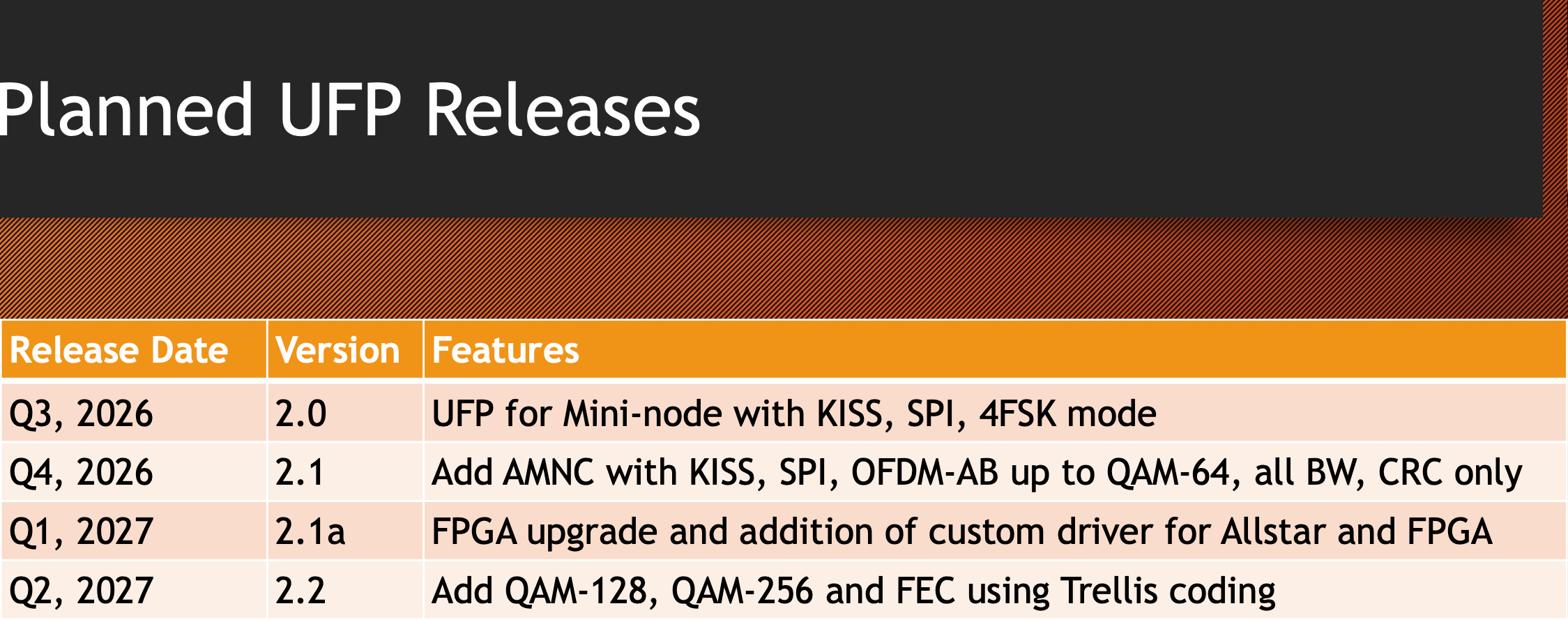
The AMNC is projected to be available, in full production, in Q4 of 2026. The distribution and pricing will be released later in 2026.
Feature development of OFDM-AB, and AllStarLink per the chart below, will extend through the first half of 2027.
Image courtesy of Alberta Digital Radio Communications Society (ADRCS)
IP400, AMNC, and OFDM-AB in The Big Picture of Amateur Radio Networking
In my perspective, IP400 and OFDM-AB is the “missing middle” of Amateur Radio networking.
On HF, we now have a good data communications mode, specifically designed for the vagaries of HF, in Mercury (which also uses OFDM). Mercury is already being tested on The Packet Radio Forwarding Network and based on feedback from that real world usage, Mercury is rapidly being improved. Thus Amateur Radio now has a reasonable “long haul via HF” data communications networking capability.
On microwave - 902 - 928 MHz (33 cm), and 2.4 GHz and 5.x GHz, we have the fantastically capable AREDN mesh networking system. (Most AREDN hardware units use OFDM.)
On the Internet for those times when we can’t “just use radio” there has been Amateur Radio’s dedicated corner of the Internet - 44Net. Getting on 44Net has been the realm of wizards, and perhaps your area has one and makes 44Net connectivity easy for you. But if you don’t have a local 44Net wizard, now there’s 44Net Connect which makes it really, really easy to take advantage of 44Net’s capabilities. (And, if you want cheap works anywhere Internet access for Amateur Radio projects and 44Net Connect, it’s hard to beat a Starlink Mini unit running on Standby service of 500 kbps for $10/month.)
But on VHF / UHF… we’ve been muddling through for decades now with AX.25 Packet Radio, mostly at 1200 bps, APRS digipeaters, with Internet-based Winlink and APRS-IS for networking. Recently there has been a resurgence in 9600 bps now that NinoTNC and DIRE WOLF have implemented FEC to make 9600 usable and reasonably reliable. We’ve also had VARA FM which implemented OFDM and FEC, but isn’t really built for networking, more for individual node access file transfers, most commonly used to access Winlink. The closest we’ve come to mesh networking in VHF / UHF is 30+ year old Net/ROM / TheNET capability in some legacy packet radio systems. And, of course, Meshtastic and MeshCore on 433 MHz, at very low data rates from using LoRa.
So, for VHF / UHF, Amateur Radio hasn’t had a very compelling story to tell to the NewTechHams who want to do data communications with their Amateur Radio license. AREDN would be a slam dunk proposition to NewTechHams (and it is, in places where there’s lots of friendly-to-Amateur-Radio hills and a minimum of foliage like Southern California). But in the rest of the world… microwave networks are often problematic, especially if there are trees, or non-optimum terrain.
Thus in many ways, VHF / UHF is the ideal portion of spectrum for NewTechHams - radios are reasonably priced (for reasonable power), antennas are easy to construct and understand and of manageable size, and best of all, VHF / UHF works reasonably well to penetrate foliage and achieve reasonable distances.
What we’ve been missing in VHF / UHF data communications is something exactly like IP400 / AMNC / OFDM-AB - reasonable speeds, reasonable reliability, ability to use existing radios, ability to use our capabilities in multiple VHF / UHF bands, built in mesh networking, a way to leverage repeaters that doesn’t disrupt existing repeater functionality, and… the ability to tinker with it - open source.
Now with IP400 / AMNC / OFDM-AB, if you want to build local networks in Amateur Radio, there is a reasonable story to tell that competes favorably with Meshtastic and MeshCore. Unlike MeshCore, IP400 has the ability to build tiered networks that, for example, could put the fastest networking on 222 - 225 MHz (with Tait radios) and local networks on 144 - 148 MHz. Or whatever. The IP400 mesh networking figures out who is where and how to route to each user.
The N8GNJ Take on the New IP400 With AMNC and OFDM-AB
Whew!This… is a big deal. Bigger than the original idea for IP400. In many ways this new system is as close… as is practical, at this moment… to the ideal Amateur Radio data communications system as I have been imagining / dreaming / scoping for… let’s just say a long time.
The development of OFDM-AB and using existing radios “bootstraps” the ability to build IP400 mesh networks much more rapidly and will prove out IP400 (and improve, with further development).
Using the “pretty fast” data speeds of OFDM-AB, especially with radios that have flat audio connections (the majority of radios I’ve bought in the past five years) is good enough for now. Such radios that are currently in production aren’t common at the moment, but they are available, such as the Yaesu FTM-150R, currently about $360 in the US. (Again, reference my Zero Retries Guide to VHF / UHF Radios for Data for as much as I know about various Amateur Radio data radios.)
I think that it’s reasonably likely that the development of IP400 and OFDM-AB will make it apparent to Amateur Radio en masse, especially manufacturers of Amateur Radio VHF / UHF radios, how “stuck in the past” it is to continue building barely adequate TNCs and AX.25 Packet Radio, especially at 1200 bps and 9600 bps (without any FEC) into radios when there’s much better technology available, like IP400.
Just as a small example, the data communications capability in the new Icom ID-5200 is 1200 bps APRS, and perhaps D-Star DV Fast Data mode (which repurposes most of the 4800 bps bitstream for data). That’s in a VHF / UHF radio that is going to cost nearly $1000. The new Kenwood TM-D750 is slightly better, being able to do 9600 bps APRS and likely a similar price.
One significant difference between those two new radios is that the TM-D750 has a flat audio connection (at least, I think it does, per some early information) which makes it at least a plausible investment for its data communications capability.
But for my purposes, to be able to create / join a IP400 mesh network operating at reasonable speeds, buying a radio with flat audio connections and an AMNC gets me online with IP400 for perhaps half the cost of those two brand new “state of the art” VHF / UHF radios. Oh, the ID-5200 and TM-D750 have Bluetooth and Wi-Fi. So does an AMNC when mated with a $40 Raspberry Pi 3B+.
It’s probably a fantasy… but it seems at least feasible that the existence of IP400 / AMNC / OFDM-AB could motivate one or more Amateur Radio manufacturers (especially those in China) to create a minimal data radio with minimal “voice featuritis” that would be suitable for use with IP400 / OFDM-AB. A few fantasy features:
Flat audio connector, of course.
Big heatsink8 rather than a small heatsink with a (Noisy! Always!) fan.
Minimal display.
Full remote access of radio functions - frequency, etc.
Don’t supply a microphone (unnecessary expense).
Oversized enclosure that can accommodate an AMNC mated onto a Raspberry Pi.
I’m looking forward to obtaining several AMNCs and mating them with radios that have a flat audio port to do testing in N8GNJ Labs, and showing off a working network (hopefully, at least three nodes) at Zero Retries Digital Conference 2026. Ideally I’ll obtain enough AMNCs to add some radios that only have microphone / speaker connections to demonstrate interoperability. Maybe… even one of my test repeaters will get an AMNC to demonstrate IP400 on a repeater capability.
Longer term, after IP400 becomes more widely known and IP400 networks are established, it becomes more feasible to develop a built-for-purpose IP400 radio, with an integrated AMNC, implementing OFDM in the radio domain, at reasonable transmit power.
Concluding Thoughts
One of the best parts about IP400 is that it’s not done! There’s still a lot… a… lot… of work left to do in developing IP400 more fully and ironing out the inevitable bugs of IP400’s mesh networking and OFDM-AB as it starts getting deployed at scale. The most important parts of IP400 - the firmware, the mesh networking, and OFDM-AB are all open source so there’s plenty to learn from and innovate with and build upon.
Not mentioned above, but important, is that IP400 isn’t entirely a clean sheet of paper system with no backwards compatibility. The available KISS interface on the AMNC makes it easy to use with existing Amateur Radio applications that “speak KISS” (it’s rare when one doesn’t). There’s also the ability to “just add a Raspberry Pi” if you want Ethernet, or a robust TCP/IP stack, or Bluetooth, or running some other network system (even Packet Radio), it’s relatively easy to do so.
Working with other networking systems such as AX.25 and TCP/IP is doable with IP400 via encapsulating their packets in IP400 packets for transport through an IP400 network. For example, a packet radio BBS such as G8BPQ Mail Server could be accessible on an IP400 network, and accessed using a packet radio terminal program such as Radio Messenger (iDevices) or WINTNC (Windows).
Another best part about IP400 is that primary developer Martin Alcock VE6VH is a long time radio technology developer and manager who believes that development isn’t done until there’s good documentation. IP400 is no exception - there is very good documentation.
Yet another best part about OFDM-AB is that it benefited from the knowledge of co-developer of OFDM-AB, Nino Carrillo KK4HEJ. I’ll guess that OFDM-AB benefited a lot from KK4HEJ’s deep knowledge of AX.25 Packet Radio on VHF / UHF gained from development of Improved Layer 2 Protocol (IL2P) forward error correction system first implemented on the NinoTNC.
It’s been dormant during the quiet period of IP400 development, but I’m told that the IP400 email list owned by ADRCS - groups.io/g/ip400 will resume being an official support source for IP400. There is also the dormant IP400-users email list - groups.io/g/ip400-users that may restart (a little diversity is sometimes useful).
For developers interested in contributing to IP400, there is a Developer email list and a Developer GitHub repository. Contact ADRCS if you’re interested in being a developer to get access to those resources.
Lastly, remember that IP400 / AMNC / OFDM-AB will be a significant element of Zero Retries Digital Conference 2026on October 16, 2026 in San Ramon, California (same weekend as Pacificon 2026 also in San Ramon). Hopefully, there will be ample demonstrations of working hardware.
If you’re interested in contacting ADRCS for interviews such as on YouTube, use the ADRCS contact form.
Along with a built-in battery, the upcoming Mini 2 dish features a far lower ‘duty cycle’ for uploads, according to a Starlink repair expert.
New Starlink firmware indicates that SpaceX has started producing a “Mini 2” dish, which features a built-in battery and a sign that it supports even lower power consumption.
On Sunday, Ukrainian repair expert Oleg Kutkov reported discovering the “mini2_prod1” in the latest firmware release for the Starlink dish hardware.
The big upgrade is the addition of the built-in battery, which the current Mini model lacks, requiring customers to source the component from third-party accessory makers. Kutkov’s finding confirmed the new Mini boasts a built-in four-cell lithium-ion battery, weeks after a separate researcher discovered signs that a built-in battery for the Mini was in the works.
In addition, Kutkov found that the Mini 2 supports charging over USB-C; the current Mini requires a USB-C adapter for compatibility.
The other notable difference is the Mini 2’s much lower “duty cycle” for uploading, or the percentage of time that a device is operating and transmitting, versus the time off. “The transmit duty cycle has been reduced significantly, from 75% to 11%, which will result in lower uplink speeds. This limitation is most likely driven by the terminal’s power budget,” Kutkov tweeted.
The “Mini 1’s” ability to “power it from USB-C” apparently isn’t very realistic. I’ve tried doing so with two of my battery units and it doesn’t work. My experience is that to power the Mini 1 requires using either the Mini 1’s (optional) 12 volt adapter9 or the Mini 1’s (included) AC adapter.
I was glad to see that my experience with powering the Mini 1 isn’t unique. In his story Fight the Power!, Eric Grumling K0JEG relates his issues trying to power the Mini 1 from USB-C.
I don’t view the lower transmit duty cycle to be a detriment for the Mini 2 - its use case is portability and for the amazing capability of having built-in batteries, this seems to me to be a minor tradeoff.
I hope that the Mini 2 will retain the Ethernet connector in addition to the USB-C power connector. It’s still mind boggling to me that we now live in an era where we have broadband Internet connectivity… anywhere (that you can see the sky).
Starlink Mobile Phone Service
Talk about kicking over a proverbial hornet’s nest in the telecommunications industry…
I’ll spare you the usual Zero Retries quotage. Yes, of course it’s outrageous and unreasonable and completely unheard of, and impossible, and… and… and…
There’s a (in)famous quote about the debut of the iPhone by Palm’s CEO that comes to mind reading the “industry experts” and their naysaying about the potential of Starlink Mobile:
And so I just would caution people that think they’re going to walk in here and just and do these. We’ve struggled for a few years here, figuring out how to make a decent phone. The PC guys are not going to just, you know, knock this out. I guarantee it.
But just consider a few bits of speculation on my part:
Starlink can install a cell / microcell / picocell anywhere there is sunlight and a view of the sky.Anywhere. Literally. They can use their own satellites as the backhaul, and solar + battery (they have some expertise…) to power it. If Starlink needs to provide coverage in a residential neighborhood, just offer free Internet and mobile service and people start putting up Starlink Mobile infrastructure on their houses.
Want in-building coverage for Starlink Mobile? Put up one of those big Starlink Enterprise units on the rooftop of a high-rise and distribute via the built-in Ethernet to every floor of the building with cheap picocells.
Some hungry or savvy vendor of enterprise Wi-Fi systems is going to partner with Starlink to add Starlink spectrum to their products. Update to Wi-Fi 7 and Starlink Mobile!
Starlink will begin adding picocell radios into every one of their units - right next to the Wi-Fi chipset. It will probably will be one chipset for both functions. I’ll guess that the Starlink Mini 2 will have this feature.
Perhaps Starlink will launch as a specialized service for Enterprises, or experimenters, or for existing Starlink customers.
One thing that you won’t see is “Starlink Retail Stores” like the big three do so expensively. If you can’t figure it out to buy it and get self-support online, you’re not a target customer for Starlink Mobile.
The newest Starlink satellites, once Starship is finally operational, will be able to do pretty reasonable “cell service” from LEO, at least providing service for areas that aren’t very customer-dense.
Between the satellites, the phased array antennas (that Starlink pioneered to drive down the pricing to consumer levels), the signal processing… I’m not going to dare to naysay that Starlink can’t parlay a mere 65 MHz of cellular spectrum in the US, that every mobile phone is set up to make use of with a minor software upgrade, into a somewhat credible mobile phone service.
One of the most telling aspects about Starlink is that it is the same system… worldwide. No other telecommunications system or telecommunications carrier10 can say that.
Starlink isn’t building new infrastructure in… Seychelles, or Maldives. They built Starlink with 21st century technology including the management infrastructure. You’re never going to end up in a “Starlink Mobile retail store” watching a bored teenager tap on a keyboard for ten minutes because they have to enter data and cut and paste between multiple systems including mainframes.
Using Starlink as my Internet has been the least frustrating experience I’ve ever had of being an Internet user. If Starlink offers mobile service, I’ll sign up in a millisecond.
We live in very interesting technological times… not just in Amateur Radio!
ARRL to Create an Open Source Contest
This seems to have slipped by unnoticed by most folks in the Hamisphere. In The ARRL Letter for July 30, 2026, in the mention of the recent ARRL Board meeting, there was a link to a “Member Bulletin” (which is claimed to emailed to all ARRL members, but as a paid-up ARRL member, I didn’t receive it) with more details about the board meeting, with this Zero Retries Interesting item:
The Board approved the creation of an ARRL Open Source Amateur Radio Competition to encourage innovation in software, hardware, and open-source development while supporting technical exploration, STEM outreach, and the next generation of radio amateurs. The competition is expected to launch in 2027.
There has been no other mention of this that I’ve seen to date.
In other Zero Retries Interesting ARRL news, in the same Member Bulletin, there was also these two items:
The Board approved the sunset of the Technical Standards Committee, recognizing the successful integration of the Clean Signal Initiative into ARRL Lab operations and thanking committee members for their service and dedication.
It’s sad to me that ARRL has “sunset” the Technical Standards Committee. I had (some, minor) hopes of petitioning the TSC to take on more of a role as I’ve been envisioning for the (fictional, at the moment) Amateur Radio Standards Organization (ARSO). The major story in this issue about the development of OFDM-AB, as exciting and promising as that is, is yet more fragmentation of data modes in Amateur Radio. An ARSO could be a unifying / rationalizing force in Amateur Radio.
Finally, the Board authorized Headquarters staff to work with the Mount Diablo Amateur Radio Club of California to host the ARRL National Convention in conjunction with Pacificon in October 2028. Pacificon annually hosts the ARRL Pacific Division Convention in San Ramon, California.
That’s gonna be cool to have an even larger presence of ARRL at Pacificon 2027. Tina and I are really impressed that Pacificon attracts a higher percentage of Zero Retries Interesting folks than any other Amateur Radio event that we’ve attended to date (other than the now discontinued TAPR DCCs).
Yet another development at ARRL is that they’re hiring for Technical Editor. I got to know the former Technical Editor Conrad Trautmann N2YCH a bit and was impressed with his deep technical background (and he’s a fan of Zero Retries).
In our copious free time (ha!), we decided to play with an interesting idea. We all know phased arrays are the ultimate antenna architecture, with instant steering, high gain, and zero moving parts. However, if you are willing to compromise a bit, a single QuadRF can be used for very long-range links when combined with a reflector dish.
With the QuadRF’s four independent channels, it can function as an advanced steering system by digitally combining the four feed elements at the dish’s focal point. This simultaneously generates a central high-gain “sum” beam for main data link, alongside azimuth (left/right) and elevation (up/down) “difference” beams. Using energy detected in these difference beams, the QuadRF knows the precise angular offset of a target. When paired with a motorized mount, this allows the dish to “lock on” and track radio objects in real-time by feeding commands to the motor. It is the fundamental principle of monopulse radar. This nicely solves the parabolic dish typical challenge of needing a calibrated mechanical pointing and a-priori knowledge of a moving target’s exact path.
QuadRF (and K1MCC) just continues to impress me with revolutionary leaps like this for an open source radio technology to put phased array beamforming in experimenter’s hands. The QuadRF crowdfunding campaign has been an overwhelming success and so we’ll see QuadRF emerge later in 2026 or early 2027.
There is a special kind of magic in a blinking cursor.
Before social networks, web forums, Slack, Discord and group chats, there were bulletin board systems. You dialed in, waited for CONNECT, logged in with a handle, read the bulletins, checked your private mail, posted a message and logged off with the unmistakable finality of:
NO CARRIER
For radio amateurs, that world never really disappeared. Packet BBS systems, club bulletin boards, mailbox nodes, Winlink-style messaging, APRS bulletins, repeater status pages and remote station dashboards all come from the same basic idea: low-bandwidth, text-first, asynchronous communication.
That is the spirit behind CBBS_PI — a vintage CBBS-style BBS emulator built in Python for a modern Raspberry Pi, Mac, Linux box or Docker host.
It is part nostalgia project and part platform for experimentation.
What It Is
CBBS_PI is a text-mode bulletin board system that recreates the feel of early BBS systems.
It supports local terminal access, Telnet server mode, SSH access through OpenSSH, selectable baud-rate simulation, ANSI themes, public message boards, private mail, a file area, access levels, daily login bulletins, SYSOP logs and web dashboard administration.
It is intentionally simple. There is no database server. There are no third-party Python packages. The storage is JSON and plain text. The main program is cbbs_pi.py.
That makes it hackable, portable and very much in the amateur radio tradition.
Getting my own Amateur Radio BBS on the air is a serious goal for me in 2026. This… might do the trick.
For the past few months I have been working on the next generation of the MMDVM, using I/Q based hardware instead of chips like the ADF7021, or using direct taps into the modulator and demodulator like the MMDVM modems do. Our new hardware is based around the Semtech SX1255 which is a 70 cm I/Q based duplex transceiver.
We are definitely not alone in using this chip, and there is TETRA development using it for example. In the case of the MMDVM, I took the standard MMDVM modem firmware and added an I/Q front-end to it, as well as other chip control functions like setting the transmit and receive frequencies. After some testing, often in the context of the MMDVM-CrossMode program, I have decided that this new firmware is now ready for testing by all.
This new program is named MMDVM-IQ and it runs on a Raspberry Pi (the Pi 4 is recommended) with some suitable hardware attached to it. It uses a SoapySDR driver to allow it to access the hardware. This new hardware allows us to use any modulation method that we want to, and this first version supports: D-Star, DMR, System Fusion, P25 phase 1, NXDN, POCSAG, and FM. So we already have one extra mode compared to the standard MMDVM hotspot.
I’m looking forward to talking to Jim Mclaughlin KI6ZUM of ZUMRadio about this at Pacificon 2026. I wish that M17 was one of the supported modes - that would make me much more interested in this development.
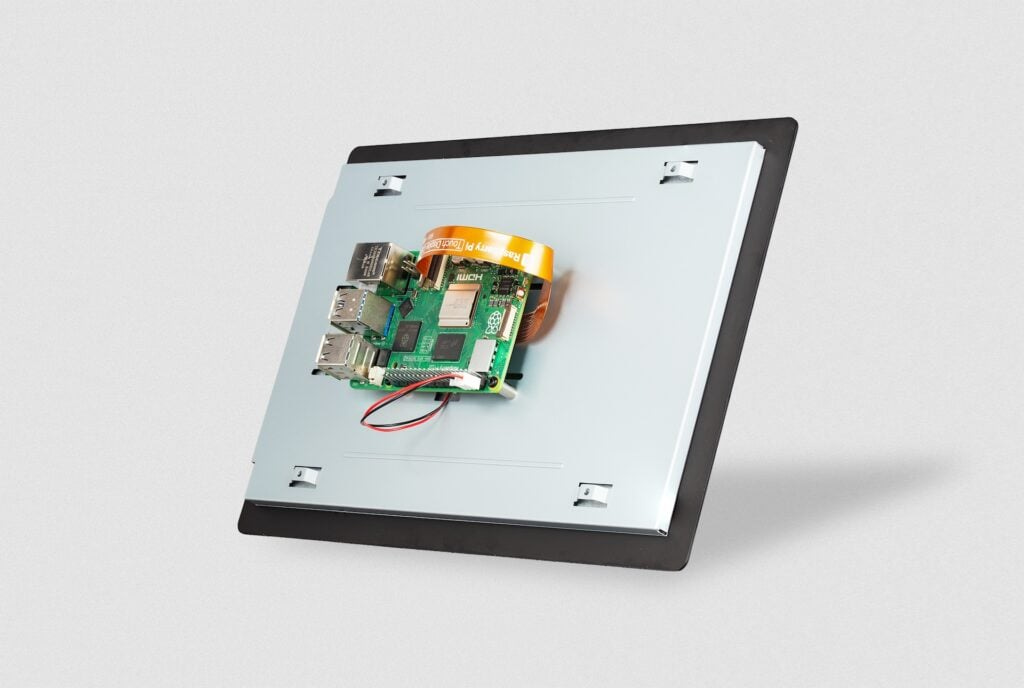
Physical size is not the only upgrade. Our new 10″ display features a higher 1200×1920–pixel resolution, a more generous 85-degree viewing angle, and a touchscreen controller with support for ten-finger touch, up from five-finger touch in the 5″ and 7″ variants.
As with all our display products, the 10″ Raspberry Pi Touch Display 2 integrates seamlessly with the rest of the Raspberry Pi ecosystem. It is powered directly from the host Raspberry Pi, and comes with all the necessary cables, connectors, and mounting hardware. The capacitive touchscreen benefits from full driver support in Raspberry Pi OS — simply update the operating system and EEPROM bootloader on your Raspberry Pi 5 or Raspberry Pi Compute Module (any model, with a Raspberry Pi Compute Module IO Boardor another suitable motherboard), connect the display to the device, and go.
The 10″ Touch Display 2 is not compatible with Raspberry Pi 4 or earlier models, or with the Raspberry Pi Zero series. While previously released Touch Displays use only two lanes of DSI data to communicate with the host Raspberry Pi — which works well with the older display connector on Raspberry Pi 1, 2, 3 and 4 — the higher resolution of the new 10″ variant requires four DSI lanes. This in turn requires our narrower, but higher-bandwidth, ribbon cable and the newer display connector found only on Raspberry Pi 5 and the Compute Module IO boards. For display options you can use with earlier Raspberry Pi computers, take a look at the 5″ and 7″ variants of Raspberry Pi Touch Display 2, or consider the Raspberry Pi Monitor.
This kind of incremental and continuous improvement in the Raspberry Pi ecosystem is what keeps me as a rabid fan of Raspberry Pi, despite issues like increase in prices of units with lots of RAM (not the fault of Raspberry Pi).
At $80… I can imagine equipping a radio desk with an array of these. Someone’s going to quickly slap this together as an inexpensive alternative to iPads, Android, and ChromeOS tablets.
Version 5.4 rebuilds parts of the IQ signal handling that sits at the center of the radio. VFO performance is sharper, the complex mixing stage is more precise, and down-conversion runs cleaner than in earlier builds. Together these changes give a noticeable lift to receive quality, especially when pulling weak signals out of noise. The AGC function and AM detector were also updated so they work smoothly with the new DSP pipeline instead of fighting against it.
FM Mode Joins the Feature List
sBitx now supports narrowband FM, complete with squelch and CTCSS tone support. This opens the door to 10 meter FM operation and transverter setups that were not practical before. Squelch has also been added to AM mode, giving operators one more layer of control over what they hear.
There are a number of other improvements mentioned in this article including Controlled Envelope Single Sideband (CESSB) and
Networking With HPSDR Protocol 1
sBitx 5.4 now streams IQ data over Wi-Fi or Ethernet using HPSDR Protocol 1.
With FM operations on 10m, imagine this mated with a IP400 AMNC for IP400 on 10 meters!
How the U.S. Army Built a Telephone Network Across the Pacific in Just 18 Months — 1944 (YouTube)
Apologies in advance. This is yet another “AI” creation, with the usual bad, almost random visuals. My technique for these is to treat them like a podcast - all the information is in the narration, so I open these in the YouTube app on my phone, close the phone, and continue playing just the audio.
The one value of these “videos” is that they’re surfacing interesting stories about technology developed in World War II that I’ve never heard about, including this one. It’s easy to be jaded about the “old” technology of 80 years ago now, but when you factor in the technology they had to work with in that era… especially vacuum tube electronics and computing power measured in kHz clocks and tens of cubic feet, is pretty impressive.
I’m a fan (and former colleague doing volunteer work for ARDC) of Bob Witte K0NR. KONR is thoughtful and articulate, and I follow his postings on his blog K0NR Above Average Terrain. K0NR is one of the Directors of ARDC, thus he has a bit more “pull” in Amateur Radio than most of us, thus even more reason to pay attention to what he’s thinking and writing.
I don’t know how I missed this good article K0NR wrote in 2025, but I only recently saw it - The Case of The Shrinking Technicians. It’s a reasonably qualified (he explains the methodology) dive into actual numbers of US Amateur Radio licensees. When there’s some reasonable methodology being applied, despite the apparent rise in overall number of licensees, K0NR argues that the overall number of licensees is declining.
That article, at least in my mind, feeds into his most recent thinking about the US Amateur Radio Technician License - How to Fix the Technician License.
This last paragraph:
Basically… (apologies for oversimplification), K0NR proposes tinkering a bit about the privileges of the Technician class license to “get a taste” of HF operation.
… was a lazy shortcut for what K0NR actually said.
In an email response, K0NR said:
Actually, I proposed a more streamlined VHF/UHF-only version of the Technician license, tagging it the Communicator license. I proposed to lower the barrier of entry for the beginner. The key argument is to create a better on-ramp for folks wanting to get involved in ham radio. Then a number of the commenters said that the real solution was to give beginners more HF privileges, not take them away. Their argument is to include HF privileges (for Technicians) to KEEP new hams on board. I see some merit in this approach, which is close to what you proposed with the two tier licensing: Standard and Extra.
Recall that there is a proposal before the FCC (from 2018 !!!), just laying there in some filing cabinet or server, that would open up HF for Technicians. See https://www.arrl.org/Technicianenhancement
My apologies to K0NR for my lazy shortcut, and my thanks to him for the graceful and thoughtful followup.
Brian Webster N2KGC is the Newest Zero Retries Pseudostaffer
It’s a long overdue “Honor” to award Brian Webster N2KGC the Exalted Title of…
Pseudostaffers are those who are fans of Zero Retries and support Zero Retries in many and varied ways - well beyond the occasional comment.
N2KGC is a careful and thoughtful reader of Zero Retries and frequently provides insightful comments. N2KGC is one of the few folks in the Zero Retries readership that are both as long experienced as I am in the glory days of AX.25 Packet Radio and willing to write and comment about it to me to support good coverage of AX.25 Packet Radio in Zero Retries.
Thanks Brian! Your Pseudostaffer badge will soon be on order and on the way.
ZRDC 2026 Ho!
Zero Retries Digital Conference (ZRDC) 2026 will be here before we (I) know it.
I’ve been doing a behind the scenes project of creating indexes for each year of Zero Retries. As I write this I’ve been working on “Year 0” - 2021 (now complete!) , and I came across this item in Zero Retries 0018 (2021-11-12) - Starlink Quietly Slips out of Beta Testing. It struck me that we had Plain Old Telephone Service for, what, at least fifty years before we considered it commonplace? Internet for twenty years before we considered that commonplace? Cellular - ten years?
Starlink… a mere five years? What’s astonishing to me is that Starlink has so much capacity that it’s being used as infrastructure for other telecommunications system. I’ve read that it’s now being used as backhaul communications for isolated villages that had been using (very expensive and not very good) Geosynchronous Earth Orbit satellite links as backhaul. With Starlink, these backhaul links are faster, have much lower latency, and much cheaper. The same for remote construction sites, islands that aren’t served by undersea cables, not to mention vessels, airplanes (even private planes), even vehicles that are doing cross country road trips to avoid the dead zones (even on major highways) of cellular coverage.
My favorite Starlink story is a dad that loved to go boating on the weekends but had trouble talking the family into coming along because the teenagers hated not having connectivity after the boat went out of (terrestrial) cellular coverage. But as soon as he installed Starlink on his boat… no problem with the teenagers, because Starlink provided full connectivity and the teenagers were no longer out of connectivity for hours.
Now… it’s not unheard of to bring a Starlink Mini on a hiking trip11, especially as part of a group so everyone can check in with the loved ones, and keep up with sports and emails, and (if you have enough power), stream a movie for the evening’s entertainment. Oh, and of course, share out the day’s selfies and scenery photos.
It seems like there’s even going to be a Mini 2, which will (reported) include a built-in battery. See ZR > BEACON - Starlink Mini 2 Will Have a Built In Battery (Rumored) in this issue.
KB6NU Nice Mention of Zero Retries Email List Discussion About US Licensing Revisions
One lump or two (or three)? - Dan Romanchik KB6NU gives a nice shoutout to a one of the most vigorous discussions on the Zero Retries email list:
Steve, N8GNJ, the fellow behind the Zero Retries newsletter, is trying to re-ignite this debate.
(By the way, if you haven’t already subscribed to Zero Retries, you really should, at least if you’re concerned about the future of the hobby. Despite the way he capitalizes “Amateur Radio,” a la the ARRL, it’s well worth reading. And, it’s completely free, although Steve is very happy to accept donations.)
In issue #258, N8GNJ published an article titled, “Fixing the US Amateur Radio Licenses.” The article, which references a blog post by Bob, K0NR titled “How to Fix the Technician License,” In it, he says that many new hams aren’t all that interested in HF, and consider the current license structure, which is a holdover from the old incentive licensing days, to be a disincentive for upgrading only to obtain more HF privileges. He says that the current licensing structure, “smacks of gamesmanship / hoop jumping / jerking them around, and simply, [new hams that Steve calls “new tech hams] have no patience for such things.” I think that he’s right, up to a point, about this.
Steve proposes that we combine the US Amateur Radio Technician and General Licenses into a single license that has all the privileges of the current General Class license and to promote all of the current Techs to this Standard Class. He would make the test for this Standard Class a bit more challenging technically, adding questions about digital technology and software-defined radio, topics which he feels are more relevant than “arcane radio circuits or formulas that aren’t necessary to operate with current off-the-shelf equipment.”
This article has started an interesting discussion on the ZeroRetries discussion group. There, the idea of a two-tier license structure is quite popular, although the form of that structure varies from person to person.
Several advocate for just a single license class and test. I’m not sure that’s a good idea, as you’d have to make that test quite difficult, and that would discourage many people. One fellow suggested a single class of license with endorsements for things such as “VE/VEC stuff, spread-spectrum operation, high-power operation, encryption, and Operational Compliance Observer (Radio Police).”
KB6NU is a thought leader in Amateur Radio, and one of the few who has the courage to be outspoken about Amateur Radio and its many structural issues. KB6NU is a regular (and early!) source of inspiration for Zero Retries and is one of the Zero Retries Pseudostaffers.
I Missed Open Sauce 2026 and Teardown 2026
Open Sauce 2026 was 2026-07-17 thru 19 at the San Mateo County Event Center in the San Francisco Bay Area, California. It looks like about as much fun as an adult (or young) techie can have, amongst hundreds of like-minded exhibitors and thousands of appreciative fellow fans. Open Sauce seems to me to be the white-hot center of the Maker movement and where techies-for-fun go to seek inspiration (and inspire) their peeps. It seems to have eclipsed Maker Faire and even Burning Man. With family commitments, it just wasn’t possible to attend Open Sauce 2026… but wow, I wanted to. To get a flavor of Open Sauce 2026, there’s ample YouTube videos.
Teardown 2026, sponsored by Crowd Supply, was 2026-07-24 thru 26 in Portland, Oregon was a very near miss for me. We had a family event planned for that same weekend. If not for that, attending Teardown 2026 in nearby Portland would have been a slam dunk. One of the highlights would have been seeing QuadRF there… and asking lots of questions.
Maybe 2027…
Summer Doldrums in Zero Retries Interesting Hamisphere?
I had to add this last bit. I really thought that “things would slow down” this summer in the Zero Retries Hamisphere. There was nothing (that I knew of) trending that was going to be significantly disruptive. That is, until about six weeks ago when Martin Alcock VE6VH got back in touch and began teasing about “something interesting” in IP400, and would I like to be the first to write about it? I had some inkling about OFDM-AB, but had no idea, until the past week, about the IP400 Advanced Mesh Network Controller (AMNC).
All of the sudden… all my expectations and outlook on Amateur Radio networking have been completely reset… and supercharged. I really can’t wait to get my hands on some AMNCs and begin experimenting in N8GNJ / Zero Retries Labs and perhaps seed some of my local co-conspirators with plug and play units for some actual beyond-the-lab experiments.
Weekends Are For Amateur Radio!
Good weather this weekend, and no major conflicting commitments for the moment, so perhaps there will be time spent in N8GNJ / Zero Retries Labs.
Have a great weekend, all of you co-conspirators in Zero Retries Interesting Amateur Radio activities!
My ongoing Thanks to: Tina Stroh KD7WSF for, well, everything! Jack Stroh, Late Night Assistant Editor Emeritus Fiona and Shreky Stroh, Late Night Assistant Editors In Training
Founding Members who generously support Zero Retries financially: Founding Member 0000 - Steven Davidson K3FZT (Renewed 2026, 4th year!) Founding Member 0001 - Randy Smith WU2S (Renewed 2025, 3rd year!) Founding Member 0002 - Chris Osburn KD7DVD (Renewed 2026, 4th year!) Founding Member 0003 - Don Rotolo N2IRZ (Renewed 2026, 4th year!) Founding Member 0004 - William Arcand W1WRA (Renewed 2025, 3rd year!) Founding Member 0005 - Ben Kuhn KU0HN (Renewed 2025, 3rd year!) Founding Member 0006 - Todd Willey KQ4FID (Renewed 2025, 3rd year!) Founding Member 0007 and 0010 - Merik Karman VK1DF / VK2MKZ (Renewed 2025 x2, 3rd year!) Founding Member 0008 - Prefers To Remain Anonymous 08 (Renewed 2025, 3rd year!) Founding Member 0009 - Prefers To Remain Anonymous 19 (Renewed 2025, 2nd year!) Founding Member 0011 - Rick Prelinger W6XBE (Renewed 2025, 2nd year!) Founding Member 0012 - Ryan Tolboom N2BP (Renewed 2025, 2nd year!) Founding Member 0013 - Newton White N4EWT (Renewed 2026, 2nd year!) Founding Member 0014 - Joe Hamelin W7COM (Renewed 2026, 2nd year!) Founding Member 0015 - Rich Stocking N7OP (Renewed 2026, 2nd year!) Founding Member 0016 - Chuck Hast KP4DJT (Renewed 2026, 2nd year!) Founding Member 0017 - Phil Karn KA9Q (New 2025) Founding Member 0018 - Prefers To Remain Anonymous 95 (New 2025) Founding Member 0019 - Prefers To Remain Anonymous 0108 (New 2025) Founding Member 0020 - Prefers To Remain Anonymous 110 (New 2025) Founding Member 0021 - Prefers To Remain Anonymous 111 (New 2025) Founding Member 0022 - Prefers To Remain Anonymous 112 (New 2025) Founding Member 0023 - Prefers To Remain Anonymous 116 (New 2026) Founding Member 0024 - Rob Bowser (SPOOLTENNA) (New 2026) Founding Member 0025 - Dave Stewart K7XST (New 2026) Founding Member 0026 - Prefers To Remain Anonymous 32 (New 2026)
Numerous Annual and Monthly subscribers who also generously support Zero Retries financially!
You thousands of readers of Zero Retries without which there would be little point in publishing this newsletter.
Fair Use - All excerpts from other authors or organizations, including images, are intended to be fair use and are fully attributed generally by author and link (URL).
Paid Promotional Content - Unless otherwise noted in the article or item, advertisement, or sponsorship notice, Zero Retries does not include paid promotional content. Exceptions:
Advertisements in Zero Retries,
Sponsorships in Zero Retries,
Zero Retries products,
Zero Retries events
Features and content exclusive to paid subscribers.
The Zero Retries email subscriber count continues to increment, despite multiple “unsubscribes” that follow the publication of every issue. Zero Retries isn’t for everyone.
I often cite the (out of production) Kenwood TM-V71A as a representative “data” radio with flat audio connections because it is one of the most widely used Amateur Radio units used for data. It’s my favorite “data” radio.
CTCSS - Continuous Tone Coded Squelch System - subaudible tones added to the transmitted signal to access a specific repeater when there are other repeaters on the same frequency. Often referred to as “PL” - Private Line, Motorola’s (formerly) trademarked term for CTCSS, now in general use.
For a 12 volt adapter for the Starlink Mini, I strongly recommend buying Starlink’s 12 volt adapter for Starlink Mini. I’ve read of some bad experiences using the units on Amazon.
Taking a Starlink Mini on hiking or camping trips. Yes, there are lots of folks, perhaps even the majority, who view hiking or camping trips as a way to get away from always-on connectivity. Understood… but some of us would rather at least have the option of having connectivity.