2026-09-25 - ZRDC 2026 Update, The Tao of ZRDC, APRS Foundation Comprehensive Strategic Plan, More on AR ATSC 3.0, Video in 2.25 kHz, GNU Radio in a Browser, Modern Radio Broadcast Protocol (HQFBP)
Zero Retries is an independent newsletter promoting technological innovation in and adjacent to Amateur Radio, and Amateur Radio as (literally) a license to experiment with and learn about radio technology. Radios are computers - with antennas! Now in its sixth year of publication, with 3600+ subscribers.
Optional Paid Subscriptions, and especially Founding Member subscriptions to Zero Retries not only help offset various expenses incurred in publishing Zero Retries, but also are a large portion of the “seed capital” that is needed to host Zero Retries Digital Conference (ZRDC) 2026, and future ZRDCs. Thank You!
My thanks to Ben Kuhn KU0HN for renewing as Founding Member 0005 to Zero Retries in the past two weeks (4th year)!
My thanks to Prefers To Remain Anonymous 47 for renewing as Founding Member 0018 to Zero Retries this past week (xx year)!
Founding members are listed in every issue of Zero Retries!
My thanks to Harris Butler NN0Y for renewing as an Annual Paid Subscriber to Zero Retries this past week!
My thanks to Prefers To Remain Anonymous 95 for renewing as an Annual Paid Subscriber to Zero Retries this past week!
My thanks to Prefers To Remain Anonymous 137 for becoming a newAnnual Paid Subscriber to Zero Retries in the past two weeks!
Financial support from Zero Retries readers is a significant vote of support for the continued publication of Zero Retries.
By Tina Stroh KD7WSF Zero Retries Digital Conference Manager
This is the sixth in a series of updates leading up to Zero Retries Digital Conference 2026.
We are counting down to ZRDC 2026 with just three weeks until conference day! This week, I have confirmed all of our speakers, the menu has been set for a welcome breakfast, we have received an additional door prize, media releases sent to various amateur radio blogs, invitations sent to Oregon and California Ham Radio Clubs, and invites sent to California and Oregon colleges and universities with active amateur radio clubs. In total, over 400 emails have gone out.
There are two items I would like to review regarding registration. First, if at all possible, please register by 10/9/2026. Like last year, I will need to give the venue a head count for breakfast. It will be possible to register at the door but unfortunately, it would not include breakfast. So, please register ASAP.
The second item is the types of registrations. I have created various ways to attend the conference. For instance, if you prefer not to attend in person, you can purchase a virtual ticket. With an added expense to us, we have asked our AV vendor to set up a live feed so that anyone purchasing this ticket can see AND participate just as if you were in the conference center. Another option for those who may not be available on 10/16/2026 is to purchase the conference video prior to its release date to the public. With these options, I continue to encourage people to attend in-person as nothing can take the place of face to face conversations with fellow Hams or joining in a panel discussion, however we do respect and honor travel and time constraints.
Roster of Speakers
Steve Stroh, N8GNJ Topic: Review of ZRDC 2025, Update on LinHT Project, AMSAT CubeSatSim
Glen Popiel, KW5GP Topic: Microcontroller Communication Technologies and Protocols for Ham Radio
Mooneer Salem, K6AQ Topic: Free DV
Craig Lamparter, KM6LYW Topic: Digi Pi
Jeff Scoville, AE5ME Topic: M17
Cale Mooth, K4HCK Topic: NewTechHams
Dave Platt, AE6EO Topic: Open TNC
Martin Alcock, VE6VH Topic: IP 400
Panel Discussion regarding encryption: Steve Stroh, N8GNJ Bruce Perens, K6BP Craig Lamparter, KM6LYW Others TBD
Hospitality
Because the conference will be starting early and many local people may be traveling, there will be morning refreshments/Continental Breakfast to get your day started. Donated by your hosts Tina and Steve Stroh.
Lunch will be on your own at any of the five restaurants and food stations directly in the conference center. Unfortunately, no outside food can be brought into the Conference Center per their rules. However, there is outside seating for those who wish to bring their own food. Coffee, tea and infused waters will be available all day.
Door Prizes
Unlike other events, you will not need to purchase additional tickets to win a door prize.
Each in-person registered attendee will have a door prize ticket in their registration packet / goody bag that will be given to the attendee upon arrival.
Donors and Door Prizes include:
GigaParts: five (5) QRZ-1 radios. The Explorer QRZ-1 VHF/UHF 5W handheld transceiver that can be personalized with your name and callsign.
AllScan.info: five (5) UR150 USB Radio Interface - AKA AIOCC++
CentyLab: three (3) Pocket PD HW 1.3 - Anderson Powerpole version and six (6) PPS Trigger V2.2
NA6D: five (5) AIOC assembled with enclosure and two (2) OpenTNC with both cables.
Sponsors:
We we would like to thank our sponsors for their gracious donations:
A Zero Retries reader recently took me mildly to task for “blathering on constantly about Zero Retries Digital Conference (ZRDC)”. They asked “What… is the big deal about this conference of yours?”
I think that ZR reader raises a fair point that deserves an answer.
Many of the most profound experiences of my Amateur Radio career, that has been the basis of a lot of info that I impart here in Zero Retries, has been from attending a number… perhaps as many as fifteen or so, (Amateur Radio) Digital Communications Conferences (DCCs) in various cities in North America.
I also helped Tina host DCC 1996 and DCC 2013 in the Seattle, Washington area, which were the first and second best-attended DCCs. Tina and I assisted TAPR with a number of DCCs after DCC 1996. Tina and I also negotiated with TAPR to host DCC 2017 in the Seattle area, but those negotiations just didn’t quite work out.
Attending the DCCs has been intense experiences for me. You can be around and listen in on conversations by some of the smartest people in Amateur Radio about some of the most interesting projects and technology in Amateur Radio. You can also ask questions and learn from those smart people. An Amateur Radio DCC is qualitatively different than professional conferences because we’re all “just Hams” and everyone at a DCC is universally helpful, informative, and pleasant. I just couldn’t help but get excited about the incredible possibilities inherent in Amateur Radio from those exposures to smart people doing interesting things in Amateur Radio. Not only did those experiences influence my Amateur Radio career, but they also meaningfully contributed to my “work” career path from being an electronic technician into being a technology writer.
Disclaimer - Most of what follows about the history of the DCCs is from personal memory, which is incomplete and may be faulty.
Terse History of the DCCs
The first “DCC” (actually, the ARRL Computer Networking Conference)1 was held in 1981 and there has been an annual DCC through 2023 - more than four decades! From 1993 through 2023, the DCC has been hosted by TAPR with some assistance from ARRL. In the final decade of (what I call) the TAPR DCCs, they were organized by a small pool of volunteers at TAPR, primarily Steve Bible N7HPR.
One of the complexities of the TAPR DCCs was an early decision to “rotate them around North America”. That meant that every year, much of the work of planning a DCC had to start from scratch - a new city, a new venue, etc.
Tina and I both witnessed the “power” of the DCCs. Just one small vignette was a trial at DCC 1996 (I think) to host two students to present an academic paper at a DCC. There was a “Call for Student Papers” and the submissions were professionally vetted by several academics associated with TAPR.
I think that ARRL contributed financially to a small stipend for the expenses of the two finalist students to travel to the DCC, along with a small cash award. My impression was that traveling to and presenting at DCC was formative for those two students
But, over the past decade, putting on the DCC had become increasingly expensive and complex.
2023 ARRL and TAPR Digital Communications Conference (DCC)
The officers and directors of TAPR are weighing the options for holding a Digital Communications Conference this year. Most likely it will be an online virtual conference rather than a live in-person conference. An announcement concerning the DCC will be forthcoming soon.
The 2024 ARRL/TAPR Digital Communications Conference is scheduled tentatively for September 20-21, 2024, in Knoxville, Tennessee. Phil Erickson, W1PJE, Director of the MIT Haystack Observatory, has agreed to be the DCC banquet speaker.
After careful consideration and weighing all available options, we regret to inform you that the 2024 ARRL/TAPR Digital Communications Conference (DCC), scheduled for September 20-21, 2024, has been cancelled. This decision was not made lightly, but due to logistical challenges, we believe it is in the best interest of all involved.
We understand the inconvenience this may cause and sincerely apologize for any disruption to your plans. We appreciate your understanding and support during this time. Should you have any questions, please do not hesitate to contact us.
That was the last mention of a TAPR DCC (that I’ve seen, to date).
At Hamvention 2025, at the TAPR booth, I talked to one of the TAPR officers, and that person told me (paraphrased):
TAPR is out of the DCC business. We just don’t have the resources anymore.
Genesis of the Zero Retries Digital Conference
Having seen all the cool things that happen at DCCs, and the beneficial effect of the DCCs on Amateur Radio, Tina and I felt that it was a real loss for Amateur Radio to not have an in-person, three day DCC.
After the announcement of the cancellation of TAPR DCC 2024, Tina and I began casually brainstorming how / when to put on a conference as an outgrowth of Zero Retries. We felt we had a few advantages that we could leverage for a new version of a DCC2:
Publishing Zero Retries for more than three years has provided a wide perspective of various technological innovations that were occurring in Amateur Radio.
Tina and I have a tight “coordination loop”. We’re both retired, live in the same household, and Tina is fantastically organized.
We had some “seed capital” to work with from the (optional) paid subscribers, especially the Founding Members, of Zero Retries.
We don’t feel constrained that we have to follow the same format, etc. as the TAPR DCCs.
Since the TAPR DCCs were no longer being held, in creating our own conference, we weren’t going to be competing with the TAPR DCC.
In early 2025, we learned that the GNU Radio Conference (GRCon) 2025 would be held that September in (nearby to us) Everett, Washington. GNU Radio is, of course, Zero Retries Interesting and Tina and I decided to offer our services to GNU Radio since we were local, and none of the GNU Radio staff were local to Everett. We quickly learned that none of the GNU Radio staff had seen the venue in person.
Not only did we have a great time working with the GNU Radio staff for GRCon 2025, I was able to attend GRCon 2025 for the entire week and I learned a lot.
GRCon 2025 was Monday through Friday, and Tina and I quickly realized that “tagging on” to GRCon 2025 and its venue was an ideal opportunity to realize our ideas for our Zero Retries Digital Conference. We scrambled a bit, and (the first) Zero Retries Digital Conference 2025 was held on Saturday, September 13, 2025 at the same venue as GRCon 2025.
We consider ZRDC 2025 a great success, especially for a very small team and only a few months of preparation. Everyone who attended ZRDC 2025 seemed to have a great time and learned a lot. Most importantly, we were strongly encouraged to do a ZRDC in 2026.
ZRDC Content Mix
One of the things I observed at the TAPR DCCs, particularly the last decade or so is that the content mix of the speakers was pretty ad hoc, at least compared to the content mix of prior decades of the DCCs. TAPR would post a notice that the DCC was accepting proposals for speaking and technical papers for the upcoming DCC… and whoever responded, on whatever topic, became the agenda. Other than a preference for “digital” related to Amateur Radio, there was little curation of topics.
When considering the content mix for Zero Retries Digital Conferences, we had a strong advantage of a high-level view of the technological innovation that was occurring in Amateur Radio. Thus we had a good overview of “who was doing what” that would make for an interesting presentation at ZRDC. At ZRDC 2025, Tina and I were particularly proud that we presented some new, unique technological innovations in Amateur Radio such as The KK7NQN Transcriber Service Node by Hunter Inman KK7NQN and Earth Moon Earth With Software Defined Radio by Dennis Rosenauer AC7FT.
Fast forwarding to ZRDC 2026, we’ve applied the same “filter” of technological innovation occurring in Amateur Radio in 2026, with a (mostly) new mix of Zero Retries Interesting topics.
At ZRDC 2026, there will be demonstrations including the AMSAT CubeSatSim and an M17 repeater, hopefully M17 data communications, and a demonstration of the new NA6D OpenTNC (especially the use of FX.25 and AX.25 Version 2.2). We had hoped to demonstrate the new IP400 Advanced Mesh Network Controller (AMNC) board, but unfortunately the timing of “production” AMNC boards wasn’t compatible with the ZRDC 2026 schedule.
As for replicating the three-day experience of the TAPR DCCs, that is a long-term goal for future Zero Retries Digital Conferences. But, we’re still learning how to do marketing that’s effective enough to attract enough attendees to financially justify a three-day standalone conference. Or, alternatively, finding the right mix of attendees and fiscal sponsors.
I very, very nearly missed this development. I’ve been checking the APRS Foundation website for “signs of life” for some time (I’ve had high hopes for the organization). I did so again today in preparation for a couple of articles in this issue. At a glance… no signs of life - the last article on the main page was APRS updates - July 2025.
But, because I’ve visited this website a number of times, I noticed “something” at the last moment (I had actually clicked away from the website). I returned to the website and noticed a new item on the top bar:
Strategic Plan
OK, maybe that’s worth a quick check. I’m glad I did.
The following is merely some bare bones intro of the 34 or so pages of this document. There’s a lot of substance to this document and it’s going to take time to digest, but I think it will be worth doing so.
Letter from John Tarbox (WA1KLI), the Foundation President
May 20, 2026
Dear APRS Enthusiast,
Thank you for taking the time to read and consider our project, the APRS Foundation’s
Comprehensive Strategic Plan. I personally knew the inventor of APRS back in the day, Bob Bruninga, WB4APR (SK), and I like to think that he would be proud of his creation and of what we, the APRS Foundation, are working on to keep it alive.
My team has labored for over a year on this plan. It took long hours of deliberation, research, and late nights to come up with a strategy that would carry Bob’s vision forward as he intended: to have APRS owned and developed by the ham radio community. We believe this plan embodies this very idea: APRS is so large now that it does need some organization, but that organization must come from the APRS hams themselves.
This plan represents our best effort to help the APRS community today and for many, many more tomorrows. It will change and adapt, like everything in Amateur Radio, but this is where we begin, and that beginning represents a lot of effort yet to come.
If, after reading this plan, you are interested in helping make any of this happen, please use the Contact Us form to reach out! We can use all the help we can get!
Thanks for being part of this amazing hobby!
John Tarbox, WA1KLI President APRS Foundation
…
Introduction
Welcome to the APRS Foundation’s Comprehensive Strategic Plan. This document details the Foundation’s long-term (more than 10 years) perspectives and goals on how it can best serve the APRS community today and tomorrow. Strategic plans are living documents and can change as the Foundation and APRS changes over time. What is presented here are our best ideas as to what the Foundation can provide to help keep APRS working and relevant. Over time the goals in this document will become more refined and true. We welcome you to be a part of that process by engaging with the Foundation on any of its strategic goal teams.
Until the passing of Bob Bruninga, WB4APR (SK), APRS’s direction and vision was held by one man, the inventor of APRS, Bob. The Foundation recognizes that since Bob first published APRS in 1992, APRS has grown to become a world-spanning ecosystem. This size and complexity go well beyond Bob and his initial vision: it is people from all parts of the globe coming together with different solutions and technologies to form a whole ecosystem of what APRS is today. Because of the sheer size and complexity of APRS the Foundation believes cooperative teams are needed to maintain a unified strategic heading with APRS while managing the adoption of new technologies into the ecosystem.
This document does not linger on the detailed definition of APRS. That is left to the technical aspects of the APRS Standard and APRS Reference Implementation. What this document does do is establish the core principals the APRS Foundation believes must be present in APRS to be successful long-term. Those strategic principals are then extended to activities and outcomes that support those principals. You’ll find those later in this document.
If you’re interested in helping the APRS Foundation, please use the Contact Us form to reach out!
The APRS Foundation is always looking for people who are invested in APRS and want to see the best for it and the amateur radio community.
Strategic Plan Components
The APRS Foundation’s Strategic Plan encompasses the following:
A definition of what APRS is and is not.
This definition is critical to understand what the Foundation will focus on in a world that widely uses the term “APRS”. While we believe APRS is specific, the term “APRS” has come to mean a wide variety of similar things that may often change. While some “APRS” things will naturally fall outside of our definition, we don’t assert that they aren’t APRS. The definition we use focuses the Foundation’s efforts solely on specific, achievable deliverables.
A statement of purpose.
Following the passing of Bob Bruninga, WB4APR (SK), the Foundation believes there is a need for a more formal effort to maintain the APRS community.
Specific strategic goals.
We have identified a series of must-have strategic goals that we believe make APRS a success for Amateur Radio. These are the goals that all our actions live up to.
A set of “within-the-next-few-years” deliverables to the community.
The Foundation has identified a set of tasks and an organizational infrastructure that will best serve the entire APRS community. The Foundation will assist in building these deliverables in accordance with our must-have strategic goals.
Again, roughly 34 pages (per my printer setup). As for me, I’m going to print this out (yes, guilty as charged for being old school) and mark it up and then follow up.
Kudos to the authors of this document:
John Tarbox WA1KLI
John Langner WB2OSZ
Pete Loveall AE5PL
Jason Rausch K4APR
Ron Startzel KB5LNC
Don Rolph AB1PH
Lion Templin K1LEO
because it’s a thorough deep dive of a vision of long term evolution and success for APRS and by extension, Amateur Radio in the 21st century.
Lastly, ’ll permit myself one “snipe” at APRS Foundation leadership:
Why didn’t you publicize this significant document far and wide and loudly?
It’s a very significant document and worth a serious study and consideration by anyone who cares about the evolution of APRS and its keystone role in Amateur Radio.
Well, maybe a second “snipe”…
Why didn’t APRS Foundation reach out to the techies / techie publications within Amateur Radio, including Amateur Radio Newsline, ARRL News, Zero Retries, and every “media” in Amateur Radio?
I’m well connected, well read on the subject of technological innovation in Amateur Radio… and I only accidentally found out about this - four months after it was released.
In my opinion, APRS Foundation could use some “marketing / promotion” help in getting the word out in the future.
ATSC 3.0 --- Ron [Economos], W6RZ, of Mountain View, California, also reports doing experimentation on ATSC 3.0. (w6rz@comcast.net).
…
This is a Zero Retries Interesting development! I had no idea that ATSC 3.0 equipment / systems had been driven downscale to the point where it might be feasible to use for Amateur Radio… though with all things SDR, ATSC 3.0 is probably mostly software. Maybe with the datacasting capability of ATSC 3.0, if it becomes adopted within US Amateur Radio, we could “bridge the divide” between realtime television folks and data communications folks on the same system / spectrum. This potential is actually kind of a SuperPeater.
I’ve emailed W6RZ for more details.
W6RZ replied with a lot of detail!
As you know, I have a GNU Radio OOT that implements an ATSC 3.0 transmitter.
It should run on any transmit capable SDR, but I’ve only tested it on the Ettus B210 and Nuand bladeRF 2.0. It only implements the PHY layer and the legacy Transport Stream interface, so it doesn’t work with regular ATSC 3.0 TVs or STBs. These devices expect the ROUTE/DASH packet layer that delivers video/audio.
However, it does work with the popular HDHomeRun FLEX 4K receiver from SiliconDust (which supports the legacy Transport Stream mode).
I have a couple of demo clips on YouTube. The first one is running on a BeagleBoard X15 to show that it doesn’t need a big CPU to run on.
The second clip is running at a negative (-2 dB) SNR. The SNR meter on the HDHomeRun doesn’t go below 0 dB, so you have to watch how I decrease the B210 power level to see how I arrived at my -2 dB estimate.
I haven’t made any real contacts. It’s all just between two rooms in my house. You’ll notice that the HDHomeRun is tuned to cable channel 65, which is 468 to 474 MHz (471 MHz center frequency). But I’m really transmitting on 2304 MHz (2301 to 2307 MHz) and using a Kuhne 2 GHz downconverter with a 1833 MHz LO. So 2304 -1833 = 471 MHz. This is so I can use small antennas with plenty of gain inside the house.
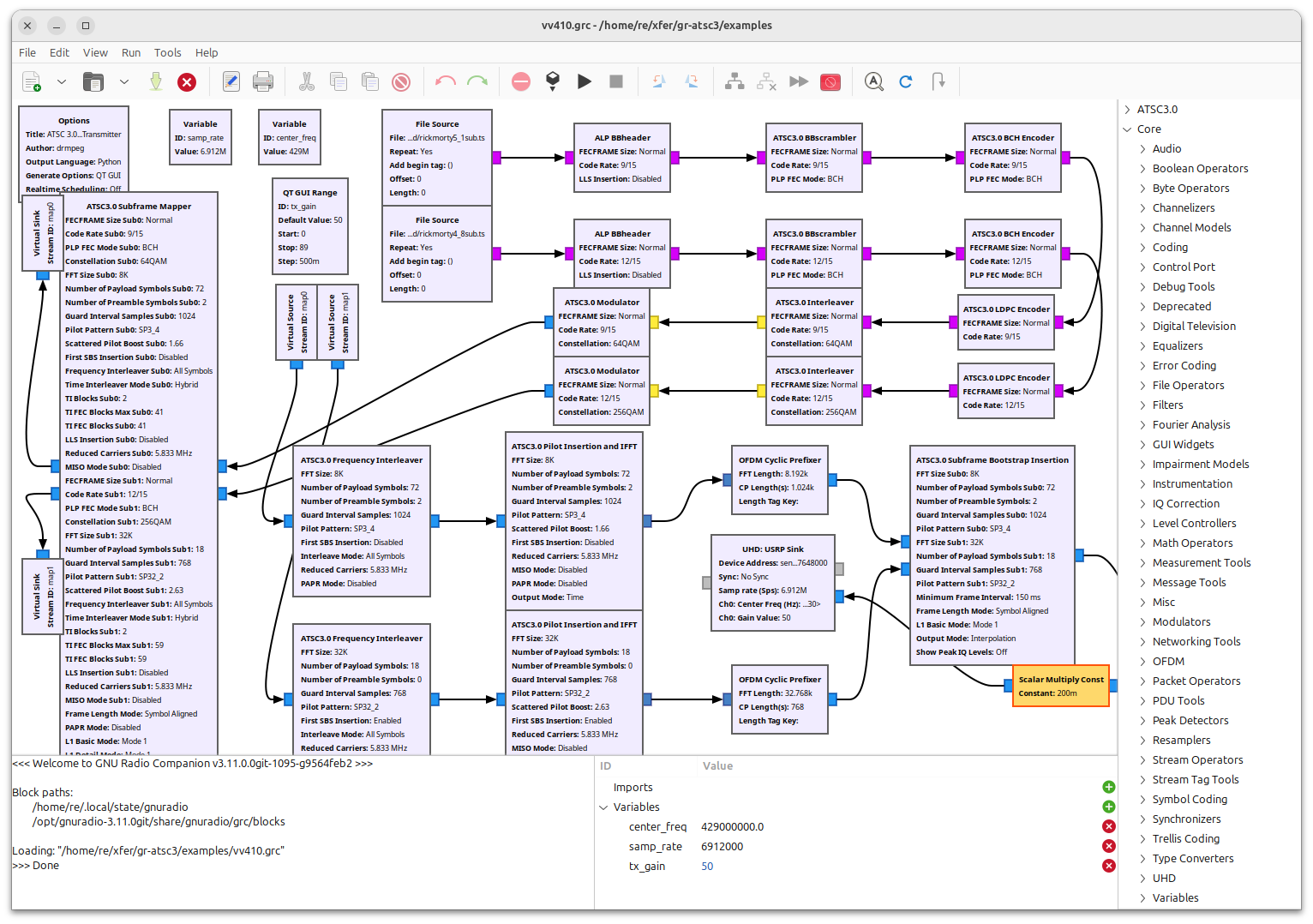
I’ve implemented almost the entire PHY specification including multiple stream modes (known as Physical Layer Pipes or PLPs). The only thing missing is MIMO (which there are no commercial receivers for). Here’s a pic of a flowgraph with a block that has a huge amount of parameters.
I did join the ATSC as an observing member. This was so I could get my hands on the verification and validation test vectors. These files test each block with a binary input file and an expected binary output file. I would not have been able to finish the project without them.
As for amateur radio use, I was happy to see KD6ILO getting some mileage out of gr-atsc3. However, most hams don’t like the complexity of GNU Radio and prefer packaged solutions like the HiDes DVB-T equipment.
D’Oh!Of course GNU Radio would have a version of ATSC 3.0 because GNU Radio does everything related to radio technology.
One of my takeaways from attending GRCon 2025 is that if you are able to develop a GNU Radio flowgraph, you don’t have to treat it like a perpetual prototype. It’s possible to “package” a flowgraph to “just run it” for the benefit of those, like me, who aren’t intimately familiar with GNU Radio. I don’t remember the details3, but that’s one of the many things (I think) I picked up at GRCon 2025.
After seeing in Zero Retries this week about ZL1WTT’s [full motion video in] 100 kHz project, I felt I should share with you my AETV project that can fit video into bandwidths as small as 2.25 kHz using an autoencoder based approach, similar to RADE. For more info, I have a blog post with video samples over both emulated and real paths at https://plaing.ca/posts/aetv/
It’s low resolution, and a bit... impressionistic at times, but it is moving pictures in some VERY small channels :)
It is still pretty early in development, and you might run into a few bugs here and there, but the core modes have all been tested over the air, primarily with FlexRadio hardware to KiwiSDRs for HF and PlutoSDR / RTL SDR for receive for the AC16 - 16 kHz wide mode, and seem to work pretty well given the extreme compression occurring here.
Feel free to send over any questions or comments!
VA7EET instantly intrigued me with this Zero Retries Interesting description of his experiments in the referenced blog post:
AETV - Teaching a machine to squish video where it shouldn’t fit
September 17, 2026 · 7 min read
What if we squeezed video through a radio channel barely wide enough for a conversation? AETV uses neural compression, questionable amounts of GPU time, and amateur radio to turn pictures into strange numbers, fire them through the ether, and politely ask another neural network to put them back.
The journey
Back in the middle of August, while farting around with new frontier LLM drops from Google, Anthropic, and OpenAI, an old idea I’d had for a couple of years resurfaced:
SSTV with convolutional autoencoders should result in higher-quality images under a similar power and bandwidth bottleneck.
That was the hypothesis, anyway. The fun part was finding out it actually works.
The appeal is pretty straightforward. I want to move pictures through a radio channel with very little room to spare, without losing the graceful degradation that analog SSTV provides.
He had me at questionable amounts of GPU time 🤣
Long-time Zero Retries readers are probably tired of me repeating this chestnut from my career writing about Broadband Wireless Internet Access. I was told in the early days of implementing OFDM in Broadband Wireless Internet Access systems, before it was widely used in mobile telephones and Wi-Fi, OFDM had been developed decades earlier. But… then it required the compute power of a (very expensive and very large) DEC VAX. For OFDM to be practical and widely used, technology had to catch up.
The “moral” of this story is to not make the mistake that a particular idea isn’t practical or doable because of current technology constraints or cost-effectiveness. If something can be implemented, however rude, crude, unattractive, not quite practical, or not yet cost-effective… eventually technology will catch up to make it practical and cost-effective.
There are gazillions of examples just in Amateur Radio. One of my favorite examples is the background single bit error passive correction technique in Dire Wolf, practical because why wouldn’t you put the idle CPU power to work doing something useful in an otherwise underutilized quad core 1.2 GHz 64bit CPU in a $35’ish Raspberry Pi 3B+ (or similar units).
I wonder if “questionable amounts of GPU time” falls within the capabilities of the newest consumer Macs?
The current “low end” MacBook Air ($1299) processor complement is:
Apple M5 chip
10-core CPU with 4 super cores and 6 efficiency cores
8‑core GPU
Neural Accelerators
Hardware-accelerated ray tracing
16-core Neural Engine
153GB/s memory bandwidth
Macs are now being bought solely because they are good enough platforms for doing offline (non-hosted) AI work. So, I bet they could handle the workload outlined by VA7EET for his low-bandwidth video experiments.
So apparently we’ll soon (enough) have full(ish) motion video in a narrow bandwidth! My thanks to VA7EET for imagining this possibility…
It just didn’t occur to me to imagine the possibility of video using the equivalent of an FM voice radio.
I really love the brain trust like W6RZ and VA7EET that has self-selected around Zero Retries.
GNU Radio, entirely in your browser — explore the open-source SDR ecosystem with zero install! GNU Radio World is a browser-based GNU Radio Companion flowgraph editor and WebAssembly runtime. It includes most actively maintained OOTs, dozens of example flowgraphs, and signal recordings to play with.
GNU Radio World includes a collection of RF recordings that are streamed to your browser when you use them within a flowgraph. Visit the Signal Recordings tab and try clicking the “View” button on one of the recordings to inspect it in the built-in recording view, adapted from IQEngine. Many of the included example flowgraphs use these recordings, so OOTs can be demonstrated with real recordings of their corresponding signals. You can also contribute your own SigMF recording.
This is another development that wouldn’t previously have occurred to me, but seeing it, it makes complete sense. This is a low-barrier way to experiment with existing GNU Radio flowgraphs that you’re curious about.
Michigan Publishing Services is the publishing arm of the University of Michigan, and you can freely download the PDF versions of a wide variety of their books.
This month’s edition of their newsletter, The Voracious Reader, features several electrical engineering books. If you really want to dig deep into the theory behind amateur radio and electronics, here’s your chance.
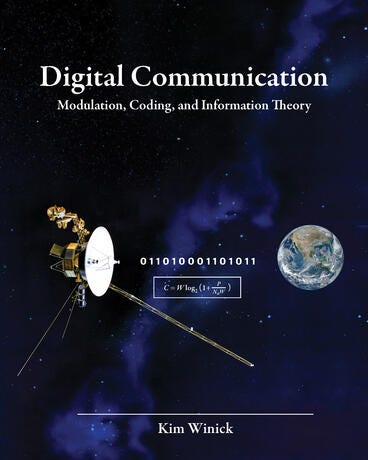
Digital Communications is one of the electrical engineering books featured in this month’s newsletter from Michigan Publishing.
You can find the entire selection of EE books offered by Michigan Publishing by going here. But, the first title to catch my eye was Digital Communications: Modulation, Coding, and Information Theory. Digital modes are a big deal in amateur radio today, and if you really want to understand the theory behind packet radio and FT8, I suggest you give this book a go.
Wow - what a great resource! I’ve read that universities and especially professors are increasingly creating their own textbooks so that can incorporate the elements they consider critical instead of assigning “additional reading beyond the textbook” and be able to make it available at no cost, via PDF, to their students, some of whom just would try to limp through the course without buying the (expen$ive) textbook.
My thanks to Zero Retries Pseudostaffer Dan Romanchik KB6NU for bringing this development to my attention for inclusion in Zero Retries.
Press Release from Alberta Digital Radio Communications Society (ADRCS)
Calgary, September 25th, 2026. We are pleased to announce that the development effort to verify the pre-production prototypes of the Advanced Mesh Network Controller has been completed, and it is now ready for production. The society has engaged Digital Hamstore Inc. to facilitate this effort, an agency that specializes in manufacturing and distribution through partner networks. The distribution channels and availability will be announced at the upcoming Zero Retries Digital Conference.
The Digital Hamstore site is currently “under construction” but it sounds interesting.
Post-publication Update - The Digital Hamstore site is live, and the first item listed under Projects is the Advanced Mesh Network Controller… but no details on availability or price.
Unfortunately the timing of the AMNC going to production means that there won’t be any units available to demonstrate in person at ZRDC 2026 in three weeks. But, Martin Alcock VE6VH promises a demonstration of his (development version) AMNCs as part of his (remote) presentation.
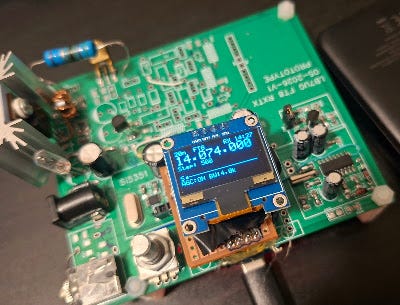
After taking a break from homebrewing, seeing the incredible creativity and dedication in the ham radio community completely inspired me to dive back in. I’m taking things slow this time around, focusing on a rough prototype that is incredibly easy to build upon, swap parts, and experiment with. My latest project moves away from legacy design complexities, opting instead for a modern, digital-first approach.
It’s a work in progress, but it’s a fantastic canvas for tinkering. I’m excited to see where this experimentation leads—stay tuned for updates as I continue to tweak
By pairing the dual-core processing power of the Raspberry Pi RP2040 with highly integrated, inexpensive breakout boards (the Si5351 and Si4732), this setup bypasses legacy design complexities to get you on the air quickly and cheaply. Plug a single USB cable into your PC or phone, fire up WSJT-X or FT8CN, and you are ready to transmit!
Project Philosophy: The Joy of “Good Enough” Radio
Let’s be clear: this project is not trying to compete with factory-built, precision instruments like the QMX or QDX. Those are highly optimized rigs with tightly engineered multi-stage filters and custom transformers. I could feel the amount of heavy work needed just by struggling with my FSK routines to send the FT8 audio to ether. Not to mention the other hurdles in putting everything into an orchestra!
Instead, this rig is all about complete hardware ownership and experimentation. It is an open sandbox proving that getting on the air with digital modes doesn’t require a $$$ commercial setup. It is pure, old-school amateur radio tinkering updated for the 21st century! If you want an out-of-the-box and inexpensive solution, I strongly recommend a QMX or QDX or G90.
Features
Single-Cable Digital Station (UAC2 + CAT): No external sound cards or tangled interface boxes. A single USB connection handles both bidirectional digital audio (24-bit/48kHz) and Kenwood TS-480 CAT control commands concurrently.Works with WSJT-X, qFT8, FT8CN, and FT8TW etc
Stand-Alone Beacon Mode: Test your antennas or propagation completely headless. Set up the radio as an independent, fully autonomous FT8 or WSPR beacon—no computer required.
“Type-to-Talk” CW Terminal: Plug into any standard serial terminal (like PuTTY, minicom, or screen). You can use a physical automatic keyer, or simply type text into the terminal to send beautifully timed Morse code over the air.
QMX-Style Interactive Serial UI: Includes a comprehensive terminal command suite. Type ? to explore, change bands, tune frequencies, calibrate the internal reference clock down to parts-per-billion (ppb), or check real-time system diagnostics.
Massive RX Coverage, Focused TX Power: Enjoy wide-open listening across the Si4732’s entire multi-mode spectrum (AM, FM, and shortwave SSB bands). For transmission, the firmware controls a simple Power Amplifier (PA) and Low-Pass Filter (LPF) switched across two targeted bands (easily expandable by mapping more GPIOs).
Rock-Solid Dual-Core Architecture: Core 1 dedicates its entire focus to flawless, low-latency DMA analog audio capturing. Core 0 manages the smooth graphics on the OLED, processes your encoder inputs, runs the beacon sequencing, and handles USB traffic without missing a beat.
This is one of those times where I feel like I’ve been living under a rock.
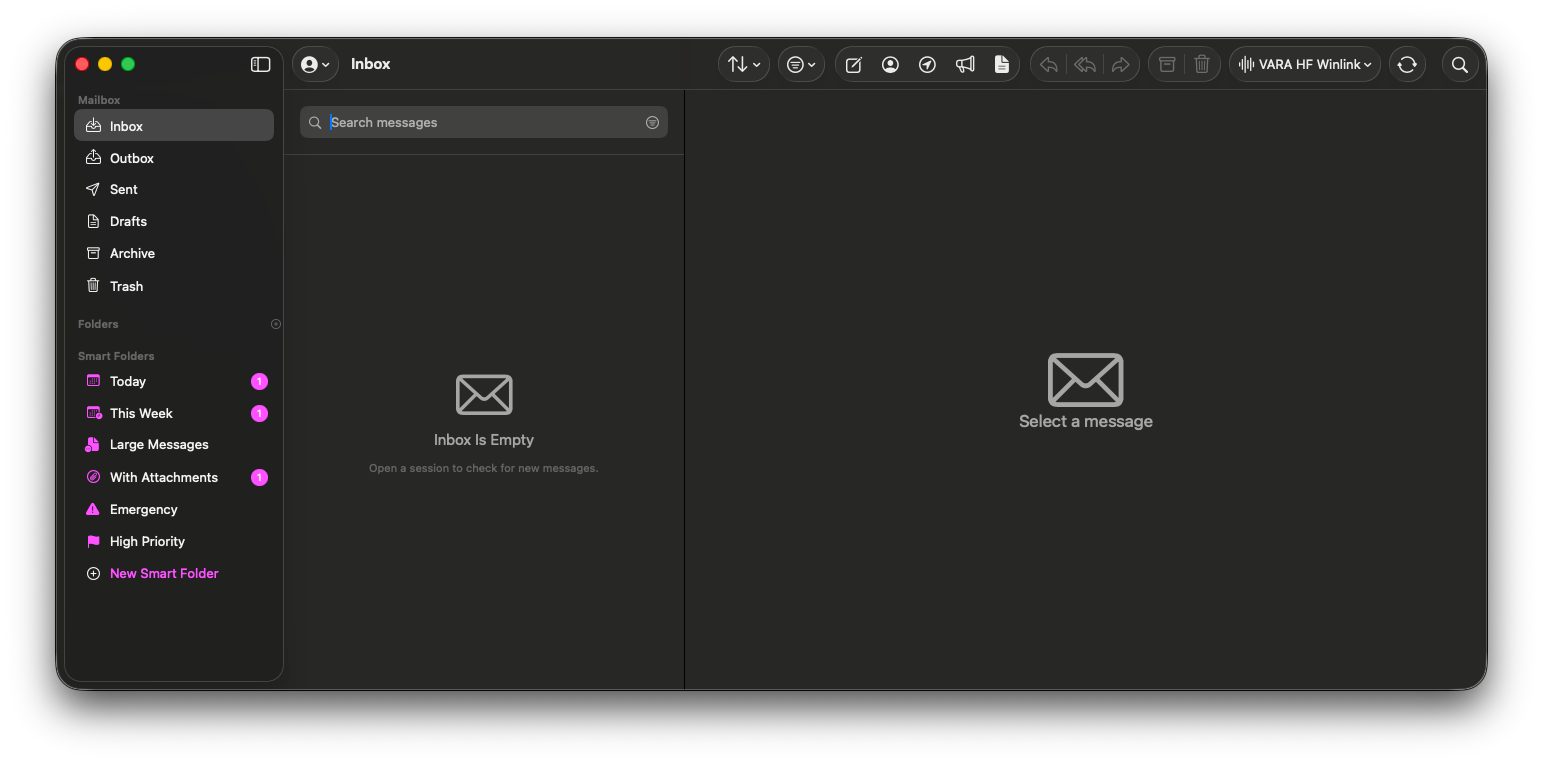
The main UI of the MacWinlink application. It looks like, well, a modern mail client.
Where Did This Come From?
I’m not sure when this project fired up, but it’s the kind of thing that I feel like I should have picked up on sooner. Oh well! At least I got to the party. And it is a party.
I’ve gone on at length about Winlink and the many and varied ways to send email over RF. My current GoTo system has been pat with a side helping of VARAHF most days running under a CrossOver (WINE) setup with rigctld as the backbone. Running this on my Mac Just Works™ and it makes me happy. pat on the command line is a dream. Easy to use, quick to configure, and available on any platform in my shack (mobile or otherwise).
For me, a person who is comfortable with the command line and rigctld and all of the other little bits and pieces that go into this process of getting an email sent, this isn’t a significant hill to climb. In fact, pat with its web UI is really, really easy to use. I recommend it all the time. I also spend some time putting together scripts for people that help them get this stuff running with a single command rather than remembering the other stuff. Top that off with a healthy conversation around modems and, well, yeah. In 2026 Winlink still isn’t a slam dunk. That’s a problem.
Enter MacWinlink!
…
Another trend I’ve noted that’s really taken off in 2026 is many, many new Amateur Radio apps that make operating Amateur Radio much more easy and intuitive thanks to really well-designed user interfaces. Some of this is undoubtedly due to software development getting easier / more efficient / faster from AI assistance. I think another trend is that talented software developers are finding their way into Amateur Radio, and start experimenting with various modes and software, and decide “this sucks; I can do a lot better”.
Well, if you are going to get the shiny new M6/M5 Mac Mini or the new iPhone Duo, you’re going to want great new and updated amateur radio apps to put on them, right? Well, there’s no shortage of good stuff to choose from. If you have a tip, news, or and good ideas for the bulletin, please contact me, Andrew VK2AWN. You can also download this bulletin as a PDF.
Items are presented alphabetically; mention doesn’t imply endorsement or use, and no listings are paid for or in kind. Items are sourced through social media posts, web sites and online news services. Pricing key (USD) $=1-9 - =10−24−$=25+. ???: Unsure of price. ***: Owned and used by the writer. First edition publishes on the second Friday of the month. The late edition publishes on the fourth Friday of the month.
Speaking of using Apple products in Amateur Radio getting more popular, in addition to the Mac Ham Radio website, we now have the Apple Amateur Radio Bulletin - a new newsletter (via Substack) by Andrew Woodward VK2AWN. One nice thing about Substack newsletters is that each one has a RSS feed, so I’m now following AARB in NetNewsWire.
Buy Online: Now shipping with May software release including Allscan built-in: Preview video from M0FXB:
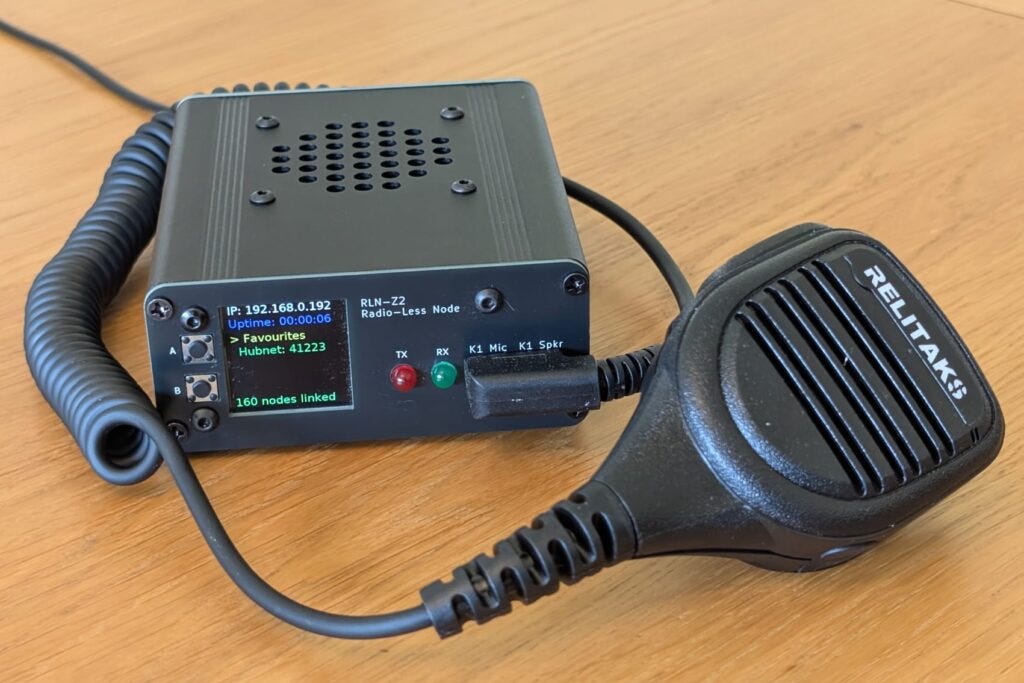
Introducing the new all-in-one appliance for AllStarLink and similar radio applications.
The unit contains all the required components to operate as an ASL node, fabricated into a sturdy aluminum enclosure with front-panel controls, no PC required.
What’s in the (Radio-less-node) RLN-Z2?
A powerful Raspberry Pi Z2 W processor with WiFi
32GB SD card with ASL3 and the G1LRO custom setup firmware pre-installed
1.25 inch color LCD screen with button navigation to select favorite node connections in ASL3
Audio interface based on the industry-standard CM108 sound processor
Powerful 2.5W amplifier with internal speaker – audio design by Allscan.info
Controls for microphone gain to support a wide range of microphone types
Line-out for connection to auxiliary audio equipment
Manual Bourns volume control and External speaker out
Sturdy 88x38x100(mm) extruded aluminum case with rubber feet
Front panel ‘K1’ microphone socket with supplied mic.
Powered from 5v USB-C (cable provided)
Amateur Radio Over Internet is getting ridiculously cool with products like this. This is a radio… without the complexities of radio circuitry and antennas. Those are “externalities” that are remoted “elsewhere”.
The only thing I would have preferred is a RJ45 connector for being able to use “big” microphones (for my above average sized paws) like those for mobile radios from Motorola or Kenwood, but that’s a very minor quibble.
This is the first post in a series exploring Delay-Tolerant Networking (DTN) and resilient communication stacks built for amateur radio, space payloads, and emergency networks.
The Simplex Noisy Satellite Challenge
The FOSM-1 Mission
The main goal of the FOSM-1 experimental satellite mission is to investigate and experiment the agility of radio communication protocols and onboard software. In addition to beacons, telemetry, and telecommands, one of the primary payloads involves broadcasting images and data captured from the onboard camera. It leverages the open source radio board Spino from Electrolab.
The Problem: simplex, noisy, and unconnected
Type of files: Bitmaps, telemetry, vector drawings, sensor logs, etc.
Link constraint: No feedback loop (no active ARQ/acknowledgment) due to power or orbit constraints.
Noisy channel: Designed for a Bit Error Rate (BER) of $10^{-3}$.
Under these constraints, existing amateur radio protocols show clear limitations:
AX.25 / PACSAT PFT: Heavy packet overhead.
PACTOR / WINLINK: Require active connected-mode handshakes (impossible in simplex broadcast).
FLAMP (FLDIGI): Too verbose for tight constraints.
The HQFBP Concept (Hamradio Quick File Broadcasting Protocol)
HQFBP was designed to serve as a lightweight, flexible, and robust file broadcasting layer. This was also a way for me to deep-dive into learning the basic building blocks for a radio protocol.
…
It is very cool that F4JXQ has recognized that current Amateur Radio “data broadcast” implementations are ripe for improvement. PACSAT is a step forward (and I’m looking forward to seeing it for myself in the CubeSatSim at ZRDC 2026). But that’s two decades old now. FLAMP is better, but in researching it, there’s more technology that could be applied to it. Thus I’m looking forward to learning more about Hamradio Quick File Broadcasting Protocol - HQFBP as it seems applicable for terrestrial use, such as Amateur Radio repeaters and mesh networks.
We have been working hard getting GNU Radio 4 ready for an official release. Part of this endeavor has been restructuring and refactoring the repositories for future maintainability, better build and CI efficiency, and the flexibility to support different licensing models across the ecosystem.
GNU Radio 4 is now organized around a super-repo builder capable of pulling together foundational projects such as the core runtime and key DSP libraries, modules containing both official and experimental blocks, and applications built on top of them.
We also wanted to make the whole thing really easy to build.
The current super-repo is now live at https://github.com/gnuradio/gnuradio4. It provides the top-level workspace that knows which repositories make up GNU Radio 4, their dependencies, and the order in which everything needs to be built. (Note: the git history from the previous gnuradio4 repo has been preserved in its entirety in the constituent components gnuradio4-core, gnuradio4-blocks, and gnuradio4-library). As discussed in https://www.gnuradio.org/news/2026-05-21-gr4-community-stewardship/ - this repo fully supersedes the earlier prototype implementations.
…
CI Efficiency
There are many ways to skin this cat, and a sufficiently sophisticated monorepo CI system can certainly determine exactly what needs to be rebuilt.
But our previous default was much simpler: a pull request could result in rebuilding the core and essentially the entire block library, even when most of that code had nothing to do with the proposed change.
With smaller, more focused repositories, the natural unit of CI becomes much smaller. If a change is made to a block library, we build and test that block library and its dependencies. A change doesn’t automatically imply rebuilding the entire GNU Radio 4 ecosystem.
…
Licensing
Another important goal of this structure is licensing flexibility.
Our vision for GNU Radio 4 is a permissively licensed core on top of which a healthy copyleft ecosystem can grow.
There are users and organizations that are prevented from using or contributing to GPL-licensed software, or for whom doing so creates enough legal and organizational friction that they simply won’t participate. A permissive core allows those users to build systems using GNU Radio 4 and, importantly, contribute improvements back to the foundational infrastructure.
…
I first learned about GR4 last year at GRCon 2025 and it’s making steady progress. Folks I trust who know GNU Radio have described GR3 “a big pile of assorted code” that is in need of a revamp. It sounds like GR4 is a solution to that issue. Also the more flexible licensing in GR4 seems like it could encourage contributions that were previously discouraged by the GR3 licensing scheme.
So now back to the original question, why shouldn’t the Pi be powered by sending 5V straight through the GPIO pins into the 5V power rail? After all, it does work. But it skips all this protective circuitry that we just looked at. And so if there’s a low quality or faulty power supply connected to the GPIO pins, there’s a chance that it will damage the components on the board if something goes wrong, killing the Pi in the process and not just blowing the fuse like it would if it were connected to the proper power input.
So in order to avoid risking damage, a Raspberry Pi and similar boards should always be powered through their dedicated power input.
The exception to this rule of course is if the circuit that sends power into the GPIO pins has the same type of protective circuitry on it that the original power input stage has, in which case the Pi is protected through that and powering it this way is fine.
I wasn’t aware that there was, in fact, significant power conditioning circuitry that this article describes in detail on the (specified) power input of a Raspberry Pi. But the MicroUSB power input is a real Pain In The Asterisk. While this article is dated 2026-08-05, the RPi being discussed is a Raspberry Pi 1, so things may have changed a bit since then, especially on the RPi 4 and 5 which require a lot more power.
Somehow I wasn’t aware of these products until last month. TO is Temporarily Offline (website name), but I didn’t find a reference to “ADS” in the product names.
I like this description (emphasis mine):
Many radios are fully capable of digital modes like Winlink, FT8, Vara, APRS or even being an Allstar node - if only there was a small/easy way to connect them up and make that happen. For some reason radio makers don’t seem to know that we want to do anymore than talk on our radios.
What if it were easy?
This is the starter board you need - from here you can wire it in yourself, or you can order one of our daughterboards and a cable and you’re all plug and play like!
If you’ve ever needed to send someone an APRS message from a browser instead of a radio, you’ve almost certainly ended up on FindU.com. It’s been the go-to gratis option for as long as most of us can remember – and it’s also old, unstyled, and not particularly reliable these days.
I got tired of that being the only free option, so I built something better.
Use It Now
USE IT FREE
Use It Now!
Head to https://aprsmsg.w0chp.radio and send a message – no signup, no cost. If you find it useful, tell a friend who’s still bookmarking FindU.com out of habit.
This is actively developed software, not an abandoned side project – expect it to keep improving.
FindU.com’s messaging page has been quietly holding the fort for APRS web messaging for a very long time. Credit where it’s due – it’s been there when nothing else was. But:
It looks and feels like it hasn’t been touched since the early 2000s.
The UI offers essentially no feedback – did your message actually go out? Did it get delivered? Good luck telling.
Uptime and responsiveness have gotten increasingly shaky.
None of that is a knock on Steve Dimse, K4HG, who built and has long run FindU.com. His contributions to APRS and the ham community are enormous, and FindU.com’s messaging platform was genuinely inspirational – it’s a big part of why I knew a free, browser-based way to send an APRS message was worth having in the first place. Credit where it’s due.
But it’s also fair to say the tooling itself hasn’t kept pace, and there wasn’t a modern, actively-maintained, free alternative. So I wrote one.
APRS works because everyone follows the same small set of rules for how a packet identifies itself. Two of those rules are being violated right now, repeatedly, by multiple pieces of software and hardware still shipping today. This is an open letter to those vendors, and a heads-up to the rest of the APRS community about why it matters.
The Two Violations
There are two separate but related problems I keep finding in the wild:
Unregistered TOCALL collisions – specifically APN000, which is being used as a lazy default/placeholder destination address by multiple unrelated vendors, instead of each registering their own unique TOCALL in the official aprs-deviceid registry.
Misuse of the @ (messaging-capable) data-type flag – packets from non-interactive telemetry senders (weather stations, headless gateways) are being stamped with @, which per the APRS spec explicitly declares the station interactive and capable of receiving text messages. It isn’t, and it can’t.
Important
Every TOCALL used on the air is supposed to be unique to one piece of software or hardware. That’s the entire point of the registry – so that decoders, gateways, and filters can identify exactly what generated a packet. APN000 specifically was never allocated to anyone – other APN-prefixed patterns exist in the registry (e.g. APN0A?, APN102, APN2??), but APN000 itself is not one of them. Multiple vendors picking it independently as a fallback defeats the purpose of having a registry at all.
…
This… seems like exactly the kind of issue that could / should be addressed / coordinated / publicized by an organization like the APRS Foundation.
I've decided to discontinue development of ardopcf.
While I believe that ardopcf is suitable for continued use, I've also included links at https://github.com/pflarue/ardop to other Ardop implementations, including a couple of new AI assisted implementations. If you know of (or are the author of) an Ardop implementation that you'd like me to add to that list, you can create a GitHub Issue (https://github.com/pflarue/ardop/issues) or post here to let me know about it. That list will not include any fork of ardopcf that still uses that name.
Mooneer Salem K6AQ on the digitalvoice email list:
I’m curious how many Mac users there are here. If you use FreeDV on your Mac, can you tell me what machine you have and what version of macOS you’re using?
The digitalvoice email list is set for replies to go only to list and thus doesn’t expose individual email addresses. If you’d like to register that you’re a Mac user of FreeDV, all I can suggest is to join the digitalvoice email list, at least briefly.
One of the few Zero Retries Interesting things I saw in several YouTube videos of the recent Ham Fair 2026 in Tokyo, Japan was this book.
It’s subtitled Internetworking with Packet Radio - 1990 - 1991. The author is Naoyuki Kobayashi JK1FNL.
Per Google Translate of the web page:
Since I’m exhibiting anyway, I’ve decided to create a new book. It’s a book about packet radio, something I’ve wanted to put together for a while. The price is undecided, but I’m thinking it will be around the same price as “Introduction to Overseas Amateur Radio Operation.”
The title is “Packet Radio Old Days.” It’s an homage to the title of the column I wrote from 1993 to 1995, “Packet Radio Today” (although it’s actually strange to pay homage to my own writing).
I believe I started operating a packet radio around 1984. In 1988, I wrote an article titled “The Cutting Edge of Amateur Radio: RBBS is Interesting Now!” for the June issue of “SR Basic Radio” (Seibundo Shinkosha).
After that, from 1990 I was in charge of a series of columns on packet radio for “Mobile Ham” (Denpa Jikken-sha), and after a short break, from 1993 for “CQ ham radio” (CQ Publishing). In other words, I covered the trends in packet radio in the 1990s.
While there are some topics that haven’t been covered much before, such as forwarding RBBS, the magazine also actively covers data communications and the internet beyond amateur radio. Reading it all together gives a good sense of how these technologies and services are developing.
By including articles from the computer technology magazine “bit” (Kyoritsu Shuppan) and proceedings from technical presentation events, we were able to compile everything into a 200-page A5-sized book.
Think of a coffee shop. People come from all over and arrive in different ways. Some drive, some walk, some take a bus or a taxi. It doesn’t matter how they got there. They all end up in the same place where they can meet, talk, and enjoy a conversation.
That’s the East Coast Reflector.
Hams from around the world connect to the ECR in many different ways: IRLP, AllStar, Hams Over IP, D-STAR, EchoLink, DMR, or YSF. Different paths, different technologies, but once they connect, they’re all in the same place: the East Coast Reflector.
Yet another thing I wouldn’t have imagined until I encountered it - a magazine that covers a virtual community. But it makes sense - the Magazine kind of “grounds” the East Coast Reflector community.
Seattle-based Hubble Network has reached a $1.6 billion valuation after raising $200 million in new funding to power its satellite-based Bluetooth connectivity network. The fresh capital propels the startup into unicorn territory as it works to connect billions of everyday, off-the-shelf devices directly to space.
…
Hubble currently operates six satellites in low-Earth orbit and plans to expand to a full 60-satellite constellation built with satellite operator Muon Space by 2030. The company says its hybrid network — which blends ground-based tracking with satellite coverage — is live for pilot customers today, including software firm Samsara, with data speeds and update frequencies set to increase as more spacecraft launch.
“When we said we’d connect Bluetooth chips to satellites, most of the industry said the physics wouldn’t allow it,” Alex Haro, CEO and co-founder, said in a news release on Wednesday. “Today we’re turning that early skepticism into a global opportunity.”
…
Hubble’s system works via a software update, allowing standard Bluetooth Low Energy (BLE) chips — found in everyday items like package trackers, vehicles, and pharmaceuticals — to broadcast signals directly to space. By pairing a ground-based network of nearly 90 million scanners with its satellite constellation, Hubble aims to replace costly cellular trackers with a setup running on roughly 50-cent chips and $4 monthly subscriptions.
Picking up individual Bluetooth signals from Low Earth Orbit… the mind boggles. Left to my own knowledge base, I’m one of those who say “the physics won’t allow it”. But, apparently, it does.
There is pretty much nothing that’s truly impossible with radio technology with today’s, and especially tomorrow’s technology.
Franklin Kuo, a pioneering engineer whose work helped lay the foundation for modern wireless communications, died April 14. He was 91.
Kuo, a professor emeritus in electrical and computer engineering at the University of Hawaiʻi at Mānoa, co-developed ALOHAnet in the late 1960s and early 1970s with colleague Norman Abramson. The system, launched in 1971, was the world’s first wireless packet network and introduced protocols that underpin technologies such as Ethernet and Wi-Fi.
Although I cannot find any reference that Kuo was an Amateur Radio Operator, given that he and Abramson created the first (publicly acknowledged) packet radio system, that’s sufficient grounds for a Silent Keyboard mention in Zero Retries.
My thanks to Joe Hamelin W7COM for bringing this development to my attention for inclusion in Zero Retries.
Partial Success in Highlighting FreeDV RADE as “Just Another Mode” in FlexRadio 8000 and Aurora Series Radios
In Zero Retries 0254, in my story The Remarkable, but Relatively Unsung Achievement of Integrating FreeDV RADE Into FlexRadio’s 8000 and Aurora Radios, I tried, behind the scenes, to get ARDC, ARRL, FreeDV, and FlexRadio to work together to promote what I consider that remarkable achievement. I had no success at that, so I decided to publish that story, from my perspective. Lesson learned - organizations have their own agendas, perspectives, and priorities about working together.
But, eventually, all four organizations have now mentioned FreeDV RADE as “just another mode” on the FlexRadio 8000 and Aurora radios.
Single sideband (SSB) is the most common voice mode for analog communications over HF radio. Its widespread adoption is due in part to its spectral efficiency, with a typical SSB signal occupying ~3 kHz of bandwidth. This efficiency, however, comes with a tradeoff: because only part of the frequency range of human speech is transmitted, received SSB audio sounds less natural than speech heard in person. Improving speech quality while maintaining the characteristics that make SSB effective over HF remains a challenge in amateur radio.
This is exactly the problem that ARDC grantee FreeDV set out to solve. Since late 2023, they have been working to create a digital voice mode that could compete with SSB across varying signal-to-noise conditions on HF while providing more natural-sounding speech. In June of 2025, they released Radio Autoencoder (FreeDV RADE or RADE), their flagship open-source digital voice mode. Building on that milestone, in May 2026, the team worked with radio manufacturers to integrate the mode directly into their radios.
It’s been a half century since single sideband (SSB) supplanted amplitude modulation (AM) as the most popular voice mode on HF, due largely to its spectrum efficiency, occupying roughly half the bandwidth of an AM signal. Now, there’s a new digital voice mode from FreeDV called Radio Autoencoder, or RADE, that occupies half the bandwidth of an SSB signal and reportedly provides more natural-sounding speech. According to Amateur Radio Digital Communications (ARDC), which funded research that advanced RADE’s development, “FreeDV RADE combines machine learning with classical digital signal processing (DSP) and can operate at signal-to-noise ratios (SNRs) as low as -2 dB. Its design also addresses spectrum use, speech quality, and power efficiency, all important considerations for voice communications over HF.”
Most significantly, ARDC reports that manufacturers are beginning to integrate the mode directly into their radios, starting with a module that can be downloaded and installed on certain FlexRadio models. Users of other transceivers may run the mode through computers connected to their radios. More details are available from FreeDV and on the ARDC website.
FreeDV 2.3.0 has just been released, and with this comes the ability to upload FreeDV to your Flex 8000 or Aurora series radio using the Docker container feature that is new with SmartSDR 4.2.18. This allows you to use FreeDV with your Flex radio in a manner similar to what you would do with regular USB or LSB modes; no need to set up DAX or CAT with the FreeDV application (though you still can do so if you’d like).
To get started, download the Docker container from here and follow the instructions over in the README. (In short, go to Tools->Waveforms in SmartSDR, make sure Docker is selected and install the downloaded file from the first link; after a bit you’ll be able to select FDVU or FDVL modes on your active transmit slice and begin operating.) The FreeDV FlexRadio integration also includes support for FreeDV Reporter, which means you’ll be able to spot FreeDV signals that you receive over the air and get a live view of what’s currently happening in FreeDV.
This is an exciting development that helps propel us closer to our goal of getting FreeDV embedded within radios (which is a big part of the ARDC grant we received). Hope to hear you on the air on FreeDV!
(BTW for those with a 6000 series radio, you can set this up with a spare Raspberry Pi 4 or newer. More information in the README above.)
And it’s just as capable everywhere else you’ll want to operate. Legendary FlexRadio transmit audio and 115 dB RMDR keep SSB clean and readable, full break in QSK CW and ultra low phase noise give CW operators the fast, quiet keying they expect, RTTY runs through the same clean digital path with brick wall filtering for crowded contest bands, and if you want to try RADE, the newest digital voice mode from the FreeDV project, this radio’s clean receiver and native digital audio path make it a great platform for that too.
…
My original goal for, what I consider a remarkable accomplishment, would have been to have a joint press release from all four organizations, highlighting the respective contributions of these organizations, such as:
ARDC explaining that they funded the work of FreeDV on behalf of Amateur Radio (and open source technology),
ARRL explaining that this is a technological development coming out of Amateur Radio development, not a commercial development,
FreeDV explaining the unique aspects of FreeDV RADE and how such high voice quality was accomplished in a smaller bandwidth than SSB, and
FlexRadio explaining how FreeDV can just be added with FlexRadio’s Docker container feature that is new with SmartSDR 4.2.18.
If this had been one joint press release, in my opinion it would have been much more effective in getting the point across about technological innovation arising out of Amateur Radio.
So, lesson learned that external suggestions like mine for collaboration probably won’t work. Organizations like these four just don’t see the same “big picture” about Amateur Radio technological innovation that I’m seeing.
But, good news, I’ve figured out a workaround for effectively implementing ideas like this in the future.
Converting to NetNewsWire for RSS - The Information Firehose Got Bigger
Using NetNewsWire (NNW) for reading RSS feeds (mostly blogs) is working out fantastically well for me. In the conversion from my previous RSS feed reader, I’m still in the process of manually adding feeds into NNW. I didn’t want to do a bulk import of feeds as I know that there was a fair amount of crap feeds accumulated over the previous decade.
But, in the NNW folders that I have cleaned up, I’m now able to keep up “same day”, and I’m seeing interesting developments that just wasn’t possible to keep up with previously. It’s hard to explain, but I got “bogged down” with my previous RSS feed reader, but I really fly through folders on NNW, and I can zero in on the few items that are worth investing some time in reading and tagging.
Two “folders” that I haven’t yet cleaned up are YouTube channel feeds, and Groups.io email lists. Not all YouTube channels and Groups.io email lists have RSS feeds, but those that do make it possible to “stay on top” of developments and spot things much faster.
If I had more travel budget, and lack of competing priorities such as Grandson #1’s recent arrival and preparations for ZRDC 2026, I would have happily attended GRCon 2026 in Raleigh, North Carolina, USA this past week.
Attending GRCon 2025 was one of those delightful trying to drink from a firehose of information experiences that happen rarely. At GRCon 2025 I was delightfully out of my element, thus practically everything I encountered was a learning experience. One of the best was learning about many more ways that radio technology was being used, that I’d never heard of, such as body imaging with very low transmit power levels.
In 2026 regarding GNU Radio, I’m still completely out of my element as I never did get GNU Radio set up to experiment with some of my Software Defined Radios… perhaps GNU Radio World (running GR in the browser) and GNU Radio 4 will help with that.
It was cool to glance over some of the GRCon 2026 sessions such as:
GNU Radio Studio - Use Cases and Future Plans GR4 Studio is a modern visual development environment for GNU Radio 4 that makes it easier to build, inspect, run and monitor signal-processing applications. …
This talk will introduce GR4 Studio’s architecture and show how it supports multiple deployment scenarios - local desktop mode, server mode, and full in browser support via WebAssembly.
My ongoing Thanks to: Tina Stroh KD7WSF for, well, everything! Jack Stroh, Late Night Assistant Editor Emeritus Fiona and Shreky Stroh, Late Night Assistant Editors In Training
Founding Members who generously support Zero Retries financially: Founding Member 0000 - Steven Davidson K3FZT (Renewed 2026, 4th year!) Founding Member 0001 - Randy Smith WU2S (Renewed 2025, 3rd year!) Founding Member 0002 - Chris Osburn KD7DVD (Renewed 2026, 4th year!) Founding Member 0003 - Don Rotolo N2IRZ (Renewed 2026, 4th year!) Founding Member 0004 - Bill Arcand W1WRA (Renewed 2026, 4th year!) Founding Member 0005 - Ben Kuhn KU0HN (Renewed 2026, 4th year!) Founding Member 0006 - Todd Willey KQ4FID (Renewed 2025, 3rd year!) Founding Member 0007 - Merik Karman VK1DF / VK2MKZ (Renewed 2026, 4th year!) Founding Member 0008 - Prefers To Remain Anonymous 08 (Renewed 2025, 3rd year!) Founding Member 0009 - Prefers To Remain Anonymous 19 (Renewed 2025, 2nd year!) Founding Member 0010 - Merik Karman VK1DF / VK2MKZ (Renewed 2025, 3rd year!) Founding Member 0011 - Rick Prelinger W6XBE (Renewed 2026, 3rd year!) Founding Member 0012 - Ryan Tolboom N2BP (Renewed 2025, 2nd year!) Founding Member 0013 - Newton White N4EWT (Renewed 2026, 2nd year!) Founding Member 0014 - Joe Hamelin W7COM (Renewed 2026, 2nd year!) Founding Member 0015 - Rich Stocking N7OP (Renewed 2026, 2nd year!) Founding Member 0016 - Chuck Hast KP4DJT (Renewed 2026, 2nd year!) Founding Member 0017 - Phil Karn KA9Q (Renewed 2026, 2nd year!) Founding Member 0018 - Prefers To Remain Anonymous 474 (Renewed 2026, 2nd year!) Founding Member 0019 - Prefers To Remain Anonymous 0108 (New 2025) Founding Member 0020 - Prefers To Remain Anonymous 110 (New 2025) Founding Member 0021 - Prefers To Remain Anonymous 111 (New 2025) Founding Member 0022 - Prefers To Remain Anonymous 112 (New 2025) Founding Member 0023 - Prefers To Remain Anonymous 116 (New 2026) Founding Member 0024 - Rob Bowser (SPOOLTENNA) (New 2026) Founding Member 0025 - Dave Stewart K7XST (New 2026) Founding Member 0026 - Prefers To Remain Anonymous 32 (New 2026)
Numerous Annual and Monthly subscribers who also generously support Zero Retries financially!
You thousands of readers of Zero Retries without which there would be little point in publishing this newsletter.
Fair Use - All excerpts from other authors or organizations, including images, are intended to be fair use and are fully attributed generally by author and link (URL).
Paid Promotional Content - Unless otherwise noted in the article or item, advertisement, or sponsorship notice, Zero Retries does not include paid promotional content. Exceptions:
Advertisements in Zero Retries,
Sponsorships in Zero Retries,
Zero Retries products,
Zero Retries events
Features and content exclusive to paid subscribers.
Long story, but what we now know as the Digital Communications Conferences came out of a merger in 1993 of the TAPR Annual Meeting and the ARRL Computer Networking Conference.
Very early on, Tina and I decided to name our conference the Zero Retries Digital Conference to leverage the Zero Retries brand and to indicate strongly that our conference was being independent of the TAPR DCC.