2026-10-02 - ZRDC 2026 Update, Good Ideas That Look Obvious in Retrospect, M17 Next, WSJT-X 3.2.0, An ESP32 That Runs Linux, GPS Dead Zones, Galileo Anti-Spoofing, 70cm High Speed LoRa, Fund LinHT
Zero Retries is an independent newsletter promoting technological innovation in and adjacent to Amateur Radio, and Amateur Radio as (literally) a license to experiment with and learn about radio technology. Radios are computers - with antennas! Now in its sixth year of publication, with 3600+ subscribers.
Optional Paid Subscriptions, and especially Founding Member subscriptions to Zero Retries not only help offset various expenses incurred in publishing Zero Retries, but also are a large portion of the “seed capital” that is needed to host Zero Retries Digital Conference (ZRDC) 2026, and future ZRDCs. Thank You!
My thanks to Randy Smith WU2S for renewing for a 4th year as Founding Member 0001 to Zero Retries in the past two weeks!
My thanks to Mitch Hamm N8XS for upgrading from a free subscriber to Zero Retries to a Founding Member 0027 in the past two weeks in the past two weeks!
Founding members are listed in every issue of Zero Retries!
My thanks to Sid Siegel for renewing as an Annual Paid Subscriber (4th year!) to Zero Retries this past week! Sid is an old friend from my former career who hasn’t yet been persuaded to join us in all the techie fun in Amateur Radio… but I keep hoping.
My thanks to Bill Sefton N6OWF for renewing as an Annual Paid Subscriber (3rd year!) to Zero Retries this past week!
My thanks to Craig Cherry N7RWB for renewing as an Annual Paid Subscriber (3rd year!) to Zero Retries this past week!
My thanks to David Billstrom N4SZ for renewing as an Annual Paid Subscriber to Zero Retries this past week!
My thanks to Justin Overfelt AB3E for renewing as an Annual Paid Subscriber to Zero Retries this past week!
My thanks to Prefers To Remain Anonymous 97 for renewing as an Annual Paid Subscriber to Zero Retries this past week!
Financial support from Zero Retries readers is a significant vote of support for the continued publication of Zero Retries.
By Tina Stroh KD7WSF Zero Retries Digital Conference Manager
This is the sixth in a series of updates leading up to Zero Retries Digital Conference 2026. ZRDC 2026 starts in two weeks!
As we are getting closer to conference time, plans have been finalized, contents for the registration packet have been received (goodie bags) and we are finalizing the proceedings.
In-Person Registration
October 5th is technically the deadline to register for the in-person attendance (which includes breakfast) ticket. Although you can register at the door, your ticket WILL NOT include breakfast as the venue has imposed a 10/5 deadline to be notified of the number of attendees. I always plan for a few extra, but I just don’t want to turn people away from the catered breakfast and snacks as it just makes me feel awkward and awful. I also want to make sure I have enough supplies for the goody bags. So if you have not done so already and are planning to attend in-person, please click the link below to register.
If you have registered for a virtual attendance ticket, an email will be sent to you at the email address you provided on the registration form. That email will be sent on Thursday October 15th. The email will contain the address for the Zoom Webinar AND the link to download the conference materials. Should you have any problems, please contact Tina Stroh, ZRDC Manager at tina@zeroretries.net.
Club Attendance
Like last year, I created an additional platform specifically for clubs to purchase. There are two versions of the club ticket; one for virtual attendance on the day of the conference and the other for the early release of the video. It is one ticket price, regardless of how many people are participating.
ZRDC 2026 Schedule
For the past few days, I have been working on the schedule for the conference. As you are reading this issue of Zero Retries, I have updated the conference page with the schedule. I would like to thank Jim WU0I and Lawrence for their input as both will also be attending the Antenna Workshop at Pacificon the same day. Your input provided the means that I could create a flexible schedule so that both conferences could be enjoyed to some extent. As always, I have to note the order and timing may change slightly as I usually have to incorporate unforeseen conflicts and requests.
The schedule for ZRDC 2026 is as follows:
Editor’s Note - Substack’s formatting is limited, thus in Zero Retries, I can’t display the table format that Tina prefers.
0730 - 0745 Registration opens
0745 - 0800 Continental breakfast opens
0800 - 0815 Call to start 15 min to start of conference
1345 - 1430 Speaker # 6: Martin Alcock VE6VH - IP 400
1430 - 1440 Speaker # 6 Q&A
1445 - 1530 Speaker # 7: Glen Popiel KW5GP - Microcontroller Communication Technologies and Protocols for Ham Radio
1530 - 1540 Speaker #7 Q&A
1545 - 1630 Speaker #8: Mooneer Salem K6AQ - Free DV
1630 - 1640 Speaker # 8 Q&A
1645 - 1730 Speaker # 9: Dave Platt AE6EO - Open TNC
1730 - 1740 Speaker #9 Q&A
745 - 1800 Closing Comments
Speakers
In addition to the schedule, I have also posted the list of speakers and their bios on the ZRDC 2026 website. Our list of speakers include Martin Alcock VE6VH, Craig Lamparter KM6LYW, Cale Mooth K4HCK, Dave Platt AE6EO, Glen Popiel KW5GP, Mooneer Salem K6AQ, and Jeff Scoville AE5ME.
I would like to mention again that some of the speakers will also be speaking at Pacificon. This does not mean their presentations will be the same. Although the topic may be the same, we have asked that their presentations be geared towards the Zero Retries audience. These speakers share our goal of dissemination of knowledge regarding Amateur Radio and to learn and develop more applicable technologies.
Sponsors
This week, we received another sponsor. Many thanks to TAPR for stepping up and being so gracious to become a sponsor and making a contribution to the door prizes. TAPR joins our other sponsors AllScan.info, ARDC, CentyLab, GigaParts, and NA6D who we continue to thank with our sincere appreciation for their support. In addition, a special thanks to Alan Johnston from AMSAT for the loan of the AMSAT CubeSatSim that will be demoed at the conference
Door Prizes
The ZRDC 2026 website has the latest list of door prizes that have been graciously donated by our sponsors. Each in-person admission ticket will have a door prize ticket that will be placed in their name badge holder for safekeeping. At various times during the day, we will draw corresponding tickets from the pool. Steve and Tina Stroh are the only people excluded from the drawing as well as the virtual attendees. We greatly appreciate the support of our sponsors and offer our sincere thanks.
Proceedings
The Proceedings of the Zero Retries Digital Conference 2026 are once again being managed by Don Rotolo N2IRZ who has done an excellent job and tries so hard to keep us on track. It is an enormous task and we can’t thank him enough for his generosity. The proceedings are available for purchase on the registration page until it is released to the general public in January.
In addition to some of the presentation slide decks, we had six original technical papers submitted for ZRDC 2026:
An OFDM Data Mode for Amateur Radio by Martin C. Alcock VE6VH and Nino Carillo KK4HEJ
AX.25 Version 2.2 by John Langner WB2OSZ
unambilify: a real-time neural post-filter for AMBE and Codec 2 Digital Voice by Rob Ludwick AJ7HR
A Unique Perspective of the New Tech Ham by Cale Mooth K4HCK
OpenTNC - its development, issues, and solutions by David Platt AE6EO
Predicting short radio paths on VHF and UHF using Radio Mobile by Don Rotolo N2IRZ
Earlier this week I saw a photo of a re-creation of the garage workshop where the first batch of Apple 1 boards were assembled. From those humble beginnings a half century ago to the one of the most influential companies in human history… my mind reels.
It can be argued older folks like me are either blessed or cursed with a longer perspective than the current generation. In my case, I grew up with the bleeding edge of microcomputers, and I watched many, many, many microcomputer companies try to perpetuate their particular vision of a microcomputer, and most of them eventually capitulated to the better idea of a IBM PC workalike running MS-DOS. That’s not to say that many of those companies didn’t have better ideas or better technology than the IBM PC with MS-DOS. Thus a company or technology that looks “dominant” in this moment “ain’t necessarily so”. A more compelling idea can easily “come from behind” to become dominant.
Things have changed rapidly in Amateur Radio in 2026. Thus the “Zero Retries Interesting” technological landscape in Amateur Radio, in five years will inevitably look vastly different than in 2026.
LinHT in Five Years Will be a GITLOiR
I’m convinced that one of those Good Ideas That Look Obvious in Retrospect (GITLOiR) 😊is the LinHT (Linux Handheld Transceiver) as a user-changeable Software Defined Transceiver. One of the reasons I say that is looking at the ads on websites and a very popular Amateur Radio magazine for the many, many, many radios that are single-mode digital voice (plus FM analog, of course). When comparing those to the capabilities of the LinHT - any of those radios that are hardware defined for a single digital voice mode will look silly (in my eyes) in comparison.
The trick with any GITLOiR technology is to actually see it in action and become convinced that it’s the right approach for the future.
To be clear, the LinHT isn't merely a potentialuser-changeable Software Defined Transceiver… it already works. It’s been demonstrated. What’s happening in 2026 and early in 2027 that the “finishing touches” are being applied (Rev C boards) to bring the transmit power up to a usable ~ 5 watts, and correcting some “oopses”.
To make it very explicit:
The LinHT isn’t a concept. It’s a working, usable radio. We just can’t buy one - yet.
So, absent a working example of a user-changeable Software Defined Transceiver that you can pick up in your own hands, most Amateur Radio Operators aren’t quite convinced, or oblivious, that such a radio is feasible. They’re used to buying a radio that’s designed by a manufacturer (or a group) for a particular use case. At most, such radios can be “lightly” modified such as firmware tweaks, or configuration modifications, or even minor hardware modifications.
But with the LinHT on the cusp of becoming widely available, I think it that will be the case in about five years that most Amateur Radio Operators won’t consider a radio that isn’t a user-changeable Software Defined Transceiver.
Amateur Radio Operators Can Create (and Use) Unique Radio Technologies
One of the most powerful… and under-appreciated aspects of being a licensed Amateur Radio Operator is that we have the ability to create and operate our own radio transmitting equipment. Most of us don’t have the capability to create our own unique radio transmitting equipment, but almost all of us have the capability to create our own unique radio transmitting equipment if we start with a user-changeable Software Defined Transceiver.
Thus, imagine the combination of a LinHT (with open source code for the firmware) and the help of an AI to modify the firmware. You don’t like something in the stock configuration of the LinHT you buy… maybe you want the “drop squelch” to sound like a Star Trek communicator chirp. So you feed that open source firmware into your favorite AI of the moment and instruct it to make the changes you want. As long as the resulting radio (code) doesn’t run afoul of the minimal Amateur Radio regulations (such as bandwidth limitations, sigh…), you get to go have fun with your unique Amateur Radio.
So… what’s different now (and in the coming five years) that will make a user-changeable Software Defined Transceiver into a GITLOiR?
Four Powerful Trends Converging
I’m observing four powerful trends converging:
The widely recognized need for such radios. We’re all getting tired of the Tower of Babel of incompatible digital voice modes and wanting to do different things with our radios that they weren’t necessarily designed for, like data or a new digital voice mode.
The technology of this moment is enabling such a radio, and such technology can only get better, and less expensive in the coming five years. The technology of the LinHT seems to be the minimum viable implementation of a user-changeable Software Defined Transceiver. Once most of the technology of the radio you own is based in software, and we now have our ever-patient, ever-capable AI assistants, nearly anything is possible. For example, an experiment I want to try out is implementing Frequency Hopping in Amateur Radio VHF / UHF spectrum.
NewTechHams are coming into Amateur Radio with new ideas and an entirely new perspective of radio technology, such as a background with GNU Radio. I predict that will accelerate in the next five years. NewTechHams will begin flooding into Amateur Radio en masse when it becomes widely understood that getting and using your Amateur Radio license is easy and enables entirely new classes of ideas in radio technology given that you can start with a radio like the LinHT that’s “mostly software”. Unlike a “lab instrument” like the popular ADALM-PLUTO that’s capable… but not exactly practical for Amateur Radio given its low transmit power… the LinHT is designed for Amateur Radio use with a five watt transmitter on the first or second most widely used Amateur Radio band - 70 cm / 420-450 MHz1.
The primary proviso for Amateur Radio to have this kind of fun, creating new modes, entirely new radio technologies, in our Amateur Radio spectrum, is this obscure mention in the FCC Amateur Radio regulations (and this is applicable only to the US, of course):
§ 97.309 RTTY and data emission codes.
…
(4) An amateur station transmitting a RTTY or data emission using a digital code specified in this paragraph may use any technique whose technical characteristics have been documented publicly, such as CLOVER, G-TOR, or PacTOR, for the purpose of facilitating communications.
Documented… Publicly… is the (sole) requirement for using “any technique”2 in Amateur Radio spectrum. Thus if you create a new mode, in software, with the help of an AI, just drop your software onto a website, or a GitHub page, or a blog, etc. and you’re compliant with § 97.309 (4). For the majority of NewTechHams, “public” (sharing, open source), this is the norm because they want to demonstrate their technical chops and share their fun with their co-conspirators for the benefit of everyone.
Legacy Modes Won’t Go Away
In the above, I’m not trying to posit that various modes that are popular in 2026 will go away. Heck, we’re still using a signaling technique from more than a century ago (Morse Code) to automatically identify many radio transmitters. Various modes will persist as long as there are users that want to (continue to) use such modes.
One reason is that repeaters in Amateur Radio are expensive and fussy infrastructure that’s pretty long-lived. I’d guess that there are repeaters on the air that are more than fifty years old, still working fine.
Enabling New, Better Modes
The new technologies possible with LinHT and its successors will make new technologies possible, feasible, and soon enough, routine. I can easily imagine a “new” digital voice mode for VHF / UHF - FreeDV RADE using SSB.
The voice quality of FreeDV RADE is arguably superior to the voice quality of some of the digital voice modes intended for VHF / UHF. Even the Amateur Radio digital voice mode with the narrowest bandwidth - D-Star using a 6.25 kHz channel seems inefficient when you consider that FreeDV RADE over SSB uses a 1.5 kHz channel. FreeDV over SSB is 4x more bandwidth-efficient, and 4x better power spectral density, and probably better battery life compared to FM or digital voice.
SSB on a reasonably priced VHF / UHF portable radio? Yep. LinHT and other Software Defined Radios means any mode, including SSB.
What’s changing is that it’s about to get easier. Two developments on the horizon are, to me, the real story:
A stock, inexpensive handheld, the Retevis C62, will be able to run M17 with nothing more than a firmware update. No soldering, no fiddling with surface-mount chips, no opening the case at all.
The same radio body can hold a full Linux computer with a software-defined radio inside (LinHT), a handheld that can learn new modes after you buy it.
Add a firmware release that brings text messaging and APRS to M17 radios already in the field, and M17 starts to look less like an experiment and more like a modern, viable platform.
The clearest summary of all this came from the weekly M17 net last Saturday on the Kansas City Wide system, which I listened to live. Net control Jeff Scoville, AE5ME, of Broken Arrow, Oklahoma, spent most of the hour on these developments. My transcription node, 588416, captured the net as well, so what follows draws on that transcript, checked against the M17 Project’s own announcements and Steve Stroh’s Zero Retries newsletter where I could.
…
Despite KJ7T’s references to Zero Retries, KJ7T was able to extract more information from the M17 references I included in Zero Retries than I was. As in, I learned more about the state of M17 reading this article than I did writing about it in Zero Retries.
KJ7T is doing a fantastic job with the Random Wire newsletter and the companion EtherHam website. He’s demonstrating a really good “division of labor” with his longer, detailed articles appearing (full length) on EtherHam and more timely, ephemeral articles (including previews of EtherHam articles) on Random Wire.
Both Random Wire and EtherHam are strongly recommended!
WSJT-X 3.2.0 introduces a new mode, JTTY, along with new capabilities in Q65, MAP65, and QMAP and a large number of improvements and bug fixes. JTTY, a new digital mode for fast RTTY-style contest exchanges and other keyboard-to-keyboard communication. JTTY has an operational feel similar to RTTY but far better weak-signal performance and a very low error rate. It can transmit at any time rather than in fixed T/R periods. Its 4-tone GFSK waveform uses 1.888-second frames and about 127 Hz of bandwidth. Function keys F1-F8 provide contest-style exchanges, and messages can be queued while transmitting. Signal subtraction and adaptive decoding help recover overlapping or fading signals. Received and transmitted text is recorded in ALL.TXT, and an MMTTY-compatible interface connects to N1MM Logger+ version 1.0.11449 or later.
Related, in the same article:
WSJT-X Improved is becoming the “WS - Digital Mode Suite”, commonly referred to as “WS” or “WS Suite”. This rebranding was done so that there’s no longer any risk of confusion with the original version of WSJT-X.
I wasn’t aware of that fork of WSJT-X. From the link:
The WS Suite consists of three programs: WS (the main program), WS-MAP (wideband Q65 monitor) and EME65 (wideband JT65/Q65 for EME). The WS main program supports FT8, FT4, FT2, JT4, JT9, JT65, Q65, FST4, MSK144, WSPR, FST4W, and Echo.
The original WSJT wasn’t magic… but it was able to do things that we thought shouldn’t be possible with radio. But Joe Taylor K1JT put his considerable talents and experience to work on the problem of communicating below the noise threshold, and radio communications hasn’t been the same since.
Amateur Radio Microwave Organizations
KE9V also mentioned these Amateur Radio microwave organizations and documents:
432 and Above EME News for September 2026 - Amateur Radio Moonbounce for 70cm and up (via PDF).
Cheese Bits September 2026 - official monthly newsletter of the Mt. Airy VHF Radio Club W3CCX (via PDF).
Fair warning, all three of these organizations provide access to their back issues of newsletters, and also provide many informative articles. All three of these are now in queue to be added to my Zero Retries Guide - Zero Retries Directory of Independent Open Amateur Radio Technical Media.
Alas, none of the three websites seem to support RSS for easy following of their activities. Thus these websites seem like a good place to try a new Apple Safari (on Mac) feature - Notify Me.
RFIC design is a complex “dark art” that limits progress in wireless technologies like 5G, autonomous vehicles, and satellite communications.
Princeton researchers use reinforcement learning and inverse design to rapidly create RFICs from scratch.
Diffusion models rapidly generate novel or human-interpretable RF layouts, achieving record performance and drastically reducing design time.
Future progress needs large, shared chip design datasets and open ecosystems so AI can learn universal electromagnetic and circuit behaviors.
I had this bookmarked from back in June, but it’s a victim of the ongoing overflow effect of there only being so much room in Zero Retries.
I second that first bullet point - Radio Frequency Integrated Circuit is, in my understanding, the most complex technology to try to encapsulate into an integrated circuit because it’s not “just digital”. Modern high-speed digital ICs are complex enough given the multi-GHz clock speeds causing “just digital” signals to behave like radio frequencies (because… they are…). But when you want an IC to act like an intentional radio frequency device… well, there be dragons.
Thus this seems like one of those perfect tasks for an AI. Some of the design decisions of an RFIC designed by an AI in the article remind me of some of the surprising 3D shapes created by AI when it’s given only basic design parameters such as minimum strength, maximum weight, mounting points, and turn it loose to create a design from absolute scratch.
Espressif has a new ESP32, the ESP32-S31, and that ESP32 comes with a gigabit Ethernet MAC, a USB 2.0 High-Speed host controller, an SD card interface with two slots, and a camera input. It’s a pretty standard set of features for a Linux single-board computer, but a rather strange list of things to find on a microcontroller.
My frame of reference for ESP32 class devices (microcontrollers) is managing something very low level, like a light bulb, with just barely some connectivity, basically a variant of an Arduino. But now… running Linux? Couple that with another variant of ESP32 that I recently wrote about that incorporates 5 GHz Wi-Fi, and yes, this is yet another example of “grow from behind” into greater and greater capabilities.
The proliferation of cheap, powerful GPS jammers has airline operators, shipping firms and militaries alike scrambling for navigation alternatives.
Nations and individuals alike are deploying cheap but increasingly sophisticated electronic-warfare systems, mostly to thwart attacks by drones and smart munitions. Some jammers, which drown out the relatively weak GPS signals from satellites 12,000 miles up in orbit, are as small as a cellphone and cost less than $100.
Jamming had become commonplace along the Russia-Ukraine border, but now the Strait of Hormuz, through which 20% of the world’s oil is transported, is besieged by such electronic attacks.
“GPS denial” is one of many factors making that waterway treacherous to navigate on account of America’s new war with Iran, says Ami Daniel, chief executive of maritime intelligence company Windward.
The article explains some of the (kind-of) alternatives such as increasingly capable, compact, and cost-effective Inertial Navigation Systems, magnetometers, and terrain vision systems. (I’m surprised that LIDAR and Terrain Following RADAR weren’t mentioned.) The article also didn’t mention the more capable Global Navigation Satellite Systems (GNSS) such as the most advanced GPS and the Galileo system.
This article kind of tickles me as I’ve seen a system such as what is being proposed to combine “whatever inputs are available” - forty years ago now. The core of that system was a ring laser gyro inertial sensor, Transit satellite passes (2/day) (Yes, this system predated GPS), magnetometer, a very expensive LORAN-C receiver, vessel gyrocompass, some kind of sonar for absolute vessel speed (when we were in shallow-enough water), and other inputs I’ve forgotten. Oh, and when absolute precision was required and we were close enough to shore, a Syledis shore-based radio triangulation system.
Considering how important it is for everything from navigation to keeping clocks in sync, satellite navigation systems are surprisingly vulnerable to a variety of attacks, ranging from simple jamming to more sophisticated spoofing attacks. This may be changing, though, as Galileo, Europe’s GNSS, recently demonstrated its first cryptographically-secured position fix under spoofing conditions.
Most GNSS systems, including GPS, have no verification measures to keep an adversary from transmitting a false signal at a higher power and hijacking a receiver; since GNSS signals are extremely weak by the time they reach the ground, this presents no great difficulty to a moderately well-equipped attacker.
Galileo’s Signal Authentication System (SAS) aims to fix this. The Galileo ground station pre-selects signal spreading codes, which it then encrypts with a regularly-changing secret key and publishes. A receiver which anticipates needing a verified signal can then download these encrypted codes ahead of time and store them. Galileo satellites then transmit on the E6-C pilot signal, and the receiver records the signal. After transmitting a message block, it then transmits the decryption key on a separate signal, which the receiver uses to recover the spreading codes. The receiver then correlates these spreading codes with the recorded signal to find the satellite’s pseudorange.
…
This article’s use of “Encryption” in the title is inaccurate, in my opinion. As I understand it, Galileo is transmitting a cryptographically signed authentication signal. Authentication and encryption are often conflated, but they’re two very different things.
Of the two GNSS threats, spoofing is worse than jamming, in my opinion. At least with jamming, you know there’s a problem. With spoofing, you may not. I’m glad this is now, or soon, an option.
DATES: Saturday, October 3, 2026 to Sunday, October 4, 2026. CONTEST PERIOD: Begins 1800 UTC Saturday, ends 1800 UTC Sunday. CONCEPT: Compete in a digital scavenger hunt game against other amateur radio operators. Test your AX.25 amateur packet radio skills by racing against the clock to be one of the first Digital Amateur Radio Scavenger Hunters to complete the most tasks in a 24 hour period using RF, the internet or both!
My thanks to Joe Hamelin W7COM for bringing this development to my attention for inclusion in Zero Retries.
More Teasing About “Big Project” by Bruce Perens K6BP
Bruce Perens K6BP on the digitalvoice email list:
Hams.com will be providing this feature [realtime language translation] in its operating console, none of which has been announced yet but it’s coming out in time for Pacificon. The software loads on your browser via the web, and then works offline. It supports 210 languages via an ML model running in the browser using WebGPU.
Other features, which will blow your mind, I’ll save for Pacificon, but my US Ham License and Incident Command System training system is announced: see https://hams.com/teachers_guide for a non-interactive version, the real thing is interactive.
Because of AI killing copyright, there are 43 patents pending. The translation part is not patented due to the pre-existing Android application.
I look forward to seeing this, and lots of other surprises, at Pacificon 2026 in two weeks.
Jon Adams N7UV on the Ham-Radio-LoRa-APRS email list:
For too long, hams have run 70 cm LoRa APRS at 293 bps (BW125, SF12, CR5:8) either because “it is good enough” or just because that’s what everyone else was doing. 293 bps isn’t even legacy HF 300 baud APRS speeds. A single packet at 293 bps takes between 1.5 and 3 seconds to send, tying up the channel for an unreasonable amount of time, Fortunately, LoRa’s got knobs!
Here in Arizona, we have a high-performance network running at 15x faster speeds, providing wide coverage that spans almost 90% of the state’s population. We far out-perform legacy 2 m APRS.
The below table is a glimpse into the reason. LoRa delivers!
…
How to we achieve this performance? Good RF engineering and better sites. Every digi is solar only with the ability to stay running even during extended poor weather. We demonstrate that high speed LoRa APRS is not only viable but something the interested ham should aim for. And you know what? LoRa’s capable of even more.
How are we doing? Southern California has followed our example, growing out their own same-settings 70 cm LoRa APRS network. We’re close to closing the link between the two states!
Please consider joining us.
I didn’t attempt to reprint the formatted table - see the link for that info.
“15x faster speeds” - 15 x 293 bps = 4395 bps. Not bad, but it should be noted that 4800 bps is reasonably achievable with packet radio. The Nino TNC has a 4800 bps mode and the IL2P Forward Error Correction built into the NinoTNC corrects for single bit errors that plague packet radio at speeds faster than 1200 bps.
What’s notable with this announcement is that they’re apparently using off-the-shelf LoRa units (for 433 MHz), with resulting minimal transmit power (for the Europe ISM band). They’re integrated plug and play - no separate radio and modem, etc.
If anyone tells you we need encryption on ham radio, they are not technically competent. Sorry, that’s just the way it is.
If you have a problem accessing an https site from your ham gateway, translate https to http at your gateway. If your browser rejects certain content as http, use an Open Source browser like Chromium, with a very slight modification for over-the-air use.
If you want to securely control a satellite or repeater over the air, use digital signature instead of encryption. It works within today’s Part 97 rules.
If you put an Amateur Radio WiFi device on the air and keep non-licensed folks off of it, there are easy ways like using published keys (to stay within Part 97), and MAC address lists. There are harder ways like modifying the already-Open-Source firmware used for your relay to use digital signature instead of encryption, but those definitely lock out the riff-raff. Use local-only Part 15 WiFi for your phone, etc. with its normal encryption.
The problem with encryption on the air is that it breaks amateur self-policing and allows all manner of abuse of Amateur frequencies, starting with commercial use. As if we didn’t have enough slims with Baofengs. You will probably have to treat every encrypted communication as if it was an emergency one, because you can’t tell that it isn’t. So, it takes priority over other communications. If one organization retains the over-the-air keys for a communication, you still probably can’t tell if the communication in _your_ neighborhood is legitimate, nor can the organization possibly have enough bandwidth to handle routine monitoring. You also cannot decrypt the communication without perfect reception of all packets.
If you are a legitimate public service communicator and can’t avoid transmitting HIPAA PII by anonymizing it, you probably already have access to public service bands, and it’s the operator they want, not the frequency. In general the reasons hospitals, etc. find it hard to accept our operators are more connected with the need to have vetted personnel for insurance and safety reasons than anything to do with ham radio.
We’ve been through this before, folks. ARRL wisely objected to encryption last time.
This is apparently a reaction to the idea of having a panel discussion about encryption in Amateur Radio at ZRDC 2026. The pointed reference to “they are not technically competent” is probably directed at me for having floated the idea. That’s OK, I take no real offense. I’ve been accused of worse.
K6BP offers some valid points of discussion, but…
Things… change… One of my major talking points about this is that the official source of truth for the status of an Amateur Radio license is the FCC’s website… which cannot be accessed without using HTTPS end to end encryption.
Some of the things that have changed recently about the possibility of increasing3 the use of encryption in US Amateur Radio are that the ARRL Board actually announced that encryption would be a subject of discussion / study. Radio Amateurs of Canada now has a key escrow program. Perhaps repeaters should also be able to use encryption, especially in a “grid down” scenario where the Internet back-channel isn’t available?
Anyway… all that, and much more will be discussed at the Encryption panel discussion at ZRDC 2026.
The M17 project is building LinHT, the most important project in Amateur Radio today. They get no more than $175/month from their repeat donors, and a board turn costs them about $1300. They do not receive funding from ARDC. They really need your help. Please use the link, and please re-post this.
I verified this with M17 Foundation. The cost is for the complex boards (RF running around) and components. It wasn’t clear if that cost included assembly, but that $1300 is mostly being borne by the developers with some help from the ongoing donations to M17 Foundation. I’ll be chipping in.
Packet radio is a particularly fun part of the ham radio hobby. Once upon a time, you might have squirted data about the airwaves using something like the Heathkit HK-21 Pocket Packet. Heathkit stopped being a going concern some time ago, but [btech] has now recreated the device with modern hardware.
[btech] has called the project the Pocket Pico, and like the hardware that inspired it, it acts as a terminal node controller for amateur packet radio. It literally runs the same firmware as the real HK-21. It achieves this by using the Raspberry Pi Pico to run a Z80 processor emulator that can run the same code, while also using the microcontroller to do the work of modulating and demodulating Bell 202 audio tones at 1200 baud to avoid the need for a dedicated modem chip.
Thanks to running the same firmware as the HK-21, you can use the Pocket Pico with lots of old packet radio software. It’s fully capable of doing APRS as well as AX.25 Level 2, and has a built-in Personal Bulletin Board System for other stations to leave messages.
Three things I love about this article and project. This microcontroller has the compute power to emulate another microprocessor (Z80), and demodulate the audio tones, and run a (personal, minimal) Bulletin Board System.
The original article by Gene Heiter N7WDZ has much more detail on the project. N7WDZ’s About page is also pretty informative. I admire his compact antenna farm.
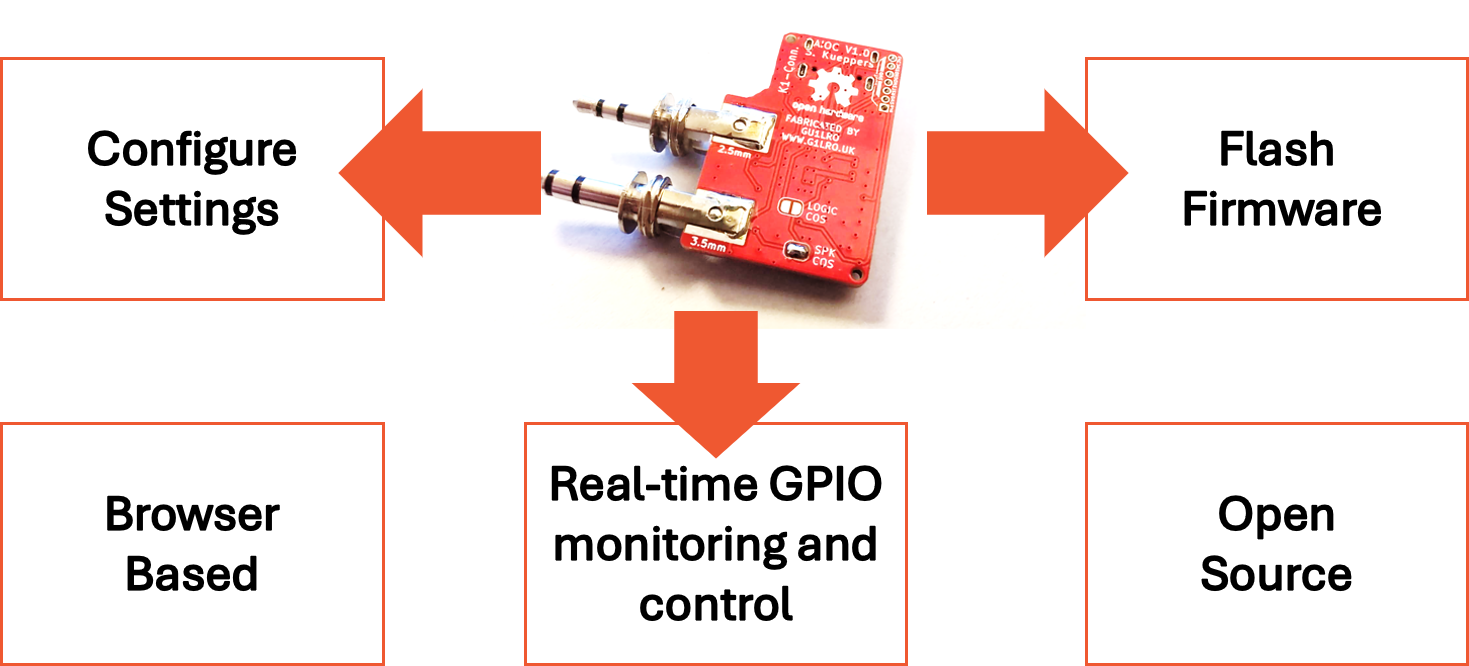
AIOC is All In One Cable, a combined programming interface and audio interface in a single device for use with portable radios (that follow the same connector spacing and electrical functions of a Kenwood portable radio).
Mark Herbert G1LRO on his website:
Configure and Flash Your AIOC From One Browser Tab
If you’ve got an AIOC adapter for your handheld radio, you’ve probably used a couple of different tools to look after it: one to set PTT sources, audio gain, and GPIO behaviour, and — separately — dfu-util on the command line whenever new firmware comes out. I’ve combined both jobs into a single page: the AIOC Toolkit.
This seems like a godsend for maintaining AIOC devices easily with “just” a browser.
Easily Turn an AIOC into a CM108 Sound Card
Mark Herbert G1LRO on his website:
TL;DR: You can make an AIOC (or URC, or Model 50) appear to your computer as a standard CM108 sound card, so it works plug and play with AllStarLink and other software with no patches or Python required. Use TF3HR’s browser-based utility at https://g1lro.github.io/aioc-toolkit/to change the Vendor ID to 0x0D8C and Product ID to 0x000C, click Store to Flash, then unplug and reconnect.
The AIOC, and associated devices like the URC and Model 50 USB transceiver, are based on the same AIOC sound processor. This is a software-defined sound card with a serial port function and several GPIO control lines for PTT, COS and similar functions.
The AIOC is becoming well supported by applications such as AllStarLink (ASL) and DigiPi, but there are still gaps compared with the popular CM108 sound card standard. The CM108 is a sound chip that has been used in PCs and other audio applications for well over a decade, so support for it is effectively universal.
Where an application doesn’t recognise the AIOC, there are two ways forward:
Modify the application to support the AIOC, either by editing the core software or applying a patch script, or
Modify the personality of the AIOC so it reports itself to the software as a CM108 and just works, plug and play, with no further tweaking.
G1LRO is on a roll with improving the utility of AIOCs with this helpful update, also browser-based.
Over the past few years, I realized the homelab community (which isn’t really a defined thing—that’s okay) hasn’t had its own gathering, the way makers, software engineers, embedded developers, and HPC professionals do.
There are many events that have crossover into the homelab realm, but nothing focused on energy-efficient servers, privacy-respecting self-hosted software, keeping old hardware useful, or cable management and rack mounting on a budget.
The space has grown tremendously since 2020, and I think the time is ripe for an in-person event focused on this hobby I enjoy.
HomelabFest
So I’m starting HomelabFest. It will run from September 12-14 2027, in my home town, St. Louis1.
A subset of Homelabs is the Mini Rack concept which seems a perfect fit for Zero Retries Interesting radio systems that combine computers, modems, routers, power supplies, etc. all in a neat form factor for desktop use. What makes the Mini Rack concept even more fun is if you have a piece of equipment that isn’t designed for a Mini Rack, just make a bracket for it with your 3D printer (or order one).
Geerling is also an influencer about all things Raspberry Pi (he’s often seeded with new Raspberry Pi products under embargo), thus he’s my go-to source of information when something new emerges from Raspberry Pi.
This sounds like a really interesting event and I wouldn’t be surprised if there isn’t something that comes out at this event from Raspberry Pi - a RPi 6 (?) in Mini Rack format would be pretty cool.
Communication Technology: From Morse Code to Smartphones teaches readers about smoke signals, semaphore towers, telephones, and wireless networks. The pupils can gain an understanding of how engineers are changing communications technology through innovations such as 6G and space-based networks. The book highlights career opportunities in the aerospace and telecommunications fields.
Electric Vehicles: Powering the Future of Transportation covers how e-cars, e-bikes, e-scooters, and electrified trains are transforming the way people travel. Readers can discover how hybrid and fully electric vehicles operate and how the batteries that power them work. They also can learn about the roles engineers play in developing smarter transit systems.
Ocean Engineering: Protecting Our Ocean Environments highlights the vital ecosystem role played by the world’s oceans, which require careful stewardship. play in our ecosystem. Readers can learn how engineers study the underwater world using submersibles and floats, how they address pollution, and how they protect marine environments.
Semiconductors: The Building Blocks of Modern Electronics focuses on the technology behind nearly every electronic tool we use. Microchips power smartphones, computers, and countless other products, all thanks to semiconductors. Readers can learn about insulators and conductors, how microchips are manufactured, and why semiconductor engineering is a fertile field for innovation.
Signal Power: The Hidden Waves Behind Modern Tech explores how engineers analyze and manipulate signals to make technologies work more effectively. Whether it is a phone call reaching the correct person despite background noise or a medical device monitoring a patient, signal processing plays crucial roles in modern life. The book introduces different wave types, the signal processing workflow, and careers in the field.
…
Interesting approach and a great idea to mention “careers in the field”.
But, I fear that IEEE has the same bias from their membership of engineers (that have advanced reading skills) that I have with Zero Retries - the relative popularity of longform text versus video in this era. These topics would make for great 10-15 minute YouTube videos and thus more likely to engage an audience 10x or more than what they’re likely to experience from these topics presented in books that must be purchased.
I’m still grinding away in spare moments / idle time (like watching entertainment television) at creating indexes for each issue / month / year of Zero Retries. Thus I’m rediscovering things that I’d forgotten I wrote.
Case in point - this Request To Send from Zero Retries 0072 on 2022-11-11:
While it’s far from a perfect “fit” for the above, perhaps TAPRcould be a vehicle for the above.
TAPR was founded on technological innovation in Amateur Radio - it’s literally in the DNA of the organization. In fact, Amateur Radio (and communications technology in general) has caught up with TAPR’s focus on digital communications technology as all communications are now digital communications (or if using legacy modes, enabled by digital techniques).
TAPR embraces open access, not only in its content, but also in its products and projects.
TAPR embraces international participation.
TAPR not only has a newsletter but also is the primary sponsor of the well-regarded and influential annual Digital Communications Conference.
TAPR has even waded into regulatory issues in Amateur Radio with the US Federal Communications Commission (which is sorely needed, again, in this era).
Sometimes, instead of creating something from scratch, you have to use the tools you have available to you and adapt them to accomplish a new task. TAPR is here, now.
I recently received my renewal notice for TAPR membership, and not only will I renew my TAPR membership, but I think it’s time that I became involved in TAPR’s activities again. I recommend to Zero Retries readers to, at a minimum, join, renew, or restart TAPR membership, and consider joining me in getting more actively involved with TAPR.
(Emphasis in the above paragraph added for this article.)
Looking back since that article, I did get lightly more involved with TAPR, including participating in the online TAPR annual meetings, submitting papers to the final couple of TAPR DCCs, some intensive (long, pointed) emails to each TAPR Board member, and submitting articles for the PSR. In retrospect, those efforts were at best “tinkering at the margins”, and none seem to have materially affected TAPR’s direction.
Thus, we’ll see how my candidacy (again) for TAPR Board goes, and if elected, whether I can affect TAPR’s direction “from the inside”. Amateur Radio really needs TAPR or an organization like it to represent “NewTechHams” and Data Communications Networking that’s becoming a larger and increasingly important aspect of Amateur Radio.
Per TAPR PSR #162 October 2026, I’m the fourth candidate for one of the three TAPR Board positions that are expiring in 2026. Thus there will be an election.
If you’re a Zero Retries reader that’s also a member of TAPR, I’d appreciate your vote for TAPR Board of Directors.
Weekends Are For Amateur Radio!
As an organizer, I got an early look at the ZRDC 2026 Proceedings and wow… there is some really good stuff in there, all queued up for ZRDC 2026.
Some of the behind-the-scenes email correspondence Tina and I have been getting from ZRDC in-person attendees is great. No matter what the numeric turnout will be, we’re all going to have a fantastic time cross-fertilizing with each other.
Basically, as of tomorrow (Saturday), I’ll be in panic mode to get some demo systems set up for ZRDC 2026. Departure for San Ramon is one week from Monday.
Have a great weekend, all of you co-conspirators in Zero Retries Interesting Amateur Radio activities!
Tina Stroh KD7WSF for, well, everything! Jack Stroh, Late Night Assistant Editor Emeritus Fiona and Shreky Stroh, Late Night Assistant Editors In Training
Founding Members Who Generously Support Zero Retries:
Founding Member 0000 - Steven Davidson K3FZT (Renewed 2026, 4th year!) Founding Member 0001 - Randy Smith WU2S (Renewed 2026, 4th year!) Founding Member 0002 - Chris Osburn KD7DVD (Renewed 2026, 4th year!) Founding Member 0003 - Don Rotolo N2IRZ (Renewed 2026, 4th year!) Founding Member 0004 - Bill Arcand W1WRA (Renewed 2026, 4th year!) Founding Member 0005 - Ben Kuhn KU0HN (Renewed 2026, 4th year!) Founding Member 0006 - Todd Willey KQ4FID (Renewed 2025, 3rd year!) Founding Member 0007 - Merik Karman VK1DF / VK2MKZ (Renewed 2026, 4th year!) Founding Member 0008 - Prefers To Remain Anonymous 08 (Renewed 2025, 3rd year!) Founding Member 0009 - Prefers To Remain Anonymous 19 (Renewed 2025, 2nd year!) Founding Member 0010 - Merik Karman VK1DF / VK2MKZ (Renewed 2025, 3rd year!) Founding Member 0011 - Rick Prelinger W6XBE (Renewed 2026, 3rd year!) Founding Member 0012 - Ryan Tolboom N2BP (Renewed 2025, 2nd year!) Founding Member 0013 - Newton White N4EWT (Renewed 2026, 2nd year!) Founding Member 0014 - Joe Hamelin W7COM (Renewed 2026, 2nd year!) Founding Member 0015 - Rich Stocking N7OP (Renewed 2026, 2nd year!) Founding Member 0016 - Chuck Hast KP4DJT (Renewed 2026, 2nd year!) Founding Member 0017 - Phil Karn KA9Q (Renewed 2026, 2nd year!) Founding Member 0018 - Prefers To Remain Anonymous 47 (Renewed 2026, 2nd year!) Founding Member 0019 - Prefers To Remain Anonymous 0108 (New 2025) Founding Member 0020 - Prefers To Remain Anonymous 110 (New 2025) Founding Member 0021 - Prefers To Remain Anonymous 111 (New 2025) Founding Member 0022 - Prefers To Remain Anonymous 112 (New 2025) Founding Member 0023 - Prefers To Remain Anonymous 116 (New 2026) Founding Member 0024 - Rob Bowser (SPOOLTENNA) (New 2026) Founding Member 0025 - Dave Stewart K7XST (New 2026) Founding Member 0026 - Prefers To Remain Anonymous 32 (New 2026) Founding Member 0027 - Mitch Hamm N8XS (New 2026)
Numerous Annual and Monthly subscribers who also generously support Zero Retries financially!
You thousands of readers of Zero Retries without which there would be little point in publishing this newsletter.
Fair Use - All excerpts from other authors or organizations, including images, are intended to be fair use and are fully attributed generally by author and link (URL).
Paid Promotional Content - Unless otherwise noted in the article or item, advertisement, or sponsorship notice, Zero Retries does not include paid promotional content. Exceptions:
Advertisements in Zero Retries,
Sponsorships in Zero Retries,
Zero Retries products,
Zero Retries events
Features and content exclusive to paid subscribers.
That’s the frequency allocation for the 70 cm band in most of the US. In the rest of the world, it’s more restricted such as 430-440 MHz in Europe, and 430-450 MHz in Canada.
I think we’re comfortably out of the era of new analog radio modes, and any new radio mode will be implemented in digital, thus this section is applicable.