2026-10-09 - Final ZRDC 2026 Update, What’s New at DLARC - October 2026, Several New Amateur Radio Apps, Tailcat, eBay To Require FCC IDs For (Most?) Sales of Electronic Devices, XCL.is - AR Cellular
Zero Retries is an independent newsletter promoting technological innovation in and adjacent to Amateur Radio, and Amateur Radio as (literally) a license to experiment with and learn about radio technology. Radios are computers - with antennas! Now in its sixth year of publication, with 3600+ subscribers.
Optional Paid Subscriptions, and especially Founding Member subscriptions to Zero Retries not only help offset various expenses incurred in publishing Zero Retries, but also are a large portion of the “seed capital” that is needed to host Zero Retries Digital Conference (ZRDC) 2026, and future ZRDCs. Thank You!
My thanks to Prefers To Remain Anonymous 49 for renewing (3 years!) as an Annual Paid Subscriber to Zero Retries this past week!
My thanks to Prefers To Remain Anonymous 99 for renewing as an Annual Paid Subscriber to Zero Retries this past week!
My thanks to Prefers To Remain Anonymous 138 for upgrading from a free subscriber to Zero Retries to an Annual Paid Subscriber in the past two weeks!
Financial support from Zero Retries readers is a significant vote of support for the continued publication of Zero Retries.
Zero Retries 0266 Won’t Have Much ZRDC 2026 Content
Next Friday (usual publication day) will be ZRDC 2026, and that evening will be devoted to interesting conversations post-ZRDC. I could attempt to push that issue off until Saturday, but by now I know better that booth duty at the Zero Retries table at Pacificon, and the usual unknown-in-advance, but-they-always-happen fascinating conversations and discoveries that will consume the entire day on Saturday.
I plan to push out Zero Retries 0266 next week, but it’ll probably be completed by Wednesday and queued up for auto-publish on Friday, and probably a bit lighter than issues have been of late. At least you’ll probably receive it at my stated (but often missed, lately) publication time of 15:30 Pacific on Fridays.
This is the seventh in a series of updates leading up to Zero Retries Digital Conference 2026. ZRDC 2026 starts in ONE WEEK!
This is my last column in the series prior to ZRDC 2026. Next Friday, 10/16/2026 it’s show time and I think we are ready! As I am writing this, I am currently at Les Schwab getting the car fine-tuned for the trip South. Our hallway outside the garage door is filled with boxes to bring both for the conference and Pacificon. My dining room table is covered with all the items to go into the goody bags for the in-person attendees. I think we are all set, except for one thing, more attendees!
The venue, The Roundhouse, and our event coordinator Shelby have been gracious and allowed me additional time to call in the final numbers. Because of this, I have been able to extend the general admission ticket price for another week, instead of having to charge the late fee the venue imposes.
The absolute deadline with the general admission ticket will be 10/12/2026.
After that, the late fee must apply. Unfortunately, also after that date, I cannot guarantee breakfast either. However, since Steve and I are hosting the breakfast, I have padded the numbers so that everyone can have a good start to the day. Coffee, tea, infused water and sodas will be available all day for attendees. After the last speaker and we have closed the conference, I will try to locate a place where everyone can continue talking. I think that was one of the highlights of last year’s conference. Steve and I hosted a pizza party across the street from the venue at a great pizzeria. Everyone continued to talk, eat and drink but best of all, have a good time. The downside was that we all had to leave by 9 PM and some had to travel home. It seems rare to find opportunities for hams to get together and just talk about their passions and Amateur Radio with friends and colleagues. Steve received a very nice note from Cale Mooth, K4HCK who notes that he always enjoys the opportunity to speak, whether it’s a local meet-up or the radio club, and is looking forward to speaking at ZRDC. It will be interesting to hear Cale’s perspective of the Techie Ham. Cale will also participate in the panel discussion regarding encryption. My hope, as the conference manager, is to create this opportunity for like minds to come together what I have determined is needed.
Along the same line, Steve and I received a shout out from Peter Marks, VK3TPM who posted in FreeDV News on 10/3/2026, “the excellent Zero Retries Newsletter often covers FreeDV and this week is no exception” and ended his post with “thanks Steve and Tina for your excellent ongoing coverage of Amateur Radio”. So guess what? One of the co-experts regarding FreeDV, Mooneer Salem, K6AQ is one of the featured speakers at ZRDC 2026. Not interested in FreeDV, what about digital voice systems or operating digital modes using a smartphone instead of the traditional keyboard? Jeff Scoville, AE5ME and Craig Lamparter, KM6LYW have presentations geared up for you. Our goal of the ZRDC is to bring to life what you read about in Zero Retries by the people who are actually doing the work. Hear first hand from the experts and ask your questions. There are not many opportunities like this. We sincerely thank Peter for his comments because its comments like this that keep us going.
In closing, if you have not registered for ZRDC 2026, I would urge you to do as soon as possible. I have placed the links below for your convenience. The website has been updated with the list of speakers and their bios plus the schedule of the conference. Please remember, if you are unable to attend in-person, there is the option of attending via Zoom and for you to receive the proceedings in advance of the release date. If you have a logistical matters or concerns, please don’t hesitate to contact me. I am here to help!
See you all next Friday in San Ramon! Safe travels everyone.
What’s New at Digital Library of Amateur Radio & Communications — October 2026
By Kay Savetz K6KJN
It’s fall, the season for pumpkin lattes and stocking up on candy that’s allegedly for the kids on Halloween, but I might have to “quality test” some of it in the weeks leading up to the holiday. I bet you didn’t know that it’s also the season for finding amazing forgotten ham radio newsletters and adding them to DLARC. This work is fueled by candy and pumpkin lattes.
But first off, DLARC has a new Automatic Packet Reporting System collection, with hundreds of items supplied by the APRS Foundation (which, I might add, has the generous policy of “web materials are freely available to the public unless specifically marked otherwise.”) A big part of the APRS material is the Bob Bruninga APRS documents sub-collection. Bob WB4APR created APRS: this collection includes 15 of Bob’s PowerPoint decks from 2007–2019, APRSdos documentation and technical notes, protocol-development notes, network design and operating material, and more.
So excited for this: We added 171 episodes of Glenn Hauser’s World of Radio show, bringing the number of episodes in DLARC to 1,534. Glenn has been covering shortwave news in World of Radio since 1980 (I still hope to find those earliest recordings) and amazingly, he’s still at it every week. These newly found episodes are some of the oldest episodes in the collection: the earliest is show number 115, which aired April 11, 1982. Some of the topics: Free Voice of Iran was transmitting coded messages, and in the US, the FCC conducted a crackdown on illegal shortwave broadcasts aimed at Cuba. Every one of these shows is an exciting time capsule of radio history: I pick them at random to listen in the background and end up 100% engaged with Glenn’s news every single time. The newly added recordings come from Shortwave Radio Archive, cut from much longer shortwave recordings on Internet Archive, and dark corners of dusty web sites.
Equally excited for this: DLARC has recovered more lost scripts of Amateur Radio Newsline: 103 scripts in all covering 1993 through 2009. Newsline is a weekly audio news bulletin of interest to radio amateurs. They’ve been at it since 1977. (The top story for the May 15, 1993 episode: the FCC proposes more restrictive rules for RF exposure. “Very important to most hams is that hand-held devices such as portable cellular phone, handie-talkies and the like are for the first time covered.”)
We’ve digitized two dozen more old videos from Bob Cooper’s estate: these are from PAL-format VHS tapes. Bob was an expert in satellite television who gave seminars, wrote books, and published magazines about all sorts of communications topics. These new additions (bringing the count of videos from Bob’s estate to more than 275) include talks from the 1997 Satellite and Cable Show, a 1981 panel on satellite antenna technology, and a circa 1979 discussion about RF amplifiers. Bob’s Satellite Magazine episodes are a fever dream that switches between informative technical content and a late-night community access television vibe. Very entertaining. Oh, and 23 minutes of raw footage of Arthur C. Clarke at his home in Sri Lanka. He discusses his 1945 communications-satellite proposal, the growth of satellite TV and the internet, 2001: A Space Odyssey, and the possibility of life on Mars.
New Newsletter Collections
So there’s a new service called Usenet Rewind: it’s a research archive dedicated to Usenet newsgroup posts from 1981 to the present. The folks at the service generously gave DLARC access, and I’ve been doing deep searches to find even more early e-newsletters about amateur radio, shortwave, and related topics. And boy, has it delivered, finding plenty of great material in addition to what Internet Archive’s own Usenet archive has brought us in the past few months. New newsletter collections added to DLARC, in part thanks to Usenet Rewind:
The Four Winds On Line: this was an e-mail-based shortwave DX newsletter edited by Giovanni Serra in Rome, Italy. Each issue includes shortwave logs, QSL reports, listener-submitted station news, and other DX bulletins from around the world. The collection includes 54 complete issues from December 1996 to October 1999. Issue 42 dated November 10, 1997 reports on pirate station RFL and its four-hour “Day of the Dead” Halloween special: music by artists “who are no longer with us” and records about death.
Hailing from about the same time period but from Melbourne, Australia, Electronic DX Press was an e-mail-based shortwave broadcasting newsletter compiled by Bob Padula OAM. It focused on broadcasting to and from Australia, Asia, the Pacific and the Indian subcontinent. DLARC has 64 editions from October 1997 to October 1999 plus a special 11 MHz Spectrum Study publication.
166 issues of DX Hotline, which was the shortwave broadcasting news and schedules section of the Benelux DX-Club bulletin, edited by Jan Nieuwenhuis on the island of Texel in the Netherlands. The earliest editions — we have them back to 1993 — were text-only (DLARC made easy-to-read PDFs as usual). By 2001 Hotline was distributed natively as PDFs, so we have 2001-2006 in that format.
We added more than 1,000(!) issues of the DARC DX Newsletter (DXNL), the English-language edition of the weekly bulletin of the Deutscher Amateur-Radio-Club’s DX Committee. It reports planned and current amateur-radio DX activity, DXpeditions, IOTA operations, contest dates, and QSL information. We’ve found issues from 1996 through the present. From the December 16, 1996 issue: two Japanese hams introduced North Koreans to amateur radio during a friendship mission, and North Koreans seemed interested in organizing their own on-air activity.
850 issues of California OES RACES and EMCOMM Bulletins. RACES Bulletin was published by the California Governor’s Office of Emergency Services to provide training, policy, and operational information for Radio Amateur Civil Emergency Service volunteers and government emergency communications personnel. In 1996 it was succeeded by the EMCOMM Bulletin, which continued through March 2003. This collection includes the closely related RACES and EMCOMM bulletin series, from 1985 through 2003.
Filling in the Gaps
In addition to adding those new newsletter collections, we’ve managed to fill in gaps in existing collections, making the library a little more complete.
We grew our collection of Gateway, the ARRL’s defunct packet-radio newsletter. DLARC already had 112 scanned issues of their paper publication. This Usenet hunt revealed that they also published an electronic version, so we’ve added 13 issues, filling in gaps from 1985. The November 11, 1985 issue reports that AMSAT and the ARRL had just proposed a packet-radio experiment, SAREX II, to include a modified TAPR TNC-2, a 2-meter HT and a laptop. (That shuttle mission would be cancelled after the Challenger disaster a few months later.)
36 newly found issues of Radio H.F. Internet Newsletter, bringing that collection to 261 issues. It was a monthly electronic publication edited by Sheldon Harvey VE2SHW of Radio H.F. in Quebec, Canada, with annotated resources regarding shortwave listening, amateur radio, and scanning.
We also filled in gaps in AMSAT Satellite Report, with more than two dozen issues of the satellite operational status updates. We now have 460 issues spanning 2002 to 2013.
50 scripts of broadcasts of Radio World, from Radio Vlaanderen Internationaal. Radio World was the English-language shortwave and international-broadcasting program of Radio Vlaanderen Internationaal, a service of Belgium’s Flemish public broadcaster BRTN. The program reported on international broadcasting, shortwave reception, station schedules, radio technology, and media developments. This (incomplete) collection preserves surviving program scripts and official web transcripts from 1993 through 2005.
229 scripts/reports from Sweden Calling DXers (later called MediaScan), Radio Sweden’s bulletin covering international broadcasting, shortwave listening, DXing, satellites, and developments in global electronic media.
We’ve also added 328 issues of Ham Radio Online, an early web magazine devoted to amateur radio. Published from 1995-2000 by Ed Mitchell KF7VY and Kim Anderson-Mitchell N7VPL, the digital magazine covered packet radio, APRS, satellites, amateur television, emcomm, shortwave listening, and the growing connection between radio and the Internet. This was originally a web site, long gone but recovered from the Wayback Machine, which DLARC converted to PDFs for easier reading.
In the Collegiate Amateur Radio collection, we’ve added a nice little collection of amateur radio activities at Milwaukee School of Engineering, which includes items from their amateur radio club W9HHX and its predecessors: QSL cards, bulletins, news clippings, and a 1963 RTTY image of John F. Kennedy, prepared by members of the club shortly after the assassination of JFK.
Newsbytes News Network
One more thing, if you’ll permit me a paragraph to talk about a personal project: I built an unofficial fan archive of Newsbytes News Network articles. Newsbytes was a sort of “Associated Press for tech-information junkies” documenting the formative years of personal computing, online services, telecommunications, and the Internet from 1983 to 2002. The archive has pretty much every article they published, well over 150,000 stories. There’s a good amount of radio and communications content there: look up Wayne Green, amateur radio, Morse code, packet radio, or FCC for copious amounts of news written as it happened.
Maybe I’ll see you at the Internet Archive’s annual celebration on October 21? The theme will be “Democracy’s Library: Tools for Participation”. If you find me we can share a pumpkin latte. But I’m not sharing any of my Halloween candy stash.
Digital Library of Amateur Radio & Communications is funded by a generous grant from Amateur Radio Digital Communications (ARDC) to create a free digital library for the radio community, researchers, educators, and students. If you have questions about the project or material to contribute, contact me at kay@archive.org.
I’m also personally delighted to see Ham Radio Online by Ed Mitchell KF7VY appear on DLARC. KF7VY is an old friend and packet radio collaborator when we both lived in the Seattle area, and it’s really cool to see these items re-emerge into public on DLARC.
KF7VY’s HRO blog inspired me to get into blogging. KF7VH “strongly encouraged me” to do so when I began commenting a little too often about “things he left out” on HRO posts.
I’m also delighted to learn about K6KJN’s passion for Newsbytes News Network - I remember that very well and I’m delighted it’s now part of DLARC. I also stumbled into Usenet Rewind, typed in my callsign… and immediately turned away for fear of losing an entire day to nostalgia for when Usenet was the new hotness.
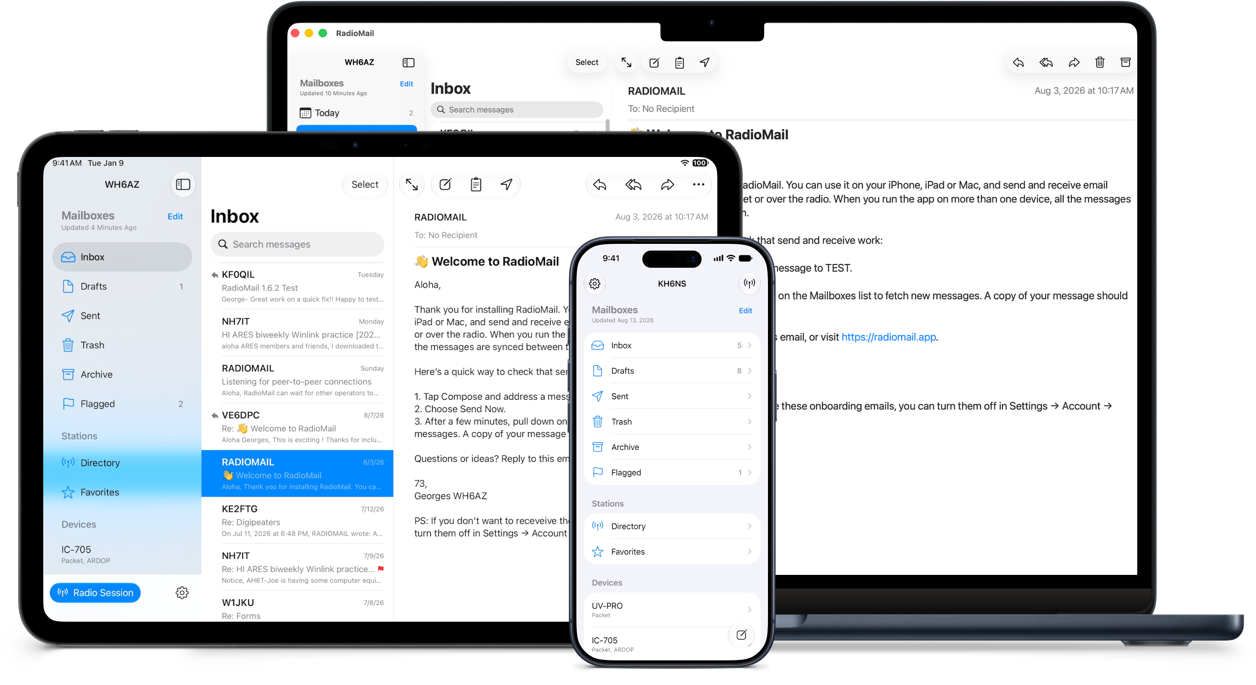
After many months of development, testing, and feedback from the TestFlight community, RadioMail 2.0 is available on the App Store.
This isn’t RadioMail 1.x with a fresh coat of paint. RadioMail 2.0 is a completely new application, built from the ground up around everything I’ve learned over the past few years.
The goal remains the same: build the best Winlink app for portable operating on iPhone and iPad (and even Mac).
What’s new
Automatic send and receive over Wi-Fi or cellular, with messages queued for your next radio session if you prefer
Built-in Packet and ARDOP modems
Native IC-705 radio support
Simplified device management and switching
Best Path propagation prediction to help select a station
Incoming peer-to-peer connections over Packet and ARDOP
Three-column interface for iPad
Message sync across iPhone, iPad, and Mac
Better mailbox management with search, smart mailboxes, and flags
Improved Winlink Forms, including experimental form reflow for easier use on an iPhone in portrait orientation
RadioMail 2.0 is free to download and includes a 30-day trial, so you have time to explore the app, confirm that it works with your equipment, and decide if it’s right for you.
After the trial, a subscription or one-time purchase is required to continue sending and receiving messages. You’ll always retain access to the messages already stored in the app.
A note about the Mac
RadioMail 2.0 also runs on Apple Silicon Macs. It works well, but it’s still an iPad app, so expect a few Mac quirks. RadioMail is built for portable operation, and now that MacWinlink exists, I don’t plan to expand it to support shack equipment like USB devices or local modem software. If that’s what you need, MacWinlink is likely the better fit. If you operate portable from an iPhone or iPad and want your full mailbox on the Mac back in the shack, RadioMail fits that workflow.
This was notable - talk about a real stress test of your app for emergency communications:
PS: This release took longer than I planned. Right before launch, Hurricane Lowell hit Kauaʻi and left me without power, water, or internet for 12 days. Then App Store review took much longer than usual, likely from the iOS 27 launch rush. You can read my field notes on what I learned from the hurricane.
I think it’s incredibly gracious… but normal for WH6AZ, to acknowledge the existence of MacWinlink, which isn’t his app.
If the rumored touchscreen Mac laptop emerges later this month, it will be an interesting tossup between RadioMail 2.0 and MacWinlink on a Mac laptop. RadioMail 2.0 running on a Mac is already “native touchscreen”.
Modern apps for Amateur Radio with well-thought-out user interfaces like what WH6AZ has become known for are breathing new life into Amateur Radio data communications. Such modern apps make Amateur Radio systems like Winlink much more approachable and usable than with older apps that are a bit clunky in comparison (but fully functional).
Let’s run Modem73 on two Pi’s and communicate over Ham radio using TCP/IP, AX.25 and Web. Modem73 is among the new open-source modems implementing “OFDM” encodings getting us (relatively) high-speed networking with packet radio. Modem73 supports OFDM/Robust/MFSK, which, in this case was transmitting QAM16 at 3.6Kb/s using off-the-shelf radios - TIDRadio H9 and Yaesu FTM400. Modem73 supports both HF and VHF, so we could possibly see this as an alternative VARAHF for Winlink Email on HF and local AX25/IP networks on VHF.
Modem73 is supported on MacOS, Windows, Linux and Android.
I first mentioned Modem73 in Zero Retries 0258 back in July - Modem731. Since then I’ve seen a number of mentions, and now that KM6LYW has integrated it into DigiPi, it’s going to be mainstream. I also saw a mention that’s its experimentally being added to JNOS.
I can’t wait to hear KM6LYW’s presentation at ZRDC 2026. I’m sure he’ll work in mention of Modem73 as well as Mercury now being additional modes available in DigiPi.
AMSAT is apparently livestreaming its annual conference on Friday 2026-09-09 (publication day) and Saturday 2026-09-10. I had to pass on watching on Friday, but I’m going to try to catch some of it on Saturday.
There is a new Android APRS app available that I really like. The cool part is that it works with Android Auto and you can see stations on your truck or car screen. It works great with my new Kenwood D750A and with my old Kenwood D710 except that the D750A connects using Bluetooth SPP.
If interested, check out https://www.g7jjf.com/aprs-client.html. This site describes features, has a link to the user manual, and a form to sign up as a beta tester. We need some additional beta testers to get Google to allow the app on the Play Store.
Unfortunately, there is no Apple version yet.
PS I have no connection with this app except as a happy user.
APRS Connect, the messaging-first APRS client that launched on Android in August, is now on the App Store for iPhone (iOS 16.4 or later). It is free to install and use over APRS-IS. Connecting a radio and several advanced features are part of APRS Connect Pro, a subscription with a 7-day free trial.
APRS OTA, the on-the-air activity that runs entirely over APRS, has its own screens in the app, so you tap buttons instead of typing bot commands. Hosts go on the air in one tap. Each chaser’s call arrives with their message, where they are and a Confirm button. A bar across the top shows QSOs, points and time left, with buttons to stay longer or message every chaser at once. A live map shows you and your chasers and adds up how far your contacts have reached. Chasers get the list of hosts on the air, tap one to call, and watch each step through to the host’s QSL. Every op is saved with its map and scores and can be shared as a picture. Chasing works over APRS-IS, free. Hosting needs a radio, as APRS OTA’s rules require.
The other services on APRS get the same treatment, a guided screen instead of a command to memorize: weather, the repeater finder, WHO-IS, the SMS, email and Winlink gateways, and APSPOT and APRS2SOTA self-spotting. #APRSThursday and other ANSRVR groups open as a single net room.
On iPhone the app connects to KISS TNCs over Bluetooth LE or TCP. It can also work through a radio’s speaker and mic, using the built-in AFSK 1200 audio modem with VOX keying. Radios with a Bluetooth LE KISS TNC built in, such as the BTECH UV-Pro, connect directly.
Several things have been added since the app was first covered here:
The phone can be an IGate. It passes what your radio hears to APRS-IS and, if you choose, sends messages from the internet back out on the air for stations nearby. It can also be a digipeater that stays quiet when another digipeater has already repeated the packet.
A coverage map shows the places your beacons were picked up by a digipeater.
Pinned stations, a grid square screen, and the ISS on the map.
A setting chooses how messages go out: radio first, APRS-IS first, one link only, or every channel at once.
An optional account keeps messages, pinned stations and settings the same on every device. When two devices share a callsign and SSID, only one of them beacons, acks, and digipeats at a time.
A “Rest of the world” map layer shows stations heard anywhere on APRS-IS, not only the ones your device heard.
The app is more accessible for operators who use VoiceOver and TalkBack. Every button has a spoken name, and an open conversation reads new messages aloud.
The newest of these are on iPhone now and reach Android with its next Play release.
Speaking of APRS apps on mobile devices, equal time for iDevices!
Simple JTTY App for MacOS
Peter Marks VK3TPM on his blog marxy’s musing on technology:
The JTTY application I made for Linux uses the QT6 framework. I could have built this for macOS but thought it would hurt my eyes so I’ve made a native macOS version.
There’s a page for it here and the source code is available here.
It does depend on hamlib for rig control. I install it with homebrew. At the moment this is left as an exercise for the reader - as they say.
Macs, thanks to developers like VK3TPM are rapidly becoming “first-class citizens” in Amateur Radio!
Utah Digital Communications Conference Call For Proposals
Email from Utah DCC:
Presenter proposals are now open for the 10th Annual Utah Digital Communications Conference, happening on Saturday, February 27, 2027, in Sandy, Utah.
We’re looking for a variety of presentations for this year’s conference, from technical topics to general amateur radio interests. If you’d like to present, please submit your proposal using the link below. Every year, we plan for a good mix of topics, including new technology for our advanced members and introductory sessions for those new to the hobby. Here are a few topic ideas, but we’re open to any amateur radio-related subject.
Digital Communications (D-STAR, DMR, System Fusion, hotspot), etc.
Software-Defined Radio’s
Emergency Communications/Preparedness
Repeater systems technology
POTA/SOTA and other Field Operations
Networking and Home Automation
Meshcore/Meshtastic
Computer Security and Amateur Radio Software
Satellite Communications
Field Day (setup, strategy, logging)
Interconnected/linked systems
Emerging technology and research
Please help us spread the word by sharing this email with your friends and club members throughout the Intermountain West. Since our email list and social media reach are limited, sharing within your local networks is the best way to spread the word. The Utah DCC conference is Utah’s longest-running educational event, and with your support, it can keep growing. We invite you to get involved by presenting, volunteering, attending, or simply sharing this information. We’re excited for great presentations and hope to see you in 2027.
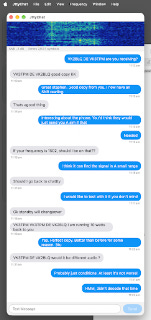
I’ve been working on a chirp-based weak-signal text chat mode called Glissando, and the first beta is out. I’m looking for a few stations willing to try it on the air.
I wanted a mode that’s pleasant to hear, even when stations double, without giving up weak-signal performance. Every symbol is a glide (a chirp) from one note to the next, then a short held note. The data *is* the melody, rendered in pentatonic (or tritone!) scales.
Planned QSO party Monday, October 5 at 2200 UTC.
The app consists of a Linux desktop console with a waterfall that captions decoded text right on the trace, a chat window, Hamlib rig control (I run an IC-7100), and a 180 s transmit timeout that releases the radio between frames on the slow gears. It’s styled after a 1950s sci-fi serial control room, because why not.
Suggested frequencies sit just below FT8/JS8/PSK31 in each band’s data segment, e.g. 7.067 and 14.067 MHz USB.
It’s open source (modem MIT, app LGPL since it started life as a fork of freedv-gui). Windows and Mac aren’t packaged yet, and it’s a beta, so expect rough edges. Bug reports, on-air signal reports, and comments are all welcome.
It’s cool that AG7EW is in my corner of the world - Lynden (Bellingham area) Washington, USA. AG7EW’s QRZ page is worth a look.
I don’t know about you, but I always get a little upset when I read an article about amateur radio in a newspaper or general-interest magazine. For one thing, they almost always get the terminology wrong. For example, they often say that radio amateurs “broadcast” instead of “transmit.” Broadcasts, as you all know, are transmissions meant for the general public, and radio amateurs are specifically prohibited from making those kinds of transmissions. These aren’t egregious errors, but as a former writer and editor, they annoy me.
Whenever I would come across something like this, I would try to contact the reporter and explain how they misused a term or didn’t quite get things right. I came to realize that what we needed, however, was something more comprehensive. What we needed was a guide that explained to the media a little bit about our hobby and some of the terminology that we use. A Field Day article in our local online newspaper was the final straw. After reading this article, I knew that I had to do something. The result you see below.
I’ve sent this guide to all of the ARRL directors, section managers, and PIOs that I can find. I’m also going to send this to news outlets and reporters that write about amateur radio. If you know of any other people/organizations I should send this to, please let me know. Or, you can do it. Download the PDF and send it to whoever you think should get it.
This is a genius idea! I have no quibbles about what KB6NU included and the great deal that he left out. The goal of this is to be read, so shorter and “higher level” is better.
But beyond the KB6NU version of Media Guide to Amateur Radio, I think every organization should create their own Media Guide to Amateur Radio that reflects their perspective of Amateur Radio. For example, AMSAT, FlexRadio, HamSCI, TAPR, Winlink, Winter Field Day, and Zero Retries all have their own “perspective” on Amateur Radio with points they want to emphasize to media for better understanding of what their organization does within (the bigger picture) of Amateur Radio.
MeshTransfer and MeshTransfer Mailbox for Meshtastic
From Steffen Heuel DO5DSH via email:
I’ve created a file transfer app for Meshtastic, that I call MeshTransfer. I thought it might be of interest to your awesome Zero Retries channel.
MeshTransfer Mailbox is an optional addition to MeshTransfer. Mailbox is firmware on a small ESP32 with its own web interface. With Mailbox, the apps connect to it instead of to the radio. It is optional: without it, your phone connects to the radio as usual.
The Mailbox for ESP32 and low-speed app are free to use.
Only when people really want to transmit bigger data I am asking for a license (this small step will hopefully keep spam out of the network).
I have some testers around and appreciate any feedback on this!
I mentioned to DO5DSH that in the US, MeshCore seems to be becoming more popular, at least in Amateur Radio, because MeshCore is more “structured” than Meshtastic because repeaters in MeshCore are “deliberate” instead of “every node is a repeater”. DO5DSH agreed that it’s likely he will port MeshTransfer and Mailbox to MeshCore:
I have been playing around with MeshCore as well. The payload is about half the size of Meshtastic, but it’s straightforward to create a version also for MeshCore as the protocol was designed very modular. To my mind also MeshCore would benefit from a Mailbox to let the mobile app do the processing of coding, that lets the ESP32 space for reception and storage. Also, as data / voice transfer is transmitted in any way relatively slow to keep the network stable.
I clarified with DO5DSH that on the MeshTransfer page, for running the Mailbox, the specified unit is an ESP32-CAM, but the -CAM variant isn’t necessary. It’s intended to be used on any ESP32 unit that has BLE / Wi-Fi connectivity and a MicroSD card slot.
It’s cool that file transfers are now available with Meshtastic (and potentially, MeshCore) thanks to DO5DSH.
Update on NPR Next Generation (NPR-NG)
From Steffen Heuel DO5DSH via email:
Things are moving forward on New Packet Radio - Next Generation. We’re continuing our investigation on cheaper commercial power amps and measuring their EVMs when transmitting our OFDM signals. Therefore we implemented and 802.11ah stack that can process IQ data measured with an R&S spectrum analyser. A known frame is transmitted and demodulated to measure EVM. Some 70cm amps show good results even though efficiency is low. Unfortunately we cannot pre-distort IQ.
If there is someone in the network willing to contribute, we are happy to receive input.
I put DO5DSH in touch with Martin Alcock VE6VH of the IP400 Project.
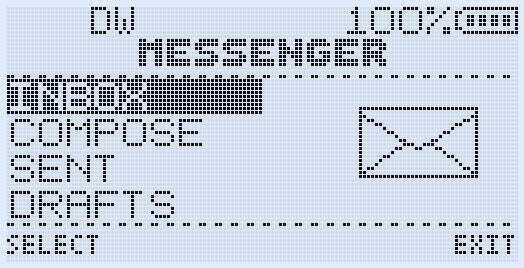
GOGUFW Messenger is a free custom firmware for the Quansheng UV-K1 and UV-K5 V3 handheld transceivers that adds direct radio-to-radio short text messaging over FSK alongside full analog voice operation.
The project lives at Gogu-Qs/GOGUFW-UV-K1-Messenger on GitHub. Current stable is GOGUFW 2.3.0, released 25 September 2026, built on the F4HWN 6.0.0 Fusion base with multiboot support. At the time of writing the repository holds around 42 stars, 5 forks, and close to 1,938 commits inherited through its fork history from the wider Quansheng custom firmware family.
What makes it different from every other Quansheng mod is the sidecar Messenger. Two compatible handhelds can exchange 36-character text messages directly over RF with delivery acknowledgements, retries, reply and resend controls, duplicate protection, and callsign addressing. No phone, no Bluetooth, no digipeater, no internet, and no infrastructure of any kind is required. Normal analog FM voice keeps working in parallel. So the radio remains a usable handheld first and a text terminal second.
…
That… is pretty Zero Retries Interesting! The user documentation on the referenced GitHub page seems quite complete.
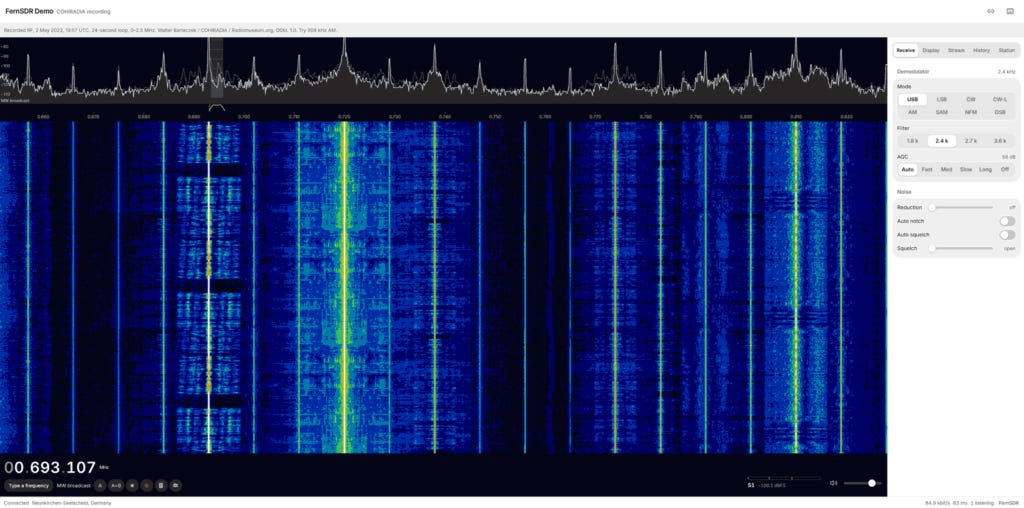
Thank you to ‘magicint1337’ for writing in and sharing with us a new program he’s created called FernSDR. The author writes that FernSDR is an open-source WebSDR server rebuilt from scratch, based on feedback from WebSDR operators. It replaces his two previous programs, NovaSDR and PhantomSDR, the latter of which we covered in 2024.
A WebSDR program like FernSDR allows users to set up an SDR receiver on a remote device, such as a Raspberry Pi or PC, and access that SDR’s data from anywhere in the world via a network connection. The author explains why FernSDR stands out:
What’s different: a single binary with no dependencies and a one-line install on any Linux, an admin panel for everything (bands, updates with rollback, modules), day/night band switching by sunrise at the station, and modules for RTL-SDR (incl. Blog V4), RX-888 MkII and SDRplay, plus an FT8 decoder with PSK Reporter spots. In my lab tests against ten other WebSDR servers it had the lowest delay and memory use; the method and raw data are public.
I’m still getting my RSS feeds under control, so I’m behind on RTL-SDR.com. Thus, My thanks to Tom Salzer KJ7T in EtherHam - Weekly Report: October 8, 2026 for mentioning this development for inclusion in Zero Retries.
Debashis Das on CNX Software - Embedded Systems News:
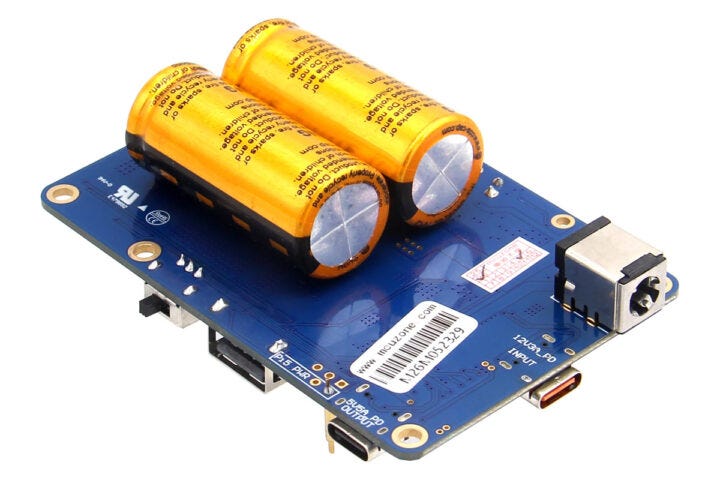
Geekworm, in collaboration with Mcuzone, has launched the UPS Scap 5V5A, a new supercapacitor UPS HAT for the Raspberry Pi 5 designed to keep the Raspberry Pi running long enough (a few seconds to a few minutes) to save data and shut down safely, rather than provide hours of backup power.
Available in 100F, 60F, and 22F versions, the HAT has a built-in PD chip that negotiates a true 5V/5A output. This gives the Raspberry Pi 5 enough power to run properly without triggering the low-voltage warnings that can happen with some power supplies. The module connects to the Raspberry Pi 5 through pogo pins to detect power loss and supports I2C for checking voltage and current in real time. It also features dual independent power inputs, so you can power it with either a wide-voltage DC barrel jack or a standard USB-C PD charger.
…
Using a supercapacitor(s) Uninterruptible Power Supply (bridge) for dealing with brief power bumps before “bigger” (and usually slower) UPS units to kick in, for Raspberry Pi (5) systems, makes a huge amount of sense to me.
One huge “win” with a supercapacitor is that it’s not lithium-anything.
This was yet another thing I otherwise wouldn’t have seen (in the near term) if it weren’t for a mention by KJ7T this week.
I commend ARRL for highlighting the role of Jeffrey Goldman K3DUA and his (apparently significant) donation (pages 6 and 7):
His major gift to ARRL has made possible something truly special: an entire week of the ARRL Teachers Institute on Wireless Technology named in his honor—the Jeffrey B. Goldman, K3DUA, Teachers Institute Week. Held in August 2025 at ARRL Headquarters in Newington, Connecticut, this session brought together 13 dedicated educators from across the United States.
The Teachers Institute is one of the most commendable, and forward-looking programs that the ARRL has developed in the past decade. It’s one of my touchstones that the ARRL is working for the future of Amateur Radio.
Also highlighted in this section (pages 8 and 9) was one of my personal heroes in Amateur Radio (and a Founding Member supporting Zero Retries), Phil Karn KA9Q:
Phil Karn, KA9Q: A Visionary Engineer and Generous Steward of Amateur Radio’s Future
Phil’s technical contributions to amateur radio are legendary. He co-founded AMPRnet and developed the KA9Q NOS (Network Operating System), an early open-source TCP/IP implementation for packet radio that enabled robust networking over radio links. This pioneering work helped bridge amateur radio with modern digital communications. He also advanced protocols like MACA for collision avoidance, error correcting codes for satellites, and more.
This was powerful:
Phil’s own words echo a powerful call to action: “The world is easier to change than you might think, but it takes time and persistence…
Even if you don’t have much time for ham radio when you are busy with your career, try to stay connected with other hams. Encourage your friends and family to become hams. Attend club meetings and dinners. It will pay dividends.”
There is this nod to (potential) NewTechHams:
Phil envisions a stronger role for education and formal programs in amateur radio, inspiring technical tinkerers from outside our ranks to join us. Projects like HamSCI and university satellite groups show the potential; Phil’s work through ARDC amplifies it.
It’s kind of astonishing (and gratifying) to see ARRL acknowledge the formative role of KA9Q’s NOS in Amateur Radio - it doesn’t get much more data-centric than that. Minor demerits for ARRL to not mention KA9Q’s current project, and just as formative for Amateur Radio - ka9q-radio.
One very minor note about ARRL in 2025 - Tina and I are grateful to ARRL Northwestern Division Director Mark Tharp KB7HDX for rapid approval of our application for ZRDC 2025 in Everett, WA to be an official ARRL event.
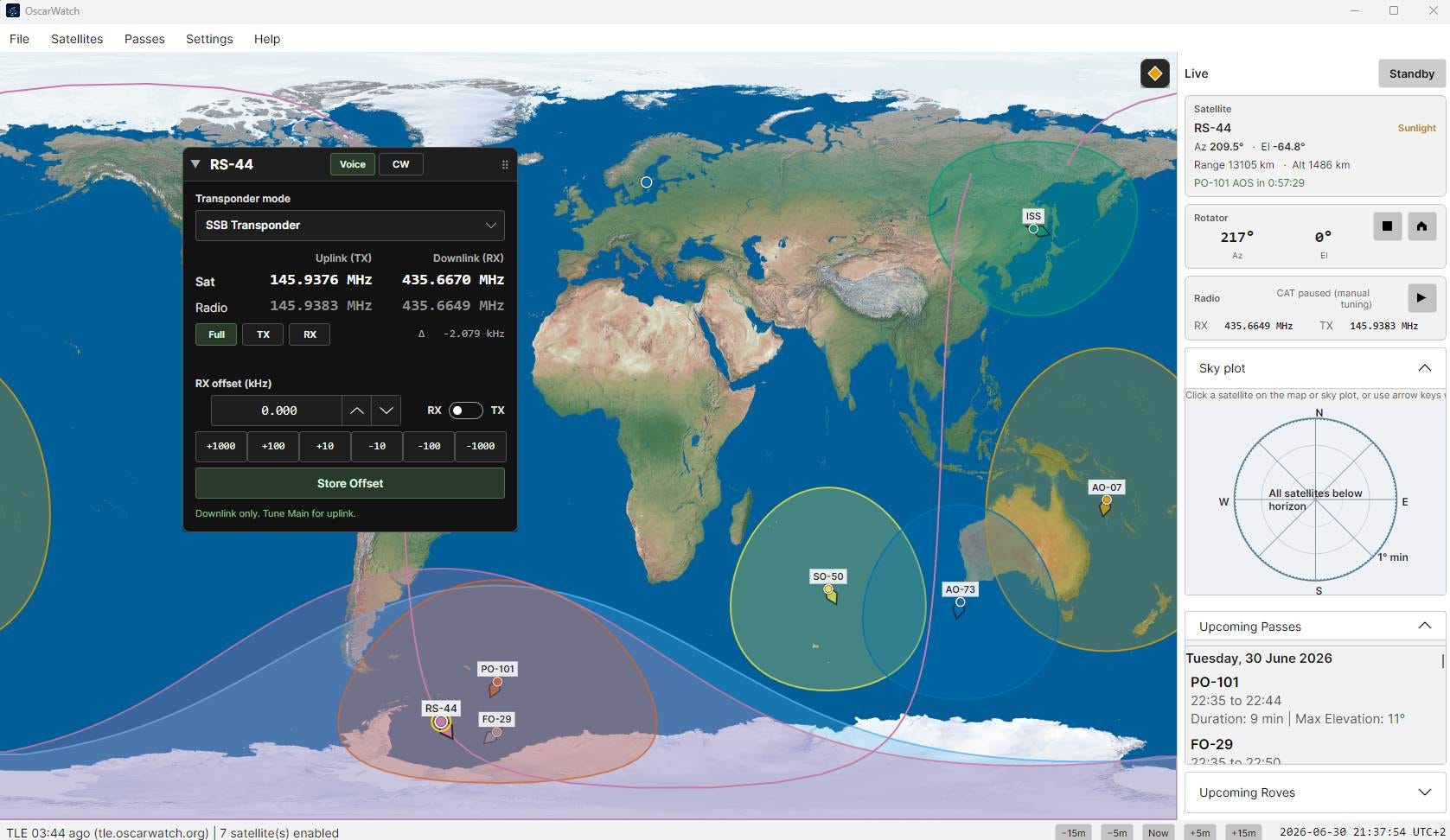
OscarWatch by Peter @mm9sql is a new desktop satellite tracking multi-platform software. It takes all the best parts from all other tracking softwares and bundles it into one package.
Peter have done a lot of work with the radio doppler control part and – as I see it – it is a huge improvement from what you have seen before in older software.
This is the current features list 30 Juno 2026, copied from GitHub:
World map: equirectangular Earth texture with satellite subpoint, ground track, footprint overlays (optional motion arrows), your QTH, and an optional remote DX station grid marker; map time scrubbing from the status bar (hardware tracking stays live)
Sky plot: polar view of satellite azimuth/elevation relative to your station; click to focus; expand/collapse state is remembered
TLE auto-update: manual refresh, on startup (if stale), or every 6 hours while running (Settings → Tracking)
Satellite picker: choose which spacecraft to track
Pass predictions: upcoming passes with TCA (time of closest approach / max elevation), min-elevation and min-duration filters; sidebar View pass plot for a single-station polar chart
Pass planner: multi-station profiles (home / portable), pass quality filters, satellite filter, pass radar gallery (polar plots for all upcoming passes of one satellite), and .ics calendar export for contest or field-day planning
Mutual pass finder: find passes visible from two stations at once (Passes → Mutual pass finder)
DX station monitor: enter a remote Maidenhead grid on the map; see where that station is and live azimuth/elevation for the focused satellite from their QTH (compact draggable overlay)
Live telemetry: azimuth, elevation, range, and altitude updated every second (UTC)
Voice announcements: optional spoken “rising” alerts when a satellite crosses a configurable elevation while ascending (e.g. “Alpha Oscar Zero Seven is rising”); Settings → Voice
Pass recording: optional automatic WAV capture from a line-in or USB audio device while the focused satellite is above configurable elevation thresholds; Settings → Recording. Files save to %AppData%/OscarWatch/recordings/ by default as {sat-name}-{yy}-{MM}-{dd}-{HH}-{mm}.wav (UTC). A red REC badge appears on the pass row while recording.
Doppler frequencies: draggable overlay on the world map with transponder modes from the satellite database, live radio/sat uplink & downlink, RX offsets (separate stored values for Voice and CW on linear SSB), CTCSS (access/arm), and Voice/CW toggle for linear SSB (header buttons + Ctrl+W; CAT/Cloudlog follow Settings → Radio → Linear CW: keep receive in USB/LSB)
Transponder database editor: Satellites → Manage transponder database… (add satellites from your TLE catalog or a custom name, Import/Export JSON, edit modes); Satellites → Update transponder database… merges published modes from tle.oscarwatch.org/satellite_database.json (new entries added with your consent; local edits kept on conflicts unless you accept remote). See documents/satellite-database.md
Radio CAT: doppler tracking, satellite/split setup, Main/Sub VFOs, uplink CTCSS where supported; Settings → Radio (see Supported hardware)
Rotator control: serial pass tracking, manual park, and manual rotator (az/el dialog in Standby for quick contacts between passes); Settings → Rotator (see Supported hardware)
Cloudlog: optional Radio API v2 uplink/downlink when tracking (Settings → Cloudlog)
Appearance: light, dark, or system theme (sky plot adapts; world map image stays light); 12- or 24-hour clock; optional greyline and footprint motion arrows on the map
I can’t quantify it, but this app looks really nice and something that I’d like to have on a dedicated computer and a dedicated screen in the shack, monitoring some of my favorite Amateur Radio (digital, of course) satellites. It would also be cool if it would display QO-100 in its geostationary orbit above the Eastern hemisphere.
This was another cool discovery from my slowly (but, constructively) declining backlog of Zero Retries Interesting RSS feeds thanks to NetNewsWire.
This document is based on my memories of the time. I do not keep a diary so some of the dates may be a little off, although some of them stay with me and I can date them based on other events occurring at the same time. Although this document is split into sections, and will be read linearly, the reality was that a lot of these things happened in parallel, and there will be a lot of cross referencing between different topics. It is a pity that all of this happened pre smart phone or digital cameras, as it would have been lovely to be able to show you pictures of it all.
Technically the first packet radio in the UK was in the mid-1980s following on from an article in March 1985 RadCom about a simple packet system called BBC Packet, using a BBC Micro. It was a remarkable program which included a simple terminal, and allowed simple point-to-point connections and chats. For a brief time this mode was quite busy, but was ultimately a technical dead end. However a number of us found it an interesting idea, and a latent interest in packet radio was created.
Another interesting find when searching for mentions of ROSE. This article is pretty comprehensive, from my knowledge of the developments of that era, but sketchy knowledge of packet radio development in Europe.
You'll find no mention of TheNet in this section. This seemingly came out of nowhere in (I think) later 1988 and was a complete functional clone of NET/ROM but was open source and had no encryption or callsign locking like the original. It didn't take too long for Software 2000 to take legal proceedings against the people behind TheNet. An independent software source code analyst verified that TheNet appeared to be an almost perfect copy of the Software 2000 code, but with the arguments to the functions reversed compared to the original. Ultimately the court ruled against the creators of TheNet, but the damage was done, and sales of true NET/ROMs fell through the floor. DANPAC had very little to do with TheNet, not for legal reasons, but because BPQCode was considerably more powerful and flexible. Later versions of TheNet also included IP over AX.25 routing which made it unique, but that wasn't enough of a selling point for us to use it.
From memory, TheNet came out of Europe and had much more usage there. I remember hearing about it from my reading in the US largely from the lawsuit by Software 2000 against TheNet. We were avid users of NET/ROM in the Seattle area. In my opinion, NET/ROM was a genius creation and the first real implementation of auto-discovery, auto-configuration mesh networking in Amateur Radio Packet Radio. Unfortunately it was hobbled (at the time) by its implementation in the 1 or 2 MHz clock speed and 32 kB ROM / 32 kB RAM of a TNC-2 type TNC.
Radio Autoencoder (RADE) - Good Story in QST
David Rowe VK5DGR in the November, 2026 issue of QST (pages 30-33):
The Radio Autoencoder (RADE) is a new way to send speech over HF radio (see the lead image). It employs modern machine-learning (ML) techniques to obtain impressive speech quality compared to SSB and traditional digital voice-over-radio systems. RADE is available as an open-source C library, and it has been integrated into Windows/macOS/Linux PC applications, the latest FlexRadio radios, and web-based software-defined radios (SDRs).
RADE transmits 8000 Hz audio bandwidth using just 1500 Hz of RF bandwidth. It has none of the usual background noise of HF radio and works well at both high and low signal-to-noise ratios (SNRs).
At the time of writing, the amateur radio community is at the forefront of this technology, with nothing comparable available in the commercial world. The work was partially supported by a grant from Amateur Radio Digital Communications (ARDC).
The October issue of QST was similarly notable for three Zero Retries Interesting articles:
The BrandMeister DMR Network
Getting Started with DMR
Long-Range Mesh Networking with Meshtastic (mentioned on the cover!)
This “burst” of Zero Retries Interesting content wasn’t accidental or coincidental. They were a result of ARRL having a Technical Editor on staff to seek out, curate, and encourage more technical topics, articles, and authors. The result of that work behind the scenes is notable in the improved (and relevant) technical content of QST.
But, unfortunately, the position of Technical Editor at ARRL is now vacant - the former Technical Editor, Conrad Trautmann N2YCH was on the QST masthead in the November 2026 issue of QST, but that position (and a number of other positions) is vacant.
This could be one reason:
We value in-person collaboration - this role is 100% on-site with no remote options.
Emphasis mine. I hope that the role of Technical Editor will be filled and there will be more Zero Retries Interesting content in future issues of QST.
It’s also been notable that there have been some Zero Retries Interesting advertisements thanks to some thinking-outside-the box outreach to new advertisers to the Amateur Radio market by now-former Advertising Sales Manager Steve Bossert K2GOG.
As always, almost all2 of the content of QST and its other magazines is behind a paywall, accessible only to paid-up ARRL members.
Products that intentionally transmit radio signals like Wi-Fi, Bluetooth, cellular, or other wireless technologies, commonly require FCC certification and an FCC ID. Examples include:
Mobile phones
Laptops
Tablets
Routers
Drones
Bluetooth devices
Wireless cameras
Smartwatches
Two-way radios
Remote controlled toys
A product’s category isn’t the only factor that determines if an FCC ID is required. If you’re not sure whether your product needs an FCC ID, check with the product’s manufacturer or supplier. You can also use the FCC ID Search Tool.
How to add FCC IDs to your listings
To help you provide this information, we’ve added a structured FCC ID field for applicable listings. When creating or revising a listing, add the item’s FCC ID in this field.
Here are a few things to keep in mind when listing:
Make sure the FCC ID you provide applies to the exact product and model you’re listing.
Don’t use an FCC ID from a similar product or model.
Depending on the product and listing, you may be unable to create, revise, relist, or publish the listing until you add the required information. Listings missing this information may be hidden from buyers in the US.
I can’t imagine this is a recent development, but I only saw a couple of mentions of this (non-authoritative so I won’t post links) this week. One stated that this requirement becomes effective 2026-10-13, but that date isn’t mentioned on the eBay page above.
I also saw another mention that this requirement also applies to items listed on Amazon - that will be an even more interesting effect than on eBay.
This… will get interesting, especially for Amateur Radio items, many of which predate the FCC ID requirement. How will sellers deal with this requirement for selling a unit that wasn’t manufactured in the US? Ditto something really vintage - I’ll venture that there’s no FCC ID for Hallicrafters radios. I’ve bought some vintage TNCs on eBay from Europe and Japan that wouldn’t have had an FCC ID. Ditto radios or computer components such as computer motherboards or expansion boards (or even vintage minicomputers) that predate the FCC ID requirement.
Today we’re releasing tailcat, a remix of pieces of Tailscale that gives you a way to use the open-source Tailscale data plane (WireGuard® + NAT traversal + DERP) without the Tailscale control plane, written by the people who made Tailscale. It’s Tailscale without Tailscale, by Tailscale.
Specifically, tailcat is both an open-source Go package and a CLI tool using that package. It lets you run a server-side listener and a client to connect to that server, moving bidirectional bytes back and forth.
That is, it’s like netcat but flowing over Tailscale’s magicsock (WireGuard encryption + NAT traversal + DERP rendezvous/fallback relay).
Notably, tailcat has:
no IP addresses
no accounts (no logins, no passwords, no SSO)
no control plane
no users
no admins
no administrative controls
no root or admin OS access requirement
no relationship with or dependence on Tailscale as a company (if you run your own cmd/derper DERP server, at least)
I tagged this a month ago and I’ve missed mentioning it several times.
As marvelous as Tailscale is, and it being rabidly endorsed by people I respect like Tom Salzer KJ7T, I’m a bit uneasy to create yet another dependency on a service out on the Internet like Tailscale. But, then again, we’re probably a bit past that point given that so much of my life online is dominated by the hyper-centralized systems like Starlink, Google, and Cloudflare.
Thus, Tailcat seems like a good solution for the problems that Tailscale fixes, without relying on a centralized service for systems like Amateur Radio that are supposed to keep going when the (commercial) infrastructure is down. Yet another thing to try to grok in the months ahead… post ZRDC 2026.
XCL.is - Cellular Technology on Amateur Radio Spectrum
XCL.IS is amateur cellular — real ham radio LTE on ham bands. A project building practical ham-radio cellular (amateur LTE) and IMS on the amateur spectrum and licensing I can get my hands on.
This… is flipping the usual script of Amateur Radio over cellular, like pairing a digital voice radio hotspot to your cellular phone when you travel on road trips, but miss the gang on your local repeater.
Click the link in the title.
I’ve been casually tracking this project for some time now and yes, it is real and functional, not merely a concept. Cellular technology seems intimidating and horribly complex (because, it is), but it’s approachable and yes, we have enough spectrum within Amateur Radio to run real cellular technology.
Given that our mobile phones are now Software Defined “DC to Daylight” (mostly) Radios, they can tune into Amateur Radio cellular.
There are a number of explanatory articles on this website that explain the concept.
Tagged for possible inclusion at ZRDC 2027.
Raspberry Pi Desktop Now Available for PC and Mac
Simon Long on the Raspberry Pi website News:
We’re really sorry you had to wait so long…
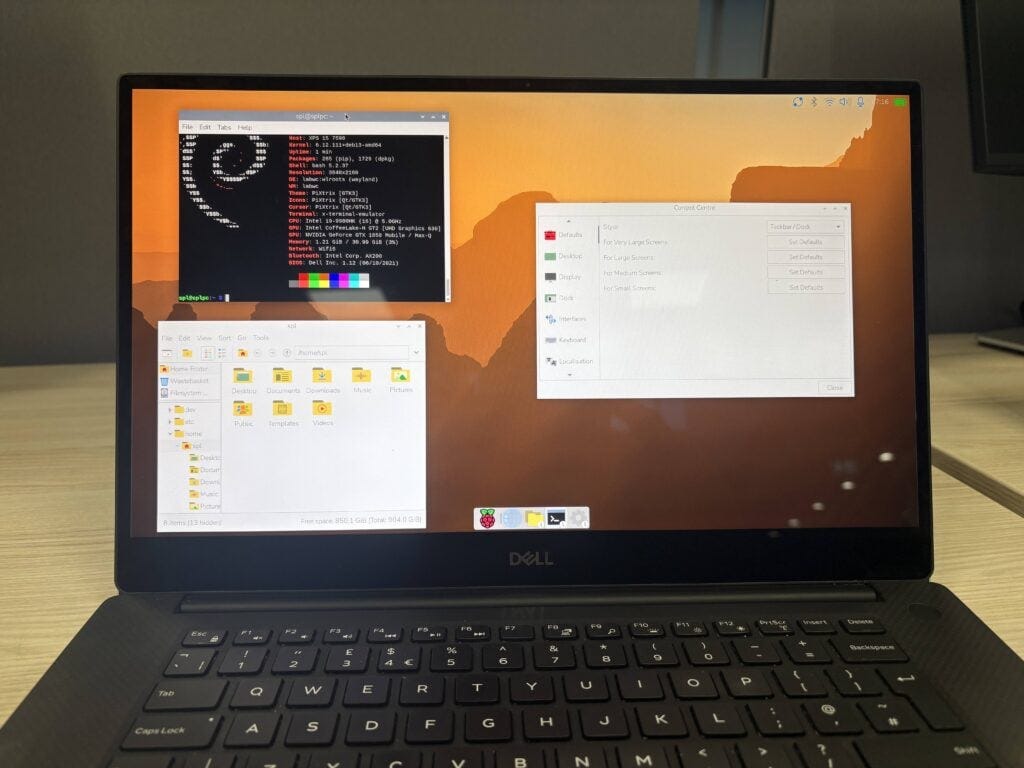
Here, at last, is the fully updated Debian Trixie with Raspberry Pi Desktop for PC and Mac. Download it from our website now to give your other computers a Raspberry Pi makeover. We’ve even included a Raspberry Pi Connect client.
Raspberry Pi Desktop installed on a 2020 Dell XPS laptop
…
Earlier this year, we (or rather Serge) finally got the latest version of the Desktop running on top of a Debian Trixie image. It’s now based on 64-bit Debian (the amd64 architecture) rather than the older 32-bit version, as Debian itself has stopped supporting 32-bit for PC architectures. This shouldn’t be a major problem – most PCs made in the last 15 years or so will quite happily run the 64-bit version of Debian, as will most Intel-based Macs. (Debian support for Apple Silicon is still experimental, so unfortunately those of you with the latest and greatest shiny fruit products will not be able to run this.)
Raspberry Pi Connect compatible
The new Raspberry Pi Desktop is fully up to date with all the latest desktop changes, such as the Control Centre and the new dock. In addition, we have added the Raspberry Pi Connect client, so you can control a PC or Mac running the Desktop along with your Raspberry Pis running Raspberry Pi Connect. It works in exactly the same way as on a Raspberry Pi; the only difference is that when you set up a PC for Connect, you will be asked to enter a name with which to identify that device – this isn’t required on a Raspberry Pi, where a unique hardware ID is used instead. The name you choose will then appear in the list of devices you see when you log into the Connect website, and you will be able to use screen sharing or a remote terminal on the device.
This is really cool, interesting news. I think the biggest takeaways are that this distribution is now 64-bit, incorporates Raspberry Pi Connect, and is now up to date and looks and works like Raspberry Pi OS.
There’s a lot of folks like me who have a tenuous, at times, relationship with Linux, and many Linux distributions ind feel like “if you don’t really know what you’re doing, you shouldn’t be using this”.
Raspberry Pi Desktop is a lot friendlier - at least that’s the way it feels (to me).
So this is very cool that there is now this option for many “orphaned” PCs and even Macs. I’ll be installing it on some of my computers in N8GNJ / Zero Retries Labs.
Video - APRS over Modem73 OFDM!
Craig Lamparter KM6LYW has been busy getting familiar with Modem73!
Nowhere in the APRS spec does it say the bell AFSK tones are to be used for modulation. Let's have direwolf use the modem73 modulator for all its aprs traffic. We set modem73 to use ROBUST RDM-1200 short packets and send some beacons and do some aprs messaging. The APRS Digipeater is on the left, the APRS client/tnc/WebChat is on the right.
This is quite possibly the first APRS conversation over modern OFDM modulation?
Digipeater (left) x86 pc, direwolf/modem73, tidradio H9 TNC/Webchat(right) Raspberry Pi Zero2W direwolf/modem73, YaesuFTM400
Post production note:
I was experimenting with modes - the video shows ROBUST packet, which is an OFDM mode, but mostly for HF/SSB. I also tested OFDM, QAM16, 1/4, Short mode which seems best for APRS with these rigs and conditions. Payload is 126B at 1KB/s with forward error correction - the packet is exactly one second (plus preamble, which I'd like to lose).
I noted in the comments of this video that this isn’t the first transmission of APRS using OFDM. I can’t cite a name or callsign of the person, but APRS has been used with VARA HF which also makes use of OFDM.
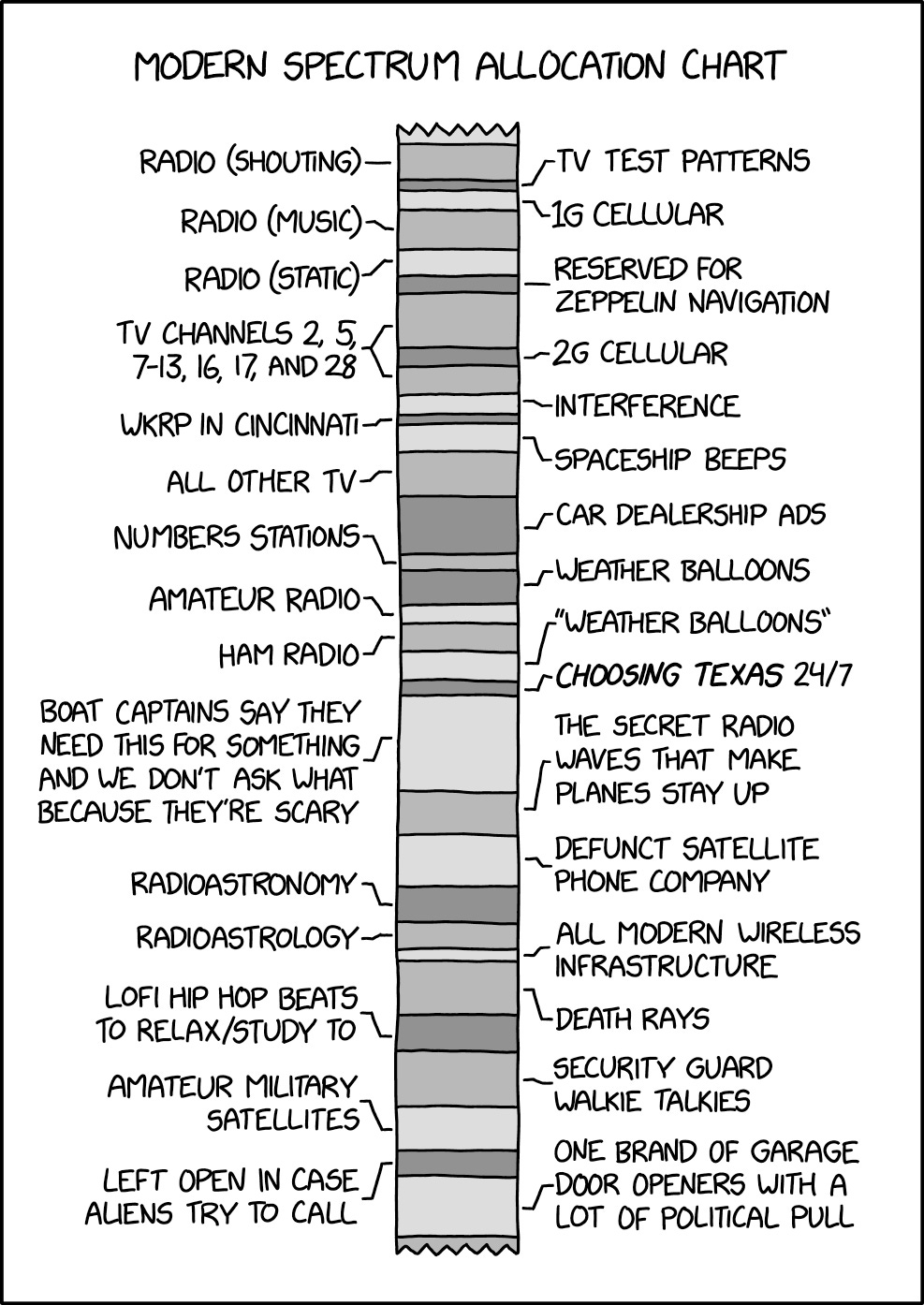
Post-publication Update: This wasn’t in the emailed version, and I meant it to be as I saw it this week and I thought it was hilarious. Cool that both Amateur Radio and Ham Radio have their own allocations of spectrum!
My thanks to Amateur Radio Weekly Issue 442 for October 10, 2024 for bringing this development to my attention for inclusion in Zero Retries. That issue yet another excellent Zero Retries Interesting issue.
I felt like before I finished editing this issue of Zero Retries, on the cusp of ZRDC 2026 and Pacificon, like I should take a look at the vendors that will be at Pacificon to highlight a few that are particularly Zero Retries Interesting. And there was a mention - Did you get the app?Of course there would be an app for Pacificon 2026 🤣
Between ZRDC 2026 on Friday, the many speakers and exhibitors, and some long-deferred in-depth conversations with Zero Retries Interesting folks like Cale Mooth K4HCK, it will be an exhausting, but delightful long weekend next weekend.
I keep neglecting to mention that K4HCK will be sharing the Zero Retries booth with us, so you can find him there on Saturday and thank him for his valiant and valuable work publishing Amateur Radio Daily and Amateur Radio Weekly.
I was intending to make this yet another Zero Retries To Do, but I was inspired by KB6NU’s version and decided that it was too good an idea to not spend a few (tens of) minutes creating a basic page - click the title link.
I started with these points:
One of the fastest-growing aspects of Amateur Radio is Software Defined Radio where the characteristics of a radio (type of transmission, choice of spectrum, etc.) can be altered in software rather than changing the hardware of a radio.
There are many data networks in operation on Amateur Radio spectrum, all over the world, with little or no dependence on other telecom infrastructure.
Amateur Radio has its own satellites for use by Amateur Radio Operators. The most prominent organizations for Amateur Radio satellites are AMSAT (US) and AMSAT-DL(Germany). There are twoAmateur Radio stations on the International Space Station, supported by ARISS.
Unlike other radio services, Amateur Radio Operators can create their own unique radio systems and use them on Amateur Radio spectrum. Other radio services require an onerous approval process for creating new radio systems.
Winlink is an email system used within Amateur Radio which (optionally) interoperates with Internet email.
This was important enough to link it from the links bar on the Zero Retries website.
I’m Agog at EtherHam’s (and KJ7T’s) Bandwidth
In this section of this week’s EtherHam Weekly Report (see a couple of sentences above), this section blew me away:
There were many Zero Retries Interesting links mentioned - too many to reference here. I know that KJ7T has automated this with his increasing familiarity / utility of AI tools, but wow…
That’s when I started feeling really old and tired for trying to keep up “manually”.
After we’ve decompressed from ZRDC 2026, I’m going to have a serious talk with KJ7T about porting some of his tools (or his services) for use with make publishing Zero Retries a bit saner and less (human) labor intensive.
The Joy of Internet Archive, and DLARC
When I was young… my primary technical references were magazines. I paid for a subscription to Popular Electronics with my income from a paper route. (Yep… I’m that old.) Thus there were at least several magazines that arrived each week and I would digest them as well as I could (with my limited knowledge of electronics, and microcomputers). The limiting factors then were storage space for all the old magazines, and disposable income to afford the subscriptions. There was also the serial nature of magazines. I’d get excited reading about an interesting project or development, and then you’d hit the dreaded “Continued next month”. Argh!
But now in the mid-2020s, every issue of Byte, every issue of Popular Electronics, every issue of The Rainbow3, every issue of 73, and thousands of other periodicals is all available for reading sequentially. And soon enough, there will be an endlessly patient AI to digest all of that great content, and tutor you through nearly any idea that’s contained in those gazillions of pages of content. My mind boggles at the potential. When I reach my dotage, I cannot imagine anything more pleasurable than sitting and reading all of that stuff I never had time, or background, to digest back in my youth.
We’re Living in the Future (with Artificial Intelligence)
I had an interesting conversation today that I was asked to keep confidential, and so I will. But the very broad context of the conversation was about using AI to tackle a very large tranche of unstructured data. You know, the kind of thing where you would never imagine having enough time to tackle (unless you’re rich enough to employ “staff” that you trust to assign menial chores like grinding through near-endless unstructured data and make some sense of it. But now with AI… such things like that are possible. After that conversation, my fantasy about grinding through four decades of great ideas about Amateur Radio data communications systems doesn’t seem so… fantastic.
Future (Way Future) “Hobby” Project - Create DreamNet Out of Past Packet Radio Work
RATS ROSE X.25 Packet Switch Historical Software and Source Code (1988–1995) is a recent addition to DLARC that I happened to see in the DLARC RSS feed. ROSE (link is for context), TEXNET, FlexNet, and NET/ROM / TheNet were all great ideas and networking technologies created for the unique conditions of Amateur Radio. But their real strengths could only be partially realized given the radio and computer technology of their eras. For radios, we can go faster over the air than 1200 bps (example - Modem73), and we finally have reliable linking with the addition of Forward Error Correction (FEC) technology, and Dire Wolf’s “bit flip” technique to fix small numbers of bit errors without retransmissions.
Not to mention that we can throw ridiculous amounts of computer power at Amateur Radio links, multi-port / multiple radios on different bands are ridiculously easy, for ridiculously low prices. And to tie it all together, we have the ridiculously capable Linux OS, we have TCP/IP stacks in $5 microcontrollers, and if we want unique IPv4 addresses, there’s 44Net.
What we don’t have at the moment, other than with AREDN microwave networks, is a well-developed auto-discovery, auto-configuration mesh networking protocol for VHF / UHF operation. So… a fantasy project in the (again, way future, for me) is to throw all that historical packet radio networking info being surfaced by DLARC (Thank You Kay Savetz K6KJN!) at a “gets better by the day” Artificial Intelligence system and begin guiding it gently into the “ultimate mesh networking system” for VHF / UHF. Or, maybe, AREDN has it as right as it needs to be by implementing Babel.
There is So Much Going On in Amateur Radio!
Please believe me when I say that the varied and voluminous content in this issue is a fraction of all the things I have tagged that I received via email and found via RSS feeds, and various other inputs like YouTube (which I haven’t taken the time to delve into).
Thus it’s jarring to read some other sources of information / media in Amateur Radio that aren’t paying attention to Zero Retries Interesting developments like what I touched on in this issue. Sometimes it seems like we’ve barely advanced out of the 1970s - we’re still talking on analog SSB, we’re still arguing about contesting, or DX, or griping about band conditions. There’s an sad old phrase, applied to Amateur Radio:
Instead of trying to sell Sushi… most of Amateur Radio media is trying to sell cold, dead fish.
It feels like this era is ripe with opportunity for the modern equivalent of 73 Magazine to make an impact on NewTechHams of this era and beyond. In saying that, I’m trying to posit the impact that 73 made in Amateur Radio, in comparison with the other “media competition” of that era - QST, CQ, and Ham Radio. If you were a reader of 73, you had your finger on the leading edge, cool stuff in Amateur Radio. There were other specialized publications like newsletters like Gateway, and television publications, and AMSAT publications, but 73 was one place where you could get a sense of the Zero Retries Interesting kind of stuff happening in Amateur Radio - like FM repeaters (yeah, there was a time when they weren’t everywhere), microprocessors (ditto), microcomputers… you get the idea.
I don’t know what it would take to really make this work - probably lots of money. But I could easily imagine something like a daily ten minute YouTube video / podcast with an accompanying website with the full text of the video / podcast, summaries, and perhaps an emailed high level summary with links.
Amateur Radio is just a fantastic resource for techies… and we in Amateur Radio that know how fantastic it is… aren’t exactly getting the word out at scale, at this moment.
But, trying not to restrict my vision… perhaps with more-powerful-by-the-day AI, perhaps we’ll be able to create such a thing as what I’m imagining with the help (or only because of) AI.
Weekends Are For Amateur Radio!
Saturday starts the last frantic 72 hours before departure for San Ramon and ZRDC 2026. This week I spent two sessions in N8GNJ / Zero Retries Labs clearing out the backlog of accumulated schtuff on my workbench to be able to have some workspace to get some things prepped.
I won’t sleep much in these next 72 hours until we’re underway in the car on Tuesday (Tina drives, I’m the primary cat comforter).
Have a great weekend, all of you co-conspirators in Zero Retries Interesting Amateur Radio activities!
Tina Stroh KD7WSF for, well, everything! Jack Stroh, Late Night Assistant Editor Emeritus Fiona and Shreky Stroh, Late Night Assistant Editors In Training
Founding Members Who Generously Support Zero Retries:
Founding Member 0000 - Steven Davidson K3FZT (Renewed 2026, 4th year!) Founding Member 0001 - Randy Smith WU2S (Renewed 2026, 4th year!) Founding Member 0002 - Chris Osburn KD7DVD (Renewed 2026, 4th year!) Founding Member 0003 - Don Rotolo N2IRZ (Renewed 2026, 4th year!) Founding Member 0004 - Bill Arcand W1WRA (Renewed 2026, 4th year!) Founding Member 0005 - Ben Kuhn KU0HN (Renewed 2026, 4th year!) Founding Member 0006 - Todd Willey KQ4FID (Renewed 2025, 3rd year!) Founding Member 0007 - Merik Karman VK1DF / VK2MKZ (Renewed 2026, 4th year!) Founding Member 0008 - Prefers To Remain Anonymous 08 (Renewed 2025, 3rd year!) Founding Member 0009 - Prefers To Remain Anonymous 19 (Renewed 2025, 2nd year!) Founding Member 0010 - Merik Karman VK1DF / VK2MKZ (Renewed 2025, 3rd year!) Founding Member 0011 - Rick Prelinger W6XBE (Renewed 2026, 3rd year!) Founding Member 0012 - Ryan Tolboom N2BP (Renewed 2025, 2nd year!) Founding Member 0013 - Newton White N4EWT (Renewed 2026, 2nd year!) Founding Member 0014 - Joe Hamelin W7COM (Renewed 2026, 2nd year!) Founding Member 0015 - Rich Stocking N7OP (Renewed 2026, 2nd year!) Founding Member 0016 - Chuck Hast KP4DJT (Renewed 2026, 2nd year!) Founding Member 0017 - Phil Karn KA9Q (Renewed 2026, 2nd year!) Founding Member 0018 - Prefers To Remain Anonymous 47 (Renewed 2026, 2nd year!) Founding Member 0019 - Prefers To Remain Anonymous 0108 (New 2025) Founding Member 0020 - Prefers To Remain Anonymous 110 (New 2025) Founding Member 0021 - Prefers To Remain Anonymous 111 (New 2025) Founding Member 0022 - Prefers To Remain Anonymous 112 (New 2025) Founding Member 0023 - Prefers To Remain Anonymous 116 (New 2026) Founding Member 0024 - Rob Bowser (SPOOLTENNA) (New 2026) Founding Member 0025 - Dave Stewart K7XST (New 2026) Founding Member 0026 - Prefers To Remain Anonymous 32 (New 2026) Founding Member 0027 - Mitch Hamm N8XS (New 2026)
Numerous Annual and Monthly subscribers who also generously support Zero Retries financially!
You thousands of readers of Zero Retries without which there would be little point in publishing this newsletter.
Fair Use - All excerpts from other authors or organizations, including images, are intended to be fair use and are fully attributed generally by author and link (URL).
Paid Promotional Content - Unless otherwise noted in the article or item, advertisement, or sponsorship notice, Zero Retries does not include paid promotional content. Exceptions:
Advertisements in Zero Retries,
Sponsorships in Zero Retries,
Zero Retries products,
Zero Retries events
Features and content exclusive to paid subscribers.
My formative microcomputer from which I learned the most, the earliest, the fastest, was the Radio Shack Color Computer (CoCo). The Rainbow was the “Byte” of the CoCo world.
Supercapacitors are pretty amazing, at least for those of us who grew up when tantalums were the brand new thing. At Turn Island Systems, we make a supercapacitor "UPS" designed for use with the small form-factor / mini / NUC computers, such as the ones used in the HamSCI / wsprdaemon SDR networks. Since these computers generally use a small external switching power supply, the holdover is so brief that even with an external UPS the switching transient during power-loss can glitch the computer. Our little box maintains power during the gap:



"A Supercapacitor UPS HAT for Raspberry Pi" -
Supercapacitors are pretty amazing, at least for those of us who grew up when tantalums were the brand new thing. At Turn Island Systems, we make a supercapacitor "UPS" designed for use with the small form-factor / mini / NUC computers, such as the ones used in the HamSCI / wsprdaemon SDR networks. Since these computers generally use a small external switching power supply, the holdover is so brief that even with an external UPS the switching transient during power-loss can glitch the computer. Our little box maintains power during the gap:
https://turnislandsystems.com/product/tis-1250-supercap-ups/