2025-12-31 — 3400+ email Subscribers, UberSDR - New GUI for ka9q-radio, Pending ARRL Book - Digital Networking for Ham Radio, Let’s Encrypt Certificates Available for IP Addresses Without Domain Names
Zero Retries is an independent newsletter promoting technological innovation in and adjacent to Amateur Radio, and Amateur Radio as (literally) a license to experiment with and learn about radio technology. Radios are computers - with antennas! Now in its fifth year of publication, with 3300+ 3400+ subscribers.
My thanks to Gerry Brown KK7GAB for renewing as an Annual Paid Subscriber (3rd year!) to Zero Retries in the past two weeks!
My thanks to My thanks to Prefers to Remain Anonymous 115 for upgrading from a free subscriber to Zero Retries to an Annual Paid Subscriber in the past two weeks!
My thanks to Bill Kreutinger KM6SLF for two years of being a Paid Subscriber to Zero Retries in the past two weeks!
Financial support from Zero Retries readers is a significant vote of support for the continued publication of Zero Retries.
3400 Email Subscribers!
Snipped from the Substack Dashboard today. Image by Steve Stroh N8GNJ
Just days before the end of 2025, the email subscriber count for Zero Retries has ticked up to 3400. The total readership of Zero Retries, via RSS, social media, pass-alongs, etc. is anecdotally much more than that number. I am grateful to all of you for “voting with your attention” that Zero Retries is contributing to Amateur Radio, and thus worth the work that I put into it. As I explain in every issue of Zero Retries in the section above, I’m am very grateful to the paid subscribers to Zero Retries that help to support Zero Retries financially.
Apologies For Publication Confusion
Thanks to those of you who reached out to check in on me if I was doing OK. It was appreciated! No health or other issues - the issue with Zero Retries not being published on schedule on Friday 2025-12-19 and 2025-12-26 was mostly poor planning on my part combined with busyness.
I had intended to take my “annual” holiday break and not publish Zero Retries in the last two weeks or so of the year in order to spend time with family over the Christmas / New Year holidays… but didn’t say anything about that in Zero Retries 0232.
There was also some last minute, barely scheduled travel just before Christmas by Tina and I to help out a friend. That kept us busy to the point where I didn’t get any laptop time to work on this issue of Zero Retries, until today.
I had wanted to implement the transition of Zero Retries to a new platform and migrate off Substack in December 2025, but as I’ve said previously, that’s a complicated process.
zeroretries.radio
That transition - Zero Retries being published on a platform other than Substack, is my highest priority for Zero Retries now. I’m determined that the transition will be implemented in January, 2026. At this point, I can reveal that Zero Retries on the new platform will be published using a new domain name:
zeroretries.radio
Currently that domain redirects right back here to Zero Retries on Substack, but soon enough it will point to Zero Retries on another platform.
While I hope to migrate the content of Zero Retries onto the new platform, that may not be possible (at least cleanly). We’ll see.
The Zero Retries Email List
… is going great! One of the nicest things about the Zero Retries email list is that there is a lot of community support and peer to peer information exchange happening on via the list. My thanks to all the participants. It’s also gratifying to see Zero Retries Interesting information posted on the list that I wasn’t aware of.
There’s a lot of Zero Retries Interesting content on YouTube, and while I’ve kind of been throwing a lot of stuff into the playlists on ZRYC, in the future I’m going to curate more selectively, such as creating specific playlists for topics such as Packet Radio (videos that I consider credible).
Synergy of Video Presentations, Zero Retries Guides, and the Zero Retries Book
I’ve been getting a lot of positive feedback and suggestions about the new Zero Retries Guide to HF Data Communications and my stated intention that it is the first of many Zero Retries Guides. I’m glad that I seem to have identified another “gap” in Amateur Radio that’s useful to furthering the mission of promoting Amateur Radio of the 21st century.
I intend that each Zero Retries Guide is going to be the basis of a three-way synergy - ZR Guides feed ZR video presentations feed chapters in the upcoming book.
Each Zero Retries Guide will be expanded into a brief video presentation (my goal is 10 minutes max) that will get posted on YouTube. These will be wholly original content, explaining a subject such as HF Data Communications, from the unique Zero Retries perspective. The idea is to “cross support” the (text) Zero Retries Guide with the (video) Zero Retries presentation. This addresses one of my primary plaints about video presentations (lack of deeper context), while addressing the near universal shift of information presentation in this era from text to video.
And then, between the Zero Retries Guide, and developing the presentation, and the feedback I receive from both, I can then “port” that information over to the equivalent chapter in the still in progress book - Zero Retries Guide to Amateur Radio in the 21st Century. After moving Zero Retries to a new publishing platform, this book is the next primary project of Zero Retries in early 2026.
Coming Attractions in 2026
My wife Tina KD7WSF, Zero Retries’ Business Manager often cautions me not to overpromise and underdeliver, and that’s a point well taken. With that in mind, I have reasonable confidence that I’ll be able to deliver on these near future projects.
Two big, important projects for Zero Retries in 2026 (besides the book) will be:
Porting Zero Retries content into Google’s NotebookLMand then sharing that out. There are limits on NotebookLM sharing, so this feature will be initially be offered to Zero Retries paid subscribers. That’s not a “shill” for additional Zero Retries paid subscribers, just a long overdue “Thanks” to the paid subscribers who currently don’t receive much “value added” for their paid subscriptions. NotebookLM doesn’t “ingest” web pages, so I was basically stymied for an reasonable way to add issues of Zero Retries to NotebookLM. But in some brief downtime the past couple of weeks, I did a specific enough AI and web query and found a reasonable way to do so. This will also address a longstanding task of porting out each issue of Zero Retries into a PDF so that it can be archived into DLARC.
Beginning the Zero Retries Zoom sessions (good name To Be Determined). In doing presentations for others, I’m not in control of the agenda (inclusion of Amateur Radio club business meetings, for example) and often, I feel that important (Zero Retries Interesting) information doesn’t get presented, or it’s diffused (discussion forks into discussing, for example, M17 in a presentation I intended to be about, for example, New Packet Radio. This is completely understandable in a context of a general presentation for an Amateur Radio club. I think there’s lots of room for a Zero Retries Interesting focused discussion / interview on specific topics with specific interviewees, and I’m determined to make that happen in 2026. Zoom does a great job in creating decent video, and I have hopes that either Zoom, or another application / service will make it possible for me to easily and efficiently edit the videos lightly (titling, minor cutting) and then post them on the Zero Retries YouTube channel. And, of course, it helps the “Zero Retries Synergy” that Zoom automagically creates a good enough transcript of each Zoom session.
As with NotebookLM, Zoom sessions, at least at the basic tier that I’m currently using, the participation in a Zoom session has limits. Thus, as with the Zero Retries NotebookLM, this feature will be initially offered to Zero Retries paid subscribers. Again, that’s not a “shill” for additional Zero Retries paid subscribers, just a long overdue “Thanks” to the paid subscribers who don’t receive much “value added” for their paid subscriptions.
Thanks for a wonderful and productive 2025, all you Zero Retries readers!
Handy Tip - Use RSS to Monitor Groups.io Email Lists
A longtime Zero Retries reader mentioned to me:
Reading the Zero Retries email list via RSS is wonderful!
RSS is Really Simple Syndication, a way of monitoring blogs (mostly) and other websites that have an RSS feed, via a RSS feed reader app. My use of RSS is one of the main reasons I can bring you interesting developments here in Zero Retries (without spending most of my days manually polling various websites).
Indeed! That got me thinking that most of the Groups.io email lists that I follow for Amateur Radio, I’m doing so passively and thus don’t need to clutter my email inbox with each new post to the list (or digest). Groups.io allows you to be subscribed, but not receive emails which has the advantage of being able to go to the Groups.io page for the list and comment there if you wish. Gmail keeps nattering at me that I’m at 88% or so capacity on my current tier, and I’m going to implement this strategy in the next few days and set those Groups.io lists to “no email” and convert my monitoring to RSS.
Best of Zero Retries 2025
End of year summaries are the usual fodder for media such as Zero Retries, and I think that’s appropriate and useful for the first issue of Zero Retries in 2026. It was a busy and productive year for technological innovation in Amateur Radio.
(Likely) No Zero Retries on Friday 2026-01-09
I’m going to reserve the next ten days or so to complete the transition to a new publishing platform for Zero Retries without the self-imposed pressure to publish a new issue of Zero Retries. Thus I don’t plan to publish Zero Retries on Friday 2026-01-09 (or Friday 2026-01-02)… unless the conversion to the new platform goes really, really well.
Weekends (and Holidays) Are For Amateur Radio!
We’ve had a streak of clear (sunny) but cold weather here in Bellingham this week, and after publishing this issue, I’m going to reserve a few days to work in N8GNJ / Zero Retries Labs to catch up on at minimum, clear the bench of accumulated projects (perpetually in progress).
Have a great weekend, all of you co-conspirators in Zero Retries Interesting Amateur Radio activities!
Are you a ham that wants to experiment with 44Net but found the setup process to be intimidating? Say no more, because we’ve got great news for you!
We’re excited to introduce 44Net Connect, a service that makes it easy for hams to begin using 44Net IPv4 addresses through a simple, modern setup. Whether you’re experimenting with digital modes, improving repeater infrastructure, setting up a home lab, or just curious to see what 44Net is all about, this new service lowers the barrier of entry to get you started.
Why 44Net Connect?
44Net Connect uses modern, secure networking technology (WireGuard) that’s already supported by many popular routers, including NETGEAR, TP-Link, and Ubiquiti, and it works across a wide range of devices, from desktop computers and phones to Raspberry Pis.
Here’s what makes 44Net Connect especially useful:
Simple setup: No complex configurations required. Just connect and go!
Get a static IPv4 address: Access a static 44Net IPv4 address without relying on your ISP.
Bypass carrier-grade NAT (CGNAT) limitations: Perfect if your IPv4 support is behind CGNAT or has a short lease from your ISP.
Experiment safely: You can experiment and learn without “breaking the Internet”– 44Net Connect has the bumpers in place for you.
All in all, 44Net Connect makes 44Net more accessible and fun, helping more people experiment with networking, amateur radio, and digital communications technologies!
How to Get Started
Getting connected is easy: all you need is a router, computer, phone, Raspberry Pi, or anything that can run a WireGuard client.
If you haven’t already, go to the 44Net Portal, set up an account, and then open a ticket for call sign verification.
Once your call sign is verified, head over to the 44Net Connect dashboard to sign up and join the registration queue.
From there, you’ll be able to explore what 44Net has to offer and see just how easy it is to get online.
A Community Effort
44Net Connect wouldn’t have been possible without the work and collaboration from Adam Lewis KC7GDY, who originated the concept; Zach Seguin VA3ZTS, an early contributor that worked closely with Adam on the project; and John Hays K7VE SK, whose subject-matter expertise and efforts were instrumental in bringing 44Net Connect to reality. Ian Redden VA3IAN, Dave Gingrich K9DC, and Dan Theisen WI7FI contributed valuable guidance, insight, testing, and support throughout the project as well.
We’d also like to thank the 2024 and 2025 Technical Advisory Committees (TAC), who helped shepherd this project from “what if” to proof of concept to being production-ready, and of course the many beta testers who provided valuable feedback along the way.
If you’d like to learn more about 44Net Connect or get involved, please reach out to Adam Lewis KC7GDY, our IT & Development Manager (adam@ardc.net) or John Burwell KI5QKX, our 44Net Program Manager (john@ardc.net).
A Nod to 44Net’s Legacy
44Net Connect debuted December 10, 2025, which is also the 45th anniversary of another pivotal moment in amateur radio, when Hank Magnuski KA6M put up the first digipeater in the United States and helped kick off the packet radio era. We are honored to mark this new service alongside a significant milestone in amateur radio and digital communications.
Join In!
44Net Connect continues the spirit of 44Net: a playground for experimentation and innovation with TCP/IP over RF. With this new service, getting started has never been easier. So fire up your router, and start exploring the possibilities!
My chosen router for 44Net Connect (not yet implemented) is the GL.iNet GL-AR300M16 (available from Amazon).
The article 44Net Connect is Live! in Zero Retries 0232 was an “insider’s heads up” notification on the 44Net email list. This is the formal, general, fully public article about 44Net Connect aimed at a more general audience.
I’m still jazzed that 44Net Connect is finally live and publicly available.
… For those running the RX-888, there is a new system that is so cool I can’t put it into words. It wraps so much into one app I may be retiring many of my other go to SDR apps and hardware.
It’s composed of two docker images to support KA9Q-Radio and another for the UI, decoding and processing. There are also standalone clients for Windows and Linux, which I’ve yet to play with that offer various audio and CAT interfaces and SDC TCI connectivity, something I’ve been looking to see supported in the opensource SDR realm. See
To which Phil Karn KA9Q (creator of ka9q-radio) replied:
Pretty cool. This is exactly what I hoped would happen when I started ka9q-radio -- somebody would put a really good UI on it.
At a glance, this looks like an ideal Software Defined Receiver client - for Amateur Radio HF reception.
That merits a plaint - UberSDR supports only HF and on a specific (albeit, good) Software Defined Receiver, the RX-888, that’s only (well, mostly…) for HF.
A second, minor plaint - UberSDR has native installations for Linux (completely understandable) and Windows (also completely understandable), but not MacOS… also understandable, I guess. But this would be really cool running on a Mac given how much Graphic Processor Unit (GPU) power that a typical, modern Mac has available (and almost entirely idle) in the era of the Apple M4 processor that is now baseline on current generation Macs.
We need the kind of functionality and usability such as UberSDR for VHF / UHF SDRx units, especially building in the decoders for common VHF / UHF modes, such as the various flavors of digital voice, conventional packet radio / APRS, LoRa / Meshtastic (on 433 / 868 / 915 MHz), etc.
“Need”, as my observation is that HF operation is mostly of interest to Amateur Radio Operators with long experience, but not of much interest to NewTechHams who are often constrained to VHF / UHF operations in apartments, condos, housing developments governed by Homeowners Agreements (HOAs) prohibiting external antennas, etc. This matters if Amateur Radio is going to be able to be seen as relevant in this era amongst the potential population that could become NewTechHams.
As an Electronic Technician (now retired), I had always intended, but never quite got around to getting certifications by the International Society of Certified Electronics Technicians (ISCET). That didn’t hinder me in my eclectic career path which expanded into SysAdmin / NetAdmin work, and eventually writing… but it was always something that I regretted not doing.
ETAI even has their own electronic magazine - High Tech News.
Wikipedia’s article - Electronics Technicians Association gives a good overview of the history of the various organizations that merged to become ETAI.
This mention in the Wikipedia article was Zero Retries Interesting:
In 1993 ETA became a COLEM for the FCC Commercial Radio License program and offers professionals the chance to sit for seven different FCC commercial licenses at ETA test sites including the general radiotelephone operator license.
I was under the (mistaken) impression that FCC licenses for individuals (other than Amateur Radio and General Mobile Radio Service - GMRS) had long since been deprecated in favor of industry certifications. Apparently the FCC Commercial Radio Operator Licenses continue, but testing for it is administered by Commercial Operator License Examination Manager organizations (COLEMs) such as (per ChatGPT):
National Association of Radio and Telecommunications Engineers (NARTE)
W5YI Group
National Radio Examiners (NRE)
ATI / FCC Commercial Radio License Examinations
It would be cool if something could be worked out with one of those groups, perhaps W5YI group (given its origins in Amateur Radio) to create “certifications” for various aspects of Amateur Radio in the 21st century such as:
Pending ARRL Book - Digital Networking for Ham Radio
This email from ARRL to some (ARRL affiliated?) Amateur Radio clubs was shared with me by Zero Retries reader Bob Houghton AD6QF:
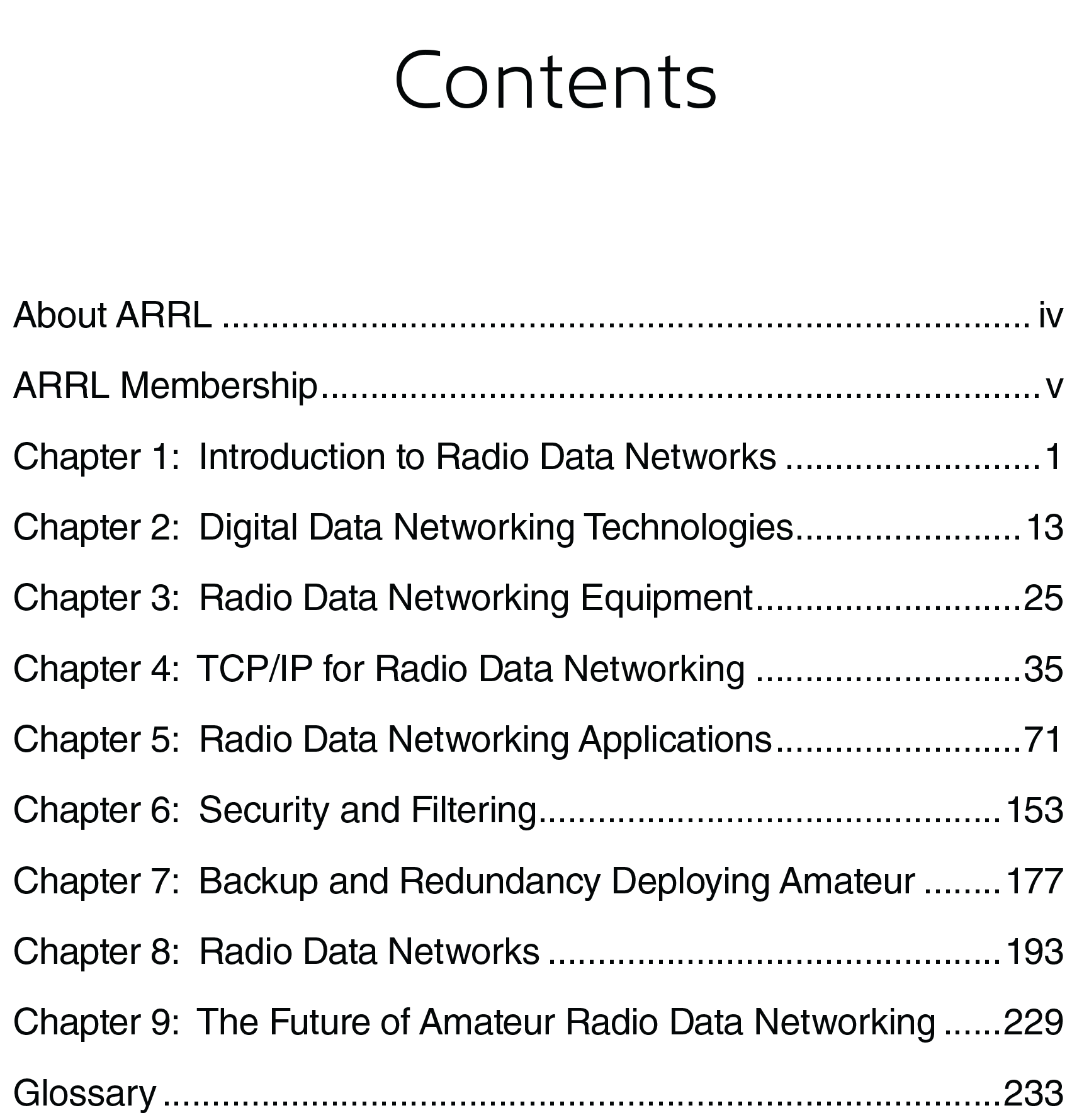
While doing some research on clubs that have members with interests around new technologies like AREDN, Meshtastic, and networking, I thought you and the executive team of [organization redacted] would be interested in a new ARRL book called Digital Networking for Ham Radio, which is expected to be available before spring 2026. We go to press officially in mid-January. Here is a link to the final high-level table of contents.
Glen Popiel, KW5GP, an accomplished author of multiple ARRL publications, brings a unique perspective to this new book. Its focus stands out, and it is worth recognizing both individuals and clubs that are engaged in these subjects. Innovative technologies in the 33-, 23-, 13-, and 5-centimeter bands are attracting commercial interest. This book highlights the amateur radio community’s engagement with these frequencies and why we must show we are using them to prevent commercial interests from taking them away from the amateur radio community.
The new book will include pages for “booster” ads, so individuals and clubs interested in these topics can take part. Here are the details:
Individuals — For $30, an individual will have first and last name plus call sign listed in the book. Individuals listed will also receive a free printed copy of the book as a thank you. Those on our list will receive a discount code to claim a printed copy as soon as it arrives in our warehouse.
Clubs — We believe that the more club members who have this book, the more it will spark discussion and encourage even greater hands-on group projects. Listing the club’s name, main call sign, and website address costs $50. Club members who are not named individually are eligible to buy the book at half price. There is no limit to the number of copies you can order.
We expect to fill six to eight pages with booster ads in this book on digital networking and their use of the microwave spectrum. With a list price of $34.95, this book is an excellent way to support an important topic, demonstrate your commitment, and help defend our spectrum as one of our boosters.
Time is extremely limited before we go to press. Submit your club details using the online form linked below. We encourage you to share this message with your members or those interested in this topic so they can be part of the individual listing option.
The ARRL member services team will then reach back out to confirm the details and to process payment.
We need to close all form entries by January 9, 2026, to prepare and complete everything for the first production run.
Please do not hesitate to call or email me directly with any questions.
73,
Steve Bossert, K2GOG Advertising Sales Manager ARRL The National Association for Amateur Radio® 225 Main Street, Newington, CT 06111-1400 860-594-0203 sbossert@arrl.org ads@arrl.org www.arrl.org
AD6QF said:
I take this as a positive sign that ARRL is moving in the right direction.
I agree!
I think that the “booster” (I’d call it sponsorship) section of the book is a great idea, though I think they slightly missed the mark by not offering a slightly more prominent mention (such as mentioning the company name in a bold font), at a higher cost, to commercial companies. It’s an interesting hybrid to the complications of crowdfunding via Kickstarter, etc. where a product must be delivered. This approach is such a good idea that I’m going to adopt it for my upcoming book.
To support this book, and ARRL’s re-entry into books about Amateur Radio data networking (there have been a number, most recently High Speed Multimedia for Amateur Radio in 2016), I queried K2GOG at ARRL about the possibility of Zero Retries being mentioned as a “club” in the book, and I received a positive response, details To Be Determined.
I agree that this new book is a positive sign for ARRL’s recognition that Amateur Radio in the 21st century won’t be Same Old, Same Old technologies, and that Amateur Radio data networking is a significant trend in the 21st century. I hope I’m wrong in inferring that the book will posit that “Amateur Radio data networking is only being done in “33-, 23-, 13-, and 5-centimeter bands” and not mention the innovation in data networking that is being done in Amateur Radio VHF / UHF bands such as VARA FM, New Packet Radio, IP400, CATS, and AREDN (in the 902-928 MHz / 33 cm band).
Back in 2025-08, when I first heard about this book, I corresponded briefly with KW5GP with some suggestions of topics I think the book should include, and pointers to a number of Amateur Radio microwave networks.
To answer a question in advance, no this book doesn’t impact my plans for, or intended content of my pending book Zero Retries Guide to Amateur Radio in the 21st Century. While I think there will be some overlap of coverage, the two books have different aims and intended audiences. For example, I have no qualms about including speculative ideas (clearly labeled as such) such as my SuperPeater concept and discussing the rise of NewTechHams, and what that demographic portends for Amateur Radio in the 21st century.
I look forward to buying this book, reading, and learning more about the covered subjects from KW5GP’s perspective.
I haven’t yet listened to this episode of HRWB, but it is next on my podcast list, within the next few days. I’m in awe of the productivity of David Gleason NR9V in churning out a wide variety of innovative audio interfaces via his company AllScan.info for a variety of use cases and radios in Amateur Radio. He's created several new variants of his products just within the last few months, which he previews on the Facebook group AllScan AllStar App & Nodes.
An episode of HRWB like this doesn’t get much more Zero Retries Interesting, and I really want to hear what NR9V has to say, especially from his encyclopedic knowledge of AllStarLink, which I could use a primer on.
This is a computer-controlled 60 GHz transceiver in the form of a Raspberry Pi HAT which can be had for relatively little money, and looking at the datasheet, I think it might be possible to use it as a high-speed data transceiver. The 60 GHz band is an ISM band, so it should be possible for hams and non-hams alike to have some fun with it.
The article says in part:
Dream Boards has released the DreamHAT+ Radar, a compact add-on board that brings high-precision 60 GHz mm-wave radar capabilities to Raspberry Pi 4B and 5. Built around Infineon’s BGT60TR13C radar chip, the DreamHAT+ is designed for developers and researchers working on gesture recognition, presence detection, indoor tracking, and privacy-focused sensing, all without relying on cameras or microphones.
The radar operates between 58 and 63.5 GHz using frequency modulated continuous wave (FMCW) technology. It features one transmitting and three receiving antennas on a single chip, enabling directional sensing and motion tracking.
…
The DreamHAT+ Radar is available now for $110.83 from Pimoroni.
Two decades ago, the cheapest 60 GHz unit available was (from fallible memory) tens of thousands of dollars, which was reasonable at the time for achieving 1 Gbps radio links rooftop to rooftop in urban areas. Much of the expense of those units was creating an antenna that could focus (and track) a beam with the wavelength of 5mm.
Now a 60 GHz radio is a cheap Raspberry Pi HAT. I love technology!
I saw the write up on the OPENTNC. The author also modified the code to work on our hardware design for the "POCKET PICO" as it is dubbed by our group.
Also another Ham forked our repo and took our firmware and made some slight changes so it runs on the opentnc hardware. That is located here: https://github.com/mpvano/pico_opentnc
PICO TNC is the Terminal Node Controller for Amateur Packet Radio powered by Raspberry Pi Pico. This is a fork of that project. I have removed all of the major features of the code except for the modulator/demodulator section and inserted a z80 emulator from my TNCEMU project that emulates a Heathkit HK21 Pocket Packet. Introductory Video can be seen here:
I have strong memories of the HK21 (see cover and review article in the link) and I now have one in my collection of TNCs. (If memory serves, the HK21 was actually a product of Tano Corp. of Japan, not an original design by Heathkit). It was cool that you could connect a downsized TNC to a portable radio for a fully portable (handheld) packet radio station (sans laptop, of course). Now we can do the same thing with the Mobilinkd TNC4 and the Digirig and Digirig Lite, not to mention some portable radios with built-in TNCs.
Codec 2 Optimized For Smaller Memory and Faster Execution
Wojciech Kaczmarski SP5WWP on the M17 Project website:
After a few days of optimizing Codec2’s code (3200 bps mode), it is time to share the results (and the code itself!).
What the goals were:
provide the 3200 bps mode through a separate, clean repository (only C code, no Octave test benches, no modems etc.)
prepare an easy experimenting ground for further improvements (beyond the bit-exactness constraint)
code clean-up: remove all the unnecessary and obsolete constructs, applied optimizations
fully static memory allocation (including KISS FFT)
After all of that has been done, the resulting code is still fully compatible with the original Codec2, but executes faster and with much less memory footprint. Sounds like an excellent drop-in replacement for OpenRTX and other embedded projects. See the readme file for more details.
As always: have fun testing the code. Feedback is welcome!
This is just one example of the continuing technological innovation occurring within the M17 Project. All the other digital voice systems used in Amateur Radio are static - they’re as good (or poor…) as they’re ever going to be. This is a situation akin to trying to improve voice quality in the Public Switched Telephone Network (PSTN) that David Isenberg so aptly described in his amazing and prescient essay The Rise of the Stupid Network. All of the interfaces for P25, D-Star, System Fusion, DMR, etc. - repeaters, radios, networking, are now “locked in” so you can’t get better voice quality (or other fundamental improvements) from those systems.
But M17 is different because it’s entirely software based, especially its vocoder - Codec 2, and M17 is Open Source, so M17 can be improved… and as demonstrated by this development, is being improved.
Also relevant to M17, there have been a number of small announcements in the last few months relating to M17 posted on the M17 Project website, including CC1200 hotspot firmware v2.0 is out.
Will some nimble Amateur Radio vendor in the US please buy a number of the CC1200 hotspots and sell them from stock so us casual M17 users can order just one via a US source? I’m happy to pay a premium for a CC1200 from such a vendor. I just don’t want to deal with the complexities of ordering quantity 5 direct from China.
Jon Adams N7UV on the Ham-Radio-LoRa-APRS email list:
The Amateur Packet Reporting System (APRS), as envisioned by WB4APR and subsequently many others, was and is an application to establish a highly robust tactical messaging system using amateur radio digital communications, which was growing quickly in popularity around 1980. His goal was to allow any suitably equipped ham to capture, in a short period of time, an overview of what was going on (from a ham radio point of view) in the local area, including announcements, bulletins, messages, alerts, weather, objects, events, frequencies in use, nets, meetings, hamfests, ham satellites in view, mobile/portable device locations, and to be able to map this activity. Messaging is a core part of APRS!
APRS is a real-time tactical digital communications protocol for exchanging information between a large number of stations covering a large (local) area. As a multi-user data network, it is quite different from conventional packet radio.

APRS is different from regular packet in four ways. First by the
integration of maps and other data displays to organize and display
data, second, by using a one-to-many protocol to update everyone in real time, third, by using generic digipeating so that prior knowledge of the network is not required, AND FORTH [sic], since 1997, a worldwide transparent internet backbone, linking everyone worldwide. APRS turns packet radio into a real-time tactical communications and display system for emergencies and public service applications (and global communications). Normal packet radio is useful in passing bulk message traffic (Email) from point-to-point, but it does not do well at real time events where information has a very short life time and needs to get to everyone quickly.
It’s well worth a read, if for no other reason than to understand better what Bob had in mind when he crafted APRS.
Many, including WB4APR, stated that APRS wasn’t intended to be a vehicle/person tracking system, but indeed that is generally considered to be the most common use of APRS today. To a great extent, that use has taken away from the original intent of messaging and situational awareness. Back when APRS was first envisioned, the GPS constellations that we take for granted nowadays didn’t exist, and once they became available the cost of a GPS receiver was astronomical (pun intended). Nonetheless, as GPS prices plummeted, it became easy to add GPS to a mobile setup. There’s nothing wrong with tracking mobile/portable units, it’s critical to remember that APRS is supposed to be an amateur radio situational awareness system, which also includes keeping track of things that are moving.
Mike KC8OWL has been one of the leaders in reinvigorating the “messaging” aspect of APRS with his (ok, it’s a bunch of folks) “APRS Thursday“ program, encouraging APRS-equipped hams to send a message. Messaging is a fundamental part of APRS.
What does LoRa have to do with APRS? First, they’re two different things. LoRa is an advanced, modern, wireless digital modulation technology, and APRS is an application (an “app”) that relies upon some method of wide-area wireless communications.
Traditional APRS (like what is heard on 2 meters) uses a very mature (or nearly obsolete, to this writer) digital modulation technology called AFSK (audio frequency shift keying) generated by simple analog<>digital modems (TNCs) to take advantage of the VHF voice FM radios that continue to be the most common item the average ham has access to. It’s straightforward to connect a TNC to a suitable 2 meter FM radio and, so long as the ham gets the wiring right, the audio levels properly set, and the RF path is solid, the TNC can construct a data packet, generate an audio waveform that modulates radio’s microphone input, and the radio transmits the packet. At the remote station (digi, igate, another operator, etc.) using a similar setup, it can receive, demodulate, and then read the contents of that data packet. Easy-peasy! (For AFSK APRS, please never use VOX to key the transmitter!)
There are two major challenges with legacy amateur packet radio. First, AFSK modulation used over the air is very sensitive to distortion, FM capture effect, random noise bursts, slow and fast path fade, mobile fade/flutter, etc. From that AFSK Wikipedia link above (mildly edited to further the point):
AFSK ... is far less efficient in both power and bandwidth than most other modulation modes.
The protocol selected to encode the information is AX.25, a variation on X.25, a protocol designed for wired packet-switched communications. X.25 works well because it is on a wire, there are no “hidden transmitters”, all units can detect whether the wire is busy or not thus to not step on one another, and there is a very low probability of external noise corrupting a bit. The A in AX.25 means “amateur”, as the hams who worked with X.25 did a few tweaks to it, and christened it AX.25. Over a radio channel AX.25 is problematic. It’s designed for a wire, not a real-life radio channel, with distortion, multipath, FM capture effect, random noise bursts, hidden transmitters, etc. AX.25 has no error correction capacity, so if a bit is corrupted over the radio channel, the receiving end has to throw out the entire packet, and that entire channel occupancy time has been wasted. Why was this selected? Because, back in the mid-1970’s, it was available, understood, and was designed for packet-switched networks, so why not? And could be implemented on fairly inexpensive (even for the 1980s) hardware.
Today, AFSK is crude. It was very common back in the dial-up modem days (does anyone even remember those ancient acoustically coupled modems where you dialed a phone number, then placed the handset into the rubber cups and could hear dulcet modem tones?), since all that there was available was an plain-old-telephone-service (POTS) audio circuit between two computers. AFSK was an easy way to encode digital information on a voice-grade telephone connection. An old-school telephone circuit is (within reason) a wire, not nearly as subject to the real world vagaries of a radio channel.
So here we hams are, in the 2nd quarter of the 21st century, still using a set of technologies that are now over 50 years old. LoRa data communications represents a thousand-fold improvement on legacy FM AFSK packet radio! LoRa is as big a step forward from FM AFSK as FT8 and other advanced digital communications modes are to RTTY %^).
Next time, let’s find out more about what’s so cool about LoRa and why it’s perfect for hams and APRS!
Kudos to N7UV on this great food-for-thought article about keeping APRS relevant with improved radio technology. Candidly, this is the kind of thought leadership I had hoped would be provided by the APRS Foundation. But that organization is fading out in relevance for lack of substantive communications (last update on their website was 2026-07) or substantive advancement of organizational perspective on APRS.
LoRa is one reasonable option for a “better than AFSK” modulation system for low data rate communications in Amateur Radio. But, LoRa is a bit tough to fit into conventional APRS usage as there aren’t any 10 or 25 or 50 watt radios available for LoRa (and especially not for Amateur Radio VHF / UHF bands other than 433 MHz (intended for low power unlicensed use in Europe) and 915 MHz (intended for low power unlicensed use in North America). Yes, there’s an argument to be made that LoRa doesn’t need higher power operation, but… we’re Amateur Radio, and we can use such power levels.
One huge improvement that could be implemented with APRS would be the incorporation, as a standardized improvement in the APRS specification, of Forward Error Correction (FEC). We now have a choice of FEC for VHF / UHF packet radio appropriate for APRS - FX.25 or IL2P1 (my choice is the latter as its FEC is interleaved, rather than being “tacked on”) but adding FX.25, if that is the consensus, would be a significant improvement to APRS.
Another vastly improved implementation of APRS beyond 2m AFSK modulation is Communication And Telemetry System - CATS which also uses 70 cm, with Frequency Shift Keying at 9600 bps. Unlike LoRa, all of the technology in CATS is Open Source.
Another great article by Jon Adams N7UV on the Ham-Radio-LoRa-APRS email list:
No, just good old fashioned math, signal processing, and silicon engineering know-how.
What makes LoRa so special? It’s a modulation scheme that is fairly unusual in our natural world, save some animals and charged particles interacting with the Earth’s magnetic field.
LoRa is a form of radio frequency modulation like AM, FM, SSB, CW, etc., but one that has some very impressive characteristics making it ideal for static high path loss situations. And it can provide this kind of performance while sipping microjoules from a 10-year-lifetime lithium primary battery or an inch-square solar panel and a supercap. LoRa is a wireless data transmission technique, not an end application. It’s a digital communications mode for which there is an extensive and ever-growing amount of technical documentation publicly available.
LoRa is the trademarked term for a specific chirp spread spectrum (CSS) technology developed by semiconductor company Semtech, headquartered in Southern California, USA. The silicon that Semtech manufactures is a complete radio transmitter/receiver on a chip. Chirp spread spectrum has been used by the military since World War II (in a former life I helped design spacecraft-borne CSS radars for NASA), it’s nothing new, it just used to be really complex to implement in hardware. It’s a form of frequency shift keying (FSK) where it’s both the carrier frequency relative to the channel center and the rate of change with respect to time of that carrier frequency that encodes the data. That’s what makes it novel and so remarkable.
Semtech developed LoRa for the Internet of Things (IoT) world. There, IoT means communicating flow rates from a water meter that’s in a concrete box mostly underground, or a gas or electric meter on the side of a house, to a aggregator site on a phone pole a kilometer away. In fact, that and similar environments and uses are what has made LoRa radio technology so successful in the global marketplace. LoRa has discrete settings that allow a wide range of data rates, channel occupancy times, power consumption, and radio link budget. Every one of these settings might find value in a particular situation. And the broad operating frequency range means it can be adapted to nearly any unlicensed band that’s available. According to Semtech, there were over 410 million end nodes with LoRa ICs deployed worldwide as of February 2025. What that means for us hams is plenty of product availability!
Unlike some ham radio digital communications techniques, there are no fees to use LoRa other than the cost of the semiconductor chip, which is a few dollars US. There are manufacturers all over the world that take Semtech chips and incorporate them into their products. According to Semtech, a lot of their chips go into metering devices that water, electric power, and gas utilities that then use the LoRa link to communicate remotely with those meters. LoRa chips can be configured to consume extremely little power, and allow that meter’s battery to last a decade. Due to the modulation method and receiver performance, 20-byte 1% packet error rate receiver sensitivities of -120 to -150 dBm are achievable. LoRa settings that enable about 1200 bps over the air have a receiver sensitivity of around -129 dBm - compare that to 2 m amateur packet radio at 1200 baud on a typical analog FM receiver breaking squelch at maybe -120 dBm and a usable signal needing to be around or greater than -110 to -105 dBm, and at those received power levels still often not able to meet the 1% packet error rates that LoRa does. And that’s for fixed nodes.
Semtech’s chip technology has progressed through 3 generations, and much of the silicon they make supports 150-960 MHz continuous; some of their chips also support 2400-2500 MHz, that’s potentially interesting too. (Sadly, they don’t support the 1240-1300 MHz 23 cm US ham band - that would be awesome if they did...)
LoRa, as implemented by Semtech, supports a wide range of data transmission rates from 11 bps (about that of a 20-word-per-minute Morse code operator) to 62.5 kbps. The challenge with very low data rates is that a message can tie up a channel for tens of seconds, cratering overall channel capacity. But the link margin is huge! (Only of value if you can make use of it.) Completely satisfactory link margins can be had at LoRa settings that provide over-the-air data rates of even 10 kbps with channel occupancy times in the 40 ms range, vastly improving the channel availability and its capacity to accommodate multiple users.
Because of LoRa’s native ability to work far below the noise floor, carrier squelch multiple access - collision avoidance (CSMA-CA) doesn’t exist in the LoRa world. However, it does have something that’s similar, channel activity detection (CAD). While generation 1 LoRa chips had a limited CAD function, generation 2 and greater LoRa chips have a full-featured CAD that allows the transmitter to check the channel for activity before making the decision to transmit a LoRa packet. CAD produces an outcome similar to that of CSMA-CA. At the aforementioned “10 kbps” settings, a CAD operation takes just a millisecond. Researchers have really begun to dig into ways to improve the overall channel availability through innovative ways of using CAD.
Hams started experimenting with LoRa around a decade ago, nearly all in Europe. There are lots of independent research papers on LoRa written since the mid-2010s, there are funny-hat-wearing Swiss hams on YouTube who talk about LoRa, there are whole ham clubs using LoRa for amateur radio comms, and at least a few who are experimenting with new ideas to take greater advantage of what LoRa has to offer. Semtech publishes detailed technical data sheets and technical white papers that describe in detail how to use LoRa. All are publicly available technical resources for learning more about LoRa and how hams can take best advantage of it.
More to come!
Sadly, a lot of hobbyist usage of LoRa, both Amateur Radio and Meshtastic / MeshCore is a Tragedy of the Commons in using a single channel for wide area networking. Amateur Radio Packet Radio experienced this in the early days of the TNC-2 and its ability to digipeat. Initially, most Amateur Radio Packet Radio activity was on a common frequency - 145.01 MHz. That’s where everyone was, so that’s where everyone wanted to be. We quickly learned that putting all packet radio traffic on a single frequency such as 145.01 MHz just doesn’t scale. Packet Radio activity soon spread out into ten widely agreed upon discrete Packet Radio frequencies - 144.91, 144.93, 144.95, 144.97, 144.99, 145.01, 145.03, 145.05, 145.07, and 145.09 with gateways, backbones (often on another band), different channels for BBS forwarding, etc. LoRa foresaw this issue and created LoRaWAN as a standardized way to “spread out” LoRa communications, but Amateur Radio (and Meshtastic, and MeshCore) haven’t embraced LoRaWAN - yet.
… is a valuable resource for hams looking to learn more about packet radio networks. The wiki provides documentation, user tools, and site tools to help users navigate and utilize the network effectively.
Just one (of the many) valuable nuggets of Zero Retries Interesting info in Random Wire 161 (and Random Wire newsletter in general). The “popular perception” is that Packet Radio isn’t in active use any more (except for VHF / UHF Winlink access and APRS), but this and many other (scattered, diffuse, not centrally organized) Packet Radio organizations are active in developing, promoting, and growing Packet Radio networks.
Let’s Encrypt Certificates Now Available for IP Addresses Without Domain Names
Another valuable nugget from Random Wire 161:
Upcoming Changes to Let’s Encrypt Certificates means you won’t need to have a domain name to obtain a short-lived Let’s Encrypt certificate: “This switch will also mark the opt-in general availability of short-lived certificates from Let’s Encrypt, including support for IP Addresses on certificates.” This is a big deal for those of us with some IP-based resources that are connected to the internet but have no domain name.
… is a Certificate Authority that provides free TLS certificates, making it easy for websites to enable HTTPS encryption and create a more secure Internet for everyone. Let’s Encrypt is a project of the nonprofit Internet Security Research Group.
This might slide by unnoticed by most in Amateur Radio (including me), but kudos to Random Wire Editor Tom Salzer KJ7T for having caught this significant development. I think it’s significant for the potential of (free) Let’s Encrypt certificates that can now be used with (free, for Amateur Radio use) static IPv4 IP addresses that don’t necessarily have domain names connected to them, issued by 44Net Connect. We cannot use Hyper Text Transport Protocol Secure (HTTPS), AKA web site / browser encryption, on Amateur Radio spectrum2. But, in setting up Amateur Radio Over Internet systems that will be accessed from the public Internet, not having HTTPS (certificates) (HTTP, no S) is a major hassle. Think accessing a remote Amateur Radio with just a 44.x.x.x IP address. Using http://44.x.x.x, your web browser starts throwing all kinds of fits. https://44.x.x.x - no problem. With HTTPS, such Amateur Radio Over Internet systems act like “real Internet”.
Continued Kudos to KJ7T for his excellent work on Random Wire Newsletter and now EtherHam.
Amateur Radio Can Be Relevant to Entry Level Job Seeking
I saw two articles recently that align with my positing in Zero Retries that hands-on experience with radio technology via Amateur Radio can be relevant to one’s career prospects for technology, and especially radio technology.
As a college student, are you concerned that your knowledge alone won’t be enough to impress potential employers? Do you feel you lack the necessary hands-on technical skills to secure a job? Maybe you’ve thought of an engineering solution for a problem in your school or community but are unsure how to take the next step.
I struggled to bridge the gap between classroom theory and real-world application. But when you combine academic knowledge with practical projects that solve a societal problem with technology, you can ace any interview.
…
Students need to understand the importance of doing something exceptional beyond learning theory and concepts. Having practical skills before leaving school is a great way to set yourself apart from other new engineering graduates.
Amateur Radio is a practical, and demonstrable way for students to get hands on experience with radio technology.
Enter the trend of “microcredentials,” professional certificates that demonstrate a candidate is pursuing additional training or qualifications to support the roles they’re applying for. According to $1.3 billion learning platform Coursera, more than 90% of employers would rather hire a candidate with a microcredential on their CV than one without.
While this article discusses semi-formal credentials from Coursera, I posit that hands-on experience with radio technology via Amateur Radio is a valuable de facto “micro credential”.
These two articles complement a comment I heard at GNU Radio Conference 2025 relating to trying to find and hire people who have experience with GNU Radio. The matter-of-fact reply was “everyone I know who has experience with GNU Radio has a good job already”.
There’s an infinite number of experiences to be gained by experimenting with Software Defined Radio (and GNU Radio is one of the easiest ways to get started with SDR), in Amateur Radio. It starts simply with getting a Software Defined Receiver working, and getting a very low power Weak Signal Propagation Reporter (WSPR) transmitter working.
To be clear, obtaining an Amateur Radio license, or using Amateur Radio spectrum, is not required to develop such expertise. But, Amateur Radio spectrum - LF, to HF, to VHF / UHF, and microwave, along with the unlimited modes available (including unique ones that you develop) has exponentially more possibilities for learning about the very broad spectrum (yes, pun intended) of radio technology.
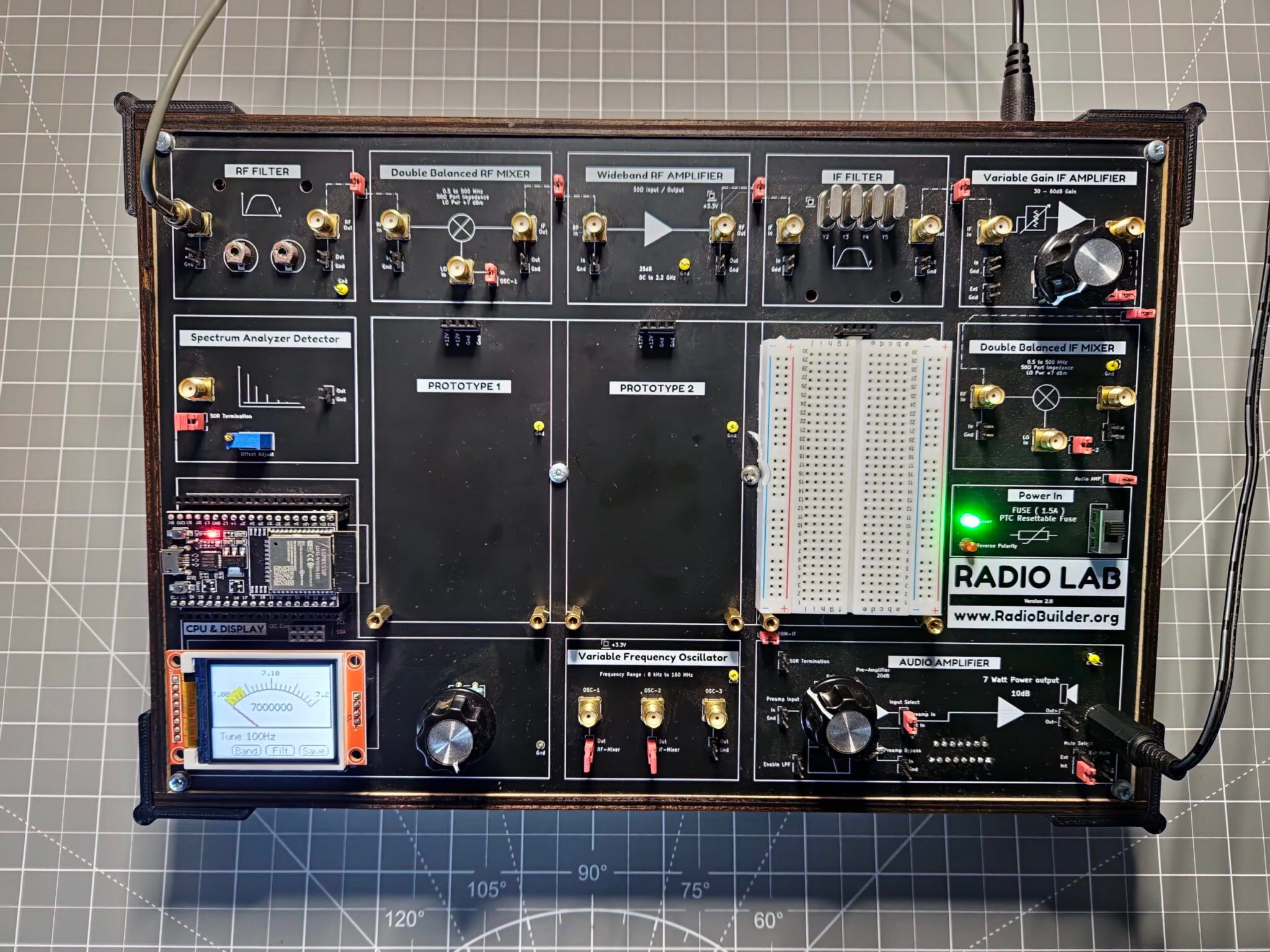
All the building blocks to experiment and build radios
AM, SSB and FM
LW to VHF
0 – 2GHZ RF Amplifier
0 – 500MHz Mixers
Variable Gain 60dB IF amplifier
7 Watt Audio Amplifier
3 Signal Generators 8KHz to 160MHz
Color Display
ESP32 Controller
RF and IF Filter
3 Prototyping areas
Spectrum Analyzer Detector
This is pretty cool - a “breadboard” for radio experimentation and learning.
No idea why this occurred to me, but in a tightly defined environment like this, with good documentation by the vendor, this would be an ideal environment for an Artificial Intelligence chatbot like ChatGPT to teach radio technology one step at a time, going beyond the exercises developed and documented by the vendor.
Radio and terahertz links could be better, faster, and cheaper
The [AI] industry is working on ways to unclog data centers by extending copper’s reach and bringing slim, long-reaching optical fiber closer to the GPUs themselves. But Point2 and another startup, AttoTude, advocate for a solution that’s simultaneously in between the two technologies and completely different from them. They claim the tech will deliver the low cost and reliability of copper as well as some of the narrow gauge and distance of optical—a combination that will handily meet the needs of future AI systems.
Their answer? Radio.
Later this year, Point2 will begin manufacturing the chips behind a 1.6-terabit-per-second cable consisting of eight slender polymer waveguides, each capable of carrying 448 gigabits per second using two frequencies, 90 gigahertz and 225 GHz. At each end of the waveguide are plug-in modules that turn electronic bits into modulated radio waves and back again. AttoTude is planning essentially the same thing, but at terahertz frequencies and with a different kind of svelte, flexible cable.
With our shared background of Amateur Radio, and more generally, the use of radio technology in free space, we sometimes don’t think of the incredible myriad uses of radio technology that aren’t communications (as we know it). This is yet another example of an unconventional, unexpected, and absolutely essential use of radio technology. At GRCon 2025, I learned about radio technology being used for higher resolution imaging, new types of RADAR, Near Field Communications (NFC), etc. We think of computing (and now, AI) being the most impactful technology in our current technological society, but there are other supporting technologies such as power generation and delivery, and now, in the 2020s, radio technology has become absolutely fundamental. It has been, for decades now, but it’s faded into the background… and it shouldn’t.
To receive new issues of Zero Retries every week via email, become a free subscriber. To support Zero Retries, paid subscriptions are appreciated, but entirely optional.
Zero Retries Boilerplate
The Zero Retries Store is now open for business with quality Zero Retries branded merchandise and items being retired from Steve’s N8GNJ Labs.
See the Zero Retries Boilerplate page for significant acknowledgements and other information relevant to Zero Retries. For new readers of Zero Retries, that page, and the About Zero Retries page has useful information to check out.
My ongoing Thanks to: Tina Stroh KD7WSF for, well, everything! Jack Stroh, Late Night Assistant Editor Emeritus Fiona and Shreky Stroh, Late Night Assistant Editors In Training Annual Founding Members who generously support Zero Retries financially: Founding Member 0000 - Steven Davidson K3FZT (Renewed 2025, 3rd year!) Founding Member 0001 - Randy Smith WU2S (Renewed 2025, 3rd year!) Founding Member 0002 - Chris Osburn KD7DVD (Renewed 2025, 3rd year!) Founding Member 0003 - Don Rotolo N2IRZ (Renewed 2025, 3rd year!) Founding Member 0004 - William Arcand W1WRA (Renewed 2025, 3rd year!) Founding Member 0005 - Ben Kuhn KU0HN (Renewed 2025, 3rd year!) Founding Member 0006 - Todd Willey KQ4FID (Renewed 2025, 3rd year!) Founding Member 0007 and 0010 - Merik Karman VK1DF / VK2MKZ (Renewed 2025 x2, 3rd year!) Founding Member 0008 - Prefers to Remain Anonymous 08 (Renewed 2025, 3rd year!) Founding Member 0009 - Prefers to Remain Anonymous 19 (Renewed 2025, 2nd year!) Founding Member 0011 - Rick Prelinger W6XBE (Renewed 2025, 2nd year!) Founding Member 0012 - Ryan Tolboom N2BP (Renewed 2025, 2nd year!) Founding Member 0013 - Newton White N4EWT (New 2025) Founding Member 0014 - Joe Hamelin W7COM (New 2025) Founding Member 0015 - Rich Stocking N7OP (New 2025) Founding Member 0016 - Prefers to Remain Anonymous 77 (New 2025) Founding Member 0017 - Phil Karn KA9Q (New 2025) Founding Member 0018 - Prefers to Remain Anonymous 95 (New 2025) Founding Member 0019 - Prefers to Remain Anonymous 0108 (New 2025) Founding Member 0020 - Prefers to Remain Anonymous 110 (New 2025) Founding Member 0021 - Prefers to Remain Anonymous 111 (New 2025) Founding Member 0022 - Prefers to Remain Anonymous 112 (New 2025)
Numerous Annual and Monthly subscribers who also generously support Zero Retries financially!
You thousands of readers of Zero Retries without which there would be little point in publishing this newsletter.
Permission for Reuse of Zero Retries Content
Blanket permission is granted for Amateur Radio use of any Steve Stroh content in Zero Retries for Amateur Radio newsletters and distribution via Amateur Radio such as (but not limited to) Packet Radio Networks, Packet Radio Bulletin Board Systems, Repeater Nets, etc. Specific blanket permission is granted to TAPR to use any Steve Stroh content in Zero Retries for the TAPR Packet Status Register (PSR) newsletter (I owe them from way back).
In such usage, please provide appropriate authorship credit for the content (especially for guest authors) and mention that it was first published in Zero Retries newsletter, preferably in this format:
This article is reprinted with permission. It was first published in Zero Retries newsletter, issue Zero Retries (number), (date) - (include full web link of the specific issue).
It’s appreciated (a courtesy, but not required) to notify Zero Retries Editor Steve Stroh N8GNJ of any reuse of Zero Retries content - editor@zeroretries.net.
If you’d like to republish an article in this issue for other uses, just ask.
All excerpts from other authors or organizations, including images, are intended to be fair use. Unless otherwise noted in the article, there are no paid promotional items in any Zero Retries articles.
I haven’t tried to look at the creation / edit history of these articles on Wikipedia… but some Amateur Radio Operator is doing a wonderful job of creating these unique-to-Amateur-Radio technologies in Wikipedia. Kudos, unknown Wikipedia Amateur Radio editor!
It’s a longer, deeper discussion, but the letter of the regulations for US Amateur Radio is that deliberate obfuscation of content is prohibited except for space telecommand and control of remote control model vehicles. Thus if you’re just trying to access something on the Internet - such as querying / validating a callsign on the FCC website (only accessible using https), you’re not trying to obfuscate the content, the obfuscation / encryption is incidental.