

Zero Retries is an independent newsletter promoting technological innovation in and adjacent to Amateur Radio, and Amateur Radio as (literally) a license to experiment with and learn about radio technology. Radios are computers - with antennas! Now in its fifth year of publication, with 3500+ subscribers.
Steve Stroh N8GNJ, Editor
Tina Stroh KD7WSF, Business / Conference Manager
Substack says this issue is too big to read in an email client. Thus, it might be easier to read in a web browser - https://www.zeroretries.org/p/zero-retries-0245.
It’s easy and free to subscribe for your own copy of Zero Retries every week:
In This Issue...
open.space - Moon Launch Update!
Introducing an AREDN Chat Client
KISS Protocol Implementation Improved
Stixs - Handheld 5 Watt VHF / UHF LoRa Data Radio In Development
Another Entirely Zero Retries Interesting Issue of Random Wire Newsletter!
Why You Might Want To Set Up Your Raspberry Pi Internet Web Server on 44Net
I-Frame
By Steve Stroh N8GNJ
Brief notes about this issue of Zero Retries.
Zero Retries Back on Substack / www.zeroretries.org
Welcome back to Zero Retries being published on Substack using the non-problematic www.zeroretries.org domain.
‘Nuff said here in Zero Retries. If you’d like to know more, see this page.
All content that was published uniquely on Ghost is in the process of being imported into Substack / www.zeroretries.org.
Please direct comments / feedback about I-Frame to the Zero Retries email list with the #ZR0245 hashtag - mailto:zeroretries@groups.io?subject=%23ZR0245.

open.space - Moon Launch Update!
By Steve Stroh N8GNJ
I’ve been excited about this project since I saw this prototype exhibited at Pacificon 2025. Unlike repurposing commodity Wi-Fi chipsets, or flashing new firmware onto an existing piece of hardware, this project really takes radio technology in a completely new direction - solid state spatial control (phased array technology) that is entirely under the control of the user and the software.
I was getting a bit worried that March came and went with no hint of actual hardware:
Expected to ship: March 2026.
But more than most people in the world, I’m sympathetic to small companies / innovative projects having “issues with domain names” due to forces beyond their control. Thus, with the following update, I’ll grant them ample grace for the schedule slip.
Note - both moonrf.com and scalerf.com, as of this writing, redirect (back) to open.space, which is probably just an artifact of moving the website content to a new domain / hosting… for which I can also offer ample sympathy.
Martin McCormick K1MCC via email
(to those signed up for updates at open.space):
Wow, it’s already spring 2026—and another full moon in the year of the scalable RF phased-array!
Over the last few months, there’s been good progress on the quest to make Earth-Moon-Earth (EME) communication simple, affordable, and actually usable.
→ The latest update here ←
None of this is an April Fool’s joke, I promise!The open·space domain name... however... has collided with the military-industrial complex. It turns out they’ve successfully trademarked the vacuum of space!
We received a formal takedown notice for our open·space domain from Kratos Defense. Yes, that Kratos, the massive defense contractor. Apparently they hold a trademark for “OPENSPACE” (no dot), which they use for obscure satellite command software tied to military and classified programs (including one called Golden Dome).
So my lawyers recommended making it very clear: we are the ham radio open·space, not the SkyNet orbital weapons control thing.
To be fair, their marketing team deserves respect. Naming a classified military network OPENSPACE is right up there with Greenland, Full Self-Driving, and the Patriot Act.
Anyway, rather than burning time and money on lawyers to argue the lack of overlap between our ham radio project and their space military system, I’m focused on our upcoming Crowd Supply campaign. They can have the open.space domain (and sure, take the Earth while they’re at it...)
Effective immediately, the moon-bounce project shall henceforth be named:
MoonRF! And the website is: MoonRF.com
So keep a lookout now for emails from m@MoonRF.com
Messages to old ___@open.space addresses will soon be bouncing—and not off the moon this time!
All for now,
- Martin
Founder of... MoonRF (I guess)
Below are excerpts of the MoonRF web pages, all of which have a great deal of rich, deep, relevant content. After reading this, I recommend going back and clicking through the links and read all of the detail on those pages.
Gems of Info From the Website / Update
Clicking through the here link - https://open.space/updates/ finds a minor detour in the roadmap towards a phased array 5 GHz antenna capable of Earth Moon Earth Communications - Meet the QuadRF Kit.
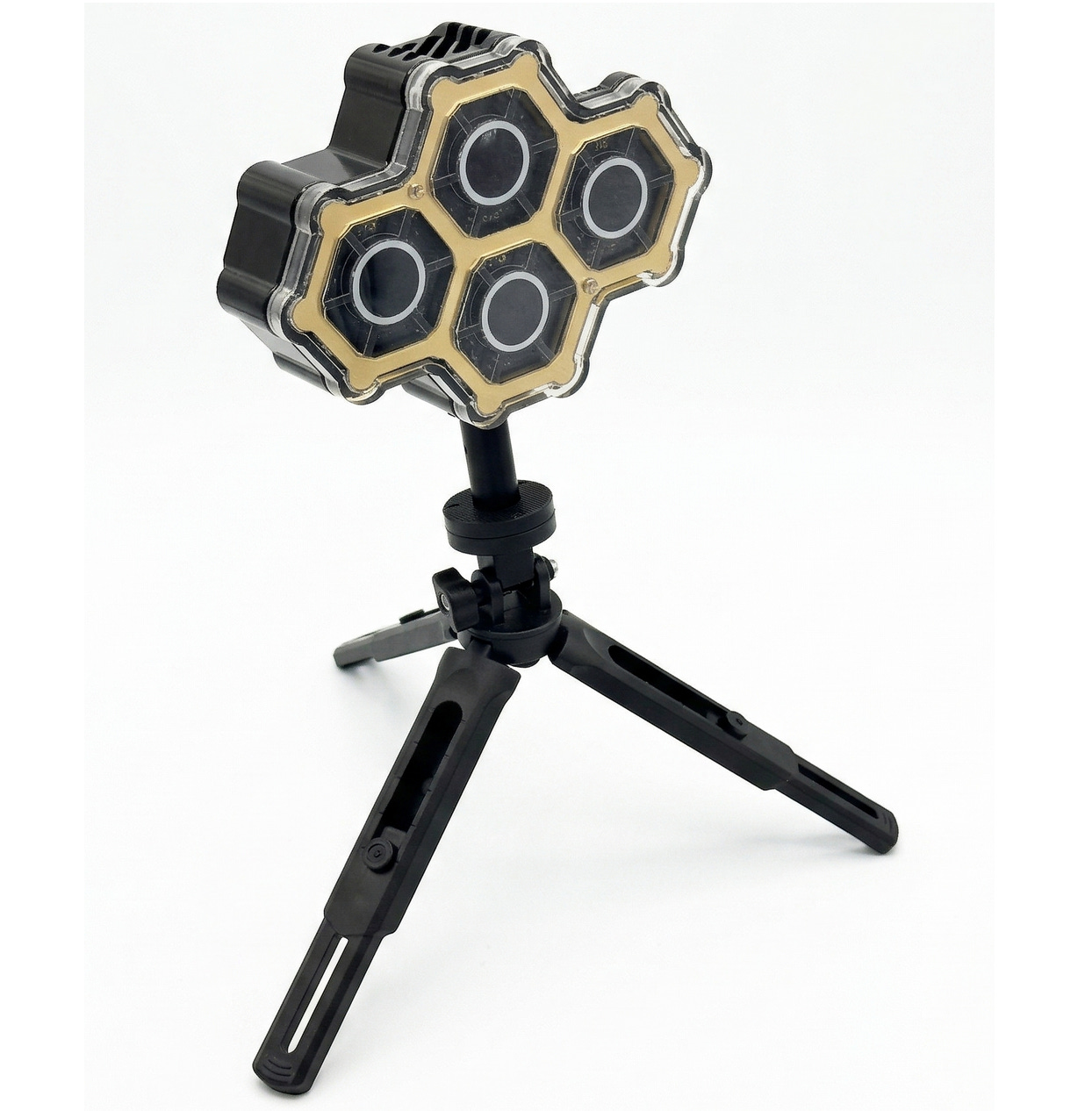
As many of you know, the full MoonRF Array utilizes 240 antennas to reach the moon. But that scalable array is built from a single key building block: the QuadRF.
The QuadRF is a powerful software-defined radio “tile” featuring four integrated antennas and four complete IQ-to-RF-digital signal chains, capable of 4x40 MHz full-duplex communication.
And now for a couple of Oh… My… Gosh… moments.
Before you start “but, in my day”, or “in my day job”, or “we’ve been doing this forever” -ing, keep in mind that this is an open source project, controllable by whatever software the user deigns to use with it (both receive, and transmit) to make it do what the user wants to do, and the pricing is very reasonable, likely to be maybe US$2000 (or less) for a QuadRF kit. Also… that this isn’t just the antenna… this is the radio integrated with the phased array antenna.
Post Publication Update: Email from Martin McCormick K1MCC:
The QuadRF [kit] is likely to be $399, not $2000.
Wow. Just… Wow. That’s an incredibly reasonable price point.
…
You’ve seen the time and frequency-domain... but what about a... space-domain! ✨
With four antennas, precise direction-of-arrival information about every signal is measured. This can be rendered in real-time to literally see your RF environment.
Real-time spatial visualization of RF signals (4.9 GHz - 6.0 GHz) in the surrounding area. Color codes frequency.
This works through walls or at very long range and you can select between different polarizations (LHCP/RHCP). The built-in Pi 5 processing is fast enough to render 1 GHz of spectrum for the surrounding environment at 30 fps update rate.
Finally! With a century of experience in “fixed phase” antennas behind us in Amateur Radio, it’s hard to keep in mind that there is that third element of a radio signal - spatial!
This capability alone will sell a ton of Quad RF Kits into Electrical Engineering programs, students, and classrooms. When you have a unit like this that enables you to understand the spatial dimension of transmitted (and received - especially via reflections, multipath, or attenuation circumstances) radio signals, “radio” really starts to click in one’s mind.
But wait - there’s more!
⚙️ Agentic Transceiver
The QuadRF comes with a pre-trained AI agent system that allows you to prompt it with an idea or RF intent, and within minutes it writes the code, compiles the program, and runs it live with the RF hardware. The system is pre-loaded with context information about the QuadRF capabilities, controls, and API, so the agentic AI knows how to write the custom SDR software correctly. If there are bugs, the agent will look at the program output, debug the problem and iterate towards a solution automatically. You can interrupt it at any time or give it hints, but normally you can just hit enter and let it go ahead!
In general, there’s no need to know programming or signal processing, but it’s good to have enough RF experience to ask the right questions. For the NTSC/PAL video decoder, grayscale was working in about 5 minutes after prompting the AI agent. Color took a few more tries. And after a little prodding to make it more efficient, it optimized the inner loops with NEON instructions for the ARM A76 cores —giving butter-smooth video.
Run on Raspberry Pi 5 folks. Capable enough, readily available1, well supported. I guess I found a good use for my Raspberry Pi 500 or my new 500 Plus).
Here’s the part I really loved:
👶 Personal Update
Meanwhile I got the flu, then a week later our entire family acquired norovirus. Everyone recovered well (me as of yesterday). We also have a baby due any day now (our first!) so there may be a little interruption to get this on Crowd Supply in March 😂. But I’m trying to at least have a good update by the end of April.
I’m still doing most all the development in my garage, and nothing has been released to the public yet. But a huge amount of open-source software will drop on GitHub soon. I’m planning to have anything that runs on the Pi 5 to be GPLv2 licensed (that’s my answer to the dozen people who asked! :)
As a former expectant parent… I could barely keep track of my butt even with it always following in close formation. K1MCC’s personal bandwidth is impressive!
Here’s the Zero Retries money quote:
🛠️ Getting involved
Very soon we are looking for beta testers to help interface the QuadRF with existing SDR tools. Most SDR tools “just work” if they support SoapySDR or ZeroMQ, but many others need native support. If you are a developer or creator of an SDR tool, especially if you can get them running on a Raspberry Pi 5, please reply to any emails you get. Will invite you to a private GitHub repository and Discord channels to get you set up as an early contributor.
There is your chance to get in on the ground floor of a new wave of technological innovation in Amateur Radio!
The Zero Retries Perspective on MoonRF
When I saw this system exhibited at Pacificon 20252, I was gobsmacked. Not that such a thing existed; I was well aware of phased array antennas (they’re much of the reason that 5G mobile networks work at all). It’s that it was being shown at an Amateur Radio conference (and not even a tech conference), and targeted towards an audience of Amateur Radio Operators. I’ll guess that with his background, K1MCC could probably have gotten some angel funding to develop the QuadRF concept to the point that would make some company that does phased array antennas for the 5G industry curious / interested / nervous enough to throw a few $Million at K1MCC to take such potential disruptive technology out of the picture.
But, to date, K1MCC was audacious enough to launch such open.space / QuadRF / MoonRF as an open source project. What’s most heartening is that he apparently hopes to find enough kindred souls within Amateur Radio to make the project’s original stated goal a reality - Earth Moon Earth communications.
It was cool… and I’m sure not coincidental or unintended that this update hit on 2026-04-01, the same day that the Artemis II mission launched to send humans back to Earth’s moon, Luna. Millions of people will get their first “live” glimpse of Luna from this mission… but with MoonRF, dreamers and builders like my friend Dennis Rosenauer AC7FT (video - Earth Moon Earth With Software Defined Radio), and organizations like the Deep Space Exploration Society…
We Amateur Radio Operators, with our radios, can “go” to Luna, and touch it with our radio signals. That… is very, very Zero Retries Interesting… and cool.
And I think that is something that can inspire young folks, on a warm summer evening, with Luna in full, glorious view, reaching out with our radios to “touch” Luna… to dream bigger3 towards a career in science, technology, engineering, art, and math.
Not to mention I think that being able to make full use of QuadRF units and a MoonRF array… would convince a lot of potential NewTechHams…
to get their Amateur Radio license.
Dear Radio Regulators… projects, and concepts, imagining, and building new technology like this is why we still need Amateur Radio in the 21st century and beyond.
Deepest kudos to Martin McCormick K1MCC for this project.
Please direct comments / feedback about this article to the Zero Retries email list with the #ZR0245 hashtag - mailto:zeroretries@groups.io?subject=%23ZR0245.
Introducing an AREDN Chat client
I think this is a very promising development. It’s especially useful that Raven can also be also used for chatting via Meshtastic and MeshCore.

Meshchat has been the go-to chat client for most users of AREDN networks. But because AREDN is a communications network software, and the core team has been reluctant to move into apps, support of Meshchat has been hit-and miss.
So the AREDN team has decided to step up to the plate with an AREDN-supported chat client, called Raven. It has a nice set of features:
Realtime text messaging.
Runs on any AREDN-supported hardware that’s running current AREDN software (but see recommendations in the wiki).
Can communicate with other Raven clients via AREDN.
Can communicate between AREDN meshes via Supernodes
Supports talking on a Meshtastic network (requires additional hardware)
Supports talking on a Meshcore network (required additional hardware, and integration is very involved. Documentation will eventually be provided).
Supports multiple channels per node.
Supports sharing images.
Supports sharing Winlink forms.
Not compatible with MeshChat (it is not possible - sorry)
Notes
This is Alpha code. While it seems to work fine in limited testing, YMMV..
Information on prerequisites, installing and configuring Raven can be found at https://github.com/kn6plv/Raven/wiki
I saw a brief kerfuffle on a AREDN-related email list that tried to take AREDN to task about Raven “enabling message transfers between Amateur Radio and unlicensed users” (Meshtastic used on unlicensed spectrum by non Amateur Radio Operators). Some regard that concept being illegal (such as Amateur Radio Operators using their Amateur Radio equipment on non Amateur Radio spectrum, such as Citizens Band (CB) or General Mobile Radio Service (GMRS).
That kerfuffle was quickly damped down when it was explained that Raven was a chat client that could connect, simultaneously, to AREDN and Meshtastic / Meshcore networks…
but Raven does not provide the router / bridge capability for message transfers between those networks.
Message transfers between networks would be a cool capability given that most MeshCore use that I’ve read about is actually being done by Amateur Radio Operators, and often done so on Amateur Radio spectrum. However, such a capability is probably more appropriate for a network-level application / service than individual’s Raven applications.
This is really encouraging! In my early involvement with AREDN, friends and I tried using Meshchat but we (I) experienced high latency and lost messages, which could have been the result of network issues prior to the development of AREDN Supernodes, and the general network improvements from the switch from OLSR mesh network routing to Babel mesh network routing.
Note that Raven isn’t a standalone app; Raven is an additional capability that is added into one’s AREDN node. After installation, Raven is just one of the web windows into your AREDN node that you would use from your favorite OS / favorite web browser.
The Zero Retries Perspective on Raven
Raven, by itself, doesn’t “close the gap” in popularity and usage between AREDN and Meshtastic / MeshCore… but it narrows the gap considerably. Having a built-in, minimal fuss, chat client that is (likely, eventually) standardized with each AREDN node, makes AREDN a lot more palatable for a lot of potential AREDN users. It’s an easier “sell” of AREDN when you can say “Oh, AREDN can do messaging too… and a lot more, at much higher networks speeds”.
While “use whatever apps you want” is an accurate description of AREDN’s capabilities given that AREDN networks are largely equivalent to using Internet connectivity4, it’s intimidating to potential new users having to figure out what they want to do / use on an AREDN network. That’s especially problematic when trying to create an entirely new AREDN network. Having that baseline chat capability is a good “sales tool” for promoting AREDN networks. Not to mention that the AREDN node’s Raven chat client can also connect to Meshtastic / MeshCore (one client - multiple networks!) is a further selling point in promoting AREDN.
Once again, I think that two big AREDN developments in 2025:
Changeover from OLSR mesh network routing to Babel mesh network routing
Support for some 802.11ah / Wi-Fi HaLow units for AREDN use on 902-928 MHz
and now, Raven, makes AREDN networks much more capable and interesting to NewTechHams (and prospective NewTechHams).
Kudos to Tim Wilkinson KN6PLV and the AREDN team for the development of Raven… and the willingness to “branch out” into developing a supportable chat capability in AREDN / Meshtastic / MeshCore.
Please direct comments / feedback about this article to the Zero Retries email list with the #ZR0245 hashtag - mailto:zeroretries@groups.io?subject=%23ZR0245.
KISS Protocol Implementation Improved
By Steve Stroh N8GNJ
Introduction
What is the relevance of covering “plain, old, boring, KISS (Amateur Radio Packet Radio) protocol in 2026? Why does any of this matter in 2026 and beyond? Why mention it at all in Zero Retries?
Simply, because Amateur Radio keeps creating new TNCs… all of which implement (their interpretation) of a KISS software interface. Years ago I thought we had hit “Peak (KISS) TNC” with the NinoTNC, but that’s absolutely not the case. New radios with integrated TNCs continue to be developed, including two being developed / released in 2026:
There are new portable radios being introduced with integrated TNCs - with a KISS interface.
The OpenTNC is a new open source project with a pending assembled and tested option - the NA6D OpenTNC, and it includes a KISS interface.
The new ESP32 LoRA-Pi Modem is a new platform for communicating via LoRA on the 420-450 MHz band… using a KISS interface.
The pending Kenwood TM-D750A will almost certainly include an integrated TNC, and it will almost certainly have a KISS option.
Updating the Linux MKISS Driver in Linux
Michael Larabel on phoronix - Linux Ham Radio KISS Serial Driver Being Modernized In 2026:
Here’s something that wasn’t on my bingo card for this year of the “MKISS” driver for ham radio being modernized in 2026 as opposed to just being dropped. The MKISS code hasn’t seen much driver activity since the original Git import of the Linux kernel more than twenty years ago.
Posted to the Linux kernel mailing list this Sunday by open-source developer Mashiro Chen is modernizing and cleaning up the MKISS ham radio driver. This is a serial port KISS protocol driver for exchanging data between a computer and terminal node computer for AX.25 amateur radio “ham radio” connections.
The MKISS driver has been around since before the Linux kernel Git import and in the 21 years since it was an SMP rewrite in 2025 and some minor fixes but that’s been about it. Even for some minor code maintenance on MKISS has been more than six years ago.Mashiro Chen explained of this 2026 modernization of the driver:
“This patch series modernizes the mkiss driver, which is used for AX.25 communication over serial lines.
The series starts by moving variable assignments out of ‘if’ conditions to improve code safety and readability. The second patch removes redundant static initializations to 0. The third patch fixes missing spaces around assignment operations. The fourth patch modernizes the logging system by replacing legacy printk() calls with netdev_* and pr_* macros for better device-specific context. The fifth patch addresses remaining checkpatch.pl issues, primarily converting space-based indentation to tabs, aligning parameters, and fixing comment formats.The patches are out for review on the Linux kernel mailing list.
The KISS Wikipedia article (my usual reference on KISS) makes no mention of MKISS, thus I had to do a minor refresher on MKISS. With some web search fu, I found Linux Amateur Radio AX.25 HOWTO which has a reference to MKISS:
6.1.1.1. Configuring for Dual Port TNC’s
The mkiss utility included in the ax25-utils distribution allows you to make use of both modems on a dual port TNC. Configuration is fairly simple. It works by taking a single serial device connected to a single multiport TNC and making it look like a number of devices each connected to a single port TNC. You do this before you do any of the AX.25 configuration. The devices that you then do the AX.25 configuration on are pseudo-TTY interfaces, (/dev/ttyq*), and not the actual serial device. Pseudo-TTY devices create a kind of pipe through which programs designed to talk to tty devices can talk to other programs designed to talk to tty devices. Each pipe has a master and a slave end. The master end is generally called `/dev/ptyq*’ and the slave ends are called `/dev/ttyq*’. There is a one to one relationship between masters and slaves, so /dev/ptyq0 is the master end of a pipe with /dev/ttyq0 as its slave. You must open the master end of a pipe before opening the slave end. mkiss exploits this mechanism to split a single serial device into separate devices.
MKISS is not Multidrop KISS (or XKISS, or 6PACK)
Part of my uncertainty about what MKISS is, is that there was also a variant of KISS that was Multidrop KISS… from back when more than two serial ports were difficult to support on PCs (the convention was that COM3 shared IRQ4 with COM1, and COM4 shared IRQ3 with COM2 - see Wikipedia COM (hardware interface). Thus “Node Stacks” (of TNCs) used “daisy chained” (multidrop) RS-232 connections:
PC Serial Port TX → TNC1 RX
TNC 1 TX → TNC2 RX
TNC 2 TX → TNC3 RX
TNC 3 TX → PC Serial Port RX
… with special firmware (or configuration options) to accommodate multiple TNCs on a single serial port.
Thus, I’m in admiration that Chen is willing to go to the trouble of updating a Linux driver for MKISS, for what is now a pretty obscure piece of hardware. Namely (mostly legacy) TNCs that incorporate more than one radio port such as the Kantronics 9612XE.
Since Kantronics does a good job supporting most TNC capabilities / standards that have evolved over the decades, I thought I’d see if the 9612XE accommodates Multidrop KISS. Apparently, that terminology has been updated to XKISS (Extended KISS). From the 9612XE manual, page 177:
XKISS (Extended KISS)
The TNC also supports the G8BPQ multi-drop KISS Mode, called extended KISS (XKISS). With this mode, the TNC can be connected to a G8BPQ node along with the other TNCs on the same serial port, to provide multiple radio ports to the node. Otherwise, XKISS works like KISS. For information on this mode of operation, see the documentation for the XKISS software you are using.
Diving even deeper into this rabbit hole of obscure, obsolete, “no need to do it this way now” technology, see the paper After 38 Years, Do I Still Get a KISS? by Mike Cheponis K6THZ and Phil Karn KA9Q for Zero Retries Digital Conference 2025. In that paper, the authors explain yet another variant of “Multidrop KISS” - 6PACK:
What Is 6PACK? (A brief AI summary)
6PACK is a specialized data link layer protocol used in amateur radio packet communications to provide efficient, low-latency communication between a host computer and a TNC (Terminal Node Controller) over a serial interface. According to < https://docs.kernel.org/networking/6pack.html > it was developed by Ekki Plicht DF4OR, Henning Rech DF9IC.N1EOW and Gunter Jost DK7WJ/K7WJ, although Thomas Sailer HB9JNX/AE4AWA and Uwe Walter DL2VAF and others were contributing.
6PACK was developed to optimize data transmission between a computer and a TNC by addressing limitations of earlier protocols like KISS. It was especially designed to support high-speed operation and multiple ports over a single serial line, improving performance in packet radio systems. The name “6PACK” comes from its origin with six-port TNC setups.
Addressing Multiple Radio Ports in the Kantronics 9612XE
If you’re curious how to use the two radio ports on a 9612XE, from page 72 and 73…
Switch from Radio Port 1 to Radio Port 2
Up to now, we have assumed you are using radio port 1. Switching to port 2 (and a particular channel (stream) on port 2) and back again is easy. At the command prompt, you enter the stream switch character (default is “|”, normally called the “pipe” symbol, but you can change it) followed by the number of the port you want to switch to, followed by the stream you want to go to on that port.
Note: The command STREAMSW sets the character recognized to switch streams (and ports). See the commands reference for details.
For example, to switch to stream A on port 2, connect to another station and
disconnect:
Step 1. At the “cmd:” prompt, type |2A and press the enter key ,
Step 2. Now you are on port 2, stream a. You can verify this, by issuing the command STATUS. The status response will show the port and stream to which your command or data will be directed.
Step 3. From here, issue a connect command, such as “cmd: C WØXI”. After a connection has been established, you can carry on a communication with station WØXI,
Step 4. To disconnect (and remain on Port 2), issue the disconnect command,
“cmd: D”.
Of course… with current technology, almost all of this is moot.
It’s admittedly “oldtechsplaining” that current computers are just so fast that they can poll [PC] serial ports (even operating at 115 kbps) that there’s no need to assign Interrupt Requests (IRQs). Thus a modern PC can support a very large number of serial ports, if necessary just by assigning a unique I/O address such as 3F8, 2F8, 3E8, 2E8, etc. Or just use USB 😀.
MKISS is no longer needed other than to support TNCs with multiple radio ports. It’s feasible to attach as many TNCs (with USB interfaces) as you wish to any computer. Even a basic Raspberry Pi 3B+ supports four native USB ports, and many more USB ports by connecting USB port expanders.
Multidrop KISS / XKISS is no longer relevant because we can have as many serial ports as we wish on any computer, even for legacy TNCs that require an RS-232 connection, thanks to USB to RS-232 adapters.
And modern TNCs already have USB interfaces, and are KISS devices, and are relatively inexpensive. Connect as many as needed and the computer will be able to handle it.
Conclusion
KISS has been with us for nearly four decades now, and I suspect that more and more variability in implementations of KISS is being introduced through the use of “tribal knowledge osmosis” in the various implementations of KISS. In my opinion, a “KISS Steering Committee” should exist within Amateur Radio to provide a reference implementation… if not a modernized KISS standard that incorporates all the accumulated knowledge of what works in KISS, what doesn’t, and a unified approach on how to fix the things that don’t.
It’s amusing, and a little bit fun to revisit all of this legacy arcane packet radio knowledge. But in this era… just buy a DigiRig Mobile or a DigiRig Lite or equivalent audio interface, and move all of the packet radio (or other digital / data mode) functionality into the host computer.
ZR > BEACON
By Steve Stroh N8GNJ
Short mentions of Zero Retries Interesting items.
IP400 Project Reaches Halfway Point
Editor’s Note - The text that follows is a concatenation of an email received from Martin Alcock VE6VH, founder of the IP400 project, and a posting - Project Status as of March 19th, 2026 on the ADRCS website, and then lightly edited for publication.
For more information on IP400, see https://ip400.adrcs.org.
The IP400 Project is pleased to announce that we have reached the half-way point for the IP400 project. The hardware development is complete, as well as the research phases for proof of concept. We are now at the point where we will be doing limited production runs for the various hardware components, and the rest of the development effort from here on it will be mostly in firmware and FPGA development.
The outputs from the development effort are many and varied, there will be a new outdoor 400 MHz node with an integrated power amplifier, an AllstarLink upgrade to add OFDM data modes to existing repeater systems, as well as an OFDM TNC for standalone use, all nodes supporting high speed data as well as an AX.25 compatible KISS mode.
The project development continues on three fronts:
Node Hardware The mini-node has been revised to add a POE ethernet adapter, making it now a three board stack instead of two. The 5W power amplifier has been designed, pre-production units will be available soon. The supernode prototype has been built, and the design for the production version and TNC OEM board is complete. Both are pending prototype builds.
See Hardware for an explanation of IP400 hardware variations.
Firmware The unified firmware platform is in development, and pending successful testing, will be released for beta testing with Mode A only on the WL33 platforms shortly.
New Modes Development of Mode B is ongoing and is looking very promising. Mode C will be available later this year.
See Vision for an explanation of IP400 modes.
…
Team Members Page A new page has been added to the IP400 project site acknowledging contributors.
Stixs - Handheld 5 Watt VHF / UHF LoRa Data Radio In Development
Stixs Labs is developing a new portable data radio with an impressive sounding list of features:
Dual-band TX - Professional VHF and UHF communication with 5W output power. Shared antenna system with intelligent band switching.
Built strong - Solid aluminium core with a 5-inch touchscreen for reliable operation across environments.
Meshtastic - Extended range communication with LoRa technology. Perfect for mesh networks and remote monitoring applications.
Quality audio - ES8316 audio codec with PAM8302A amplifier delivers crystal-clear communication with advanced noise suppression and echo cancellation.
Robust power - Advanced power management with USB-C Power Delivery charging. Multiple voltage rails ensure optimal efficiency for extended field operations.
Open Source & Customizable - Built on Armbian Linux with full source code access. Customize, extend, and contribute to the platform that grows with your needs.
Current Development Phase: Pre-production software development & testing in progress with expected availability in August 2026
This is a “kitchen sink” unit, combining an FM radio (the VHF / UHF radio), a LoRa radio operating on 868 or 915 MHz, 2.4 GHz Wi-Fi, etc.
Despite this mention:
Join amateur radio enthusiasts and developers who are already backing the future of handheld radio communication.
It’s obvious that Amateur Radio really isn’t the target audience of this unit. If it were, the features would be more tailored to the unique capabilities of Amateur Radio, such as being able to run LoRa on the Amateur Radio UHF (70cm) band at higher power than unlicensed users, it would probably incorporate MeshCore, and there would be some mention of multiple modes that the VHF / UHF radio section supports, other than “FM”.
This unit sounds interesting and ambitious. Perhaps it will be able to achieve the fabled “just load a modem for data communications” via the Linux subsystem. Making all of this work together (especially the three distinct radio subsystems), at a reasonable price, on a reasonable timeline is going to be a challenge.
My thanks to Mark Poole K6MAP for bringing this unit to my attention for Zero Retries.
DLARC: The Radio Geek’s Doomscrolling Antidote
Nick Langan in Radio World:
Immerse yourself in a digital collection of amateur radio and communication artifacts
The internet has aged to the point where it is easy to fall into a rabbit hole, reminiscing about websites from decades past.
The site that fuels those scrolling endeavors is the Internet Archive — a nonprofit that hosts a digital library of internet sites and other artifacts in digital form. The project began in 1996 to archive the web.
Today, it contains one trillion web pages through its “Wayback Machine,” as well as 56 million books and texts. It also works with approximately 1,400 libraries through its Archive-It program to identify and preserve important digital history.
Kay Savetz (K6KJN) freely admits to having been an Internet Archive power user. Savetz used not just the archive.org website, but also its command line interface to upload many documents.
Kay Savetz poses with some of the seven pallets of Bob Cooper’s material. Cooper was a noted pioneer in long-distance VHF reception and satellite television.
A licensed amateur radio operator since 1989, Savetz’s own interviews with Atari 8-bit computer pioneers are among those early uploads.
So when the Amateur Radio Digital Communications foundation provided a significant grant to the Internet Archive to form a collection of the history of amateur radio and adjacent endeavors, the archive sought a lead curator. Savetz was a natural fit.
The project was funded in 2022 and titled the Digital Library of Amateur Radio and Communications. Today, DLARC has approximately 225,000 items, spanning magazines, newsletters and call books.
In computing terms, that’s about 26 terabytes of storage space, Savetz told us.
Savetz took us inside DLARC’s impressive array of content, and we’ve added links to the featured offerings throughout our story.
This is a great (delightful) lengthy story about DLARC. Langan did an in-depth interview and teased out a lot of detail about Kay Savetz K6KJN and DLARC / Internet Archive. Recommended!
Another Entirely Zero Retries Interesting Issue of Random Wire Newsletter!
While I love all of the content in the average issue of that Tom Salzer KJ7T packs into his Random Wire Newsletter, there are some issues like Issue 176 that are entirely Zero Retries Interesting. (Issue 175 was really good too!) To wit:
Updates on M17 and LinHT (that I’ve missed this week, but KJ7T caught)
Installing an Uninterruptible Power Supply for a Raspberry Pi Zero
More info on his Buddipole antenna project (and I am very grateful for learning of the existence of the Buddipole Center Tee Adapter which converts the odd thread of a painter’s pole to 1/2 inch threads which at least I have a prayer of matching to put up a lightweight temporary VHF / UHF antenna5.
Lots of other interesting techie info.
You could conclude from the regular mentions of each other’s newsletters that KJ7T and I have a “Ham Bromance” going… but to date, we’ve never met, only corresponded and talked briefly, and know of each other entirely from publishing our respective newsletters. KJ7T and I are fellow techies, focused on the more technical / digital elements of Amateur Radio, and both of us are comfortable writing about what we find interesting. Thanks for the Zero Retries shoutout in RW 176!
Amateur Repeater Directory - With a Novel Update System
At a glance, https://app.amateurrepeaterdirectory.org looks like many other visualizations of the location (and features / capabilities) of Amateur Radio repeaters in a map format. There’s nothing overt there that suggests this page is doing anything from displaying a visual representation of a (static) database of repeater information.
But, apparently, there’s (claimed to be) more interesting technology than is readily apparent.
Maddeningly, to me, there is almost no text description of the technical underpinnings of these systems apart from snippets of text on the YouTube videos. To me, that calls into question whether this system is real (beyond deploying / demonstrating a few prototype units).
From the video’s description:
AirPulse is a new RF sensing device designed to power the Amateur Repeater Directory with live radio activity data. By connecting radios to the AirPulse Network API, repeaters can be automatically discovered and radios programmed instantly—no cables, no guesswork, just turn on your radio and connect.
At https://www.youtube.com/@AmateurRepeaterDirectory is this additional description:
Feedline Labs created Greywire Fabric, the Live RF Intelligence Fabric — a real-time intelligence layer for radio. With AirPulse, live activity comes into view, repeaters light up on the map, and RF becomes something you can see as it happens. Greywire Fabric moves beyond static repeater data and turns radio into a living, connected network.
I will give credit to these folks for coming up with a number of impressive-sounding buzzwords system names - AirPulse, Feedline Labs, Greywire Fabric, LiveRF Intelligence Fabric, etc.
I can imagine how something like this would work (no help from the above descriptions or anything else I was able to find). The following is solely from my imagination:
Radio receiver is a “reasonable” Software Defined Receiver, with reasonable quality such as bandpass filters to improve sensitivity from broadcast transmitters, paging transmitters, etc. that are prevalent in metropolitan areas. The receiver would periodically scan through the entire spectrum, creating an internal (or on a remote host computer) heat map of radio activity on various channels.
On received signals, it could cross reference databases such as Amateur Radio repeater directories, FCC database, etc.
It could periodically send snippets of audio for processing with an AI.
It could load ka9q-radio for simultaneous monitoring of the active channels. That would provide the realtime activity from actual spectrum use, feeding updating the Amateur Repeater Directory.
Again, this seems like an impressive technology integration… but I can’t bring myself to buy into it too deeply when it’s explained almost entirely in YouTube videos… in this era where videos can be entirely fabricated with AI.
Post Publication Update: A reader of Zero Retries did a reality check against of a known good list of repeaters in a major metro area against (this) Amateur Repeater Directory, and the latter was way out of date. Thus this project doesn’t seem credible (or real?).
My thanks to Mark Poole K6MAP for bringing this to my attention for Zero Retries.
Why You Might Want To Set Up Your Raspberry Pi Internet Web Server on 44Net
Dave Ginsberg N3BKV on his N3BKV’s Ham Radio Hacks blog:
I had a big problem with my blog. Since it’s hosted on Blogger, there were issues with Google and Bing indexing it. I must have spent nearly two weeks trying to figure out why search engines were having trouble with redirects and couldn’t index the site. After some research, I found out this is a common problem with Blogger.
So, I decided it was time to set up my own web server. That way, I’d have full control over everything—from which content management system and plug-ins I use to how the site is hosted. I had a spare Raspberry Pi sitting around that I could use, since my site doesn’t get a lot of traffic. All I needed was a static, internet-addressable IP address. But those are generally hard to come by without an expensive business-class internet connection.
As hams, we have access to millions of IPs for free, thanks to some forward-thinking operators from the 1980s via 44Net. Here’s a link to an article and a short video on the history of 44Net:
https://www.ardc.net/ardc-kicks-off-youtube-channel-with-44net-origin-story/
What I needed was an internet-routable 44.x IP so my web server could appear on that IP on the public internet. Most home internet service providers (ISPs) don’t allow this kind of setup, so I needed a way to route my traffic through someone who could provide internet connectivity for my 44Net IP.
Enter 44Net Cloud. It lets you create a Virtual Private Network (VPN) tunnel from your computer to the 44Net Cloud, and they route your traffic to the internet. There’s a bit of latency, so it’s not ideal for radio traffic, but for websites or file sharing with your club (e.g., using Nextcloud - https://nextcloud.com/), it’s a great solution.
Agreed wholeheartedly that N3BKV’s use case is ideal for 44Net Connect.
Video - Meshtastic vs Meshcore vs Reticulum vs ATAK
Jason Johnston KC5HWB on his Ham Radio 2.0 YouTube channel:
Today I compare Meshtastic, Meshcore, Reticulum and ATAK in a high overview of each service. These 4 are not in direct competition with one another, and they can often work together.
I had not heard of ATAK (Android Team Awareness Kit). See ATAK & Meshtastic for Next-Generation Field Intelligence for an explanation.
Please offer comments / feedback about ZR > BEACON on the Zero Retries email list with the #ZR0245 hashtag - mailto:zeroretries@groups.io?subject=%23ZR0245.
Request To Send
By Steve Stroh N8GNJ
Paid Subscribers / Founding Members Update
The only updates on this subject this week is that with the return to publishing on Substack, paid subscriptions in Substack have been reactivated as of 2026-04-03.
Financial support from Zero Retries readers is a significant vote of support for the continued publication of Zero Retries.
Presentation at Surrey Amateur Radio Communications Society (SARC) Next Week
Next Wednesday 2026-04-08, Tina and I will journey to Surrey, British Columbia for me to give a talk at the monthly meeting of SARC. I’m looking forward to meeting members of this dynamic Amateur Radio organization in person. SARC is one of my few Amateur Radio memberships and I joined SARC because I appreciate its progressive approach to Amateur Radio, and especially I want to support their amazing newsletterzine, The Communicator.
That… is the kind of publication - entirely online, entirely free, with great production values, good editing, and a good content mix including (but not exclusively) Zero Retries Interesting articles that is relevant and interesting about Amateur Radio in the 21st century. I’ve been so consistently impressed with The Communicator that I now write a column for each bimonthly issue, and then went on to become a paid member of SARC. I’m especially looking forward to meeting the Editor of The Communicator, John Schouten VE7TI.
Cross Fertilization
One of the surprises of the overall experience of publishing Zero Retries has been how much time I end up cross fertilizing between folks that are involved in technological innovation in Amateur Radio. It regularly happens that I’m writing something for Zero Retries and it occurs to me to provide an introduction between two folks that might not be aware of each other’s complementary activities / projects. That cost me an hour of email time today as I was working on this issue.
Lately I’ve had some very interesting in-depth conversations by phone. This week I had three of those - thanks folks - you know who you are.
Hamvention Ho!
6 weeks until Hamvention 2026
in Xenia, Ohio, USA...
Zero Retries / DLARC booth 1506
in Building 1 / Maxim
Weekends Are For Amateur Radio!
This weekend will be butt-in-chair time to finish converting the content published on Ghost / www.zeroretries.radio back onto Substack / www.zeroretries.org.
Please offer comments / feedback about Request To Send on the Zero Retries email list with the #ZR0245 hashtag - mailto:zeroretries@groups.io?subject=%23ZR0245.
73,
Steve N8GNJ
Closing Thanks
My ongoing Thanks to:
Tina Stroh KD7WSF for, well, everything!
Jack Stroh, Late Night Assistant Editor Emeritus
Fiona and Shreky Stroh, Late Night Assistant Editors In Training
Founding Members who generously support Zero Retries financially:
Founding Member 0000 - Steven Davidson K3FZT (Renewed 2025, 3rd year!)
Founding Member 0001 - Randy Smith WU2S (Renewed 2025, 3rd year!)
Founding Member 0002 - Chris Osburn KD7DVD (Renewed 2025, 3rd year!)
Founding Member 0003 - Don Rotolo N2IRZ (Renewed 2025, 3rd year!)
Founding Member 0004 - William Arcand W1WRA (Renewed 2025, 3rd year!)
Founding Member 0005 - Ben Kuhn KU0HN (Renewed 2025, 3rd year!)
Founding Member 0006 - Todd Willey KQ4FID (Renewed 2025, 3rd year!)
Founding Member 0007 and 0010 - Merik Karman VK1DF / VK2MKZ (Renewed 2025 x2, 3rd year!)
Founding Member 0008 - Prefers to Remain Anonymous 08 (Renewed 2025, 3rd year!)
Founding Member 0009 - Prefers to Remain Anonymous 19 (Renewed 2025, 2nd year!)
Founding Member 0011 - Rick Prelinger W6XBE (Renewed 2025, 2nd year!)
Founding Member 0012 - Ryan Tolboom N2BP (Renewed 2025, 2nd year!)
Founding Member 0013 - Newton White N4EWT (Renewed 2026, 2nd year!)
Founding Member 0014 - Joe Hamelin W7COM (Renewed 2026, 2nd year!)
Founding Member 0015 - Rich Stocking N7OP (New 2025)
Founding Member 0016 - Prefers to Remain Anonymous 77 (New 2025)
Founding Member 0017 - Phil Karn KA9Q (New 2025)
Founding Member 0018 - Prefers to Remain Anonymous 95 (New 2025)
Founding Member 0019 - Prefers to Remain Anonymous 0108 (New 2025)
Founding Member 0020 - Prefers to Remain Anonymous 110 (New 2025)
Founding Member 0021 - Prefers to Remain Anonymous 111 (New 2025)
Founding Member 0022 - Prefers to Remain Anonymous 112 (New 2025)
Founding Member 0023 - Prefers to Remain Anonymous 116 (New 2026)
Founding Member 0024 - Rob Bowser (SPOOLTENNA) (New 2026)
Numerous Annual and Monthly subscribers who also generously support Zero Retries financially!
You thousands of readers of Zero Retries without which there would be little point in publishing this newsletter.
The Usual Administrivia
Zero Retries About - https://www.zeroretries.org/about
Zero Retries Digital Conference - https://www.zeroretries.org/p/conference
Zero Retries (Substack Blanket) Privacy Policy - https://substack.com/privacy
Zero Retries Reprint / Reuse Policy - https://www.zeroretries.org/p/reprint-reuse
Fair Use - All excerpts from other authors or organizations, including images, are intended to be fair use and are fully attributed generally by author and link (URL).
Paid Promotional Content - Unless otherwise noted in the article or item, advertisement, or sponsorship notice, Zero Retries does not include paid promotional content. Exceptions:
Advertisements in Zero Retries,
Sponsorships in Zero Retries,
Zero Retries products,
Zero Retries events
Features and content exclusive to paid subscribers.
Zero Retries 0245 was published on 2026-04-03. This issue was 7708 words.
end
Footnotes for This Issue
To see the relevant sentence for the footnote, just click the footnote number.
No trying to buy a proven mini PC that was apparently last week’s model and no longer available. Gosh I missed (this) footnote capability in Ghost!
That this was shown at Pacificon… and not anywhere else (that I’m aware of) was a primary reason Tina and I decided to attempt Zero Retries Digital Conference 2026 in proximity of Pacificon 2026.
A long overdue Thanks to my friend and mentor Ken Koyan K8TV who, once upon a time, decades ago brought me along to meet a friend of his in rural Northeast Ohio who had perhaps the only tractor Power Take Off (PTO) EME array in the world. I never forgot that sight, and the implications of that system and seeing a real EME array. I wish I knew who that EME operator was.
The same web browser, same (local) email client, web servers, file servers, etc. as used on Internet can, generally, be used on AREDN networks.
Either Buddipole is missing a huge potential market in Amateur Radio for lightweight VHF / UHF antennas with a 1/2 inch pipe thread base using painter poles… or I’m oblivious to some common source of such antennas.