2026-08-21 - ZRDC 2026 Update, What’s New At DLARC, Followup on NPR-NG, Why New Hardware for IP400?, Spectrum is Fungible, Mesh* vs AX.25 Packet Radio, W6NBC is SK, NA6D OpenTNC, HamSCI, CHIRP-Next
Zero Retries is an independent newsletter promoting technological innovation in and adjacent to Amateur Radio, and Amateur Radio as (literally) a license to experiment with and learn about radio technology. Radios are computers - with antennas! Now in its sixth year of publication, with 3600+ email subscribers.
Optional Paid Subscriptions, and especially Founding Member subscriptions to Zero Retries not only help offset various expenses incurred in publishing Zero Retries, but also are a large portion of the “seed capital” that is needed to host Zero Retries Digital Conference (ZRDC) 2026, and future ZRDCs. Thank You!
My thanks to Merik Karman VK1DF / VK2MKZ for renewing as Founding Member 0007(4th year!) to Zero Retries in the past two weeks!
Founding Member Subscribers are listed in every issue of Zero Retries!
My thanks to Prefers to Remain Anonymous 35 for renewing as an Annual Paid Subscriber (3rd year!) to Zero Retries in the past two weeks!
My thanks to Matt Payne N3PAY for renewing as an Annual Paid Subscriber to Zero Retries in the past two weeks! (This is a correction; in Zero Retries 0259 I stated:
My thanks to Matt Payne N3PAY for becoming a newAnnual Paid Subscriber to Zero Retries in the past two weeks!
Financial support from Zero Retries readers is a significant vote of support for the continued publication of Zero Retries.
Zero Retries Summer 2026 Publishing Schedule - Biweekly
During Summer 2026, Zero Retries is being published biweekly. The intended publication schedule for the remainder of Summer 2026 is:
With just under 60 days until ZRDC 2026, we have been able to confirm another speaker. Jeff Scoville AE5ME will join the panel of speakers and will be discussing M17. Per Jeff’s message, he will bring an M17 repeater and set up a demonstration of the MSEVEN iOS app running a Mobilinkd TNC4 over the air.
In addition to the panel of speakers , there is a possibility of hosting a panel discussion regarding encryption on Amateur Radio. We had initially planned on doing it in the evening, however it is cost prohibitive. I will speak more about this in the next issue of Zero Retries.
Lastly, I had an email from a ham from whom I sent a message trying to research a speaker/topic for ZRDC. The context of this message was in regard to the date of ZRDC and its connection with Pacificon. His message literally shocked me not just by his audacity but also how misinformed he was. Therefore, as I am about to send out a mailing to many of the amateur radio clubs, I would like to set the record straight so that hopefully everyone can be on the same page, eliminate rumors, and most of all come together as a community to promote Amateur Radio.
We chose to align ZRDC 2026 with Pacificon because last year we were approached by a person associated with Pacificon and they suggested the possibility of ZRDC 2026 in conjunction with Pacificon. Given that we have attended Pacificon for the past two years, we have been impressed with how well the conference was organized and executed, it seemed possible. What has always appealed most to me about Pacificon was the outreach to the youth. Seeing scout troops and school age children at the conference to me is very important as I believe, “you never know where the next great idea will come from”. Based on all that, we made a proposal to Mt. Diablo Amateur Radio Club about ZRDC 2026. But, in the end, the club was unable to accommodate our needs.
That said, in every posting about ZRDC, we have promoted Pacificon 2026. ZRDC is only on Friday, October 16th, not the entire weekend. I specifically chose that date as most techie hams from my surveys do not have an overwhelming interest in antennas and many comments were made about having to take an extra day off work and another hotel night if ZRDC were to be held on Thursday.
Having ZRDC 2026 on Friday leaves Saturday and Sunday open for attendees to attend Pacificon, listen to the various talks and have time to browse the vendors at Pacificon. Zero Retries will have a table again this year in the vendor area as well. In my opinion, it was the best of both worlds.
One last point, we are NOT in competition with Pacificon by any means, although it may appear that way with the overlap. But that Mount Diablo wasn’t receptive to ZRDC may explain why we have not received ARRL sanctioned event status, despite having made numerous attempts, and direct correspondence with ARRL Pacific Division Director John Litz NZ6Q has gone unanswered.
In closing, if anyone from the Mt. Diablo Amateur Radio Club or avid followers of Pacificon have felt slighted because of ZRDC 2026, please accept our sincere apologies as that was never our intent. We sincerely hope that both conferences will be successful, informative and another opportunity for hams to come together and build our community.
What’s New at Digital Library of Amateur Radio & Communications — August 2026
By Kay Savetz K6KJN
Greetings from the Digital Library of Amateur Radio & Communications, your free online ham radio library. This month I’m excited to announce significant expansions in the areas of ham radio community preservation, long-lost newsletters, and recovery of (almost) prehistorical technical documents.
Yahoo Groups and Usenet Discussions
Ham radio is all about communications and community, but those things don’t happen exclusively on the air. Since at least the 1980s, radio nerds have used the Internet to discuss and diagnose radios, debate policy decisions, and ask and answer questions.
Do you remember Yahoo Groups? It was a service from Yahoo! that provided e-mail-based discussion groups. In 2010, there were 10 million Yahoo! groups, with people discussing every conceivable topic and interest. But in 2020, the company shut down the groups. Naturally, some of those groups were related to amateur radio topics. I’m thrilled to announce that DLARC has added a searchable repository of radio discussions from Yahoo Groups. And it’s a lot.
The discussions are presented as pretty, searchable PDFs: 968 PDF files totaling 2.8 million pages. Some of the largest groups recovered are radioescutas (for Portuguese shortwave listeners), bayscan (for scanning enthusiasts in the California Bay Area), baofeng_uv5r (for users of the popular Chinese handheld), TS-520_820_530_830 (for fans of the Kenwood hybrid HF transceivers), and rda_group (a radio discussion group in Russian). You can explore all of the Yahoo Groups messages here.
A surprisingly difficult part of the job was removing spam from the collection: we removed more than 400,000 spam messages from the radio discussions, 16.5% of the corpus. We certainly didn’t catch them all, but we did our best.
I’d heard of DXing and island operation, of course, but castles! No one told me you could transmit from castles! DLARC has added 647 issues of ICPO Bulletin — “Islands, Castles & Portable Operations”. It was an amateur-radio newsletter compiled and published by Canadian radio amateur Dave Raycroft, VA3RJ, from 2002-2015. Each issue listed forthcoming on-air activity from islands, castles, lighthouses, parks, portable stations, and DXpeditions worldwide.
And then there’s the ANARTS RTTY News — these newsletters were originally transmitted by RTTY. Now, they’re nice, pretty PDFs. The Australian National Amateur Radio Teleprinter Society (ANARTS) focused on radio teletype and digital communication modes. The group was founded in 1977: DLARC now has an archive of 377 issues of their RTTY Bulletin, which was transmitted via radioteletype on Sundays. News items are related primarily to RTTY and telegraphy. This is not a complete set: let me know if you have access to missing transmissions.
The library also added 225 issues of the Radio H.F. newsletter, which was a monthly electronic publication edited by Sheldon Harvey VE2SHW in Quebec, Canada. It presented annotated links and resources concerning shortwave listening, amateur radio, scanning, broadcasting, and radio equipment. We have a complete run from issue 1 (February 1999) through Volume 19, Number 5 (May 2017). I don’t know if it continued after that.
Also added: 399 issues of the MMMonVHF Newsletter. Published by the Make More Miles on VHF portal, these newsletters document the international weak-signal radio community from 2007 through 2015, with news about VHF, UHF, and microwave amateur-radio activity, including DXpeditions, propagation, contests, and Earth-Moon-Earth communication.
This is a particularly exciting addition: DLARC has added 325 lost episodes of Amateur Radio Newsline spanning 2001-2010! This fills in some gaps in our collection of the weekly news bulletin. The new additions include 90 episodes complete with audio from 2002-2003, and the scripts of 235 more episodes spanning 2001-2010. These episodes contain so much important information and history, including the script for episode 1257, released three days after the September 11 attacks. “Amateur radio took to the airwaves to provide assistance in the wake of apparent terrorist attacks in New York City… More than 300 died in the four highjacked airliner crashes…”
This brings our collection of Newsline to nearly 1,300 episodes, with some dating all the way back to 1992. (There are still plenty more gaps to be filled, listed in the newly updated DLARC Wantlist, as always.)
We’ve also archived nearly 300 episodes of Ham Radio Perspectives, a YouTube channel about ham radio: “Have fun exploring ham radio with K8QS, WA9TDD, and special guests.” — and oh look, they interviewed me about DLARC earlier this month. We’ve also added 30 episodes of Zone Zero, a podcast by VA7ST exploring “HF radio contesting through contest previews, operating tips, propagation talk, and reflections from the shack.”
Packet Radio Temporary Notes
Here’s an update on DLARC’s collection of Packet Radio Temporary Notes. PRTNs were a series of informal technical documents distributed by various technology organizations from 1972 through 1983 to share their research as they created packet radio from the ground up. I’ve worked hard to find as many of these documents as possible, but there are still plenty that are missing from the collection.
An eagle-eyed patron pointed out to me that PRTNs were sometimes buried in longer documents, directing me specifically to Measurement and Evaluation Studies of Packet Radio Telecommunications Systems, which was already in DLARC and which, sure enough, includes 8 PRTNs that we didn’t have as standalone documents.
Digital Library of Amateur Radio & Communications is funded by a generous grant from Amateur Radio Digital Communications (ARDC) to create a free digital library for the radio community, researchers, educators, and students. If you have questions about the project or material to contribute, contact me at kay@archive.org.
Editor’s Note - I’m really thrilled to see the recovery of Yahoo Groups, and USENET, and more PRTNs, and… and… It’s not overstating things to say that DLARC has become a keystone resource for Amateur Radio. I (and I think Amateur Radio as a whole) is indebted to K6KJN for such a singular contribution to Amateur Radio.
Followup on New Packet Radio - Next Generation (NPR-NG)
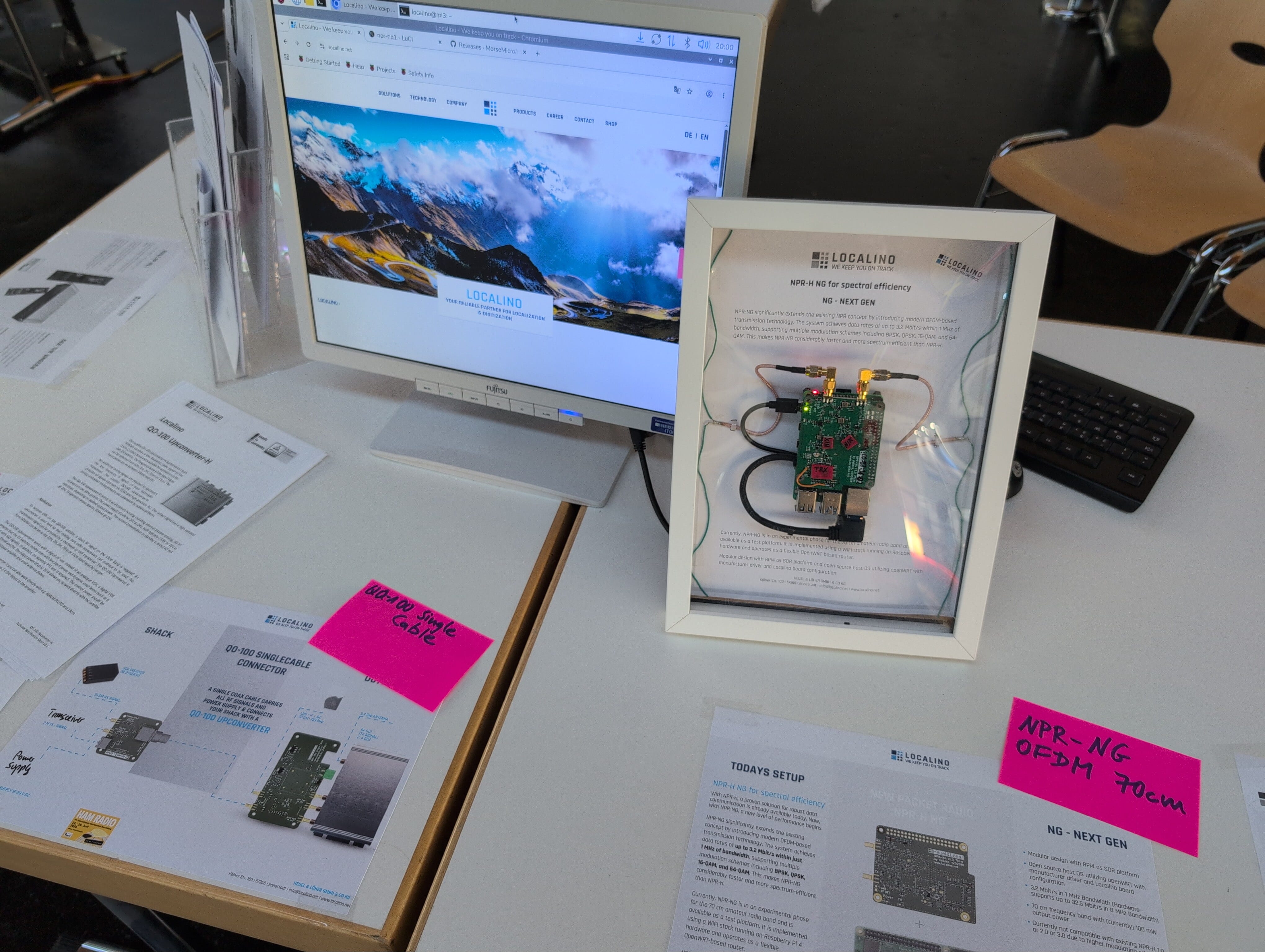
Prototype NPR-NG on display at HAM RADIO 2026. Image courtesy of Steffen Heuel DO5DSH
DO5DSH: On the 1 MHz [minimum bandwidth], I am in discussion with stakeholders in Germany (as I am also active in CEPT groups for other topics). In Germany it’s not a no-go anymore to keep the legacy 200 kHz bandwidth and things are starting to move, slowly, but are in motion. I am confident that, as soon as Germany clears the way, other countries will have the chance to use 1 MHz BW in 70cm. Hopefully this will propagate.
N8GNJ: Is there any interoperability with “classic” NPR, including NPR 3.0 (other, than of course, TCP/IP networking via the Ethernet ports)?
DO5DSH: This is not implemented yet as we make full use of the 802.11ah standard. I did think about it if NPR-NG should implement NPR or vice versa. But it’s probably not so straightforward as I initially thought when deciding for the OpenWrt stack. I need to re-check on the least common mode, e.g. 4FSK and what needs to be done in NPR then. It’s probably easier to update this than mess in the 802.11ah standard… but undecided yet.
N8GNJ: Is there any actual relationship with NPR-NG with classic NPR given that that NPR-NG is going to be based on OpenWRT?
DO5DSH: [As with NPR and NPR 3.0, NPR-NG is] a NLOS [Non Line of Sight] end-user entrance for HAMNET (it is for sure used in many more applications already out there). Technically [NPR / NPR 3.0 and NPR-NG] both run a high speed TDMA [Time Division Multiple Access], but NPR-NG scales with higher modulation rates and multi user access. To use an open source OpenWrt was driven by the technical completeness, robustness and open source availability of that stack. Instead of inventing the wheel again I wanted to focus on the missing pieces.
N8GNJ: Is there a “central node” (repeater / digipeater functionality on a high central node), such as there was for NPR classic that will be incorporated into NPR-NG?
DO5DSH: That’s one of the beauties we have with the stack now. Already today you can configure it just as your Wi-Fi at home, client, access point, repeater, mesh (!). It’s all the same hardware and the OpenWrt config will do the rest. And if something is missing, OpenWrt is open source and the community can work on this basis.
N8GNJ: Will the development work you outlined - input / output ports into a single antenna combiner actually go forward or does there need to be a new grant obtained for that work?
DO5DSH: I did start investigations and tests. I have started to implement the full 802.11ah decoding to measure EVM and next is to work on the amplifiers.
N8GNJ: What is the anticipated transmit output of NPR-NG?
DO5DSH: A QPSK requires ~10dB SNR for a BER or ~10^-6. 64 QAM needs ~22-24 dB. So technically I would need 12-14 dB more power for NPR-NG to have a similar SNR as with NPR under the same RF path. In other cases NPR-NG will automatically adapt the MCS [Modulation Coding Scheme] rates to lower speeds or longer guard intervals. Best would be to have something in the 40-46 dBm range, but the OFDM with 64 QAM has a much higher PAPR [Peak-to-Average Power Ratio] than FSK. That requires proper thoughts on the amplifier...otherwise the EVM will become bad. Then you have enough TX power and high RX signal power but still bad connection.
N8GNJ: Will there be work to create NPR-NG for other bands such as 23cm? I’ll guess 2m is a non-starter given the 1 MHz minimum bandwidth, although here in the US we have 4 MHz in 2m - 144-148 MHz, so it’s a bit more feasible.
DO5DSH: Step-by-step 😉. The hardware can do 1, 2, 4, 8 MHz of bandwidth and technically up to 32 Mbps. Higher RX bandwidth in turn increases your noise floor. The hardware concept was made in a way that the sub 1 GHz transceiver IF signal can be mixed either upwards or downwards. Mixing upwards would result in 23 cm.
N8GNJ: What is the anticipated timeline for NPR to be available in a form similar to Localino’s NPR 3.0 products?
DO5DSH: We have some things to do like updating to latest stable OpenWrt stack, find a proper solution for the PA [Power Amplifier], start testing at longer ranges without direct LOS [Line of Sight]. Unfortunately I have no timeline yet, but we will continue work on this as the solution is just too good to lie around😉.
N8GNJ: I would like to feature the progress of NPR-NG in Zero Retries if you’d be willing to supply me with periodic updates.
DO5DSH: Absolutely, it’s a pleasure to read this Sunday mornings at our breakfast and see this great interest from the community!
Rereading it, it offers a substantive explanation for why it makes sense to use dedicated hardware for a high performance data mode instead of a software running on a desktop-class computer with a general purpose multitasking operating system with an audio interface.
…
From his work on the Winlink Development Team, Rick Muething KN6KB knows a thing or six about designing effective modems. I saw this on the VARA-MODEM list and found his perspective on this topic enlightening.
A couple of things I might add that are often overlooked :
The trend of the past several years of using “software modems” running on non real time OS machines (Windows, Mac OS, Linux, etc) doesn’t often address the significant problem of real time delays caused by the OS and what other programs may be running. The typical exchange of data with an ACK/NAK involves the requirement of software modems (running on non real time operating systems) to accommodate the delays that are determined by BOTH the decode process (software modem doing DSP) AND the OS latency (this can be 100 ms or more depending on software modem implementation, Sound card latency etc.) This can have a significant impact on throughput since the timing in the Data + ACK/NAK exchange must normally accommodate the worst case anticipated delays.
The cost of high performance Dedicated Microprocessors with very good Real time capability (e.g. Teensy 4.x running the Arduino C++ code) has dropped significantly and now rivals or exceeds the DSP capability of some of the earlier Pactor 2 and 3 modems. While a dedicated CPU (e.g. like a Teensy/Arduino) is not a zero cost item (like a free Software modem) it has a number of advantages:
Significantly reduces the demands of the host OS response times and CPU loading.
Allows the host OS interface to be a much simpler program (and easier to maintain and adapt) since it is not required to do real time DSP and critical Data/Ack/Nak timing. This dramatically reduces the programming support required to “interface” a protocol to multiple operating systems, computers, and OS revisions.
Allows building more complex and sophisticated modems (e.g. Dynamic path compensation like used in STANAG and Mil Std 188 modems) that are normally outside the capability of software implementation on non real time OS hosts.
All this should remind us of the “No Free Lunch” theorem!!! (which we too often forget when requesting free software with unlimited free support!)
…
I shared the above with Martin Alcock VE6VH and he added his perspective on the applicability of the above to the IP400 development team’s decision to create the Advanced Mesh Network Controller (AMNC) for managing the new OFDM-AB waveform for IP400, and managing (what may grow to be pretty complex) IP400 mesh networks:
There is some buzz about taking our modem and implementing on a PC sound card, and, apart from the OS issues, there are two GOTCHAs that make it difficult or nearly impossible. The first is a lack of a hardware AGC on receive will limit its ability to decode data from different radios that will be transmitting at different modulation levels, so on the AMNC the CODEC has a hardware AGC [Automatic Gain Control] that takes care of this issue. The second is that and the sample timing is extremely critical. The OFDM symbol requires over 1000 samples, so the sampling offset introduced by the a less than accurate crystal would cause spreading in the receive constellation, making the higher bit rates unusable, and requiring a large amount of forward error correction. In the AMNC we use a PLL sourced from a 0.5ppm TCXO [Temperature Compensated Crystal Oscillator] for sample timing, in contrast a PC sound card will use whatever the cheapest, and probably 100 ppm, crystal.
I asked VE6VH:
So could there be a “slow speed” version of OFDM-AB that could be implemented with “PC sound card” to offer some very limited (slowest modes) compatibility with IP400 and OFDM-AB? Kind of a “training wheels” / very cheap (like students really like)?
He answered:
Theoretically, yes. But - the current development team is fully occupied completing the AMNC, work which extends well into 2027. So, we won’t be the ones doing such a mode, nor do we have the bandwidth to support that and our own efforts. As the source code will be open when we are ready to release it, someone else could tackle such a project independently, but I highly recommend against it. Instead they would be far better off to use the hardware that was specifically designed for this purpose, as it will be supported. They are also ignoring the fact that the modem is only a small part of the mesh network controller, there are other layers for that purpose also built in.
Also as you mentioned in ZR259 about the FPGA: I’m told it’s currently “lightly utilized” and thus offers ample expansion capability. (sic) So, there should be a clue there that future firmware development on [the AMNC] will utilize the FPGA resources more extensively. Locking into a sound card implementation is not only a lateral move that excludes these further developments, but it also does not take advantage of the mesh networking capabilities. You would be far better off not re-inventing the wheel on a PC, and using the hardware module that was specifically designed for the purpose, therefore being able to participate in future developments.
Of course, volunteers to join the team are always welcome.
A MHz is a MHz. A brief digression that we can, in fact, use Amateur Radio VHF / UHF spectrum to do higher speed data communications… including using wider bandwidths than is traditional. Also, a brief overview of some attempts to build data radios for Amateur Radio that did so.
In the discussions of starting to use higher speed data - pushing up to 1 Mbps and beyond, in Amateur Radio VHF / UHF spectrum, there’s some confusion that “well, you can only do that up in microwave spectrum”.
That’s a widely held perception, but it’s not accurate. The information capacity of 1 MHz of spectrum at 420-421 MHz is fully equivalent to 1 MHz of spectrum at 2.390-2.391 GHz.
The Perception That High Speed Data “Belongs” on Microwave
The perception that “you can only do high speed data on microwave frequencies” arose from a number of factors:
We’ve been using spectrum below 1 GHz intensively for 70+ years now (post World War II), and reasonably wide segments like 1 MHz for fast data communications are relatively rare1.
Until the advent of sophisticated high density modulations like QAM (Quadrature Amplitude Modulation) aided by techniques like Orthogonal Frequency Division Multiplexing (OFDM) to provide a “clean channel” for QAM to work, fast data meant a wide channel (often, 1 bit per Hz), with very high Signal to Noise Ratio (SNR) required to work. QAM + OFDM + Forward Error Correction (FEC) means that we can now do fast data with smaller portions of spectrum.
It’s easier to do high SNR (better for data) paths on microwave - the antennas are compact and highly directional, often dish antennas.
It’s (traditionally been) harder to engineer and manufacture radio equipment using wider (multi MHz) bandwidths on VHF and UHF. It was obviously doable - analog television channels were 6 MHz (and needed all of that). But, that was using very high SNR (some television transmitters were > 1 MW) and poor selectivity (television channels in use in an area were widely spaced out). Current technology has rendered those issues moot, but the perception persists.
There’s more spectrum allocated for Amateur Radio on microwave spectrum than VHF / UHF spectrum. The US Amateur Radio allocations around 2.4 GHz is 70 MHz (2.300 - 2.310 and 2.390 - 2.4502), and are lightly used for Amateur Radio, thus the “put high speed data up there” is a widespread perception.
The original Wi-Fi standard using 802.11 Direct Sequence Spread Spectrum (DSSS) used a 22 MHz bandwidth, thus couldn’t be used in any spectrum below microwave. Later updates of Wi-Fi chipsets allowed bandwidths of “as low as” 5 MHz, though those were not standardized. Post Publication Update - Another 802.11 standard option was Frequency Hopping Spread Spectrum (FHSS), which was not widely implemented except in proprietary systems. The Bluetooth standards use narrower channels on 2.4 GHz using FHSS.
Thus the idea of beginning to use wide(r) bandwidths for fast(er) data communications is not incompatible with Amateur Radio VHF / UHF spectrum. The problem for doing so has (mostly…) been the lack of designed for purpose data radios.
There Have Been Amateur Radio Data Radios
In the 1990s or so we saw a few radios designed for data such as the Kantronics D4-10, with wider audio bandwidths to use higher data rates such as 19.2 kbps. There were other such radios:
T7F Data Radio - 430 - 440 MHz / 70 cm. The T7F was more advanced than the D4-10, including frequency agility.
Azden PCS-9600D - 420 - 450 MHz / 70 cm. Was notable for featuring separate Phased Lock Loop (PLL) frequency synthesizers for transmit and receive frequencies so the transmit / receive settling time for a synthesized radio was minimal. I think that this radio pioneered the “data jack” / “9600 port” standard that became a feature, for a while, in many VHF / UHF FM radios from manufacturers in Japan.
WA4DSY 56 kbps Modem- Used a 100 kHz bandwidth on 28 MHz. The band to operate on was up to the user - just choose a transverter.
Doodle Labs DL435-30 - 420 - 450 MHz / 70cm. Data rate up to 8 Mbps (5 MHz bandwidth) or up to 15 Mbps (10 MHz bandwidth).
Icom ID-1 - D-Star Digital Data (DD) mode is 128 kbps in a 100 kHz bandwidth, on 1.2 GHz / 23cm. Although the ID-1 is out of production, the ID-1’s “Digital Data” mode is still available in Icom’s ID-RP1200VD repeater, IC-9700 radio, and IC-905 radio.
Attempted Amateur Radio Data Radios
There were also some notable attempts of Amateur Radio data radios which didn’t come to fruition:
TAPR packetRADIO- see illustration3. A short lived project. I think that the Kantronics D4-10 removed much of the need and interest for this project. Also was the source of a memorable quote within TAPR: Radios… are hard!
TAPR 900 MHz FHSS Radio - Designed for 902-928 MHz / 33 cm, up to 250 kbps, and 1-5 watts of transmit power. This project suffered from obsoleted parts before the design could be finalized and productized, twice.
FaradayRF - This was a noble effort to develop a new Amateur Radio data radio for the 902-928 MHz band, from 2016 - 2019. It faded out without much notice, but there are elements of it that are still available via the Internet Archive and their Github page.
UDRX-440 Software Defined Transceiver / Data Radio - A project by Northwest Digital Radio that came agonizingly close to becoming a product. It was to be a 25 watt multimode (semi Software Defined) data radio with all the features we wanted - flexible modems, full software control of transmit bandwidth, frequency, power, etc.
New Packet Radio
Unlike the above radios, New Packet Radio is in production and available for purchase. Data rate is 100 kbps - 1 Mbps in a 100 kHz - 1 MHz bandwidth, on 420-450 MHz / 70cm. (Assembled and tested version by ELEKITSORPARTS.) For reasonable power levels, a specific amplifier was required. Localino’s NPR 3.0 units are (in my opinion) more practical to use with a transmit power of 7 watts. In addition to the original spectrum for NPR of 420-450 MHz / 70cm, Localino created NPR 3.0 units for 144-148 MHz / 2m, and 1240 - 1300 MHz / 23 cm.
VHF / UHF FM Radios With Flat Audio Connections
Beginning in the same era as the PCS-9600D, manufacturers of conventional VHF / UHF radios began to add “data ports” to be able to use 9600 bps Frequency Shift Keying (FSK) data. FSK signals are distorted if the microphone and speaker connections were used because those are designed for human voice (pre-emphasis and de-emphasis) instead of linear data signals. The “data ports” (which I refer to as “flat audio connections”) bypass the pre-emphasis and de-emphasis circuits in the radio. Radios with “data ports” are the preferred way to use “audio path” data modes such as VARA FM and now, OFDM-AB.
But such radios are a stopgap for faster data. VHF / UHF FM radios designed for voice, typically with a radio bandwidth of 12.5 or 25 kHz, and operate in a 2-10 MHz frequency range.
Software Designed (Data) Radios
We now have Software Defined Radios (SDRs) with no such restrictions. We can experience this now, easily, inexpensively with, for example, a SDRplay RSP1B Software Defined Receiver. It can receive any 10 MHz continuous segment of spectrum within its range of 1 kHz to 2 GHz. So receiving wider bandwidths, such as 440 - 450 MHz, is a solved problem. Transmitting wider bandwidths is also a somewhat solved problem using Software Defined Radio technology. For example, the ADALM-PLUTO Software Defined Transceiver can transmit or receive any 20 MHz contiguous segment of spectrum within its range of 325 MHz to 3.8 GHz.
Transmitting wider bandwidths is only somewhat solved because while the transmitters can operate over such frequency ranges and wider bandwidths, the power amplifiers necessary to achieve power levels of 25 watts or so for typical Amateur Radio terrestrial operation haven’t yet caught up4 with the flexibility of the Software Defined Transmitters. We have power amplifiers for individual bands such as the Toptek Communications PA-80U UHF Power Amplifiers PA-80U that operates from 430 - 470 MHz… but it requires an input transmit power level of at least 3 watts, and the typical Software Defined Transmitter only outputs a power level of a few tens of milliwatts.
Obviously this situation is a solvable problem with some radio engineering applied to the problem. We will eventually have Software Defined Transceivers for the Amateur Radio VHF / UHF bands that can transmit at 25 watts or so. We just don’t have them at the moment.
In The US, Arcane and Obsolete Regulations Hamper Progress in Faster Data in Amateur Radio VHF / UHF
The current US Amateur Radio regulations limit bandwidth for data communications:
20 kHz maximum bandwidth for 50-54 MHz / 6m and 144-148 MHz / 2m
100 kHz maximum bandwidth for 222-225 MHz / 1.25m and 420-450 MHz / 70cm.
Thus, US Amateur Radio Operators are mostly, but not entirely out of luck with New Packet Radio, which has a “Silly Arcane US Regulations” mode that restricts NPR to operate with a 100 kHz bandwidth and 56 kbps over the air data rate. But in the US, NPR cannot be used at its full speed of 1 Mbps, which requires a 1 MHz bandwidth.
Thanks to the Arcane, Obsolete, and Just Silly in the 2020s US Amateur Radio Regulations about data communications for VHF / UHF… US Amateur Radio Operators are entirely out of luck with the proposed New Packet Radio - Next Generation (NPR-NG) - (see the related story in this issue) which requires a minimum of 1 MHz bandwidth.
That said, it’s possible for an independent group to petition the FCC for a regulatory change, or perhaps a Part 5 Experimental License to use wider bandwidths on Amateur Radio VHF / UHF spectrum. A primary “talking point” of such a request is the example that video operation on 420-450 MHz / 70cm is at least 1 MHz (digital video) and 6 MHz (analog video), with no issues.
Making Due, For Now, With VHF / UHF FM Radios With Flat Audio Connections - Up to 57 kbps and Mesh Networking
to create Amateur Radio mesh networks across all of our Amateur Radio VHF / UHF bands, at reliable data speeds of up to 57 kbps.
Post Publication Update: Part of the networking, especially local / regional networks, can make use of IP400-enhanced FM repeaters for users to be able to participate in data networks even more easily than they can use repeaters for voice.
All in all, not bad. Not bad at all. Three decades ago in the heyday of packet radio, when we dreamed of 9600 bps and faster inter-city backbones, and network node routers, we didn’t imagine it would turn out like it has. We also didn’t realize it was going to take so long to have this kind of capability.
But now we do have such capabilities, and it’s now up to Amateur Radio to make use of them.
A Brief Comparison of Networking - Meshtastic / MeshCore vs Amateur Radio AX.25 Packet Radio
By Steve Stroh N8GNJ
Amateur Radio has always had networks. From the very beginning of Amateur Radio, it has always built networks for passing messages - traffic. In fact, passing traffic was the original mission of the American Radio Relay League (ARRL) more than a century ago. Per Claude AI:
The ARRL was founded in 1914 by Hiram Percy Maxim after he couldn’t reach a fellow ham 30 miles away and had to relay his message through an operator halfway between them. That experience convinced him a formally organized relay system — amateurs passing messages (”traffic”) station to station over long distances — would be essential to the hobby’s usefulness, which became the League’s founding purpose.
Post Publication Update: The Winlink network and Winlink Radio Mail Server (RMS) stations on Amateur Radio HF bands for exchanging email via Amateur Radio HF should have been included in the same “networking over HF” reference above as the mentions of NTS, RRI, and TPRFN.
Thus, building, operating, and using networks in Amateur Radio is nothing new for Amateur Radio. But two decades into the 21st century, with ubiquitous, broadband, ambient Internet via mobile networks, fiber, and satellite (and very recently, mobile access via satellite anywhere on the planet), Amateur Radio networks seem, to many, especially those not involved in Amateur Radio, an outmoded concept.
In the Mid 2020s, There’s Ample Interest in Independent Networks Via Radio
At least, that’s the way it seems at first glance. But in the mid 2020s, there’s more interest in independent networks via radio, than there ever has been. Witness the incredible interest in Meshtastic, and recently MeshCore (hereafter, Meshtastic / MeshCore5) using LoRa, in unlicensed spectrum6 by experimenters who like the idea of participating in decentralized, independent networks using radio. There’s uncountable thousands, likely tens of thousands of individuals participating in these decentralized, independent networks operating in unlicensed portions of spectrum.
Why this surge of interest in decentralized networks via radio in recent years? Here are my perceptions:
Many techies are generally curious about radio technology as an adjunct to electronics, software, hardware, computing, and networking hacking (casual experimentation). Meshtastic / MeshCore on unlicensed spectrum is an inexpensive and easy way to get started with radio technology.
Most techies now understand that our incredibly sophisticated, broadband communications infrastructure(s) are generally reliable. But… when there is a failure - a single fiber cut, a widespread power outage in your area lasting more than a couple of hours, a cyberattack on a key Internet resource, or a failure in a far-away data center (like a tornado in the US Midwest), the communications infrastructure fails hard.7 Thus, knowing this happens, techies are open to potential backup systems for communications.
Meshtastic / MeshCore is pretty easy, and fun to get started. There’s lots of “join the fun” promotion and there are meetups targeted at techies, such as at Makerspaces and Hackathons on how to set up your new Meshtastic / MeshCore nodes.
The hardware is widely available and inexpensive. It’s easy to persuade nearby techie friends to get their own nodes online to join in on the fun.
It works - Meshtastic and MeshCore networks do provide a decentralized, independent resilient mesh network for messaging, often with low enough power demands that nodes / repeaters can be powered from small solar panels plus small batteries.
Experimenting with Meshtastic and MeshCore is a much lower barrier to entry, and less intimidating, than “Get your Ham Radio license”.8
The Competition for Independent Networks Via Amateur Radio
Those of us already in involved in Amateur Radio networking can easily look at Meshtastic and MeshCore on unlicensed spectrum and think “That’s OK, and I understand the easy and fun aspects. But if they’re serious, they’ll come over to Amateur Radio.”
Yes, and No.
Yes - Amateur Radio has a lot of experience in building radio-based networks (packet radio, though a lot of that knowledge has lapsed), Amateur Radio has more and varied spectrum available for networking than unlicensed spectrum, and has a lot of technology that can (theoretically) applied to networking, such as high profile VHF / UHF repeaters, and even GEO satellites.
No - Amateur Radio doesn’t currently have a networking system that’s directly comparable or competitive to Meshtastic / MeshCore on unlicensed spectrum. Those factors are data-first, easy to deploy, that’s as inexpensive to get involved with, or has the popular, unified support available for Meshtastic / MeshCore.
Amateur Radio Networks Often Depend on Internet
It’s notable that Meshtastic / MeshCore is radio-only. Internet isn’t used and that’s one of the primary attractions of Meshtastic / MeshCore - that it has no dependency on Internet or other “centrally controllable” infrastructure.
Post Publication Update:
As originally published, in the above paragraph was a footnote:
It is my understanding that there’s no Internet gateways / tunneling / bridging with Meshtastic or MeshCore. There is a technology for LoRa called LoRaWAN that is such an Internet backbone, but LoRaWAN is generally not used in hobbyist use of LoRa.
My statement about no Internet gateways / tunneling / bridging in Meshtastic or MeshCore above is profoundly incorrect from not doing reasonable research. My apologies, and I’ll have a correction, amplification, and explanation in the next issue of Zero Retries. My thanks to Conrad Trautman N2YCH for pointing out this error.
The popular perception (and, in my reading, almost all deployments of Meshtastic / MeshCore) is that Meshtastic / MeshCore networks don’t use or depend on Internet or other “centrally controllable” infrastructure.
If Amateur Radio is trying to position Amateur Radio networking as an alternative to Meshtastic / MeshCore… well, a lot of Amateur Radio networking systems depend wholly, or in part, on Internet for their functionality:
Winlink’s backbone for exchanging email messages is Internet. Only with careful configuration can Winlink software and radios be used locally / non-Internet.
Most of the Automatic Packet Reporting System (APRS) infrastructure, such as linking between APRS digipeaters, messaging, etc. depends on the APRS-IS Internet servers: APRS-IS (Automatic Packet Reporting System-Internet Service) is the common name given to the Internet-based network which inter-connects various APRS radio networks throughout the world (and space).
All Amateur Radio “hotspots” such as the ZUMRadio Elite 3.5 LCD ZUMspot (as an example) are dependent on commercial Internet access to function.
As cool and unique as the all-in-one-device SharkRF M1KEis for participating in Internet Amateur Radio talk groups, it only functions with Internet access (and Wi-Fi).
In mentioning the above Amateur Radio systems’ dependencies on Internet, that’s not to disparage such activity. Amateur Radio Over Internet is a fantastic option for many Amateur Radio Operators, as explained very well by EtherHam and ROTA: Recliners on the Air. But… when Internet access isn’t available, those systems can’t function in part, or in whole.
Also in mentioning the above dependencies on Internet, it’s no longer accurate to say “When All Else Fails, Amateur Radio is the answer”. For many organizations (served agencies), and especially “replacement” for Internet access, Amateur Radio is no longer a good fit. For more on that perspective, see my article Zero Retries Perspective on Emergency Communications (EMCOM) Capability in Amateur Radio.
What About AX.25 Packet Radio Networks?
I said above:
Meshtastic / MeshCore is pretty easy, and fun to get started. There’s lots of “join the fun” promotion and there are meetups targeted at techies, such as at Makerspaces and Hackathons on how to set up your new Meshtastic / MeshCore nodes.
and…
The hardware is widely available and inexpensive. It’s easy to persuade nearby techie friends to get their own nodes online to join in on the fun.
That’s not really the case with AX.25 Packet Radio. There’s a lot of “baggage” with AX.25 Packet Radio on Amateur Radio spectrum.
The first “baggage” of AX.25 Packet Radio that is obtaining an Amateur Radio license. Even if you’re “just curious”, you cannot legally “just experiment a little bit” with AX.25 Packet Radio on Amateur Radio spectrum.
The second “baggage” of AX.25 Packet Radio is figuring out how to get started. In the 2020s, there’s now more than four decades of history with AX.25 Packet Radio, and much of what one finds on the Interwebs is woefully out of date, such as recommendations of “Terminal Node Controllers” (TNCs) that you can’t even buy any more (if their manufacturers even exist).
Much of AX.25 Packet Radio technology is antiquated in the mid-2020s. Most AX.25 Packet Radio operates at 1200 bps. Admittedly that’s faster than LoRa, which is the technology that Meshtastic / MeshCore uses, but just stating up front “1200 bps” is underwhelming to a typical techie. Almost all AX.25 Packet Radio does not use more modern implementations of AX.25 Packet Radio, such as the “single bit error recovery” of Dire Wolf, Forward Error Correction such as NinoTNC (and DIRE WOLF), or faster speeds.
Worst, from a networking perspective, AX.25 Packet Radio doesn’t have a widely used automatic, dynamic (mesh) network system - only digipeaters, or for some more capable AX.25 Packet Radio networks using JNOS which supports the (old, but functional) Net/ROM / TheNet mesh network protocols.
AX.25 is its own protocol, with no easy, well-understood, widely known ways to move TCP/IP over AX.25 Packet Radio networks except for JNOS. There used to be “packet radio drivers” as standard in Linux, but those have been removed. See Zero Retries 0249 - Amateur Radio Drivers Removed From Linux Kernel.
While TCP/IP over AX.25 at 1200 bps does work… it’s not that impressive. I speak from experience.
Another factor is that with AX.25 Packet Radio is that there is no centralized “source of truth” for AX.25 Packet Radio as there is for Meshtastic / MeshCore. There are many AX.25 Packet Radio “tribes”. And if you’re trying to get started with AX.25 Packet Radio… and you don’t want to start from scratch and follow the lead of one of the tribes, it’s tough to get a new branch of a particular tribe started in your area.
Lastly, and perhaps the most pervasive factor that hurts AX.25 Packet Radio is that within Amateur Radio, it’s widely perceived within Amateur Radio as old, tired, done… “Oh, no one does that any more”. That didn’t used to be literally true because Winlink gateways on VHF / UHF almost always used AX.25 Packet Radio, but Winlink access on VHF / UHF has been converting over to VARA FM because it just works better.
Similarly, APRS used to be solely AX.25 Packet Radio, but APRS operation has been migrating to use LoRa technology (and some notable use of VARA HF for APRS on HF bands) because it works better.
Thus, it’s a hard sell for someone to promote Amateur Radio AX.25 Packet Radio as a viable alternative to Meshtastic / MeshCore.
If you are going to try to make the case for AX.25 Packet Radio…
here are some pointers (not a complete list) to some modern AX.25 Packet Radio implementations:
Ideally, the AX.25 stack you’re using should be compliant with AX.25 v2.2.
JNOS is an AX.25 / TCP/IP router, and can also exchange Packet Radio Bulletin Board System (PBBS) messages. JNOS also supports IPv6.
SILENT KEY: AUTHOR, ANTENNA INNOVATOR JOHN PORTUNE, W6NBC
STEPHEN/ANCHOR: An advisor and mentor to many, and a widely respected expert on antennas, has become a Silent Key. We hear more about him from Paul Braun WD9GCO.
PAUL: Many hams who have wanted to get more out of their antennas - or simply learn more about them - no doubt turned to the words and writings of John Portune, W6NBC. The retired KNBC TV broadcast engineer, an experimenter and an innovator, was always generous with his time and wisdom on the subject.
John became a Silent Key on the 6th of July. Born in 1938, he had been a ham since 1965.
The Los Angeles, California native was a frequent presence - either via Zoom or in person - at club meetings and ham expos needing his expertise on everything from mag loop antennas to stealth antennas that went undetected by homeowner associations.
He was a prolific writer, with bylines in QST and On the Air magazine to his credit. He was also the author of a number of books, including “Slot Antennas for Ham Radio: the Forgotten Antenna.” Many hams turned to John for his advice on how to get on the air from homes in communities governed by home owner associations’ antenna restrictions. He was also known for hosting informal Monday morning chats on Zoom, open sessions where friends gathered to compare notes and, of course, ask questions. Or, as John wrote on his website: “Just fun.”
This horizontal “slot” antenna, cut into the reflector of a TV dish, is both the master of disguise and high in performance.
By John Portune W6NBC
47 C.F.R. Section 1.4000, October 1996, “prohibits restrictions that impair… antennas used to receive video… including… satellite dishes less than one meter (39 in.) in diameter”. (FCC Web Site)
I’ve long wondered, is it practical to hide an efficient 2 meter base- station antenna in a TV satellite dish? My CC&R committee couldn’t make me take it down. But what about all the metal in the TV dish?
Wouldn’t that compromise a 2 meter antenna? Finally it struck me, don’t fight the metal; take advantage of it. Cut a “slot” antenna into the TV dish’s reflector.
A slot antenna is a narrow rectangular opening in a large conductive surface, such as a TV satellite dish. Slot antennas are familiar in the commercial radio world, but not to hams. They’re common in TV broadcasting, the skin of aircraft and in radar, microwave and cell phone applications. This disguised TV dish slot is equal to a J-pole (Figures 1 and 2) and is also a great way to learn about slot antennas.
I was lucky enough to converse with W6NBC on a Zoom chat a few months ago . He was charming and informative in casual conversation. I’m glad I got to tell him how much I admired his TV dish slot antenna, and he seemed to enjoy the recognition.
I’m personally, generally, a functionalist (minimalist) on antennas for Amateur Radio. I prefer to do my experimentation with data communications and networking. Thus I’m fine with omni antennas for VHF / UHF, wire antennas for HF, and dish antennas for microwave and (high gain microwave) for space. But, W6NBC’s explanations of different antenna types such as slot antennas is really interesting and informative and gets one thinking that radiation of radio frequency energy at different frequencies is just… weird…. and thus Zero Retries Interesting!
In a presentation / slide deck - TV Satellite Dish Slot Antenna.pdf, W6NBC updated that elegant antenna hack for both 2m and 70cm (different slots / feedpoints, with a duplexer on the back).
W6NBC’s ideas and explanations about “interesting” antennas in Amateur Radio will live on in perpetuity.
100% Open Source & Extensible: Built on the open-source hardware and software architecture created by Dave Platt (AE6EO), the OpenTNC is designed to keep getting better. Powered by the dual-core RP2040 and Zephyr RTOS, open firmware updates continuously bring new features, protocol enhancements, and performance improvements to your shack.
Why Choose the NA6D Edition?
Rugged Aluminum Enclosure: Ditch exposed PCBs and fragile 3D prints. Our custom black anodized aluminum extrusion case shields sensitive RF equipment from digital noise while enduring tough field conditions.
Compact Go-Kit Footprint: Sized at just ~64.3 mm x 49.1 mm x 23.7 mm, it fits easily into portable setups and crowded operating desks.
Pre-Calibrated Out of the Box: Shipped factory pre-calibrated to 50 mV peak-to-peak (50 mVpp) transmit audio output, offering plug-and-play operation for standard radio microphone inputs (K1 / HTs / Mobile Data jacks) without needing an oscilloscope.
Kantronics-Compatible DE-9 Port: Uses standard female DB-9 (DE-9) pinouts for simple radio interface cabling.
Powerful Digital Modes & FX.25 Error Correction
The OpenTNC manages AX.25 protocol processing directly on-board:
FX.25 Forward Error Correction: Wraps standard AX.25 packets inside Reed-Solomon RS(255,239) error correction blocks. Reconstructs noise-damaged frames automatically without time-consuming retransmissions, while remaining 100% backward compatible with standard AX.25 TNCs.
APRS & Fill-in Digipeating: Track locations, exchange messages, and run built-in WIDE1-1 fill-in digipeater modes with duplicate suppression.
Packet Chat & BBS Access: Robust keyboard-to-keyboard QSOs and seamless connection to PBBS emergency mailboxes.
KISS Mode & High Speed: Full serial KISS compatibility for Winlink, Direwolf, and APRS clients, supporting 1200-baud AFSK, 2400-baud V.26, and 9600-baud G3RUH modes.
Note: OpenTNC is a hardware AX.25 TNC running on-board modems via serial/KISS. It does not run PC-side software soundcard modes like VaraFM.
Refreshingly, OpenTNC incorporates AX.25 v2.2:
AX.25 v2.2 & Selective Reject (SREJ): Modern link layer enhancements supporting Selective Reject (retransmitting only missing frames rather than the full window) and extended sequence numbers (modulo 128 windowing).
I have… a few… (heh!) legacy AX.25 TNCs of varying vintage and capability, and I bought a pair of NA6D OpenTNCs because it would be refreshing to just have a pair that are modern and plug and play TNCs:
Metal case, not bare board or 3D printed case,
USB-C for power and comms, so no serial or 12 volt power hassles,
Full AX.25 Command Set, not a KISS-only interface that I have to fuss with a host program instead of bog-standard terminal program,
Kantronics 9-pin DSUB connector, just about as easy to use for interfacing to a radio as it gets,
$99 including a cable (several options).
Kudos to NA6D for pushing out such a polished version of a modern TNC.
AMSAT-CA promotes, develops, and supports Amateur Radio in space, including via human-made and natural satellites (e.g., the Moon), space stations and planets, and related experiments, as well as new developments in technology, methods and techniques.
AMSAT-CA is expected to play a significant role in the futureGEO geostationary satellite project potentially covering portions of North America.
I’ve filled out my application to support AMSAT-CA.
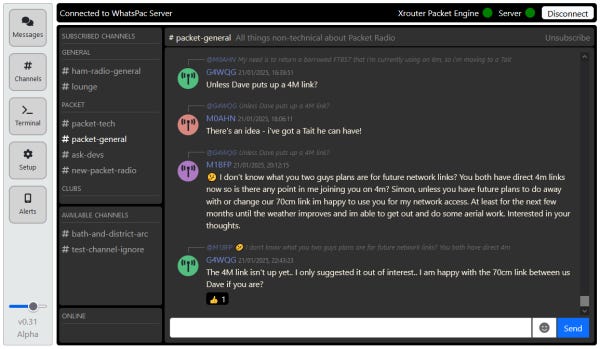
WhatsPac is a great new application for packet that has chat channels and private messages. Visit http://whatspac.oarc.uk/ for more information.
It is currently in beta and being actively developed but already has a nice user base. There is currently only one server running on MB7NPW, so this is where you will need a route to for the moment (see the UK packet network map to get an idea of possible routes), but there are plans to move to a distributed server model where there will be many servers on different nodes.
Resources:
To get started just open the web interface from here - this can talk to your local equipment / node - http://whatspac.oarc.uk/
By loading the AREDN®1 firmware in an outdoor wireless access point, you can join a ham radio network. It’s like the Internet but runs on ham radio frequencies, mostly in the 5.8 GHz band.
By joining this network you can find and use all sorts of applications (known as “services”). Anything running on a server, like weather stations, web sites showing site conditions and camera views, email servers, etc can be provided as a service. There are also services that don’t rely on a browser: video streams, chat servers, VOIP PBXs, etc. The network can also be used to host Winlink post offices, D-Star and DMR repeaters, and AllStarLink devices.
Pretty much any kind of service you can put on the Internet you can put on the AREDN® network, subject to the restrictions of the ham radio regulations (FCC Part 97).
This document is a great overview to getting up and running on typical (5 GHz) (Wi-Fi or Wireless ISP) devices, including includes explanations of various common AREDN hardware. It’s written by AREDN Ambassador (and Zero Retries Pseudostaffer) Orv Beach W6BI.
Just in time for the fall academic season, the latest issue of the HamSCI Newsletter has been published, available here on the HamSCI website. Topics include:
Thoughts on HamSCI from Nathaniel Frissell W2NAF HamSCI in the News Amateur Profile: Jesse Alexander WB2IFS 2026 Meteor Scatter QSO Parties by Gary Mikitin AF8A Contributor Column: The Maunder Minimum by Ron Wilcox KF7ZN Students Learn About HamSCI by Ron Kumon K8DTJ and Ruth Willet KM4LAO 2027 HamSCI Workshop Announcement (Save the date: April 17-18, 2027, coinciding with both Citizen Science Month and World Amateur Radio Day)
Thanks to the hard working Newsletter Editorial/Production Team: Ed Efchak WX2R, Mary Lou West KC2NMC, Vikki Lawhon (University of Scranton), and to all of the contributors and reviewers!
One excerpt:
HamSCI has announced the dates for the 2027 HamSCI Workshop. The 10th anniversary workshop will be held at The University of Scranton on April 17-18. It is worth noting that April 18 is World Amateur Radio Day, and April is Citizen Science Month. More details to follow but make sure that you save the date!
This is a great, thoughtful newsletter! I particularly enjoyed the profile of Jesse Alexander WB2IFS who I was privileged to meet at GRCON 2025 in Everett, WA.
HamSCI Activities - Meteor Scatter and Transmitting Time Signals
It’s just cool to watch the energy and activity of the HamSCI community! I found these two conversations on the HamSCI email list to be Zero Retries Interesting:
SWBC is Shortwave Broadcast station, example WRMI. I enjoyed this terse update from John Ackermann N8UR:
We’re beyond exploratory and into assembling hardware and writing software. Turns out that generating “time at the tone” isn’t as easy as it looks. :-)
Technological innovation in close proximity to, and developed by Amateur Radio!
I don’t remember what caused me to note this, but it’s great to see that CHIRP is actively being maintained and improved.
CHIRP is a free, open-source tool for programming your radio. It supports a large number of manufacturers and models, as well as provides a way to interface with multiple data sources and formats.
This has the latest and greatest set of features and fixes. Drivers that have not been validated with CHIRP-next are denoted by an asterisk (*) symbol on the supported model list on the Home page. This is the only version of CHIRP that is actively maintained. All users should be running the latest version of CHIRP.
How a software modem turns bytes into sound and the sound back into bytes: the modern signal science, examined through a single VARA FM session.
Every digital mode you run uses a modem: something that turns bytes on one end into a sound a radio can transmit, and turns that sound back into bytes at the far end. The same principle powered the early computer networks that sent data over analog telephone lines. These functions can be performed by a hardware device (TNC), or by software running on a general-purpose computer. Today we are looking at the software modem VARA FM — one of the better ones, and the least documented. It incorporates many of the important techniques used in modern digital communications and because of that it is a great case study for this series.
Cartilage is an FPGA board: a modular two-dimensional array of FPGA modules with physical I/O, a touchscreen, built-in Vivado, and a touch circuit editor. It works like Logisim, except it feeds the drawn circuits back into the FPGA hardware. Any region can be securely copied and pasted, including nested regions, and circuits can modify circuits. It is a physical, self-modifying Logisim FPGA board with I/O.
…
Cartilage is a modular 2D-array FPGA board with physical I/O, a touchscreen, built-in Vivado, and a touch circuit editor. It works like Logisim, but feeds circuits back into its FPGA modules, securely copy-pastes arbitrarily nested regions, and can modify its own running circuits—a modular, physical, self-modifying Logisim.
…
It’s like Logisim that modifies its own circuits and calls them Turing-complete programs!
At best, I can merely intuit around the edges of this. This seems like a profoundly different way to think of designing… or actually designing circuitry. He’s thinking way different things than I’m used to hearing about how you make use of Field Programmable Gate Arrays (FPGAs).
From a brief look, Cartilage doesn’t seem a good fit for viewing on a Mac running Safari, but I couldn’t take the time to experiment with it on other platforms.
I have a QRP story for you about mesh transceivers using 1 watt or less in the 33-centimeter band. That’s a UHF frequency of 900 MHz, from 902 to 928 MHz. It’s the Industrial, Scientific and Medical (ISM) band and is also able to be used by amateurs as a secondary service.
The story begins with a technology called Meshtastic. You can download Meshtastic firmware and flash it to a Long Range (LoRa) mesh device. LoRa devices are inexpensive and readily available through multiple sources, including Amazon. These devices typically run RF output power of 22 dBm or about 158 milliwatts. The Meshtastic device connects to your mobile phone using Bluetooth along with an app you download, which allows you to send and receive text messages over the mesh network. If you have a few of these devices, you can communicate with each other over short distances. They’re handy to have on a group hike in a park or on a mountain where there’s spotty or no cellular service, for example.
Enter Meshcore. Using the same LoRa hardware technology and frequencies as Meshtastic, the Meshcore developers designed the architecture and operation of the system differently. Meshtastic nodes will repeat a message they hear up to seven times before they stop transmitting, limiting how far it will go on the mesh network.
Meshcore, on the other hand, uses a companion/repeater design, where the device you carry is called a companion, and it will transmit to the closest repeater. The Meshcore companion does not repeat signals like a Meshtastic device does. The Meshcore repeater sends the message from the companion across the mesh network with a life of up to 64 hops (we’re set to 32 hops here in the Northeast). Rather than expiring after seven hops, messages getting onto the mesh network, hopping from repeater to repeater, can travel much further.
I mentioned this article inline earlier in this issue, but it deserves a detailed mention.
N2YCH is the former Technical Editor of ARRL / QST and his departure from ARRL is a significant loss. Of late, the percentage of Zero Retries Interesting content (and even advertisements) in QST has noticeably increased.
Intel just matched Apple Silicon. Seriously.
The Dell XPS 13 in this video is a welcome development. It’s an entry-level, but good, Windows on Intel laptop that Jeff Geerling KF0MYB judges to be equivalent to a MacBook Neo. It’s in the same price class - $700’ish and KF0MYB reports that the display, keyboard, battery life, and overall build quality were equivalent to the MacBook Neo. Previously, lower priced Windows laptops were crap’ish, or used, and if you wanted a reasonable unit (again, equivalent to what Apple accomplished with the MacBook Neo), you had to pay more for equivalent quality and efficiency.
Similarly, we’ve seen that the $1200 (per GigaParts) Kenwood TM-D750A, with the higher price including (in the North America versions) the 222-225 MHz / 1.25 m band, and some packet radio capability. Giving Kenwood the same ding as Icom, the TM-D750A isn’t on the Kenwood USA Amateur Radio page.
APRS Ready: Enjoy real-time two-way data communication with full APRS protocol support. Benefit from a wide range of displays and functions for seamless APRS operations. Built-in KISS TNC provides standalone digipeater functionality, and PC connectivity enables 1200/9600 bps packet and iGate operation.
But neither supports modern AX.25 Packet Radio as it has evolved in the past couple of years, as exemplified by the excellent Dire Wolf Software TNC, such as:
Vastly improved single bit error recovery technique (single bit flip testing),
Support of Forward Error Correction (FEC) - both IL2PandFX.25,
Implements AX.25 v2.2
9600 bps Frequency Shift Keying (FSK) has been problematic since it was first introduced. It works, but it’s fussy - really requiring a quiet channel and a good radio. Since you’re trying to push more data than 1200 bps, one little noise burst corrupts a fair amount of data, requiring retransmitting the entire packet. That’s why FEC makes such a huge difference, as does the single bit flipping technique that Dire Wolf implements.
These modern improvements to AX.25 Packet Radio are readily available for anyone to use. All of it is open source. Anyone who’s paying attention would know this. FX.25 is especially a common sense improvement to implement in new units since it’s backward compatible with AX.25. If an FX.25 station is communicating with an AX.25 station, that works. If an FX.25 station is communicating with another FX.25 station, FEC is used for the exchange for a reliable, efficient exchange of data.
So, how silly is it that these $1000 / $1200 radios don’t do these modern implementations of AX.25 Packet Radio? If you want those modern packet radio capabilities, just get a radio with a flat audio connection like the $360 (DX Engineering) Yaesu FTM-150R, and add an $100 NA6D OpenTNC.
That combination gets you:
144-148 MHz / 2m and 440-450 MHz / 70cm radio with up to 50 watts transmit power,
Full TNC capabilities (not just KISS or simple APRS-only),
1200 bps Audio Frequency Shift Keying (AFSK) or 9600 bps Frequency Shift Keying (FSK)
FX.25 Forward Error Correction
AX.25 v2.2
And… the data system is decoupled from the radio. Thus when it’s time to upgrade to better data communications such as IP400 OFDM-AB at up to 57 kbps, you unplug the OpenTNC and plug in the IP400 Advanced Mesh Node Controller (AMNC).
This minor (?) rant spawned a new project that I plan to show off at ZRDC 2026.
Funny story that kind of puts technological innovation into perspective. My old phone had given great service for nearly five years, but it was finally time for a new unit. After weighing all the pros and cons of a new phone, I dug pretty deep to, for the very first time, buy a top of the line iPhone - an iPhone 13 Pro Max with 1 TB of storage. Yes, that’s one Terabyte of storage… in my pocket. I was planning to bring a video camera to Hamvention, but after purchasing this phone with its 1 TB of storage, that’s no longer necessary. Technology evolution is amazing, if a bit expensive at times.
I decided to make that purchase just prior to our big trip in May / June 2022, driving cross country from Bellingham to Xenia, to have the best possible communications on the road. To my amazement, despite staying on major highways like Interstate 90, there were many cellular dead spots.
My iPhone 13 Pro Max has been remarkable. The battery still lasts all day. The exception on battery life is when I’m in a dense urban area where it works better to switch from LTE-only (most appropriate here in rural Whatcom County, Washington) to 5G, which starts to slurp battery. Most amazing, despite pouring many videos and photos into the device over my four years of usage, I’m still not even close to using half of that 1 TB of storage.
Along the way I’ve picked up a few accessories - a “selfie stick” and a pair of wireless microphones to make it easier to record video interviews. The one minor nitpick about those (cheap) microphones is that recording an ordinary video doesn’t allow a split between the (external) microphone audio and being able to use my AirPods Pro to monitor the microphone audio10. But with many things Apple, it just seems to work, so I go without monitoring the microphone audio as I’m recording.
One iPhone generation later, the iPhone 14 added the Apple Emergency SOS by Satellite capability.
Two iPhone generations later, the iPhone 15 began using USB-C as its primary external device / charging connector rather than the Apple Lightning connector. USB-C is just so… useful and in the last year, in my experience, it’s become nearly universal, and now you’re a bit handicapped if your smart device doesn’t have USB-C. Think about it - the MacBook Neo is essentially an iPhone (processor) in a laptop body. How much longer until you just have a “shell” like a MacBook Neo and you plug in your iPhone, and that’s the primary computing device.
Those two hardware features are the only things I’m looking forward to on an eventual new iPhone.
Four Years Later, Lack of Connectivity is a Solved Problem
As for those connectivity gaps of no mobile network coverage on portions of major US highways in the Western US, fast forwarding from May / June 2022 to present day, a mere four years later…
At no additional cost (to date), Apple’s Emergency SOS by Satellite (iPhone 14 and later) provides some safety communications using the Globalstar satellite system, albeit with some caveats, like you have to be stationary.
At an additional cost, T-Mobile now works with Starlink to provide some communications with unmodified mobile phones by equipping their Starlink satellites with additional radios and big antennas for accessing mobile network spectrum.
For as little as $55 / month, the Starlink Mini provides no-excuses seamless Broadband Internet anywhere in North America. There are many mounting systems for putting it on top of a vehicle. The rumored Starlink Mini 2 reportedly has built-in batteries, and might not even need a cable to get signal inside the vehicle, especially if the vehicle has a sunroof.
Looking forward, if we were to take another big cross country trip as soon as 2027, there are some potential additional connectivity options via satellite:
Having purchased their own mobile network spectrum, Starlink is making noises about creating a hybrid satellite / terrestrial mobile network service. I’m betting that they can, and they will. Unlike the “traditional” mobile network carriers, Starlink can create mobile network cells as entirely standalone. Power via solar / battery, mobile network spectrum within the capabilities of any phone, and most problematic for “traditional” mobile network carriers, use Starlink as low-latency backhaul… literally anywhere on the planet.
I’ll further bet that the Starlink Mini 2 (and eventually every Starlink consumer terminal) will likely have a built in mobile network capability (part of Starlink’s Wi-Fi chipset) to act as a mobile network picocell for the (potential) Starlink Mobile service. If not, the Starlink Mini 3 will certainly do so.
Amazon Leo will eventually debut, with their own services, likely matching Starlink’s services.
AST SpaceMobile intends to launch satellites that are pure “Direct To Device” (D2D) with huge antennas. AST SpaceMobile doesn’t have their own spectrum, so they will partner with terrestrial mobile network carriers to (re)use terrestrial mobile network spectrum.
Converting from NewsBlur to NetNewsWire
It could easily get me bounced from any group of serious Mac users to admit this, but since Google discontinued Google Reader (GR) for using RSS feeds, I have been using NewsBlur.
I don’t remember the specifics now, more than a decade later, but at the time Google forced the exodus from GR, I liked NewsBlur better than NetNewsWire (NNW). I think it was because NewsBlur was (then) web-based like GR, and it had an iOS app (that used the web-based NewsBlur back end), so there was built-in synchronization between “desktop” and iDevices. NNW was local-only (I think).
But in the last few years, subtle, annoying issues have crept into NewsBlur to the point where it’s slowing me down in trying to keep track of RSS feeds, especially in trying to keep up for Zero Retries developments. Every time I’ve asked Mac folks about alternatives, the only answer I get is NetNewsWire! So, I’ve been long overdue to check out NNW circa 2026 on MacOS 26+, on my (current) MacBook Air with an M1 processor.
Oh my gosh, NNW just rocks. Being a native Mac app, by fanatical Mac developers, and being a very, very mature Mac app, it works exactly as any longtime Mac user can expect. Everything I’m doing to move RSS feeds over to NNW is just fluid and (Mac) intuitive.
I wasted way too much time not having migrated to NetNewsWire much earlier.
Huntsville Hamfest is This Weekend
From my inputs, Huntsville Hamfest (HH)11 is getting a lot more attention in 2026 than it has in previous years. The HH organizers have been marketing it very well, including a booth at Hamvention 2026. In the past year, I’ve been seeing mentions of HH in the same “scope” as Hamvention and Hamcation as one of the primary Amateur Radio events to consider attending.
The Ultimate Technology Superstore. Over 50,000 square feet of PC hardware, Amateur Radio, 3D Printing, Astronomy, and more.
And, of course, we’re very grateful that GigaParts was one of the first sponsors of ZRDC 2026.
Tina and I have dear friends in Huntsville that we’re overdue to visit so perhaps in 2027 we’ll attend (or exhibit Zero Retries) at Huntsville Hamfest.
Lots of projects in queue for N8GNJ / Zero Retries Labs. I hope the OpenTNC arrives soon as I’ve promised to get on a local frequency to start playing AX.25 1200 bps Packet Radio, and the OpenTNC is a perfect fit for that.
But… our neighbors literally across the street put on a great Summer Party on Saturday afternoon that will take precedence for that day. Good music, good company, good food!
Have a great weekend, all of you co-conspirators in Zero Retries Interesting Amateur Radio activities!
My ongoing Thanks to: Tina Stroh KD7WSF for, well, everything! Jack Stroh, Late Night Assistant Editor Emeritus Fiona and Shreky Stroh, Late Night Assistant Editors In Training
Founding Members who generously support Zero Retries financially: Founding Member 0000 - Steven Davidson K3FZT (Renewed 2026, 4th year!) Founding Member 0001 - Randy Smith WU2S (Renewed 2025, 3rd year!) Founding Member 0002 - Chris Osburn KD7DVD (Renewed 2026, 4th year!) Founding Member 0003 - Don Rotolo N2IRZ (Renewed 2026, 4th year!) Founding Member 0004 - William Arcand W1WRA (Renewed 2025, 3rd year!) Founding Member 0005 - Ben Kuhn KU0HN (Renewed 2025, 3rd year!) Founding Member 0006 - Todd Willey KQ4FID (Renewed 2025, 3rd year!) Founding Member 0007 - Merik Karman VK1DF / VK2MKZ (Renewed 2026, 4th year!) Founding Member 0008 - Prefers To Remain Anonymous 08 (Renewed 2025, 3rd year!) Founding Member 0009 - Prefers To Remain Anonymous 19 (Renewed 2025, 2nd year!) Founding Member 0010 - Merik Karman VK1DF / VK2MKZ (Renewed 2025, 3rd year!) Founding Member 0011 - Rick Prelinger W6XBE (Renewed 2025, 2nd year!) Founding Member 0012 - Ryan Tolboom N2BP (Renewed 2025, 2nd year!) Founding Member 0013 - Newton White N4EWT (Renewed 2026, 2nd year!) Founding Member 0014 - Joe Hamelin W7COM (Renewed 2026, 2nd year!) Founding Member 0015 - Rich Stocking N7OP (Renewed 2026, 2nd year!) Founding Member 0016 - Chuck Hast KP4DJT (Renewed 2026, 2nd year!) Founding Member 0017 - Phil Karn KA9Q (New 2025) Founding Member 0018 - Prefers To Remain Anonymous 95 (New 2025) Founding Member 0019 - Prefers To Remain Anonymous 0108 (New 2025) Founding Member 0020 - Prefers To Remain Anonymous 110 (New 2025) Founding Member 0021 - Prefers To Remain Anonymous 111 (New 2025) Founding Member 0022 - Prefers To Remain Anonymous 112 (New 2025) Founding Member 0023 - Prefers To Remain Anonymous 116 (New 2026) Founding Member 0024 - Rob Bowser (SPOOLTENNA) (New 2026) Founding Member 0025 - Dave Stewart K7XST (New 2026) Founding Member 0026 - Prefers To Remain Anonymous 32 (New 2026)
Numerous Annual and Monthly subscribers who also generously support Zero Retries financially!
You thousands of readers of Zero Retries without which there would be little point in publishing this newsletter.
Fair Use - All excerpts from other authors or organizations, including images, are intended to be fair use and are fully attributed generally by author and link (URL).
Paid Promotional Content - Unless otherwise noted in the article or item, advertisement, or sponsorship notice, Zero Retries does not include paid promotional content. Exceptions:
Advertisements in Zero Retries,
Sponsorships in Zero Retries,
Zero Retries products,
Zero Retries events
Features and content exclusive to paid subscribers.
Post Publication Update: Exceptions that come to mind are television broadcast channels 2-83, each of which was 6 MHz (including those that were later repurposed for mobile networks) and government allocations.
Shared with Industrial, Scientific, and Medical (ISM) - unlicensed systems, of course. Not just Wi-Fi and household microwave ovens, but also industrial use such as drying ovens used in manufacturing plywood.
In my opinion, the TAPR packetRADIO (concept) was easily the coolest looking Amateur Radio data radio, but it’s admittedly “retro”. It nicely matched the Retro Coolness of the Altair or the IMSAI computers.
Wideband power amplifiers do exist. For example, the AR / AMATEK 50W1000D operates from 80 MHz to 1 GHz, but as I understand it, internally it’s a collection of more narrowly tuned amplifiers such as 80-300 MHz, 300-700 MHz, and 700 MHz - 1 GHz that are switched inline as dictated by frequency of the driver transmitter. Again, that’s my understanding from an explanation by a knowledgeable friend. This company’s broadband amplifier products are designed for government / military use, and are priced accordingly.
It’s necessary to mention both Meshtastic and MeshCore. While they’re both “mesh”, they’re two incompatible / non-interoperable systems… akin to D-Star and DMR. Meshtastic is very widespread and popular, but MeshCore is growing and more “stable” with its more structured network architecture.
“The Internet is down” is a misstatement. The Internet is a network of networks, and that worldwide network of networks never wholly ceases to function (it’s just too big, too diverse). What does go down is Internet access, which does go down all the time. My Comcast cable modem would go down every early morning for some (system / network) reason. In a widespread power outage, cable infrastructure and mobile network nodes typically only have a very limited backup battery capacity of a few hours. Fiber-seeking backhoesare a thing. Wireless ISPs using unlicensed spectrum can experience interference from other unlicensed transmitters. Satellite communications can be disrupted by very heavy and freezing rain coating antennas. Etc.
Techies are hearing about Meshtastic and MeshCore on unlicensed spectrum, but they’re not hearing (much) about Amateur Radio. At many technical events, such as Open Sauce 2025, there was an exhibitor promoting Meshtastic. But there was no exhibitor promoting Amateur Radio.
With the iPhone Camera app (on video), if I use my AirPods Pro, the iPhone switches audio output and input to the AirPods Pro. There are other apps that allow the input / output split, and I’ll be checking those out in plenty of time for ZRDC 2026.