


Zero Retries is an independent newsletter promoting technological innovation in and adjacent to Amateur Radio, and Amateur Radio as (literally) a license to experiment with and learn about radio technology. Radios are computers - with antennas! Now in its sixth year of publication, with 3600+ subscribers.
Zero Retries Digital Conference 2026 is October 16th in San Ramon, CA
www.zeroretries.org/p/conference
Steve Stroh N8GNJ, Editor
Tina Stroh KD7WSF, Business / Conference Manager
Substack says this issue is likely to be truncated by some email clients. Thus, it might be easier to read in a web browser:
https://www.zeroretries.org/p/zero-retries-0262
It’s easy and free to subscribe for your own copy of Zero Retries every week:
In This Issue:
ZRDC 2026 Update 09/18/2026
Tina Stroh KD7WSF
What’s New at Digital Library of Amateur Radio & Communications — September 2026
Kay Savetz K6KJN
Breaking - New Product - AllScan.info URI50 (AKA AIOC++)
David Gleason NR9V
Successful M17 Transmission Using an Unmodified Retevis C62 Running OpenRTX
Wojciech Kaczmarski SP5WWP
Comments on This Issue (Redirects to Comments Page)
I-Frame
By Steve Stroh N8GNJ
Brief notes about this issue of Zero Retries.
Paid Subscribers / Founding Members Update
Optional Paid Subscriptions, and especially Founding Member subscriptions to Zero Retries not only help offset various expenses incurred in publishing Zero Retries, but also are a large portion of the “seed capital” that is needed to host Zero Retries Digital Conference (ZRDC) 2026, and future ZRDCs. Thank You!
My thanks to Rick Prelinger W6XBE for renewing as Founding Member 0011 to Zero Retries in the past two weeks (3rd year)!
My thanks to Phil Karn KA9Q for renewing as Founding Member 0017 to Zero Retries in the past two weeks (2nd year)!
Founding members are listed in every issue of Zero Retries!
My thanks to Don Coker KM6TRZ for renewing as an Annual Paid Subscriber (4th year!) to Zero Retries in the past two weeks!
My thanks to Prefers To Remain Anonymous 10 for renewing as an Annual Paid Subscriber (4th year!) to Zero Retries in the past two weeks!
My thanks to Alex Free N7AGF for renewing as an Annual Paid Subscriber (3rd year!) to Zero Retries in the past two weeks!
My thanks to Prefers To Remain Anonymous 45 for renewing as an Annual Paid Subscriber (3rd year!) to Zero Retries in the past two weeks!
My thanks to Prefers To Remain Anonymous 46 for renewing as an Annual Paid Subscriber (3rd year!) to Zero Retries in the past two weeks.
My thanks to Prefers To Remain Anonymous 91 for renewing as an Annual Paid Subscriber (2nd year!) to Zero Retries in the past two weeks!
My thanks to Prefers To Remain Anonymous 92 for renewing as an Annual Paid Subscriber (2nd year!) to Zero Retries in the past two weeks!
My thanks to Prefers To Remain Anonymous 94 for renewing as an Annual Paid Subscriber (2nd year!) to Zero Retries in the past two weeks!
My thanks to Brian Wall W1BKW for upgrading from a free subscriber to Zero Retries to an Annual Paid Subscriber in the past two weeks!
My thanks to Prefers To Remain Anonymous 50 for three years of being a Paid Subscriber to Zero Retries in the past two weeks!
My thanks to Prefers To Remain Anonymous 136 for becoming a Paid Subscriber to Zero Retries in the past two weeks!
Financial support from Zero Retries readers is a significant vote of support for the continued publication of Zero Retries.
Resuming Weekly Publication
As much as I enjoyed the more leisurely biweekly publication schedule (and less stressful Friday publication days) of the last few months, it’s time to get back to weekly publication of Zero Retries. I do expect to take a few weeks off at the end of the year to fully enjoy the holidays, especially with our newly expanded family.
Please direct comments / feedback about I-Frame to the Zero Retries email list with the hashtag #ZR0262. Paid subscribers can comment directly on the web version of this issue.
ZRDC 2026 Update 09/18/2026
By Tina Stroh KD7WSF
This is the fifth in a series of updates leading up to Zero Retries Digital Conference 2026.
With roughly four weeks to go, ZRDC 2026 is looking sparse. Although we have mostly been away from the office for the past two weeks welcoming our first grandbaby (grandson) to the world, I have been remotely checking on registrations for ZRDC. I am not sure if the low attendance is due to the ill founded and totally false rumor that Zero Retries is trying to slight Pacificon or perhaps due to lack of interest. In either case, we are moving ahead and are continuing to plan an outstanding conference. Please remember, there are multiple ways to attend the conference. You can register for in-person attendance, which we strongly recommend, or attend via a live link on Zoom link. If you haven’t already, I would urge you to register ASAP so that I can be assured I have enough supplies on hand.
New Door Prizes and Sponsor! AllScan.info URI50
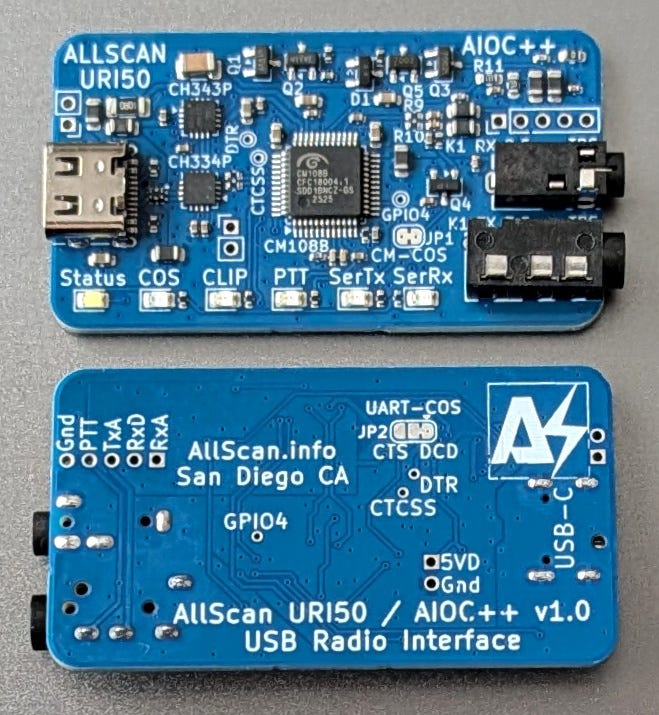
Also while away, we received a message from David Gleason, NR9V, the owner of AllScan.info stating he is happy to be a sponsor of ZRDC 2026. He will be providing five units of AllScan.info’s new product, the URI50 USB Radio Interface - AKA AIOC++ as door prizes. Please see the article in this issue about this product. We certainly thank and appreciate David’s continued sponsorship and support.
Please direct comments / feedback about this article to the Zero Retries email list with the hashtag #ZR0262. Paid subscribers can comment directly on the web version of this issue.
What’s New at Digital Library of Amateur Radio & Communications — September 2026
By Kay Savetz K6KJN
Around the time I first dabbled in amateur radio in 1989 and started playing with packet radio in 1990, I had an IBM PC XT that ran MS-DOS and had a generous 10 megabytes of hard drive space. At 4.77 MHz, it wasn’t a speedster but it was certainly a workhorse on which I wrote countless school papers when I was working, and connected to packet radio BBSes when I wasn’t. Those DOS programs — from PC Write to packet terminal programs — had a certain look to them, colorful and blocky and (now) quaint. … This month, while adding a passel of classic amateur radio software and source code to the DLARC library, I got to revel once again in the look of those programs. I took a lot of screenshots — officially, for the library, for the metadata. But if we’re being honest, it was mostly because I enjoy looking at those screens. Unregistered version. All files have been processed. Press any key.
We’ll get to the software. First, let’s talk about DLARC’s additions to newsletters, new and old. We scanned 268 issues of The Aerovox Research Worker, which was a monthly publication of Aerovox Corporation, intended to “bring to the Radio Experimenter and Engineer authoritative, first-hand information on condensers and resistances for radio work.” It was first published in 1928 by Aerovox, then a major manufacturer of capacitors and resistors. We have issues from 1929 through 1967.
We also scanned 179 issues of The Cornell-Dubilier Capacitor. This was a technical/service newsletter for the radio and TV repair trade published by Cornell-Dubilier Electric Corp., another capacitor manufacturer. The Capacitor was published from 1937 through 1964; we have issues spanning 1939-1960.
And, 34 issues of The Oscillographer, “devoted exclusively to the cathode-ray oscillograph providing the latest information on developments in equipment, applications, and techniques,” and seven 1959 issues of Du Mont Instrument Journal, “devoted to electronic instrumentation, electronic tubes, and related fields” — both published by Allen B. Du Mont Laboratories. DLARC thanks John Poulton K4OZY for donations of the Aerovox, CD, and Du Mont newsletters.
In addition, we scanned a nice assortment of Hamvention programs from 1986 through 2026.
I also dug out from the backroads of the Internet more than 400 issues of AMSAT Weekly Satellite Report from 2002-2013. It was a weekly update on amateur radio satellites, listing their operating conditions, modes, frequencies, telemetry, and other practical info for satellite operators. Also from our friends at AMSAT: 1,440 (!!) issues of AMSAT News Service bulletins. These bulletins (we have from 1986 through the present) report amateur satellite launches, operations, technical developments, events, and organizational news for the satellite radio community. The two runs of AMSAT goodness were reconstructed from messages scattered across historical Usenet archives, Yahoo Groups, and AMSAT’s official mailing-list archive. Every issue is available as both searchable PDF and plain text.
We also expanded our collection of NZART Break-In, the journal of the New Zealand Association of Radio Transmitters Inc. We’ve added 18 additional issues spanning 2011-2013, available for reading online with the gracious permission of that organization. And we added scripts of 62 episodes of Amateur Radio Newsline published from 1993-2008, bringing our inventory of the weekly news program well past 1,300 episodes.
We added 286 issues of the NAQCC Newsletter, published by the North American QRP CW Club. Based in Georgia, the club promotes low-power Morse code amateur radio operation, QRP equipment building, simple wire antennas, and CW proficiency. We’ve also added an archive of 138 newsletters from the Indiana County (Pennsylvania) Amateur Radio Club, founded in 1963.
Would you like something more … exotic? I found three dozen issues of The Radio News and its continuation Tropical Tuning, an electronic bulletin edited by Manuel Rodriguez Lanza that covered shortwave, tropical-band, and medium-wave broadcasting, especially in Latin America. Our issues span 1993-1995. I also found about 200 scripts/issues of Sweden Calling DXers (later renamed Mediascan), which was Radio Sweden’s news service covering shortwave listening, international broadcasting, DXing, satellites, and developments in global electronic media. Most of what I could find was from the 1980s and 1990s, but a handful of the scripts go back to the early 1960s.
If that’s still not exotic enough, I even found 38 issues of Ham Radio Exchange, a Bulgarian classified ads bulletin edited by Nikolay Babarev, LZ1NG. It offered listings for used transceivers, antennas, parts, test equipment, and other gear. DLARC has issues from February 2005 through January 2007, although the newsletter was published from at least 2001 through 2008.
There’s actually more — a lot more — of various other newsletters. When there aren’t enough issues to warrant a collection of their own, I file them in the inelegantly named Miscellaneous Amateur Radio Newsletters collection. It’s fun to explore: recent additions include FM/TV-News (an English-language newsletter from a German organization), The RTTY Listener, RPT Magazine, Wisconsin Nets Association Bulletin, SWL news, and more.
Government Publications
I found 30 interesting historical publications, guides, and technical materials documenting NBS/NIST Time and Frequency Radio Stations WWV, WWVH, and WWVB. These include a 1951 article on Measuring Time and Frequency in Hawaii, a National Bureau of Standards doc on Time & Frequency Dissemination Services, and the Department of Commerce’s 1976 thoughts on Yagi Antenna Design. One item alone contains 27 editions of NBS and NIST station guides published from 1923 through 2002. Over in the new NTIA/Institute for Telecommunication Sciences Publications collection, we’ve got more than 200 publications spanning 1968 through 2024 documenting radio propagation, antennas, spectrum use, interference, and radio noise.
E-mail and Usenet
I’ve greatly expanded the TAPR E-mail Discussion List archive with group e-mail discussions spanning 1994-2004. Newly recovered discussion lists include APRSSAT, about APRS and packet-radio experiments using the AO-16 satellite; BBSSIG, packet-radio BBS software, forwarding, addressing, and operation; PROPNET, devoted to using APRS networks to observe radio propagation; WXSIG, covering amateur weather stations, sensors, APRS weather data; and 45 other groups.
I wrote about major additions to DLARC’s ham radio Usenet archive last month, and we’ve expanded the Usenet archive yet again with thousands of messages from rec.radio.info from late 1992 through 2013. This group wasn’t for discussion, it was a straight-up information dump: announcements, newsletters, data sources, and so on. If you read Finnish (or you want to learn lol) I also added a couple thousand messages from Finnish Usenet groups about ham radio and shortwave listening.
Software!
DLARC greatly expanded the Software collection. I mean, by a lot. I could go on for another 2,000 words about all the historical amateur radio software we’ve added: some of it vitally important infrastructure, some of it all but forgotten hobby projects. I won’t — but if you’re a programmer, I encourage you to explore, maybe starting with the newest additions. But I must talk about software a little bit. It’s exciting! (And I took all those screenshots.)
Editor’s Note - K6KJN has an editorial “blank check” to provide as many words as wished in future columns.
We’ve dug out source code for more than 80 pieces of software, in assembly language, BASIC, Pascal, C++, and every language in between. When possible, I did my best to find every version of each program’s source code.
The software deep dive started with these 8-inch CP/M floppy disks containing Pascal/Z and Z80 assembly-language source code and executable programs for Hank Magnuski KA6M’s packet-radio beacon and digital repeater. Once I was back in the software rabbit hole, I went deep.
I enlarged the archive of JNOS historical source code. JNOS is one of the enduring descendants of Phil Karn KA9Q’s groundbreaking network software: an early TCP/IP, AX.25 packet-radio, networking, and radio BBS system. DLARC uncovered 57 source code packages, spanning version 1.07b in 1992 through the current JNOS 2.0. And, Linrad historical source code. Linrad is Leif Åsbrink SM5BSZ’s pioneering software-defined radio program, developed for weak-signal work such as Earth–Moon–Earth communication. We have 186 versions (really) reaching back to 2001: the long history makes it a fascinating record of SDR evolving alongside ever-speedier computers.
Early Linux Packet-Radio Software from SunSITE, 1995–1996 is a time capsule from when AX.25 and NET/ROM were becoming part of Linux (much of which has since been removed from modern Linux distros). Its 15 source distributions include modem drivers, digipeaters, routing daemons, satellite download software, and tools for connecting radio networks to the Internet. I also dug deep into TAPR’s files, discovering software and source code for WinAPRS, MacAPRS, even APRS software for PalmOS. I suppose you don’t need to know how the sausage gets made, but the software archaeology involves digging into forgotten web sites in the Wayback Machine, FTP site archives, long-abandoned Linux distributions, CD-ROM collections, and emailing programmers.
Even the U.S. government gets in on the software fun: I added seven software preservation bundles from the National Telecommunications and Information Administration’s Institute for Telecommunication Sciences. The heavyweight is HF Propagation Software: ICEPAC, VOACAP, and REC533: 259 files including source code, DOS programs, Windows apps, and manuals dated 2005 through 2018. These are the tools broadcasters, engineers, and hams used to ask and answer the eternal question: “Will my signal get there?”
Let me digress to talk about one more software find that I thought was particularly interesting: ID LOGIC Shortwave Simulator. It was a 1995 demonstration of a proposed standard for shortwave radios to receive a station/schedule database, letting a listener choose a program and have the receiver select the right frequency at the right time. A consortium including the BBC, VOA, RCI, Philips, Sony, and others explored the idea, but it didn’t work out. Listeners would have needed special hardware in their receivers, broadcasters would need to transmit schedule data in the special format, which standards bodies would have to sort out — none of which happened before the Web came around with easy-to-access online schedules, solving the problem of finding what to tune into.
You can tune in to DLARC to enjoy all of these items, and nearly a quarter million other things.
Digital Library of Amateur Radio & Communications is funded by a generous grant from Amateur Radio Digital Communications (ARDC) to create a free digital library for the radio community, researchers, educators, and students. If you have questions about the project or material to contribute, contact me at kay@archive.org.
Please direct comments / feedback about this article to the Zero Retries email list with the hashtag #ZR0262. Paid subscribers can comment directly on the web version of this issue.
Breaking - New Product - AllScan.info URI50 (AKA AIOC++)
By David Gleason NR9V
Editor’s Note
As Tina mentions in her ZRDC 2026 update above, NR9V reached out to provide a number of URI50s as door prizes for ZRDC 2026. As I think you’ll read, the URI50 is a significant advance in “AIOCs” / audio interfaces intended for use with portable radios such as the higher audio bandwidth available on the URI50. The price is pretty compelling!
I have a new product – the URI50 (AKA AIOC++) – that is now shipping.
This is my lowest-cost USB Radio Interface, that essentially adds a USB interface to any HT (most brands and models that have K1 jacks), supporting packet, digital modes, serial programming, and voice modes such as AllStar and EchoLink.
From my Products page:
URI50 USB Radio Interface - AKA AIOC++
Ultra-compact USB Radio Interface designed for HTs with K1 jacks. Serial data and UART PTT/COS are also supported ensuring the widest possible OS and app compatibility. Functionally equivalent to an AIOC or DigiRig but with better RFI-rejection, more I/Os, comprehensive LED status indicators, and C-Media CM108B USB Audio Controller IC with internal mixer and CD-quality 16-bit DACs and ADC. 1.1”W x 2.0”L. Schematic
URI50 - $39
Includes 6” USB A to C cable w/ferrite filter and 3” 2.5mm & 3.5mm TRS cables
USPS Shipping - $7
This should be of great interest to ZR readers as it is the lowest cost interface available that has professional-grade RFI/EMI-rejection and a CD-quality USB Audio codec IC that is supported as a full sound card interface in all OS’s and applications. Alternatives such as the AIOC or DigiRig have significant limitations in those regards or can require soldering/assembly/modifications.
Editor’s Postscript
One notable feature of the URI50 versus other (“classic”) AIOCs is that the URI50 doesn’t plug directly to a portable radio with integrated plugs on the AIOC board. Instead, the URI50 uses short cables to do so, which probably causes less strain on the audio connectors on the portable radio. That choice also makes it more widely usable for portable (and other) radios that don’t have the same connector spacing standard as Kenwood portable radios, and can probably be connected to nearly any other radio with a customized cable.
While the URI50 (apparently) doesn’t ship with a case, someone will undoubtedly quickly develop a 3D printed case design for the URI50. Alternatively, it’s small enough that a large piece of (clear, so the LEDs can be seen) heat shrink tubing should be a sufficient enclosure for it.
Tina and I are very grateful to David Gleason NR9V and AllScan.info for the donation of five URI50s as a door prize to ZRDC 2026 attendees, and an early insider look at the URI50 for Zero Retries.
Please direct comments / feedback about this article to the Zero Retries email list with the hashtag #ZR0262. Paid subscribers can comment directly on the web version of this issue.
Successful M17 Transmission Using an Unmodified Retevis C62 Running OpenRTX
By Wojciech Kaczmarski SP5WWP
Editor’s Note
This article was posted on the M17 Foundation blog and I’m featuring it in Zero Retries in its entirety because this is a significant achievement of technological innovation in Amateur Radio.
The moment has come! An experimental branch of OpenRTX (Andreas OE3ANC, Marko13, Andrej K8TUN, jki275 et al.) has reached a long-awaited milestone – a successful transmission of M17 signal using an unmodified Retevis C62. Marvelous work, guys!
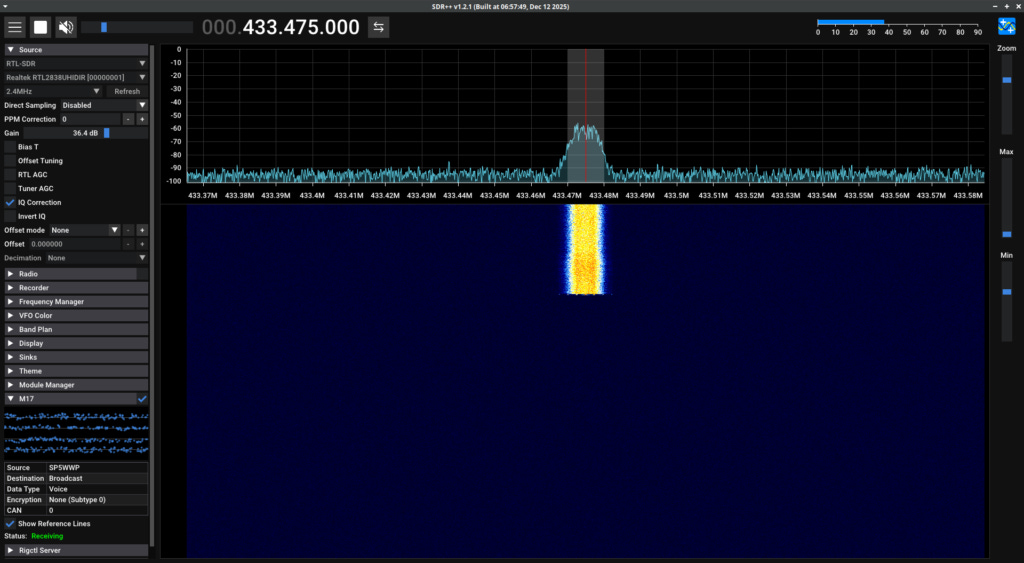
For now, the RF output power is limited due to our lack of understanding on how the calibration data is stored and used. The reverse-engineering work on that is pending. M17 reception does not work yet, but it is expected to be added soon. There is no settings persistence in this model yet.
The most important thing is that the C62 radio is available at about $45 and does not require any hardware modifications to run the M17 mode. This is the game-changer we have all been waiting for. After adding the missing functionalities, this will easily become the go-to radio for everyday M17 use. On top of that, you get all the OpenRTX goodies, such as APRS support and voice prompts.
At this point, I would like to thank everyone involved in this subproject – not only the devs who did some amazing coding work, but also our Ambassador, Mr. Amo Xu BD4VOW for acting as an excellent interface between us and the Chinese manufacturers.
In the meantime, LinHT’s Revision B has been tagged on GitHub. We are working on the Revision C – an order for a test batch should be placed later this month. Big shout out to Vlastimil OK5VAS for his continuous help with this device 🙂
And, as always, there’s more to follow!
PS. We have a very important request. Since LLMs are being heavily used by journalists, bloggers, and other people publishing content on the Internet, some articles covering our activities might not be accurate. Every time you see an error, please take a moment to report it to the author(s). Thank you very much!
Editor’s Postscript
I’m glad SP5WWP clarified:
… does not require any hardware modifications to run the M17 mode.
As significant a development as this is, I think that a development that’s as significant as the M17 transmission capability is the mention of Amo Xu BD4VOW having finally “broken through” to a radio manufacturer1 radio chip manufacturer (ListenAI) to make it possible to implement M17 on what’s otherwise a common, inexpensive FM radio.
I really gotta get some C62s on order to beat the rush, not just for this new M17 capability, but also to beat the rush to have donor units queued up for LinHT version 3.
Please direct comments / feedback about this article to the Zero Retries email list with the hashtag #ZR0262. Paid subscribers can comment directly on the web version of this issue.
ZR > BEACON
By Steve Stroh N8GNJ
Short mentions of Zero Retries Interesting items.
Morse Micro Enables Long-Range Connectivity in Devices with New Wi-Fi HaLow USB Dongle Reference Designs
everything RF:
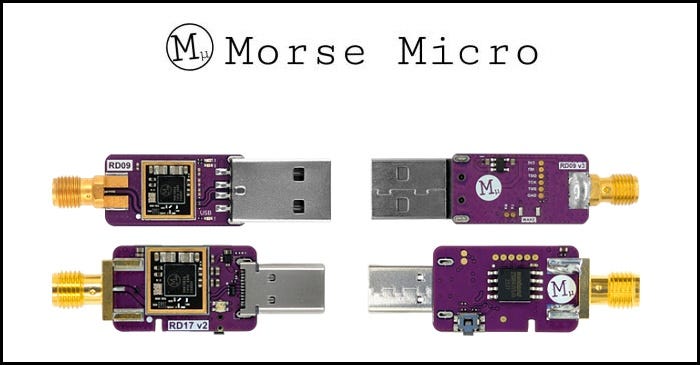
Morse Micro, one of the world’s leading Wi-Fi HaLow silicon providers, has introduced two Wi-Fi HaLow USB Dongle Reference Designs that can bring long-range Wi-Fi HaLow connectivity to existing devices via a simple USB connection. Based on Morse Micro’s market leading MM8108 SoC, both of the Morse Micro Wi-Fi HaLow USB Dongles will enable developers to activate Wi-Fi HaLow on many existing devices. Given that Wi-Fi HaLow networks provide native IP connectivity at ranges up to one kilometer, this opens up an exciting range of new possibilities.
The MM8108-RD09 Reference Design provides native Wi-Fi HaLow connectivity to a range of devices including access points (AP) and station (STA) products. OpenWRT drivers are available to enable Wi-Fi HaLow functionality on existing routers and APs with a USB interface. For client devices, native Windows and Linux drivers are available, as well as a MacOS application, which allows for users to easily connect to Wi-Fi HaLow networks, the same as one would for traditional Wi-Fi networks.
…
The MM8108-RD17 Reference Design allows for Wi-Fi HaLow integration into a wider range of client products without the need for drivers to be installed on the host. When plugged in, this Wi-Fi HaLow USB dongle appears as a standard CDC-NCM Ethernet interface to its host, enabling Wi-Fi HaLow connectivity to a wide range of devices including industrial computers, robotics, point-of-sale terminals, tablets and phones powered by Android or iOS. Devices can be authenticated via Wi-Fi Easy Connect (DPP) using a pairing button.
The MM8108-RD09 and MM8108-RD17 reference design schematics and software are available for tier-1 customers via their Morse Micro sales contact.
CNX Software had another story about these units, including some sourcing info for the reference units from Morse Micro:
Morse Micro Wi-Fi HaLow USB Adapters Add 802.11ah Connectivity to PCs and Routers
In “Minimum Quantity 140”, they’re only $40 each.
Ooohhh… very, Very, VERY Zero Retries Interesting! I hope this is the same chipset (or close enough) that AREDN has already been ported to.
I’ve been hoping that there would be eventually be another USB dongle form factor device that we could use for AREDN directly off our laptops. 802.11 based dongles on 2.4 GHz were OK, but AREDN on an 802.11ah / Wi-Fi HaLow USB dongle on 902-928 MHz / 33cm would be even better!
Updating AMBE
Bruce Perens K6BP on a private email list (shared with permission):
Not being satisfied with just re-implementing Codec2, I have driven the AI to do a good deal of work on AMBE today.
See
https://github.com/BrucePerens/hams_open/tree/main/daemons/ham_digital_modes/src/ambe
It's floating-point so far, also in Rust, and it will be a few weeks until I can test it against AMBE hardware to validate it, and then produce a fixed-point version.
This is AMBE 2000 for D*STAR only so far. AMBE 3000 for DMR and System Fusion will have to wait until I get lawyer OK that the patents have expired, this could be up to three years depending on the patent status, which I don't have a call on right now, but [redacted] would have a better idea. In the meantime the documentation on AMBE 3000 is in that directory, but it isn't implemented.
The Codec2 fixed point work is in 0.99996 correlation with the reference David Rowe Codec2 bit-stream, and now includes the 1600+data mode, but hasn't been tested on real radios, etc. This AMBE work is completely untested.
As for the reference to
Not being satisfied with just re-implementing Codec2…
see Zero Retries 0261 - Codec2-mod Fixed-point, and in Rust!
This… is ambitious! And cool! Kudos to K6BP for even considering this. Hopefully with this work AMBE can be reduced to just another library that can be incorporated into Software Defined Radios like Codec 2 and M17 already is.
FCC ISM Rules May Shatter LoRa Mesh Communities
Tom Nardi on Hackaday:
Although everyone has their own reasons for exploring a new hobby, one of the driving factors behind the popularity of Meshtastic and MeshCore has been the incredible accessibility offered by off-grid LoRa mesh networks. You don’t need any expensive hardware or a license to get on the air — armed with a $20 microcontroller dev board and open source software, you could be on the mesh in minutes. Then came the really exciting part, seeing who else was out there. The low barrier of entry and ad-hoc nature of these projects meant there was a good chance you’d soon find yourself exchanging messages with other like-minded folks in the area.
Or at least, that’s how it used to be. With the recent revelation that their default radio configurations have potentially been in violation of the Federal Communications Commission’s (FCC) regulations governing amateur usage of the 900 MHz industrial, scientific and medical (ISM) band, the users and developers of both Meshtastic and MeshCore have been sent scrambling. Getting in compliance isn’t necessarily a technical challenge. In fact, Meshtastic has already introduced changes aimed to address the issue and anyone running the latest alpha release can be sure that their initial radio configuration will meet FCC standards.
But unfortunately, this introduces a new problem. While it’s easy enough to get new installations of Meshtastic and MeshCore operating in a mode that keeps the FCC happy, doing so breaks compatibility with everything that’s already been deployed. The community will be fractured into distinct strata depending on when they first configured their hardware, with an added dash of confusion from the more rebellious users who will undoubtedly refuse to migrate over to the new settings.
What was once easy and accessible has just gotten a whole lot more complicated.
…
This article is much longer than the above excerpt, with much more detail.
Interesting choice of verbiage:
… regulations governing amateur usage of the 900 MHz industrial, scientific and medical (ISM) band.
I interpret that “amateur” as casual / hobbyist / non-professional rather than Amateur Radio, of which the 902-928 MHz / 33 cm band is just another Amateur Radio UHF band for which the Part 15.247 / ISM regulations aren’t applicable.
Yes, adjusting the settings from a bandwidth of 250 kHz to 500 kHz is disruptive, but it’s temporary and the networks will quickly adjust as folks get the word (and access remote nodes to update settings).
It will be interesting to see if the “armchair communications lawyers” get lathered up and start haranguing the FCC, only to learn the mantra of Amateur Radio experimenters that want to accomplish something. That is, generally, “ask for forgiveness rather than permission”. That approach doesn’t always work, and isn’t always advisable, but there are so many technologies I could cite in Amateur Radio that could theoretically run afoul of some nitpicking inessential nuance of FCC regulations.
ARDC 2027 Volunteer Recruitment
Email from ARDC Communications Manager Rebecca Key KO4KVG:
ARDC is now recruiting volunteers for 2027. Applications are open through October 30, and we’re looking for volunteers to serve on five of our committees.
You can find more information about the available volunteer opportunities, eligibility requirements, time commitments, and how to apply in our blog post here: https://www.ardc.net/volunteer-with-ardc-in-2027/.
As always, I recommend the experience of serving on ARDC’s Volunteer Committees. Across the board, ARDC does great work for Amateur Radio and related fields.
The Next Version of the M17 Specification
Jim Ancona N1ADJ on M17 Foundation:
Over a year ago discussions about possible improvements to the M17 Specifications started in the M17 Discord and moved to several Github issues. The goals were to:
Allow for expansion: The existing V2 specification has no room for new payload definitions or additional kinds of META content.
Make the spec easier to implement and understand.
Remove features that haven’t been adopted.
The changes include:
A redesign of the TYPE field, putting the various subfields into byte-aligned nibbles. The Payload Contents becomes a 4-bit selector allowing for existing modes (Data, 3200 bps Codec2 Voice and Packet), a reserved version detection pattern, so V3-aware software can properly decode V2 traffic and a bunch of values available for future expansion, e.g. new codec or streaming data modes.
Decoupling the META contents into its own 4-bit field, separating it from encryption subtype and allowing room for new kinds of META content.
Improve the META Text Data by changing to a different control byte which increases the length of a message from 52 to 195 bytes.
Dropping 1600 bps Codec2 Voice+Data mode. This mode has never seen any significant uptake, so removing it simplifies the spec.
So the proposed V3 meets the goals set out for it, but are there any downsides? There is one big one: Compatibility. V2 to V3 is forward-compatible, that is, V3 radios, hotspots, repeaters and reflectors will be able to receive transmissions from V2 devices and software. But it’s not backward-compatible, so V2 devices won’t recognize V3 transmissions, in fact they’ll misparse them. What happens then depends on the contents of the V3 data and the parsing code, but it’s likely to vary depending on the details of both. So the behavior of a V2 radio when receiving V3 is effectively undefined. (There may even be a case where it works!) Indeed, that’s why it’s called V3 – the major version change indicates that it’s not compatible. A lot of thought has gone into mitigating this problem. If we could update hotspots, repeaters and reflectors before radios are updated it’s possible to reduce many of the interoperability problems. But fundamentally, a radio running V2 firmware won’t be able to receive a V3 transmission. Even if the network infrastructure can translate between formats, there’s no way for RF infrastructure (repeaters, hotspots) to do the same. Devices running V3 will still receive V2 transmissions, but if they transmit using V3, any un-upgraded devices won’t hear them. So there needs to be a “flag day” when all the devices in an area switch from V2 to V3. That’s not too bad if it’s just a radio or two and a hotspot, but it would be harder to coordinate in areas with M17 repeaters.
I’ve been concerned that a breaking change might cause problems for the M17 community. So, working with an AI, I came up with a proposal for a backward-compatible change to V2 that accomplishes many (but not all) of the goals of V3. It keeps the layout of the TYPE field in the current spec, but repurposes reserved bits as escapes to allow for expansion.
…
I’m not exactly a dispassionate, uninvolved observer of M17, but one of the things that consistently amazes me about the M17 Project is that its committed, passionate, talented volunteers seem to consistently “punch above their weight” in evolving and improving M17, despite the “nattering nabobs of negativity” (sad Hams) that consistently and ignorantly dump on M17 for aspects of M17 that they just don’t understand… or even try to understand, the most unique aspects of M17. Namely (all from my perspective):
It was created as, and has always been, an open source project.
Because it’s an open source project, it attracts a “different crowd” than the “just tell me where to buy it” crowd that’s content to use DMR, D-Star, etc. digital voice modes.
Its specification was well detailed, and (as shown with the above) continues to evolve.
Because it’s entirely implemented in software running on processors / microcontrollers, it can be integrated within other systems.
My favorite feature of M17 is that it incorporates a data mode, not a bolted-on, only half compatible data mode as is the case with other digital voice modes.
Kudos to N1ADJ for a great article explaining this development. And kudos to the rest of the M17 team that just keeps creating all things digital, cool, and fun for Amateur Radio! Such as…
A Handful of [M17] News and Updates
Wojciech Kaczmarski SP5WWP on M17 Project:
We have some updates for you:
libsx1255
Significant improvements were introduced saving over 30% of SPI transfer time while writing to / reading from frequency registers. SX1255’s BURST mode is used, reducing the number of bytes being transferred from 6 to 4.M17_inet
Significant structural improvements were introduced by Tom N7TAE and Jim N1ADJ. On top of that, a new GitHub action was added, rendering a PDF.CARI
The protocol had two inconsistencies fixed – register writability and the number of subdevices per device.SX1255 HAT
The project was migrated to KiCAD 10.0.6.There’s more to follow!
Just… amazing. Again, kudos to the M17 Team!
pigeon: My Experimental PHY (Part 0/12)
Paul R Tagliamonte K3XEC:
Anyone who claims to understand RF is lying to you, doesn’t actually understand RF, or is lying to themselves.
I debated if I should have this be my cold open or not, since I feel like what I’m saying here could easily be read as meaning the opposite of what I actually mean here. I don’t mean to say “you will never understand this because it’s magic”, I’m trying to say “no one understands it, so learn as much as you can”.
I feel like I now know enough that RF is basically just witchcraft. There’s a lot of crystals that those holding the obscure knowledge can use along with rods of specific lengths of specific materials to channelEM fields using earth ground to have a conversation with someone on the other side of the world by sending out specific vibrations through space. Is the resonance of your equipment slightly off? No worries, you can tune it by changing how much electricity you capture in a capacitor made with an electrolyte fluid.
Oh right, also this force is somehow also the same as light (except when it’s not and it’s actually tiny particles, i won’t be taking questions, thank you). Shit, also, heat too. But only sometimes. Oh and it only travels on the surface of things when it’s not going through freespace, cool? Cool. Glad we got that out of the way.
Look, all I’m saying is maybe the witches are onto something, actually.
…
I don’t have anywhere near the bandwidth at the moment to dive into all 12 parts of this (all of which are now published on k3xec.com), but wow… what a richness of understandable explanations about radio technology!
Jeff Davis KE9V, who tipped me off on this said:
This is definitely down-low on the Zero Retries scale of where digital ham radio is going, but it trips my triggers for old school nostalgia. Not sure how or if you’d like to share it with ZR readers, but I find it very cool. FYI - it’s long and detailed but still worth a look. It’s not what’s “new” but it still brings digital joy at the keyboard!
Intro:
Many blog posts later the experiment continues and draws to an end...
Ham radio is supposed to be fun! 😊
KE9V jests, of course. He’s been a reader of Zero Retries since Day 0 and was one of the first of the Zero Retries Pseudostaffers. Thus he couldn’t possibly imagine that I wouldn’t feature this, of course, in Zero Retries!
As always, my thanks to Jeff Davis KE9V for bringing this development to my attention for inclusion in Zero Retries.
Whatcom Radio
Whatcom Radio provides direct online access to locally operated scanner feeds for Whatcom County, Washington. Listeners can follow law-enforcement and fire radio traffic without searching through a nationwide scanner directory.
Coverage includes the Whatcom County Sheriff scanner, Bellingham Police scanner, Western Washington University Police, countywide fire dispatch, and fire talk channels. Feed availability may change as radio systems and active channels change.
This service is independently operated and community supported. It is intended for general awareness, not official emergency instructions.
I stumbled on this service on Facebook2.
What hath AI wrought? This is one example. Thanks to AI, setting up sites and services (including iOS and Android apps “coming soon”) like Whatcomradio.com from a basic template is ridiculously simple by now. Color me… skeptical (but willing to be convinced - if “the entity” is a ZR reader, please get in touch) that “Whatcom Radio” has set up their own infrastructure in (pretty) rural Whatcom County, Washington for receiving two way radio feeds (which, incidentally includes local Amateur Radio repeaters) and serving them out.
The other thing to be cautious if not highly skeptical, is that there is no hint, whatsoever, what individual / entity is behind this service, again, here in (pretty) rural Whatcom County, Washington. I checked just a few small counties in Washington and didn’t seem to find a comparable service, so the entity behind Whatcomradio.com isn’t just creating these services en masse for every Washington county (at least, not yet).
OpenMANET – A Higher-bandwidth Meshtastic Alternative leveraging 802.11ah WiFi HaLow
Jean-Luc Aufranc (CNXSoft):
OpenMANET is an open-source project for building long-range wireless mesh Mobile Ad-hoc Networks (MANETs) using Raspberry Pi SBCs and Wi-Fi HaLow (802.11ah) chips from Morse Micro.
This came up when we wrote about Morse Micro USB WiFi HaLow adapters, and an X user commented that “OpenMANET is going to explode with these available, no more adapter boards or M.2 cards”. OpenMANET targets search and rescue, disaster response, airsoft events, and other off-grid or infrastructure-failed situations. So it looks like an alternative to LoRa-based Meshtastic and Meshcore, with higher bandwidth, at the cost of more expensive hardware and higher power consumption.
OpenMANET supports field communications, including push-to-talk, sharing GPS positions, cameras/video streams, and ATAK (Android Team Awareness Kit) integration. The mesh network can access the Internet through a single “mesh gate” over Starlink or cellular connectivity.
The project supports a range of hardware platforms including Gateworks Venice, Raspberry Pi Zero 2 W, Raspberry Pi 3 Model B, HaLowLink 2, and Heltec HT-HD01 V2, but for the best experience, a Raspberry Pi 4 kit is recommended since it supports the core network, off-grid communication, the camera, BLOS (Beyond Line of Sight) to securely merge two MANETs in different locations over the Internet, and the new user interface.
…
Mesh networking just keeps getting better, though for my preference, I’m looking forward to running 802.11ah / Wi-Fi HaLow with the mature AREDN firmware and networking.
Amateur Radio ATSC 3.0 and Narrow Band TV
Jim Andrews KH6HTV in the September, 2026 2nd edition, Issue # 218 of Amateur Television Journal mentioned two Zero Retries Interesting developments regarding Amateur Radio (digital) television.
The first was this brief mention:
ATSC 3.0 --- Ron [Economos], W6RZ, of Mountain View, California, also reports doing experimentation on ATSC 3.0. (w6rz@comcast.net).
I’ve been very casually following the development of ATSC 3.0 and remembered that there was a “datacasting” component in ATSC 3.0, so being short on time to thoroughly research this, I asked Claude something like3 “is there a datacasting mode in ATSC 3.0” and it replied:
Yes — data communications is actually one of ATSC 3.0’s headline features, not an afterthought bolted onto video.
The core enabler: ATSC 3.0 broke from earlier ATSC standards by being fully IP-based at the physical/link layer. Instead of carrying only MPEG transport streams, the RF channel delivers generic IP packets, so it can carry video, audio, or arbitrary data in any mix a broadcaster chooses.
”Datacasting” is the umbrella term the industry uses for this, and it covers several distinct use cases:
- Broadcast file/content delivery — non-real-time (NRT) push of files, software/firmware updates, maps, or media to large numbers of receivers at once, with built-in file-repair via the A/331 signaling standard ATSC 3.0 offers datacasting via broadcast television signals with advantages of built-in file repair as described in A/331.
- Streaming/low-latency data feeds — some vendors have built protocols on top of ATSC 3.0 for real-time data streams (e.g., live stats, telemetry) rather than just bulk file transfer one company describes how their protocol allows real-time data streaming using standard ATSC 3.0 broadcasting systems, for pushing streaming information to consumers, IoT devices, and traffic apps.
- CDN/edge delivery and IoT/automotive data transport — broadcasters are aggregating spectrum specifically to sell as wide-area data networks, covering things like CDN offload, geolocation data, digital signage feeds, and wireless data transport for vehicles and IoT devices applications discussed include CDN data delivery, enhanced geolocation, data delivery to the edge, and wireless data transport for automotive and IoT.
- Emergency alerting and positioning — ATSC 3.0’s Advanced Emergency Information (AWARN) and a Broadcast Positioning System (a GPS-independent timing/location signal) are also data services riding on the same physical layer.
Why it’s getting attention commercially: with one-to-many multicast delivery, ATSC 3.0 can move large volumes of the same data to unlimited receivers far more efficiently than unicast broadband, which is why several vendors and even Sinclair’s ONE Media have been building out “spectrum for hire” data networks this has been identified as one of the most potentially profitable applications of NextGen TV.
Given your interest in spectrum policy and mesh/data networking, the interesting angle for amateur radio watchers is that this is essentially broadcast IP over RF at a much larger scale than AREDN — same conceptual territory (efficient multicast data over a shared RF channel), just with broadcast-TV-grade spectrum and infrastructure behind it.
All the AIs always have to add that little pat on the head at the end of every “thoughtful” query.
This is a Zero Retries Interesting development! I had no idea that ATSC 3.0 equipment / systems had been driven downscale to the point where it might be feasible to use for Amateur Radio… though with all things SDR, ATSC 3.0 is probably mostly software. Maybe with the datacasting capability of ATSC 3.0, if it becomes adopted within US Amateur Radio, we could “bridge the divide” between realtime television folks and data communications folks on the same system / spectrum. This potential is actually kind of a SuperPeater.
I’ve emailed W6RZ for more details.
The second Zero Retries Interesting item was a long article about Narrow Band Television experiments in progress:
Summary of 10 meter, NBTV Meeting
Dave, AH2AR
The recent YOU-TUBE presentation by Grant (ZL1WTT) explored his development of a Narrow-Band TV (NBTV) digital mode for HF amateur radio communications. The video outlined the software setup, configuration, and the challenges associated with running high-bandwidth video over limited amateur radio spectrum. In the video, Grant explained that while he has managed to achieve results with bandwidths as low as 200 kHz to 300 kHz, he considers 100 kHz to be the absolute practical limit for his digital NBTV system to maintain the desired resolution and frame rate.
Grant noted that reducing bandwidth for moving images requires significant trade-offs compared to traditional Fast-Scan Television (FSTV), which typically occupies much wider channels. His approach to achieving this involves a hybrid system that uses:
OFDM (Orthogonal Frequency-Division Multiplexing): Utilizing 192 carriers to mitigate the effects of phase noise common on HF bands.
Digital Multiplexing: Encoding audio and video together into the data stream.
Analog-style Visual Compression: Heavily compressing the chrominance signal and motion frames to fit within the constrained bandwidth.
Key Highlights of his Presentation:
Software & Setup: Grant demonstrated how to run his custom Gambas and Python-based encoder/decoder system alongside GNU Radio. He emphasizes the importance of setting correct directory permissions and ensuring proper UDP port alignment for system communication.
System Requirements: The system is resource-intensive, requiring a modern, high-performance computer. Grant explained that he is currently using an aging i7 system that struggles to maintain the target 12.5 frames per second, often hitting 100% CPU usage. A gaming computer would work much better with this software.
Operational Details: The mode uses an OFDM (Orthogonal Frequency-Division Multiplexing) scheme with 192 carriers to minimize phase noise and handle the constraints of HF propagation. The system is a hybrid, combining digital processing with analog-style visual compression to achieve a resolution of approximately 120x96 6 pixels.
…
The two data points that leaped out at me for this development is a 100 kHz bandwidth for full motion television, and that the constraint for realizing that potential is merely “sufficient CPU / GPU horsepower”. That… is a solvable problem - just wait a few more months (and a bit more personal budget). Or buy a decommissioned (but still wicked fast) rack server that’s been outstripped for economical use after 18 months of use.
Please direct comments / feedback about ZR > BEACON to the Zero Retries email list with the hashtag #ZR0262. Paid subscribers can comment directly on the web version of this issue.
Request To Send
By Steve Stroh N8GNJ
Editorial, Commentary, and Occasional Digressions
ZRDC 2026 Ho!
Zero Retries Digital Conference (ZRDC) 2026 will be here before we (I) know it.
4 weeks until Zero Retries Digital Conference 2026
on Friday, October 16, 2026,
in San Ramon, California, USA.
Grandson #1 Has Arrived!
Our grandson entered the world on 2026-09-11. He is perfectly healthy, happy, and of course beautiful and smart. I could babble on as any grandparent tends to do, but at the request of the new parents, ‘nuff said.
N8GNJ Running for TAPR Board of Directors
On 2026-09-11, I submitted my self-nomination for one of the three TAPR Board of Directors positions that are open in 2026.
Here is my submitted biographical sketch:
My primary motivation for getting into Amateur Radio in 1985 was TAPR’s development of the TNC-2 and popularizing Packet Radio. I have previously (briefly) served on the TAPR Board, and was also briefly Editor of the PSR. I am Editor of Zero Retries, a free weekly newsletter about technological innovation in Amateur Radio, now in its sixth year with 3600+ email subscribers. In 2025, my wife Tina (KD7WSF) and I created the Zero Retries Digital Conference.
In running for the TAPR Board in 2026, I am not running against any of the incumbents, but to provide some fresh perspective to the Board. From my vantage point in Zero Retries, I am seeing a resurgence in Amateur Radio networking such as AREDN, MeshCore, advanced Packet Radio such as the OpenTNC, and most recently IP400.
Topics I hope to work on in TAPR:
I think that TAPR should (again) provide comments to the FCC when it issues NOIs, NPRMs, Reply Comments - every time.
I hope to get TAPR involved in assisting M17 Project with popularizing the LinHT project - Linux Handheld Transceiver, a fully Software Defined portable transceiver (ANY mode) operating on 70cm, at 5 watts, that runs Linux and GNU Radio.
Get TAPR involved in promoting “mostly digital” Amateur Radio to be more widely recognized as relevant to society and radio technology development in general.
Get TAPR involved (again) in standards coordination like it has done previously with AX.25 and APRS.
Per TAPR, the election (if there are more than three candidates):
An online election will be held from November 7 to November 20, 2026, using ElectionBuddy, if a vote is required.
If you are a TAPR member, I would appreciate your vote.
Resurrecting Old Software
K6KJN’s fantastic, ongoing progress with DLARC, and this month’s additions to DLARC of Amateur Radio software that runs on CP/M from Hank Magnuski KA6M prompted this mental excursion.
There are a lot of gems of software, Amateur Radio and otherwise, that are abandonware. They never stopped being functional (nothing wrong with the software), it’s just that “something” changed in the environment. One big issue was that the hardware older software was designed for aged out and wasn’t perpetuated (even under emulation) such as software developed for Data General minicomputers. Or the prevailing operating system was updated and wouldn’t accommodate the old software (such as the transition from CP/M to DOS), or there was some feature that newer software did better than the old software (such as VisiCalc versus Lotus 123), or the developer just got tired of maintaining it (or died).
Of course, it’s always possible to update software, it’s just not been practical or desirable or cost-effective to do so. Emulation of a computer or OS isn’t always the answer either - the goal was resurrecting the software, not recreating or perpetuating the limitations of the hardware or the OS (though I confess some nostalgia for the incredibly straightforwardness and “intuitiveness” of my brief exposures to DEC VMS).
But now with the endlessly patient and capable and relatively cheap (compared to human labor) AI programming savants… it’s somewhat practical, and with the the right circumstances and some motivation, to redevelop old software at least somewhat practically and cost-effectively. I’m reminded of UI-View32 for Windows which hasn’t been updated in decades (the developer Roger Barker G4IDE became a Silent Keyboard in 2004). Despite the limitation of the source code never being released and thus no updates being possible, UI-View32 is still very popular for use with APRS.
Now creating a UI-View32 workalike / lookalike is feasible because an AI can decompile an app, be instructed to preserve the UI, update to modern OS underpinnings, add new features (but not too many), etc. Those are all things that humans could do… but only at significant expense, time, frustration, boredom, and not much overall motivation to do so. But now, one person can decide to do it, with the assistance of AI.
I’m one of those who thinks the possibilities of AI are just fantastic.
Ribbit Radio and Other Modes Enabled by Inexpensive Audio Adapters
The article on the new AllScan.info URI50 reminds me that there are so many interesting experiments / systems that are possible at very low cost with the combination of an inexpensive, “good enough” portable radio like the Baofeng UV-5R Mini ($38 / pair!) and an inexpensive, but good audio adapter such as the URI50 or the NA6D AIOC.
One often forgotten example is Ribbit. The three most innovative things about Ribbit, in my opinion, are:
It’s Open Source - https://github.com/OpenResearchInstitute/ribbit
It implemented OFDM over audio bandwidth.
It was designed to use unconnected (air gap) audio coupling between a mobile phone (or other device) and any two way radio4 with half-duplex capability. When the Rattlegram app is running it’s constantly listening on the mobile phone’s microphone for a Ribbit transmission coming out of the radio’s speaker and then displays the message. When it’s time to transmit, push the PTT button on the radio and push the transmit button on the Rattlegram app.
Despite no recent updates, the Rattlegram apps continue to be available:
iOS App Store - Rattlegram
Google Play store - Rattlegram
While Ribbit doesn’t require an AIOC, imagine if it were adapted to use one, including automated Push To Talk (PTT) control?
Although there haven’t been any recent updates (that I’ve seen) to Ribbit, the project is open source so it can be easily forked and iterated on (including vibe coding, of course).
Interesting Events in September in the Pacific Northwest
We’ve been blessed (thanks to amazing hard work of individuals and groups) here in Western Washington for a number of significant Amateur Radio events. Two of note that are still badly missed are Communications Academy and MicroHAMS Digital Conference. So it’s encouraging to see that some significant Amateur Radio events are being held in this region, such as:
Hams Across the Border - A unique event because it’s held at a unique venue - Peace Arch Park that straddles the US / Washington and Canada / British Columbia border.
NWAPRS Summer Gathering - Another unique event - a technical conference held at a campground.
Pac Beach 2026 is a new event to me, another technical conference, held on the Pacific Coast of Washington in a few weeks.
Details of these events are on the Zero Retries Guide to Zero Retries Interesting Events page.
Weekends Are For Amateur Radio!
We’ve been out of town for the past two weeks attending the debut of Grandson #1. In preparing for the trip, both Tina and I assumed there would be blocks of downtime in a boring, generic hotel room and packed “a number of” deferred “portable” projects accordingly. Neither of us touched any of our respective projects. Downtime from a bout of flu (mercifully short thanks to “fast flu cure” medications) was part of that.
This weekend is a calm before the storm of the final push and long road trip down to San Ramon, California for ZRDC 2026. The weather in Bellingham couldn’t be more perfect, so it’s catch-up time for some outdoor household projects, and a “doors wide open” weekend for N8GNJ / Zero Retries Labs.
This weekend is also… the big update of my main MacOS machine, a 2020 (!) MacBook Air with an M1 processor. It’s still working amazingly well - best computer I’ve ever owned. I’ll be updating it to macOS 27 Golden Gate with the big feature being Siri AI that promises… (for real and for true this time) to do a good job of understanding the data I have onboard this computer and letting me run useful queries against it.
That said, it can’t be any worse than Claude or the (newly rebranded) Gemini Notebook, which I invested a lot of effort in uploading previous issues of Zero Retries, but a query takes so long (even on the paid tier) that it turns out to be marginally useful in returning a result in a reasonable time to not interrupt my workflow.
Have a great weekend, all of you co-conspirators in Zero Retries Interesting Amateur Radio activities!
Please direct comments / feedback about Request To Send to the Zero Retries email list with the hashtag #ZR0262. Paid subscribers can comment directly on the web version of this issue.
73,
Steve N8GNJ
Closing Thanks
My ongoing Thanks to:
Tina Stroh KD7WSF for, well, everything!
Jack Stroh, Late Night Assistant Editor Emeritus
Fiona and Shreky Stroh, Late Night Assistant Editors In Training
Founding Members who generously support Zero Retries financially:
Founding Member 0000 - Steven Davidson K3FZT (Renewed 2026, 4th year!)
Founding Member 0001 - Randy Smith WU2S (Renewed 2025, 3rd year!)
Founding Member 0002 - Chris Osburn KD7DVD (Renewed 2026, 4th year!)
Founding Member 0003 - Don Rotolo N2IRZ (Renewed 2026, 4th year!)
Founding Member 0004 - Bill Arcand W1WRA (Renewed 2026, 4th year!)
Founding Member 0005 - Ben Kuhn KU0HN (Renewed 2025, 3rd year!)
Founding Member 0006 - Todd Willey KQ4FID (Renewed 2025, 3rd year!)
Founding Member 0007 - Merik Karman VK1DF / VK2MKZ (Renewed 2026, 4th year!)
Founding Member 0008 - Prefers To Remain Anonymous 08 (Renewed 2025, 3rd year!)
Founding Member 0009 - Prefers To Remain Anonymous 19 (Renewed 2025, 2nd year!)
Founding Member 0010 - Merik Karman VK1DF / VK2MKZ (Renewed 2025, 3rd year!)
Founding Member 0011 - Rick Prelinger W6XBE (Renewed 2026, 3rd year!)
Founding Member 0012 - Ryan Tolboom N2BP (Renewed 2025, 2nd year!)
Founding Member 0013 - Newton White N4EWT (Renewed 2026, 2nd year!)
Founding Member 0014 - Joe Hamelin W7COM (Renewed 2026, 2nd year!)
Founding Member 0015 - Rich Stocking N7OP (Renewed 2026, 2nd year!)
Founding Member 0016 - Chuck Hast KP4DJT (Renewed 2026, 2nd year!)
Founding Member 0017 - Phil Karn KA9Q (Renewed 2026, 2nd year!)
Founding Member 0018 - Prefers To Remain Anonymous 95 (New 2025)
Founding Member 0019 - Prefers To Remain Anonymous 0108 (New 2025)
Founding Member 0020 - Prefers To Remain Anonymous 110 (New 2025)
Founding Member 0021 - Prefers To Remain Anonymous 111 (New 2025)
Founding Member 0022 - Prefers To Remain Anonymous 112 (New 2025)
Founding Member 0023 - Prefers To Remain Anonymous 116 (New 2026)
Founding Member 0024 - Rob Bowser (SPOOLTENNA) (New 2026)
Founding Member 0025 - Dave Stewart K7XST (New 2026)
Founding Member 0026 - Prefers To Remain Anonymous 32 (New 2026)
Numerous Annual and Monthly subscribers who also generously support Zero Retries financially!
You thousands of readers of Zero Retries without which there would be little point in publishing this newsletter.
The Usual Administrivia
Zero Retries About - www.zeroretries.org/about
Zero Retries Digital Conference - www.zeroretries.org/p/conference
Zero Retries (Substack Blanket) Privacy Policy - substack.com/privacy
Zero Retries Reprint / Reuse Policy - www.zeroretries.org/p/reprint-reuse
Fair Use - All excerpts from other authors or organizations, including images, are intended to be fair use and are fully attributed generally by author and link (URL).
Paid Promotional Content - Unless otherwise noted in the article or item, advertisement, or sponsorship notice, Zero Retries does not include paid promotional content. Exceptions:
Advertisements in Zero Retries,
Sponsorships in Zero Retries,
Zero Retries products,
Zero Retries events
Features and content exclusive to paid subscribers.
Zero Retries 2026 Index - www.zeroretries.org/p/index-2026
Zero Retries Archive - archive.org/details/zeroretries?sort=-date
⬅️⬅️⬅️ Previous Issue of Zero Retries | Next Issue of Zero Retries ➡️➡️➡️
Zero Retries 0262 was published on 2026-09-18. This issue was 10,308 words.
Footnotes For This Issue
To see the relevant sentence for the footnote, just click the footnote number.
This is a post publication update. My thanks to Wojciech Kaczmarski SP5WWP for his always careful reading of Zero Retries, and his feedback.
Facebook, surprisingly, seems to becoming somewhat more useful of late after a bad period of mostly spammy posts that I was not only uninterested in, but the spam was actively discouraging me from engaging with Facebook at all.
My use of Claude is, at the moment, in one of its “I’m stupid and don’t remember what you asked earlier today” modes.
Ribbit can be used with any… literally ANY two way radio (and I state that in the most inclusive possible context). There are many radio services / systems that are stated as “voice only” or tightly restricted data (such as position data), such as US (and other countries) Marine VHF, CB, GMRS, FRS, PMR446, broadcast, etc. In this era, with this kind of technological capability… just give up such arcane restrictions such as “voice only”.
My late, very good friend Dewayne Hendricks WA8DZP often offered the thought experiment of imagining situations where arcane, outdated US regulations regarding radio technology wouldn’t apply. He actually did some interesting radio experiments on Tribal Nations making use of that scenario. So, imagine CB (now FM is an option on US CB) plus a reasonable data mode for a reasonable neighborhood data network.