
From Zero Retries 0227:
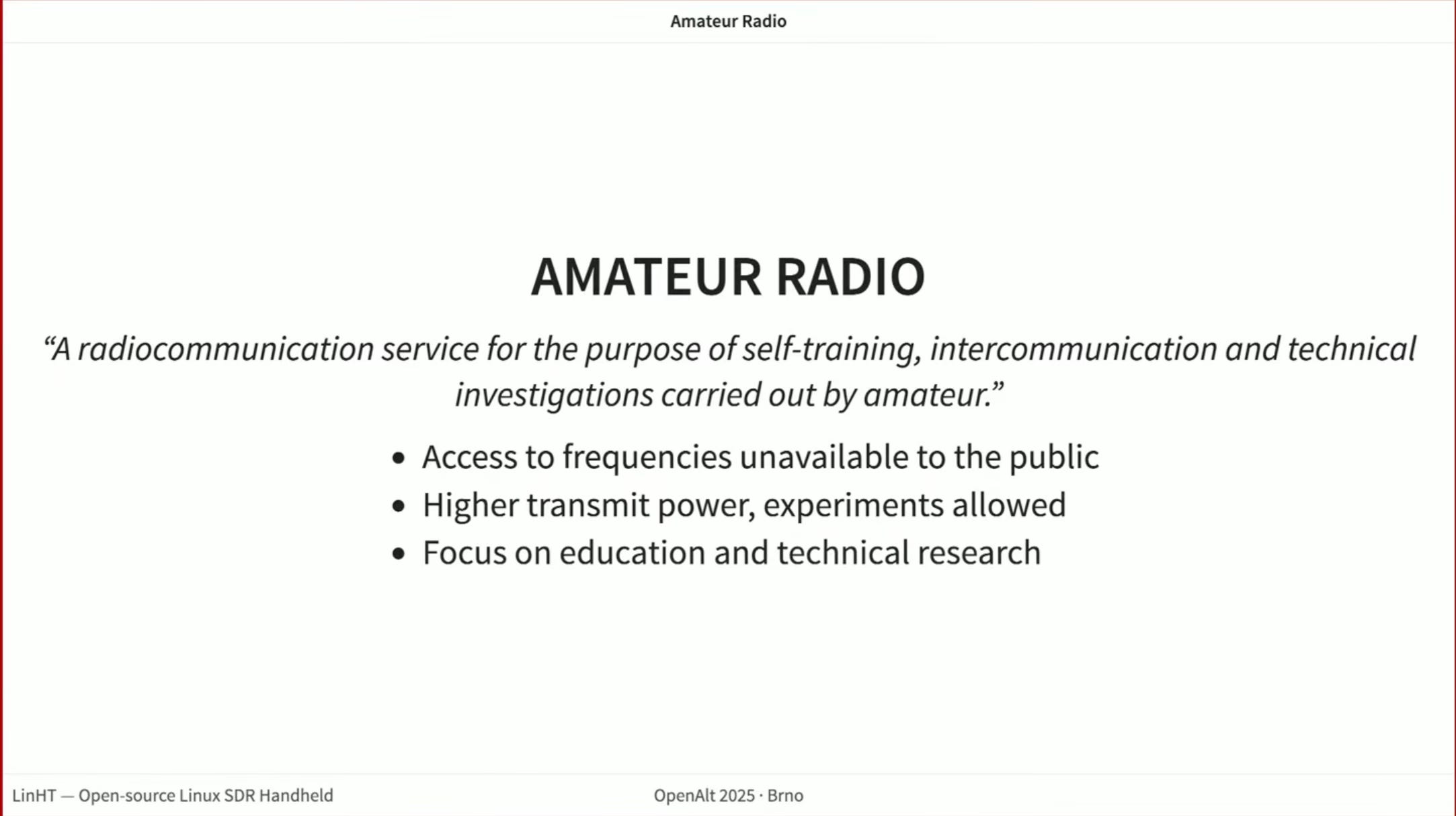
The above is a screen capture of one of the slides by OK5VAS.
Here’s a (text) version for easier searching and copy / paste:
AMATEUR RADIO
“A radiocommunication service for the purpose of self-training, intercommunication and technical investigations carried out by amateur.”
Access to frequencies unavailable to the public
Higher transmit power, experiments allowed
Focus on education and technical research
Vlastimil Slinták OK5VAS at OpenAlt 2025
That… is a fantastically wise… and wonderfully distilled explanation of Amateur Radio of the 21st Century.
First use of NewTechHams in Zero Retries
Editorial about ARRL
https://www.zeroretries.org/i/150024163/arrls-dismissive-arrogance-re-technician-class-amateur-radio-operators
Discovered this community of new Amateur Radio Operators in writing Zero Retries
Generally younger and involved in tech such as IT, software development, hackers makers, EE students. Example - DEF Con and GRCon attendees.
Not recognized by mainstream Amateur Radio because
They don’t “advance” to General
They don’t participate in conventional Amateur Radio - DX, HF, voice chatting
They don’t attend / join Amateur Radio clubs
They don’t join big orgs like ARRL (no value proposition for them)
Professional and Technical Backgrounds
• Tech-Centric Roots: They often come from backgrounds in software development, Information Technology (IT), networking, the space industry, open-source advocacy, and the Maker/Hacker communities.
• Internet Natives: They have grown up with ubiquitous Internet access and mobile broadband. They view the Internet not as a competitor to radio, but as a utility to be integrated with radio operations,.
• Software Proficiency: They are often comfortable with Linux and high-level programming languages. They prefer solving problems and innovating via software rather than hardware or soldering,.
Operational Preferences
• Data First, Voice Second: They generally prefer text-based and data communications over voice communications. They value the efficiency and record-keeping of text (similar to Slack, Signal, or Discord) and often do not enjoy “talking to strangers”,.
• Transactional Approach: Unlike hobbyists who view radio as a pastime, NewTechHams often approach Amateur Radio as a “transactional activity” with specific goals, such as learning a specific skill or building a specific network.
• VHF/UHF Focus: They tend to be more interested in VHF, UHF, and Microwave bands rather than High Frequency (HF) bands. This is often due to the lower cost of equipment and the constraints of living in apartments or areas where large HF antennas are not feasible,.
• Technician Class Oriented: They frequently hold Technician class licenses and may not feel compelled to upgrade to General or Extra class because they find sufficient challenge and utility in the spectrum available to Technicians,.
Technological Philosophy
• Open Source Mandate: They strongly prefer, and often require, open-source hardware and software. They actively dislike proprietary systems (such as the proprietary codecs used in D-Star and DMR) and look for GitHub repositories before getting involved in a project,.
• Software Defined Radio (SDR): They view the “state of the present” in radio as Software Defined Radio. Their mental model of a radio is “a computer with an antenna”,.
• Hackable and Affordable Hardware: They prefer hardware that is “software hackable” and inexpensive. They are comfortable using commodity hardware like Raspberry Pi computers and modifying off-the-shelf equipment (like the Quansheng UV-K5) rather than buying expensive, fixed-function appliances,.
Learning and Community
• Independent Learners: They prefer self-education through open resources like YouTube, Wikipedia, and the Digital Library of Amateur Radio & Communications (DLARC) rather than joining clubs for mentorship.
• Aversion to Paywalls: They generally ignore content hidden behind paywalls (like traditional Amateur Radio organization magazines) and rely on open media,.
• “Invisible” to Legacy Metrics: Because they may not join traditional clubs, participate in voice nets, or join the ARRL, they are often categorized as “inactive” by traditional Amateur Radio metrics, despite being actively engaged in building networks or experimenting,.
Motivations
• Infrastructure Independence: While they use the Internet daily, they are acutely sensitive to its fragility. They are motivated to build independent backup communications systems (like AREDN or Meshtastic) for times when the Internet or cellular networks fail,.
• Experimentation: They view an Amateur Radio license literally as a license to experiment with radio technology, often exploring areas like satellites, digital broadcasting, and mesh networking.