
The following is the Zero Retries perspective of this subject, primarily the knowledge and perspective of Steve Stroh N8GNJ.
Index:
Systems for “Advanced” Data Communications on Amateur Radio HF
Use Cases / Systems / Networks for Amateur Radio HF Data Communications
Introduction to this Zero Retries Guide
Amateur Radio data communications over HF has come a long way since Radio Teletype (RTTY) was developed in WW2 and 300 bps Audio Frequency Shift Keying (AFSK) AX.25 Packet Radio was developed in the 1980s.
“300 baud HF packet” was never a good, fast, or reliable system.
It only kind-of worked, some of the time.
It had poor ability to deal with the noise and other vagaries of the HF bands.
The only redeeming features of “300 baud HF packet” were:
1) It was better than RTTY for data communications,
2) It was the best we could do at one point (using TNCs),
3) As an open standard, it was included in every legacy Terminal Node Controller (TNC) after the TAPR TNC-1.
In the decade following the development of the TNC-2, “sound cards” in PCs began to be used instead of dedicated modems, and then in the 2000s built-for-purpose Amateur Radio audio interfaces were developed such as the Tigertronics SignaLink USB in the mid-2000s.
Data modes really became Zero Retries Interesting with the introduction of the groundbreaking Weak Signal Propagation Reporter (WSPR) mode in 2008. Although WSPR is not a data communications mode, it was a breakthrough in digital communications via radio, demonstrating reliable digital communications over HF bands even when using very low transmit power, such as < 1 watt.
The intent of this Zero Retries Guide is to highlight Amateur Radio HF data communications systems (software, hardware, systems, etc.) that can reliably provide at least 5 kbps and usually 10 kbps or faster on HF Amateur Radio bands using Amateur Radio equipment1 . Also highlight is systems that can make full use of the 2800 Hz bandwidth that can now be used on most US HF Amateur Radio bands.
Whither TNCs for Use on HF
The following information is intended for those considering doing data communications on Amateur Radio High Frequency (HF) bands, and don’t have the background to understand the differences in Amateur Radio catalogs between TNCs and “sound card” interfaces.
The primary use case for using a TNC for HF data communications is “I already have one” / “I’ve been using it for years” / “It works fine for me and what I want to do on HF”. Those are all fair points, and this information is probably not applicable for you.,
While there are many implementations / variations of “TNCs” (including some developed in the 21st century), there is no significant advantage to using a “TNC” where protocol functions are performed in a microcontroller in the TNC, such as implementing a “KISS” interface. The reason to prefer an audio interfaces versus a TNC is that for HF use, most “TNCs” implement legacy HF packet radio - 300 bps, or perhaps a bit faster.
Some TNCs for HF packet radio add Forward Error Correction for 300 bps AFSK packet for HF:
NinoTNC hardware TNC (implements IL2P FEC)2. An assembled and tested unit is available.
Dire Wolf software TNC (implements FX.25 and IL2P FEC).
An article by Billy Penley KN4NKB makes the case, in the 2020s for audio interfaces versus TNCs - The Hard Truth about Hardware TNCs in Packet Radio. KN4NKB also has an excellent YouTube channel - ModernHam.
Amateur Radio can now use advanced modulation techniques such as Orthogonal Frequency Division Multiplexing OFDM within the audio bandwidth of the transmission, and other techniques such as Forward Error Correction (FEC) to achieve reasonable data rates and reasonable reliability for data communications on HF.
In the US, HF Maximum Bandwidth is 2800 Hz
A significant improvement in HF data communications for US Amateur Radio took effect in 2024-01 - “symbol rates” were removed, and…
Maximum bandwidth of 2800 Hz for most HF bands
was implemented by the US FCC for US Amateur Radio Operations.
A bandwidth of 2800 Hz allows many modern data communications systems, that achieve reasonable speeds (10 kbps), to be used on the US Amateur Radio HF bands.
Use Audio Interfaces, Not TNCs
Terminology
From my Information Technology (IT) background, I reflexively want to label a device that translates analog audio signals to digital bits as a modem (modulator / demodulator).
But using the term “modem”, especially to someone with an IT background, implies a fixed function to use specific types of audio signals (that a modem is designed for) such as specific tones for specific speed tiers. That’s often not the case in Amateur Radio, where the “audio” won’t always be tones, and the actual processing of the analog audio is handled solely in software, and thus not fixed-function.
That said, a KISS TNC does meet the definition of a modem - it’s expecting (designed for) specific audio tones. The original TNCs, for example, the TAPR TNC-2 modem subsystem was implemented in hardware - a modem IC, lots of signal conditioning circuitry, etc. I make the distinction KISS TNC as being a modem because the “KISS” function is only to “translate” the results of the modem subsystem and pass it along to a host computer, and vice versa.
Thus, for purposes of this topic - Amateur Radio HF Data Communications, the term “modem” is only used in reference to the TNC units listed in the section above Whither TNCs for Use on HF.
Better, more technically accurate terminology for the function of translating analog audio to digital bits is…
Audio Interface
Audio Interfaces used within Amateur Radio are sometimes referred to as “Sound Card” Interfaces or “Sound Card” modems. The term “Sound Card” is from the era when audio circuitry in a personal computer was an add-in card - a sound card.
Thus, the best implementation of “advanced” Amateur Radio HF Data Communications is to use an audio interface (USB connection, with no intelligence) between a computer and an HF radio:
Computer <—> USB Audio Interface <—> HF Radio
The audio interfaces listed below also include the ability for the computer to send a “hardwired” Push To Talk (PTT) control signal to the HF radio. (Using a “hardwired” PTT is strongly preferred, and more reliable and efficient, than the use of Voice Operated Transmit - VOX.)
Commercial Amateur Radio Audio Interfaces for HF
Some well-supported commercial audio interfaces for Amateur Radio HF data communications:
Some Modern HF Radios Have Integrated Audio Interfaces
Many modern HF radios feature an integrated audio interface, for example:
An integrated audio interface makes it very simple to set up and operate modern data modes on HF with just a USB cable between the computer and HF radio, with minimal configuration of audio levels, no custom audio cables, no RF energy getting into audio cables, etc.:
Computer <—> USB cable <—> HF Radio
Systems for “Advanced” Data Communications on Amateur Radio HF
The primary distinguishing characteristic for inclusion of “Advanced Data Communications” in this section is the incorporation of Forward Error Correction (FEC). This one factor makes data communications on noisy channels such as HF much more reliable.
Pactor 4
Data rates up to 10500 bps using 2400 Hz bandwidth.
Requires a proprietary (and expensive) hardware modem by SCS
Usable for network communications - just a bit pipe, no integrated applications.
VARA HF
Adaptive data rates - see chart; (bandwidth unspecified):
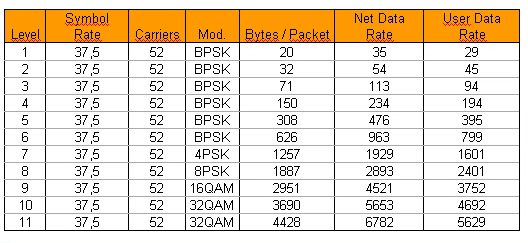
Proprietary, Windows only, requires $75 license for full functionality
Download and information at https://varamodem.com3.
Usable for network communications - just a bit pipe, no integrated applications.
FreeDATA
Data rates up to 9800 bps using 1700 Hz bandwidth.
Open source project, uses the OFDM waveform technology developed for FreeDV Amateur Radio Digital Voice mode for HF, adapted to transport data instead of digital voice.
Download and information at https://freedata.app.
Usable for network communications, includes a messaging system.
Rhizomatica Mercury
Data rates up to 5735 bps (bandwidth unspecified).
Open source project (not specifically for use in Amateur Radio).
Download and information at https://github.com/Rhizomatica/mercury
Usable for network communications - just a bit pipe, no integrated applications.
As of 2026-05-07, Mercury has been officially released. See Zero Retries 0250 - Rhizomatica Releases Mercury, a Fully Open-source Modem for Digital on HF.
Amateur Radio Digital Open Protocol (ARDOP)
ARDOP was originally a project by Rick Muething KN6KB to develop a new, open source, higher speed data mode for HF use by Winlink. That (original) development work (and use of the ARDOP software developed) was largely abandoned as VARA HF was developed and subsequently widely adopted by WInlink HF users. Some usage of ARDOP has continued.
Development of ARDOP has continued in two “forks”:
ARDOPOFDM
Data rates up to 4600 bps (bandwidth unspecified).
Open source project (status unknown).
Download - https://www.cantab.net/users/john.wiseman/Downloads/Beta/.
Information - https://www.cantab.net/users/john.wiseman/Downloads/Beta/ARDOP1OFDM.txt
Usable for network communications - just a bit pipe, no integrated applications (I think that is the case.)
ardopcf
Data rates and bandwidth unspecified.
Open source project (still in development).
Download and information - https://github.com/pflarue/ardop/tree/master.
Usable for network communications - just a bit pipe, no integrated applications (I think that is the case.)
Hush
See article - Hush’s first release is FINALLY OUT!!!!:
The current speed levels are QRP(X), MFSK(X), and OFDM(X) - OFDM goes up to SL12 and can reach a Theoretical maximum of *100 kbps* on HF (2700 Hz bandwidth)
Download and information -https://github.com/kc1wzq/Hush
NinoTNC HF Modes
See NinoTNC N9600A Operation for details.
300 AFSK - IL2Pc - 1600/1800 Hz tone FSK. Filtered for 500 Hz occupied bandwidth
300 BPSK - IL2Pc - Phase modulation of 1500 Hz tone. 300 symbols/sec. filtered for 500 Hz occupied bandwidth
600 QPSK - IL2Pc - Phase modulation of 1500 Hz tone. 300 symbols/sec. filtered for 500 Hz occupied bandwidth
1200 BPSK - IL2Pc - Phase modulation of 1500 Hz tone. 1200 symbols/sec. 2400 Hz OBW.
2400 QPSK - IL2Pc - Phase modulation of 1500 Hz tone. 1200 symbols/sec. 2400 Hz OBW.
JS8Call - Weak Signal Chat
See js8call.com for details.
Features:
Weak signal communication down to -24dB SNR
Keyboard-to-keyboard messaging and QSOs
Store and forward messaging via relays
Automatic station spotting via APRS-IS
Heartbeat and CQ monitoring
Multi-speed modes: Slow, Normal, Fast, Turbo
Cross-platform: Windows, macOS, Linux
Free and open source (GPLv3)
Use Cases / Systems / Networks for Amateur Radio HF Data Communications
Below are some examples of making use of Advanced Amateur Radio HF Data Communications using the higher speeds and higher reliability now available.
VarAC
VarAC is tightly4 coupled to VARA HF, enabling reliable and fast exchange of email messages, file transfers, one-to-many bulletins, and realtime chat, and numerous other features.
SafecomLink Hamradio Edition
SafecomLink is the commercial version of VarAC. The primary differentiation for Amateur Radio to use SafecomLink Hamradio Edition versus VarAC is that SafecomLink can use PACTOR modems in addition to VARA HF.
The Packet Radio RF Forwarding Network
Unlike legacy packet radio BBS forwarding networks, TPRFN makes excellent higher speed and higher reliability data transfers now available on HF data communications:
The Packet Radio Forwarding Network, is a specialized network that connects existing VHF/UHF packet radio systems and standalone nodes using High Frequency (HF) bands and modern digital modes like VARA HF, prioritizing Near Vertical Incidence Skywave (NVIS) links for reliable, RF-only communication without relying on internet (AXIP) connections. It aims to provide a resilient and independent digital communication infrastructure, particularly useful in emergency situations where traditional networks may be unavailable, and supports various packet radio functionalities like store-and-forward messaging, digital data transmission, and error correction.
VARAtrack - APRS over HF (using VARA HF)
A VARA-based APRS Tracker Inspired By The Byonics “TinyTrack”
The VARA soundcard “soft-modem” has been shown to be orders-magnitude superior to traditional 300-baud AX.25 packet radio on HF for transmitting APRS position reports and data.
Traditional packet requires a fairly strong signal to be received reliably on HF because it incorporates NO forward error connection (FEC). FEC is data added to a packet that allows a corrupted packet to, in many cases, be repaired at the receiving end without retransmitting it.
APRS makes the problem even worse. It exclusively uses the unconnected packet protocol known as “UI” (Unconnected Information) frames. This is one-way one-to-many “broadcasting” to anyone and everyone within range. There is no two-way handshaking with other stations. There is no mechanism for negative acks and requests-for-retransmission from receiving stations that classic “connected” packet uses.
Without either FEC or ACK/NAK, the receive success rate for packets is rather poor. All the receive station can do is reject the damaged packet and wait until the sending station decides to beacon again minutes later.
The VARA modem wraps transmitted data in multiple levels of FEC, and uses powerful digital signal processing on received audio signals. The signal processing “horse-power” in current consumer PCs would have been unthinkable even just 10 or 15 years ago. VARA can produce reliable copy on signals so weak, you literally can not hear them in the radio speaker. (VARA has weak-signal capability similar to FT-8.)
Conclusion
With new systems available in the 2020s, Amateur Radio data communications on HF now achieve reasonable speed5, and reasonably reliability. Network connections and file exchanges can be conducted on regular schedules and with reasonable expectation of those exchanges occurring regularly, despite the vagaries of the HF radio communications.
Potential Additional Topics
Low Speed HF Data Modes Intended for Text Chatting
There are many… many… text chat applications that may be worth listing in this Guide.
SCAMP (ORI)
Low Power HF Operation
Newer HF data (and digital voice) communications technology enables low power (“QRP”) HF radio communications to be more reliable and consistent.
New Types of HF Antennas
Use of Near Vertical Incidence Skywave (NVIS) antennas to achieve more reliable regional communications via HF in conjunction with better HF data communications technology.
Use of Magnetic Loop antennas to be able to use HF without outdoor antennas in conjunction with better HF data communications technology.
Remote HF Station Operation
Use a physically remote HF station when it’s not feasible to have colocated operating position, radio, and antenna(s).
Software Defined HF Radios
Discuss various HF Radios that are “user defined” Software Defined Radios that can use new types of radio waveforms in addition to new types of data communications modulating the audio bandwidth of an HF radio.
Discuss various GNU Radio flowgraphs relating to HF Amateur Radio that provide a “head start” to using GNU Radio technology for Amateur Radio Data Communications.
See Also - Related Zero Retries Guides
(To be added as additional Zero Retries Guides are developed.)
Zero Retries Guide to Rhizomatica Mercury Modem
Zero Retries Guide to VARA HF
(To be added as additional materials such as YouTube videos are identified.)
Feedback Requested
Readers of this page, please advise if there are other “advanced” data communications systems for Amateur Radio HF data communications that are not listed above.
Please email editor@zeroretries.net with any feedback or comments.
To discuss this Zero Retries Guide on the Zero Retries email list, click here.
This page last updated 2026-04-20
HF data communications units intended (priced, availability) for commercial / government / military and non-Amateur Radio spectrum are out of scope for this page.
Reference https://tarpn.net/t/nino-tnc/n9600a/n9600a_operation.html and the section Latest SSB and FM modes - Improved Layer 2 Protocol with supplemental CRC. These are intended to work on SSB sideband channels or with Mic/Speaker connections on FM transceivers.
Updated 2026-05-07. Former info (bold is changed info):
Proprietary, Windows only, requires $69 license for full functionality.
Download and information at rosmodem.wordpress.com.
VarAC isn’t necessarily exclusively coupled only to VARA HF. VarAC has an Application Programming Interface (API) to allow its functionality to be extended by other applications. It’s also possible that VarAC would eventually support other data systems such as Rhizomatica Mercury.
Reasonable speed… when the available bandwidth of 2800 Hz maximum is taken into account.