2026-01-16 — Transition to Ghost (almost!), What’s New at DLARC 2026-01, Amateur Radio Standards Organization?, NA6D OpenTNC, AREDN 4.26.1.0, DTMF as a Data Protocol, AI6YM New Prods, HydraSDR Update
Zero Retries is an independent newsletter promoting technological innovation in and adjacent to Amateur Radio, and Amateur Radio as (literally) a license to experiment with and learn about radio technology. Radios are computers - with antennas! Now in its fifth year of publication, with 3400+ subscribers.
My thanks to Prefers to Remain Anonymous 19 for renewing as Founding Member Subscriber 0009 to Zero Retries this past week (3rd year)!
My thanks to Prefers to Remain Anonymous 116 for becoming newFounding Member Subscriber 0023 to Zero Retries in the past two weeks!
Founding Member Subscribers are listed in every issue of Zero Retries!
My thanks to Gerry Brown KK7GAB for renewing as an Annual Paid Subscriber (3rd year!) to Zero Retries in the past two weeks!
My thanks to Prefers to Remain Anonymous 62 for renewing as an Annual Paid Subscriber to Zero Retries in the past two weeks!
My thanks to Prefers to Remain Anonymous 115 for upgrading from a free subscriber to Zero Retries to an Annual Paid Subscriber in the past two weeks!
My thanks to Prefers to Remain Anonymous 117 for upgrading from a free subscriber to Zero Retries to an Annual Paid Subscriber in the past two weeks!
My thanks to Prefers to Remain Anonymous 118 for upgrading from a free subscriber to Zero Retries to an Annual Paid Subscriber this past week!
My thanks to Bill Kreutinger KM6SLF for two years of being a Paid Subscriber to Zero Retries in the past two weeks!
My thanks to Prefers To Remain Anonymous 113 for one year of being a Paid Subscriber to Zero Retries in the past two weeks!
My thanks to Prefers To Remain Anonymous 38 for restarting their Paid Subscriber subscription this past week!
Financial support from Zero Retries readers is a significant vote of support for the continued publication of Zero Retries.
I remain deeply grateful, and humbled, to the Zero Retries paid subscribers. To date, they don’t receive much “extra” for their paid subscriptions. Finally in 2026 there will be some significant benefits for paid subscribers, but more about that in the next few months. In the next few months, paid subscribers will be in flux in the transition from Substack to Ghost publication platforms (see below). I haven’t yet turned off paid subscriptions in Substack, but will do so after the transition to Ghost is complete. Paid subscribers on Substack will receive full “credit” for their paid subscriptions. I’ll go into (probably excruciating) administrivia detail about the transition to paid subscriptions on Ghost directly with the paid subscribers. Platform conversions are hard!
Leaving Substack
Post Publication Update - If you’re reading this after 2026-04-03, the conversion to Ghost / www.zeroretries.radio didn’t work out and Zero Retries is again being published on Substack / www.zeroretries.org. Thus the info in this section is retained solely for historical reference.
The primary reason I decided to migrate Zero Retries off Substack as a publishing platform is that Substack has some significant “structural” issues that I don’t want to be even a passive participant of. This isn’t a new issue and I had hoped to transition off Substack at several points in 2025, but other projects / issues like ZRDC 2025 took precedence. Many readers have told me that they love the Zero Retries content, but, on principle, won’t subscribe to Zero Retries as long it’s published on Substack - which I understand.
Another issue with Substack is that its business model is based around it becoming an ecosystem, not just a publishing tool for independent writers. One illustration of this focus is that Substack newsletters are often referred to as “substacks” rather than email newsletters. Increasingly, use of the Substack app is required for certain functions. Substack has expanded its platform to encompass publishing video, podcasts, short blurbs, an app-based messaging system, and many other “enhancements” that, for me, just get in the way of trying to publish an email (primary) newsletter that is also is accessible on the web as a blog (RSS). One irritating issue is that I can manage email subscribers to some extent... but I cannot do anything to manage “followers on Substack”, and I especially cannot turn off having “followers”.
My last issue with Substack is that its editorial focus is to support, amplify, and cross-fertilize topics that are generally popular culture, politics, sports, and business. In contrast, the content of Zero Retries is a niche (technical aspects...) of a niche (data communications, microwave, space, regulatory issues...) of a niche (Amateur Radio) and thus just doesn’t really fit as a topic that Substack supports well.
All that said, there is a lot to love about Substack. A new writer like me with a wild idea for an email newsletter could get started for no cost. Substack “carried” Zero Retries at their expense, and no expense to me, for the first two years. After that, with (optional) paid subscribers, Substack began making a bit of revenue from Zero Retries, which given all that Substack does (that I didn’t have to worry about, like email subscription issues) I think Substack’s “cut” of the revenue from Zero Retries paid subscribers is entirely reasonable. I am grateful to Substack for helping get Zero Retries started. But now it’s time to move on beyond Substack.
Welcome to Ghost
I hope... expect, that the experience with Ghost will be vastly simplified - write, publish, repeat.
But the learning curve is already significant. I reflexively want to return to Substack because after years of use, I understand allmost of the mechanics of writing and publishing there and writing in Substack’s editor is muscle memory. I’m confident that all the capabilities that I used and valued in Substack can be done here in Ghost... it’s just going to take some time to figure it out. I’m going to have to resist the temptation to “fall back” to Substack.
For example, Ghost’s (web-based) editor is driving me nuts in these first few hours of composing this first issue on Ghost as I don’t understand some of the paradigms to be able to do basic formatting of text, that had become muscle memory in Substack.
But one of the significant differences between writing in Substack’s editor and writing in Ghost’s editor is that the latter supports the use of Markdown syntax so (assuming you know Markdown) the graphical user interface of the Ghost editor doesn’t need to be so full featured. Now to try to develop “Markdown muscle memory”.
One issue that will make it easier to transition Zero Retries to Ghost is my choice to use a new domain name:
For the immediate future, all the old Zero Retries content, published prior to 2026, and for the moment, the static pages such as the Zero Retries Guides, will remain on Substack at https://www.zeroretries.org. As soon as feasible, I’ll migrate that content here to Ghost.
Update - Not… quite… so… fast! I was forcing myself to write in Ghost, despite the learning curve handicaps. But I quickly realized that I made a fundamental mistake in setting up Zero Retries on Ghost, and there was no (apparent) way to correct that mistake, and no apparent way to delete my Ghost account and completely start over. So I had to throw myself on the mercies of Ghost support to fix that mistake… and wait for a response. Assuming I may not get an answer for a couple of days, I reluctantly restarted writing this issue of Zero Retries in Substack. And since I ran into that fundamental mistake, I didn’t redirect https://zeroretries.radio to my account on Ghost - it remains redirected to https://www.zeroretries.org.
Update to the update - Ghost support came through with a fix to my issue, but enough time had elapsed that I won’t have time to even attempt an import of email subscriber addresses into Ghost, so this issue will go out via Substack. But next week should be “all Ghost”.
Platform conversions are hard!
Zero Retries Archive Now On Digital Library of Amateur Radio & Communications
An independent newsletter about technological innovation in Amateur Radio, promoting Amateur Radio as (literally) a license to experiment with and learn about radio technology. Published by Steve Stroh N8GNJ. The official web site is https://zeroretries.radio
Followup by Kay Savetz K6KJN, Program Manager, Special Collections, Internet Archive, Digital Library of Amateur Radio & Communications, and Zero Retries Pseudostaffer, and great friend of Zero Retries:
Use the search “text contents” field to do a full-text search, or click “Date Published”.
Thanks for being a part of the DLARC archive.
Kay is thanking me for Zero Retries being included in DLARC?!?!?!
It’s actually the reverse - I thank Kay for including Zero Retries with other amazing content in DLARC such as 73 Magazine, Packet Radio Magazine, all the amazing content of TAPR over multiple decades, the Digital Communications Conferences, etc.
It’s humbling to think that the content of Zero Retries will now be preserved for posterity by Internet Archive - as long as IA survives, Zero Retries will survive.
What made this feasible and reasonably efficient is that I finally discovered the not very obvious method to export all the issues of Zero Retries from Substack into individual files. This had been a long term task at Kay’s urging (you… don’t back up every issue???)
But even with the “magic export” discovered, there was still considerable massaging that needed to be done on the exported files, such as consistent naming (despite my use of logical, sequential naming for each issue). Kay and I divided and conquered the tasks - I got all the file names consistent over the course of a couple of hours of otherwise passive video viewing, and Kay applied their scripting ninja skills at adding some metadata to each file (the exported file didn’t include the title of the file in the file).
Anyway… we got it all done, and now Zero Retries issues, 0000 through 0233 dated 2025-12-31 is accessible as easy to download PDF files. The DLARC archives of Zero Retries isn’t quite as “sexy looking” (no Substack formatting), but one primary irritation of Kay (and others) is fixed, that the links in each issue aren’t obfuscated into Substack links that were used to monitor clickthroughs.
It’s a bit embarrassing to have forgotten, and now admit how much time had passed since the last episode of Store and Forward, a podcast about the past and future of ham radio where Kay Savetz K6KJN discusses Digital Library of Amateur Radio & Communications and I discuss Zero Retries.
Thus we had a bit of catching up to do on the latter half of 2025, and our very near term plans for 2026.
Store & Forward is a labor of love for both of us, and it serves as a useful benchmark for our respective projects in a relaxed, conversational format.
NotebookLM Success
A second motivation to convert the Zero Retries archives into PDF format was that Google NotebookLM only accepts certain formats, and one of them is PDF, so getting Zero Retries archives into PDFs is a win / win - DLARC and NotebookLM. With Zero Retries spanning 4.5 years now, and more than a couple hundred separate issues… I’m at the point of sometimes forgetting “did I write about x in Zero Retries“?
As with all sophisticated software tools these days (see above), NotebookLM has irritating, unintuitive limitations and a learning curve… but unlike all AI chatbots I’ve used to date, NotebookLM works. To date, I’ve mostly used it superficially, but as a test, I asked it to generate an article on a topic I’ve written about extensively in Zero Retries… and it did a very decent job. Most impressively, as advertised, the output stayed bounded by the input material - Zero Retries. NotebookLM didn’t invent anything and did a very reasonable synthesis of the total of my writing on the subject - even some aspects I’d forgotten I wrote.
My original use for NotebookLM also works - it’s pulling up references to specific subjects that I do remember that I’ve written about, but didn’t remember when or what issue, though I did one query that NotebookLM wasn’t able to find, and I had to find manually and “instruct” NotebookLM. So, not perfect yet.
have received extensive updates. Updates for the former two were largely based on input from participants on the Zero Retries email list. Wisdom of crowds - thanks folks!
On the Events page, I’ve noted the events that I and Tina hope to attend. The first major event we’ll attend in 2026 will be HamSCI 2026 on 2026-03-14 and 15 in New Britain, Connecticut, USA. I look forward to chatting with Zero Retries Interesting folks at HamSCI 2026.
As I’ve mentioned, developing new Zero Retries Guides is a virtuous cycle - NotebookLM can help pull together previous material, each one serves as a standalone reference to a particular subject, and they are most of the content of chapters in the book. Much more to come in 2026.
Weekends Are For Amateur Radio!
Bellingham (and this corner of North America in general) is experiencing waves of… sunshine… for a four day weekend. That’s a nice bonus for this weekend, and I’ll be spending time in N8GNJ / Zero Retries Labs.
One nagging task in N8GNJ / Zero Retries Labs that’s now complete is the 30 foot antenna pole for my primary VHF / UHF antenna that was braced at approximately 13 foot proved not robust enough for the Wicked Whatcom Winter Winds and developed a permanent, severe bend. In every windstorm (frequent in the winter), it seemed that the antenna pole might fail and collapse. That antenna pole has now been replaced by a new, more modest, 20 foot antenna pole, that is now actually straight, and is now no longer annoying to look at.
Have a great weekend, all of you co-conspirators in Zero Retries Interesting Amateur Radio activities!
What’s New at Digital Library of Amateur Radio & Communications — January 2026
By Kay Savetz K6KJN Internet Archive’s Program Manager, Special Collections
I have two topics to share this month: first, some of the newest additions to the DLARC library. Then, some of the oldest items in the library have entered the public domain.
DLARC has scanned 66 issues of the Proceedings of the Institute of Radio Engineers. Adding those to the smattering of IRE Proceedings we had before, the new collection has 80 of these journals ranging from 1917 through 1962. The Institute of Radio Engineers was a professional organization that existed from 1912 until the end of 1962. In 1963, it merged with the American Institute of Electrical Engineers to form the Institute of Electrical and Electronics Engineers (IEEE).
We’ve added 40 issues of “Call Letter”, the newsletter of Northwest Vintage Radio Society. Based in my neighborhood of Portland Oregon, NWVRS is a nonprofit educational membership organization dedicated to the preservation and enjoyment of vintage radio and antique wireless equipment. Also: 19 issues of Arizona Antique Radio Club News, another fine newsletter from another fine not-for-profit vintage radio preservation group. (The IRE, Call Letter, and Arizona newsletters are the last of the material donated to DLARC by the wonderful Spark Museum of Electrical Invention.)
We’ve added 22 issues of an interesting newsletter devoted to medium/low-frequencies, published by Jim Ericson KG6EK. The first issue we have is number 45, where the newsletter is titled “1750 Meters: Western Update” with the wordy subtitle “The Western Newsletter for the Experimenter’s Band (160 to 190 KHZ)”. By issue 62, the newsletter’s name pivoted to simply “Western Update” but with a new equally wordy subtitle: “The Western Newsletter for MF, LF, and VLF Experimenters”. It’s filled with interesting ideas and anecdotes about low-frequency operation, such as Max Carter’s article “Some quirks of super slow” which discusses the problems of receiving a signal sent at one-tenth baud (10 seconds to transmit one symbol change)!
We have a smattering of issues published from May 1987 through November 1990. I’d love to fill in the gaps, so I’ve added this one to the ever-shifting DLARC Wantlist. I don’t know exactly when the newsletter began or ceased publication. If you have any insight or any issues, please let me know. (Thanks to California Historical Radio Society for these newsletters.)
Aaaaand we’ve added the complete archive of a little newsletter called Zero Retries! 256 issues of the independent newsletter about technological innovation in Amateur Radio, published by Steve Stroh N8GNJ. It took some serious finagling for Steve to get the text of the issues exported from Substack, and then for me to get them converted into readable PDF files, but it was worth the effort to create a complete, searchable archive of this newsletter in DLARC.
We’ve added documents from Quartzfest, the “ham radio, camping, learning and living event” hosted near Quartzsite, Arizona, annually since 1997. The archive includes conference schedules, newsletters, and other documentation of that event going back 10 years.
Also check out “Amateur Radio in Space: A Teacher’s Guide with Activities in Science, Mathematics, and Technology”, a 1998 educational guide to the Space Amateur Radio EXperiment (SAREX).
Public Domain Amateur Radio
Every January 1 in the United States is “public domain day”, when items of a certain age shed their copyrighted status and become, well, everyone’s. At the start of 2026, written works published in 1930 became public domain, including the characters Betty Boop, Blondie and Dagwood; the film All Quiet on the Western Front; and the musical compositions Georgia on My Mind and I Got Rhythm, among many other notable and not-so-notable works. Duke University’s Center for the Study of the Public Domain has a thorough rundown.
Relevant to radio, a number of items in the DLARC library also became PD. Some of the highlights:
The books Short Waves (”the first book devoted to high frequency currents as related to radio communication”) and The Radio Manual (”for radio engineers, inspectors, students, operators and radio fans”) and Radio and Its Future.
1930 issues of Hugo Gernsback’s Radio Craft magazine (chock full of great color art and advertisements that you can use!)
Television To-day and To-morrow by Moseley and Chapple — published just four years after TV was introduced. (”In 1926 television was demonstrated for the first time, and there seemed little reason why the apparatus should not come into public use without undue delay.”)
The book Education On the Air: First Yearbook of the Institute for Education by Radio by Josephine H. MacLatchy
I hope you enjoy the old stuff in the DLARC library as much as I enjoy adding new stuff to the DLARC library.
Digital Library of Amateur Radio & Communications is funded by a generous grant from Amateur Radio Digital Communications (ARDC) to create a free digital library for the radio community, researchers, educators, and students. If you have questions about the project or material to contribute, contact me at kay@archive.org.
In Zero Retries 0079 (2022-12-30), I imagined The Amateur Radio Standards Organization (ARSO):
The Amateur Radio Standards Organization (ARSO) was formed for a pragmatic reason. Amateur Radio Operators, and Amateur Radio organizations were free to create entirely new modes as long as those modes were publicly documented. Before ARSO was formed, documentation for Amateur Radio technologies were (mostly) in public, but sometimes hard to find. This caused some consternation in the mid-2020s when the FCC and US Department of Defense (DOD) accused a small group of Amateur Radio Operators in New Mexico of using encryption in Amateur Radio spectrum. The accused Amateur Radio Operators responded that they were just using an obscure modulation technique, but none of them could find where that obscure modulation technique was publicly documented. ARDC provided a grant to establish ARSO with a website and some contracted labor from various universities with strong radio technology curriculums. ARSO quickly became a clearinghouse for documentation of almost all Amateur Radio technologies. ARSO developed a simple identifier that could be transmitted with most digital modes, allowing very easy lookup of the technology used for every transmission.
One minor illustration of the utility of ARSO was the consolidation of TCP/IP port numbers for various functions for better commonality between various units and software. Another was acting as an intermediary for obtaining unique Media Access Control (MAC) addresses for Ethernet and Wi-Fi devices used in Amateur Radio so that Amateur Radio interoperated smoothly with non Amateur Radio systems. Prior to ARSO assuming this role, obtaining MAC addresses, and identifiers for new devices with USB ports, was cumbersome and expensive for small vendors such as Amateur Radio manufacturers.
The formation of ARSO solved another growing problem in Amateur Radio - authentication. As Amateur Radio became more popular, a few bad actors occasionally tried to “horn in on the fun” without having an Amateur Radio license. ARSO developed a reasonable, universal authentication and registration system for Amateur Radio Operators worldwide, allowing Amateur Radio Operators to use their authentication signature for all major Amateur Radio systems such as accessing AmGEO-200.
Universal authentication also helped solve a nagging issue in Amateur Radio - the historical ban on using encryption in Amateur Radio. There had always been corner cases such as emergency communications involving sensitive information where encryption was considered necessary. The combination of qualification via the US government’s Federal Emergency Management Agency (FEMA) and authentication was a workable compromise. Amateur Radio Operators that wanted to qualify to use encryption for emergency communications had to be licensed for at least two years, and submit to a background check / qualification process that wasn’t any more onerous than participation in the various US military auxiliary communications programs. Amateur Radio Operators that (attempted to) use encryption but didn’t go through the background check / qualification process were quickly identified, found, and “given a stern talking to”.
ARSO Conferences
In the early 2020s, there were a number of Amateur Radio conferences such as Digital Communications Conference (DCC), AMSAT Annual Meeting, and the various large events such as HAM Radio Friedrichshafen, Ham Fair, Hamvention, and Hamcation. ARSO decided that conferences were part of its mission, and decided to have more frequent and more accessible conferences. ARSO holds one-day “companion” conferences adjacent to the major Amateur Radio events for discussion of new technologies. The subject matter of the annual GNU Radio Conference (GRCon) so closely overlapped with Amateur Radio that ARSO considered GRCon just another Amateur Radio conference.
ARSO conferences received funding to be inclusive and comprehensive. All presentations at ARSO conferences were streamed live, video recorded, and edited for clarity. Post conference, all presentation videos were publicly available, audio was transcribed into text, and the presenter’s slide deck, or still photos of slides were excerpted from the video. This standardized approach to conferences began generating considerable “cross fertilization” especially between Amateur Radio Operators in different countries. The ARSO conference held in conjunction with Ham Fair was particularly popular as few US Amateur Radio Operators were conversive in Japanese to understand presentations made at Ham Fair.
ARSO conferences also revived the practice of putting out a Request for Student Papers (RFSP) for students to present their ideas at an ARSO conference. This was pioneered by Greg Jones WD5IVD at the 1996 DCC. Participation in the ARSO conferences generated even more interest in Amateur Radio among students.
I keep returning to the idea of ARSO, and the need for such an organization every time I read of a new Amateur Radio device that implements compatibility with another device, but not necessarily compatibility against a standard.
Examples include the OpenTNC implementing 9600 bps data and testing compatibility with Dire Wolf Software TNC, and now a new generation of APRS devices operating over LoRa?
I think “ARSO” is needed… but I have no idea how to create such an organization, and I’m wide open to ideas for doing so.
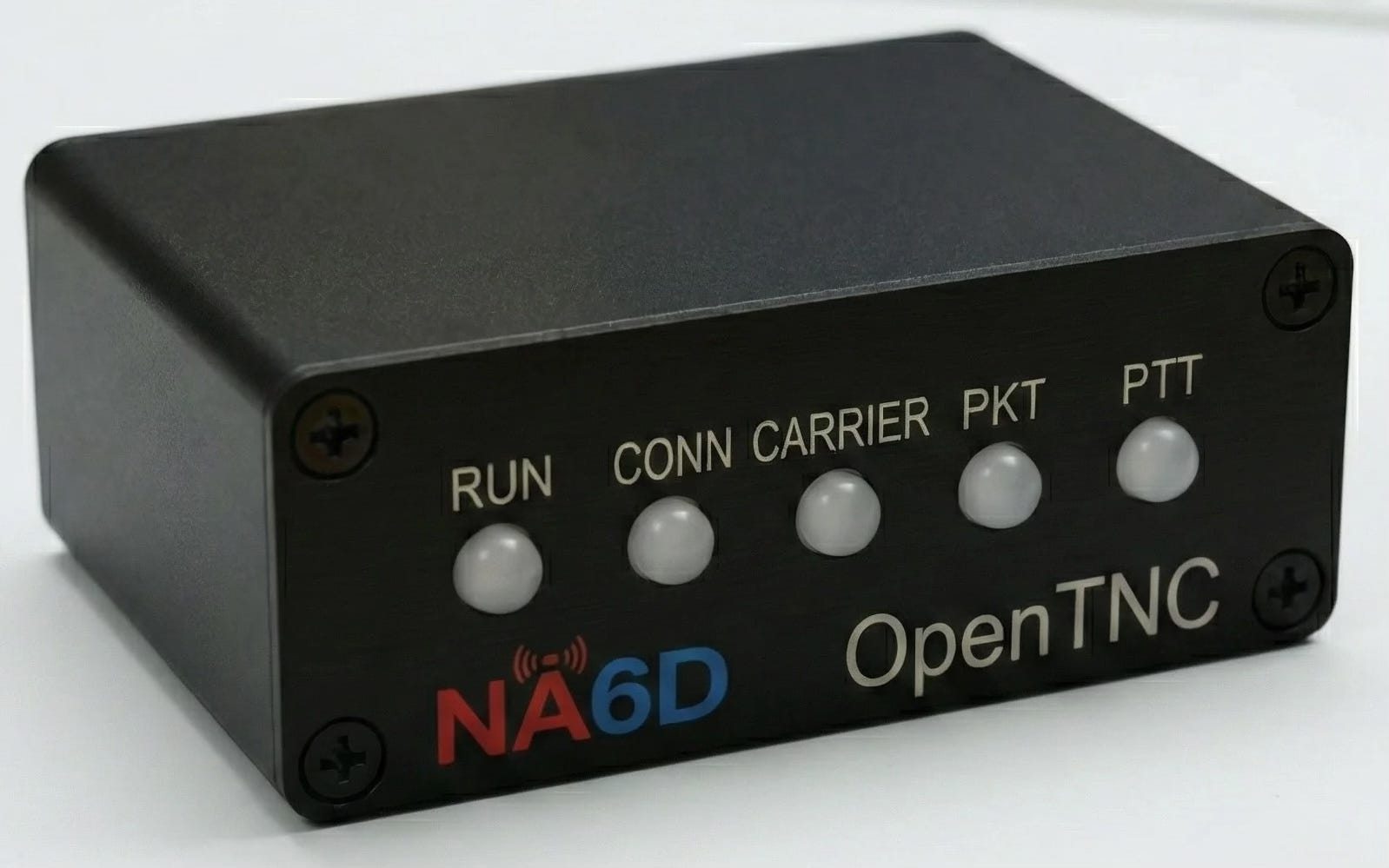
Upgrade your digital station to the modern era with the NA6D OpenTNC, the premium evolution of the open-source TNC.
We have taken the versatile architecture designed by David Platt (AE6EO) and refined it for the serious operator. While our original development kits were designed for tinkering, this new edition is designed for operating. We’ve shrunk the footprint, optimized the circuit, and encased it all in a rugged aluminum enclosure that belongs on your desk or in your go-kit.
Why the NA6D Edition?
The original OpenTNC is a fantastic platform, but we wanted to make it better for everyday use.
Rugged Aluminum Case: Say goodbye to exposed PCBs and 3D-printed plastics. Our custom aluminum enclosure provides superior durability and helps shield your sensitive RF equipment from digital noise.
Compact Footprint: We redesigned the PCB to be significantly smaller, making this the perfect TNC for go-kits, portable operations, or crowded shack desks.
Optimized Audio Path: We have refined the component values in the TX audio filtering stage (fixing the quirks found in the v0.8 beta designs) to ensure cleaner audio and broader compatibility with modern transceivers right out of the box.
Powerful Digital Modes
Just like the original, the NA6D OpenTNC is a powerhouse for AX.25 communications. Powered by the RP2040, it unlocks:
APRS: Track locations, send messages, and map local traffic.
Packet Chat: robust keyboard-to-keyboard QSOs.
BBS Access: Connect to local mailboxes and emergency networks.
KISS Mode: Full compatibility with modern software suites for advanced networking.
And more...
Since the OpenTNC is a traditional TNC, it does not support software TNC modes, like VaraFM.
Dimensions: Approximately 64mm x 40mm x 24mm [w x l x h]
Cables:
We’re still working on getting cable and initial production runs might not have custom cables. We’re working on offering cables for:
Mobile/Base radios with a mini-DIN 6 connector (common modern “data” connector)
HTs with the 2-Pin Kenwood connector
If you are interested in other connectivity, you can fill out the survey after signing up for notifications to let us know.
The above info is a bit vague on the specifics, but it looks like a straightforward refinement of the OpenTNC project as documented on Dave Platt AE6EO’s OpenTNC project on GitLab. Some things to admire about this implementation and OpenTNC in general:
Aluminum enclosure with blinkenlights - always cool,
NA6D makes nice hardware. The NA6D version of the All In One Controller (AIOC) is the nicest AIOC I’ve seen to date.
It seems likely that support for IL2C FEC might be implemented given that Dire Wolf Software TNC is a reference for packet radio compatibility with OpenTNC, Dire Wolf supports both FX.25 and IL2C, and Dire Wolf is open source.
The use of the RP2040 - generically one of the Raspberry Pi microcontrollers, is a smart choice in my opinion. Raspberry Pi makes an unusually strong commitment to education and support. Raspberry Pi also works hard to keep its products available over a long term, as well as backwards compatibility in never products as much as possible. Thus, in my opinion, for “hobby” projects such as Amateur Radio, where there are low production quantities involved, and significant interest in open source, if you’re using a microcontroller (or embedded computer) other than Raspberry Pi products, you’re working too hard.
My thanks to David “Zonker” Harris N6UOW for mentioning this development.
Disclosure - NA6D donated a number of AIOCs to the Zero Retries Digital Conference 2025 to be given away as raffle prizes.
New RPC Electronics Products Spotted
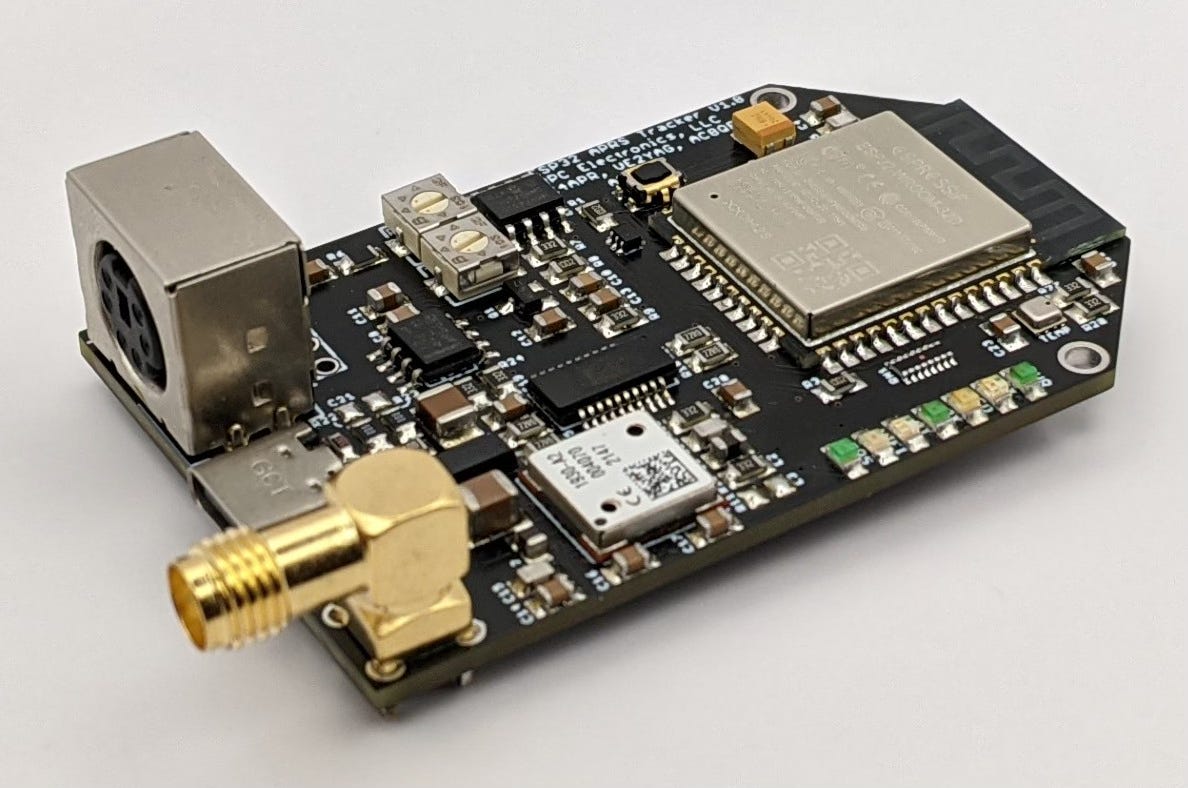
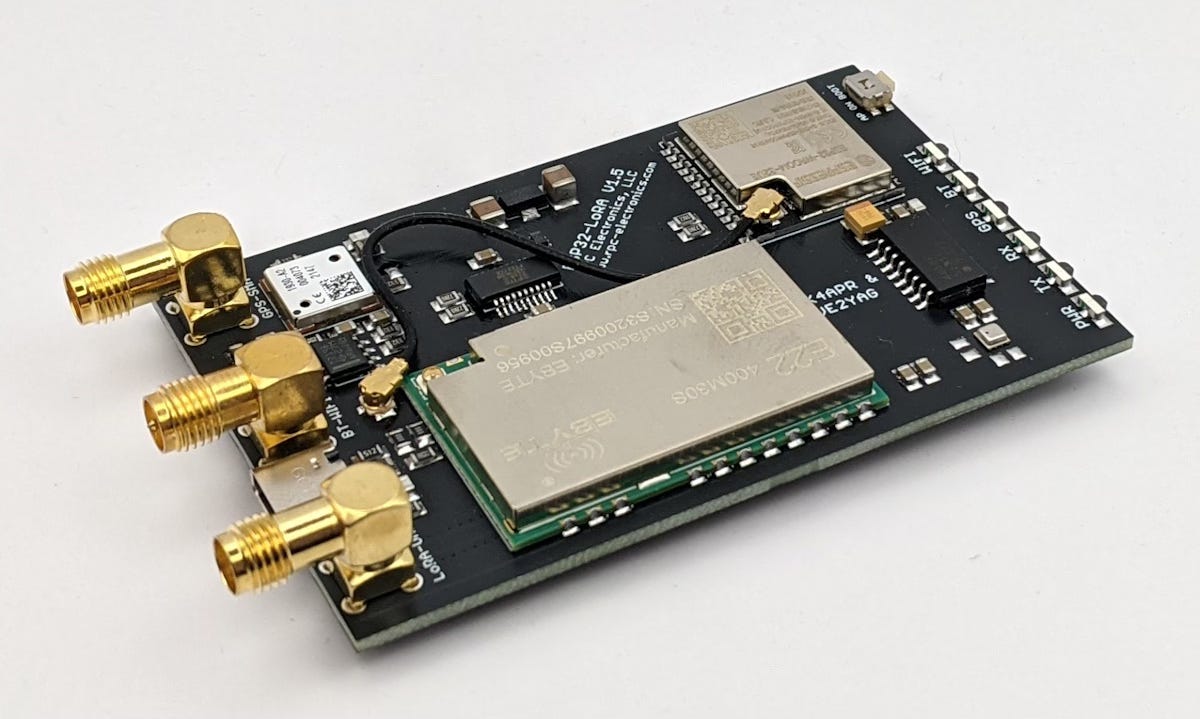
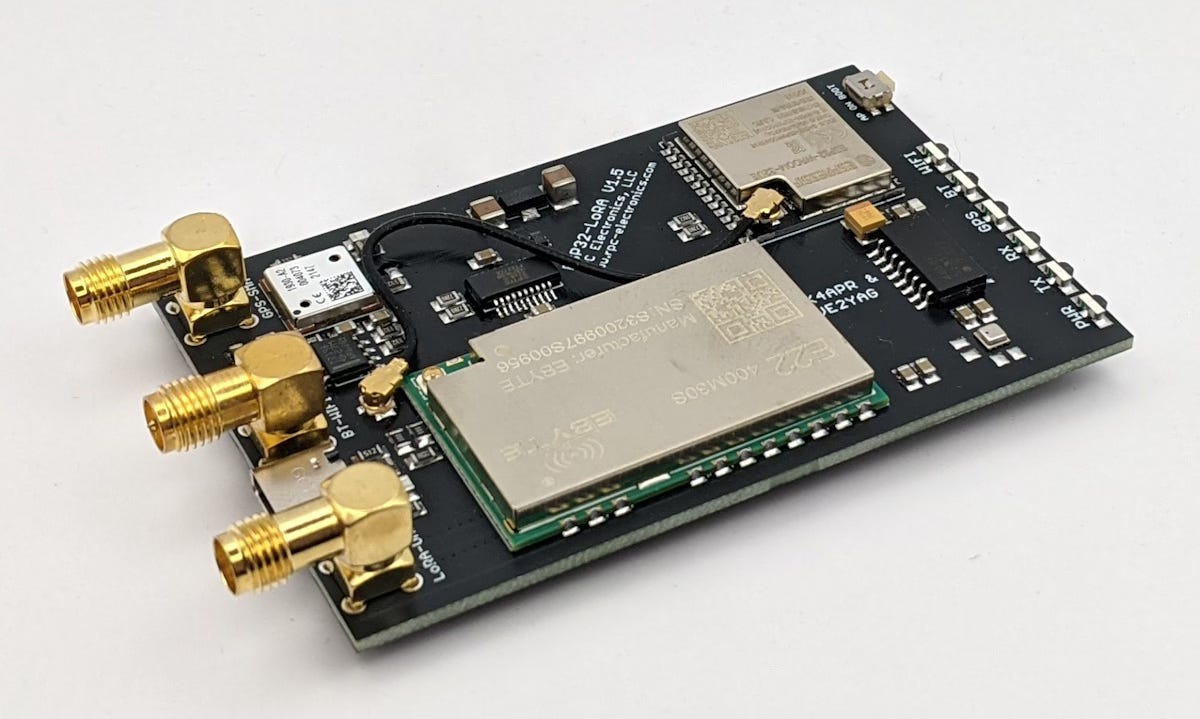
Jason Rausch K4APR makes lots of Zero Retries Interesting products. I’m a fan and owner of several SMT NinoTNCs. I was checking RPC Electronics for another story, and found mention of a number of interesting new (to me…) products:
The ESP32-APRS Tracker is an all new APRS Tracker meant for the 21st century. We started with the powerful ESP32 WROOM module and built the platform on its vast array of built-in peripherals. Adding a high quality, fast locking GPS, sensors and other devices, we have created a small form factor, feature rich APRS Tracker/Digipeater/iGate/Modem that will fit your APRS operating needs.
The ESP32-LoRA SAK is an all new APRS-LoRA device meant for the 21st century. We started with the powerful ESP32 WROOM module and built the platform on its vast array of built-in peripherals. Adding a high quality, fast locking GPS, sensors and other devices, we have created a small form factor, feature rich APRS-LoRA Tracker/Digipeater/iGate/Modem that will fit your APRS-LoRA operating needs. The best part...an on-board 1 Watt LoRA transceiver!
It’s just fascinating to see the technological innovation in Amateur Radio evolving. It’s encouraging to see experienced Amateur Radio hardware designers like K4APR with a deep background in APRS creating solid new products like these but using LoRa as a radio interface.
Kudos to K4APR for these new (and the upcoming) products!
AREDN production release 4.26.1.0 is now available
This release is the first AREDN production release that omits the legacy OLSR protocol, and consequently the first release with the major number 4. That may sound scary, but if all your local nodes are on 3.25.5.0 or greater, they already speak Babel. That means a migration to this production release should pretty much be a non-event for your network.
If you are upgrading to 4.26.1.0 from a babel nightly build, you may see the following message:
BEWARE: Downgrading firmware WILL result in a broken or incomplete node configuration. This can be safely ignored during this upgrade.
There is still some instability with HaLow devices due to immature support for these radios in current Linux kernels. This manifests as occasional device restarts.
HaLow devices may sometimes require power cycling after upgrading.
In my opinion, this release is a very significant improvement in functionality for AREDN. Sunsetting the Optimized Link State Routing (OLSR) mesh networking protocol that AREDN used to use, in favor of Babel mesh networking protocol, is a huge leap forward in reliability for AREDN networks that choose to use dynamic mesh networking. The unreliability and performance issues of dynamic mesh networking was a (often deserved) “knock” on AREDN networks, but converting from OLSR to Babel offers the best of all worlds - reliability, reasonable performance, and dynamic mesh networking.
In my opinion…
Support for some HaLow (802.11ah) 900 MHz radios
is also a very big improvement for AREDN. Perhaps even a new era for AREDN becoming more popular. Now small AREDN networks can be implemented that operate on the 902-928 MHz band can be implemented (and fully interoperable with AREDN networks on other bands) with the simple expedient of connecting AREDN radios via Ethernet to form a inter-band router. It’s on my “soon” list to purchase a pair or three Alfa Tube-AHM radios to start experimenting with AREDN on 902-928 MHz.
Kudos to the AREDN team for these developments, and the “courage” to deprecate OLSR from their production releases at the end of 2025.
…
44Net Connect Makes AREDN Tunnels Easy (and Free)
A separate project (but, in my opinion, shouldn’t be1…), relevant to AREDN is the production release of 44Net Connect. The tunnel capability in AREDN, being able to connect AREDN RF networks via Internet, was problematic because AREDN tunnel servers required the use of a static IPv4 address. That was sometimes costly, and even sometimes impossible with some Internet Service Providers (ISPs). Now, static IPv4 addresses for Amateur Radio use are very easy to implement thanks to 44Net Connect.
Doug Kingston KD7DK on the HamWAN PSDR email list:
(Excerpts follow - click the link for full details.)
West Tiger Mountain - The Boeing BEARS installed a full HamWAN cell site at the company’s facility on West Tiger Mt. HamWAN supported the project with technical assistance but the project was funded by the BEARS and a couple of other donors. The site is connected to the rest of PSDR via 2 10GHz links capable of 500Mbits, one to Ziply Fiber in Everett (our primary internet connection point) and the other link to Capitol Park, which is well connected in the Seattle area. HamWAN will operate the cell site and its already attracting clients, some of whom were previously on East Tiger. We thank the BEARS for making this possible.
…
New Monitoring System - We installed a new monitoring system based on Zabbix using the community edition of the commercial product. This has added a lot better visibility of HamWAN system health. We still have some customization we want to accomplish (some additional parameter collection, map updates, inventory export), before we retire Cacti, but it's already been a great help. If you want to help with this, please reach out to netops@.
…
RouterOS Fleet Upgrade - We upgraded all the HamWAN maintained devices to RouterOS 7.x. At this point we can recommend this upgrade to all PSDR/HamWAN users.
Documentation Refresh - Much of our online documentation has been updated and new documentation added. We also added a new client config generator to help make client configuration easier for users.
On the West Tiger Mountain item, note the use of (Amateur Radio band) 10 GHz links. This one of the first uses of Amateur Radio 10 GHz band networking, not just experimentation or use by satellite. A few factors came together to make this possible:
Technically capable Amateur Radio organizations - BEARS and HamWAN PSDR,
Use of 10 GHz links is an excellent implementation of the philosophy of Use It (our Amateur Radio bands) or Lose It. This is especially an imperative in the US as the current FCC is very actively engaged in reassigning spectrum allocations, especially above 1 GHz, to the cellular industry for exclusive use.
The HamWAN Puget Sound Data Ring (PSDR)2 is the excellent Amateur Radio microwave network (on 5 GHz) in Western Washington. Its coverage extends into British Columbia to the North, to nearly the Oregon border to the South. Unlike many Amateur Radio microwave networks, PSDRallows (encourages) individual user access, as well as supporting Internet connectivity for repeaters and other Amateur Radio infrastructure. The two biggest differences of HamWAN from AREDN is that HamWAN is an engineered (static) network (no mesh networking capability) and HamWAN uses Mikrotik technology for the linking and user access radios. All PSDR nodes feature at least two backbone connections to maintain reliability. Another point of admiration for HamWAN is that each node has standalone capabilities - DNS, routing, etc. and thus remains functional even if backbone connections go down.
Nothing beats having a real communications Service Monitor to test FM radios and repeaters for various functions, but they are incredibly expensive new, and even used ones (that are worth while) are commonly $2000.00 or more. There are inexpensive frequency modulated RF signal generators currently available that provide reasonable accuracy for testing receivers. These signal generators allow you to do basic sensitivity and simple audio tests including CTCSS tones. But, there are no manufacturers left making inexpensive test equipment for measuring FM deviation of transmitters. The Heathkit IM-4180, AEA DM-1, and MFJ-224 are long gone. I’ve owned all of these, and they are mediocre at best - even when they were brand new. The test equipment offered here is an attempt to provide a better solution than anything prior, with reasonable accuracy, on a hobbyists limited budget.
The FMDM-150M FM Deviation Meter provides direct / accurate measurement of Frequency Modulation from 0 to over 5kHz deviation with modulating frequencies from 50 Hz to over 4 kHz without the need of a computer, SDR, or spectrum analyzer or involving Bessel nulls or any complicated math. The system is comprised of several individual components that are available separately in kit form or assembled and tested and calibrated. The receiver is a current production Uniden “Bearcat” BC355N “police”scanner (chassis 367E) that is modified by adding a 3.5mm (1/8”) stereo jack to its rear panel to bring out discriminator audio and a squelch logic signal.
For as long as we’re going to be using FM transceivers for data communications, connecting external audio adapters, TNCs, modems, etc. to FM transceivers3, setting correct Deviation is a significant issue for optimum performance.
Thus the FMDM-150M is a notable accomplishment in the service of data communications (using FM radios) over Amateur Radio - kudos to Kevin Custer W3KKC of Masters Communications for creating this unit.
While setting “good enough” deviation “by ear” is usually possible4 for lower speed data modes like 1200 bps Audio Frequency Shift Keying, higher speed data modes suffer when deviation isn’t set correctly. I purchased an AEA DM-1 at a hamfest last year mostly because it was cheap. I remember its reputation at the time it was introduced was “better than nothing” and it was an appliance rather than a big, expensive, hard to use service monitor.
Thus this low cost system for determining accurate deviation with the interesting approach of using a Uniden BC335N scanner (with a minor modification) as the receiver system.
While individuals might not want to invest in this system to set up a few personal data radios, it would be an ideal investment for an Amateur Radio club interested in data communications, or just a group of friends who want to do data communications.
This unit would be useful for my intended setup of many radios in N8GNJ / Zero Retries “Interoperability Lab”… I probably should get one on order. (Update - done!)
Interesting Potential Data Mode - Using DTMF as a Data Protocol
I stumbled onto this presentation by Zhemin Zhang KD2TAI who presented an interesting premise - use the 12 (or 16 if you include the “A, B, C, D” keys in a 4th column) Dual Tone Multi Frequency - DTMF (much better known as “Touch Tone”) tones as encoding for a data communications system.
One primary advantage I can imagine is that DTMF is specifically designed to work within the audio spectrum of analog telephone circuits / human voice spectrum / and thus just about any FM (or digital voice?) radio. Thus “DTMF data” would be transmitted clearly with very simple audio connections to just about any radio.
Such a system would be a lot of fun to listen to - wonder how fast a data rate could be accomplished? (Hopefully there could be some form of at least minimal Forward Error Correction incorporated.)
This kind of thinking outside the box about data communications over radio taking advantage of “cheap compute power” reminds me of Ribbit / Rattlegram from a few years ago.
If you’ve recently searched for information about the LinHT radio, you’re not alone. LinHT has started appearing in amateur radio and software-defined radio (SDR) discussions, often described as an open-source, Linux-based, software-defined handheld radio.
That combination naturally raises questions – especially for hams who are newer to digital voice and are still getting comfortable with concepts like SDR, codecs, and experimental radio platforms.
This beginner guide explains what the LinHT actually is, why it’s generating interest, and how it fits into the broader ham radio landscape, without assuming prior SDR or Linux experience.
This is a good overall treatment of LinHT from the perspective of someone interested in Amateur Radio digital voice modes and is curious about where LinHT fits into the digital voice paradigm.
Steve, N8GNJ, publishes a newsletter called Zero Retries. Steve describes the newsletter as “an independent newsletter about technological innovation in Amateur Radio (sic), promoting Amateur Radio as (literally) a license to experiment with and learn about radio technology.” It’s a great newsletter, and I’d encourage you to subscribe.
Nice mention by Zero Retries Pseudostaffer KB6NU of this discussion on the Zero Retries email list. Lots of good ideas came out of this discussion, and I’ll be consolidating / synthesizing them in a near future issue.
KernWi‑Fi has partnered with Australian amateur radio enthusiasts to design and deploy an enterprise‑grade, secure IP network for Yaesu’s Internet‑linked Multi‑site Repeater System (IMRS) -bringing carrier‑class routing, segmentation and compliance practices to community radio infrastructure. The initiative is led by Managing Director Phil Kern (VK5PK), working closely with Chris Dimitrijevic (VK3FY), who first approached KernWi‑Fi to explore a robust digital framework for IMRS. Chris Dimitrijevic connected Phil Kern with Peter Clee (VK8ZZ), who helped shape the technical scope that underpins the rollout.
VK5PK : “Our goal was straightforward: deliver IMRS over an IP fabric that behaves like a carrier network—predictable routing, strong isolation, and security you can audit. If we treat community infrastructure with enterprise discipline, reliability follows.”
Interesting project to create repeatable, predictable, consistent, reliable infrastructure for repeater linking.
What I found most interesting about this project is the willingness of a telecommunications infrastructure vendor to get involved with an Amateur Radio repeater network, though KernWi-Fi Managing Director Phil Kern being VK5PK was a major factor.
Selling sunlight at night, making drugs in space, detecting weapons at a distance – and the latest in shortwave, in Experimental Radio News 14.
As always, ERN is a fascinating “read it right now” publication about radio technology developments I wouldn’t otherwise hear about. Literally the items mentioned in ERN are at the bleeding (experimental) edge of radio technology.
ERN has been at the forefront of tracking “High Frequency Trading” experimental radio communications on the HF bands. This issue includes:
Walking back waivers
The FCC is now issuing letters to HF experimental licensees emphasizing their obligations, including non-interference to incumbents. But the letters include a major change: They remove routine waivers of station identification.
The FCC has never explained the waivers. Some of these stations run hundreds of thousands of watts in multiple HF bands, yet did not have to identify themselves. The exemptions complicate the process of identifying interference sources.
Stations now must follow the ID rule, which requires voice or Morse identification without digital encoding or modulation.
“Failure to comply with any of the above will result in cancellation of station license,” the FCC said.
Yay! Minor win for the rest of us HF band users now that we can distinguish who is originating those weird transmissions.
Unapologetic Zero Retries plug for financial support of Experimental Radio News:
More info about ERN and the author on the About page.
As a beneficiary of financial reader support for Zero Retries, I can attest that reader’s financial support makes a difference to one’s motivation to continue to produce content without a primary motivation of revenue (not restricted to paid subscribers). In my occasional research relating to the FCC, I can attest that it takes significant research work, skill, and time investment to dig out original material that is very professionally presented in ERN. AK4AV is a skilled writer and editor with deep experience. Unlike Zero Retries, all of the material in ERN is unique and original content, with a very small audience who can appreciate it. As Zero Retries financial contributions are re-established on Ghost in the next few months, I’ll become a financial contributor to ERN.
APRS Over LoRa Articles on How APRS Works
Two interesting, detailed articles by Jon Adams N7UV on the How APRS Works website, sponsored by the APRS Foundation:
It’s great that “APRS” as represented by the APRS Foundation is now beginning to incorporate LoRa technology for APRS. This “embrace”5 of LoRa for APRS is long overdue.
(It’s easy to overlook new articles on the How APRS Works website / blog as older articles, rather than newer articles, appear at the top of the page. Thus you have to scroll all the way down, and click through Load more issues to see the newest articles. Or, you can subscribe with RSS.)
tl;dr - The T41, but smaller. Full specs will be published soon. The first units will be available at FDIM & Hamvention. Kits only $399 with fully assembled radios available too.
It’s no secret I love the T41. Fully open source, modular, all-band, all-mode transceiver with a 192kHz spectrum display? I love everything about that sentence.
There’s two things I don’t love.
The price tag. I sold my kits at a VERY low margin, the manufacturing costs on this thing are NUTS.
The “trunk portable” design. I just don’t have the option to operate HF at home. My rigs have to be portable.
So I’ve been quietly working on a smaller, lighter, and CHEAPER T41. It needed to keep the spectrum display, big screen, powerful processor, and of course the fantastic RF performance. I was willing to sacrifice a bit on modularity, supporting every band in one radio isn’t a strict requirement either.
…
PicoFox Update
tl;dr - PicoFox r3 shipping soon. It’s a big improvement over r2 thanks to great feedback from this community!
Manufacturing is done, I’m waiting on delivery of enclosures before final assembly can begin. Orders are open now with shipments expected by the end of January. Look for ads in QST and other publications - and let me know what you think of them (I have ZERO marketing experience).
…
FoxSniffer Announcement & Update
tl;dr - The FoxSniffer is a handheld RDF receiver that can determine the direction to a transmitter miles away or standing on top of it. Shipments expected to start March 1st. Full specs and pre-orders are open. ($50 off for a limited time!)
I had hoped to make this announcement a LONG time ago but it turns out that building a VHF/UHF receiver from scratch is sort of difficult.
My early design had a couple of flaws. LO leakage into the detector being the biggest issue. That was easy to fix but it was masking image rejection problems. Pushing the si5351 to UHF was also a bit more challenging. My first prototype worked well enough but unit to unit variance meant a good number of devices would not function up to 450MHz.
I met AI6YM briefly when we both had vendor tables in at Pacificon 2025 and was impressed by his products. I’m curious about the T41 Mini - that’s a compelling price point. I’m enthusiastic about the forthcoming PicoFox r3 and the FoxSniffer, and I’m sure that I’ll be investing in those two products. (Radio) “Fox Hunting” / Transmitter Hunting / Radio Direction Finding are Zero Retries Interesting activities that easily appeal to NewTechHams and those potentially interested in Amateur Radio as a physical aspect of Amateur Radio. Developing and maintaining such expertise is a useful capability to demonstrate knowledge of radio technology.
HydraSDR Update
I pinged Benjamin Vernoux of HydraSDR about the how the new (introduced in 2025) RFOne Software Defined Receiver was doing, and he provided this informative update. One differentiating feature of the RFOne is that it’s manufactured in the US, so no tariff / import / overseas manufacturing issues.
The launch has been going well and I’ve been pleased with the reception from the community so far, except in Europe where things have been a bit slower.
As with any new product, there’s always a learning curve as I gather feedback and continue to refine things, but overall I’m happy with where things stand.
RFAnalyzer – RF Analyzer is an Android app for real-time spectrum analysis using SDR hardware. It displays live FFT and waterfall plots of the radio frequency (RF) spectrum and supports demodulation, recording, and more, support HydraSDR RFOne (Since 6 Oct 2025)
kalibrate-hydrasdr - Kalibrate-HydraSDR - GSM-based frequency calibration tool for HydraSDR RFOne. Scans GSM base stations to measure and correct the internal TCXO frequency offset with precision PPM/PPB measurements.
This update will include significant enhancements to the DDC with more than 2x performance improvement, as well as optimized streaming with reduced overhead.
It’s cool that there’s explicit support for RFOne for use with SatNOGS!
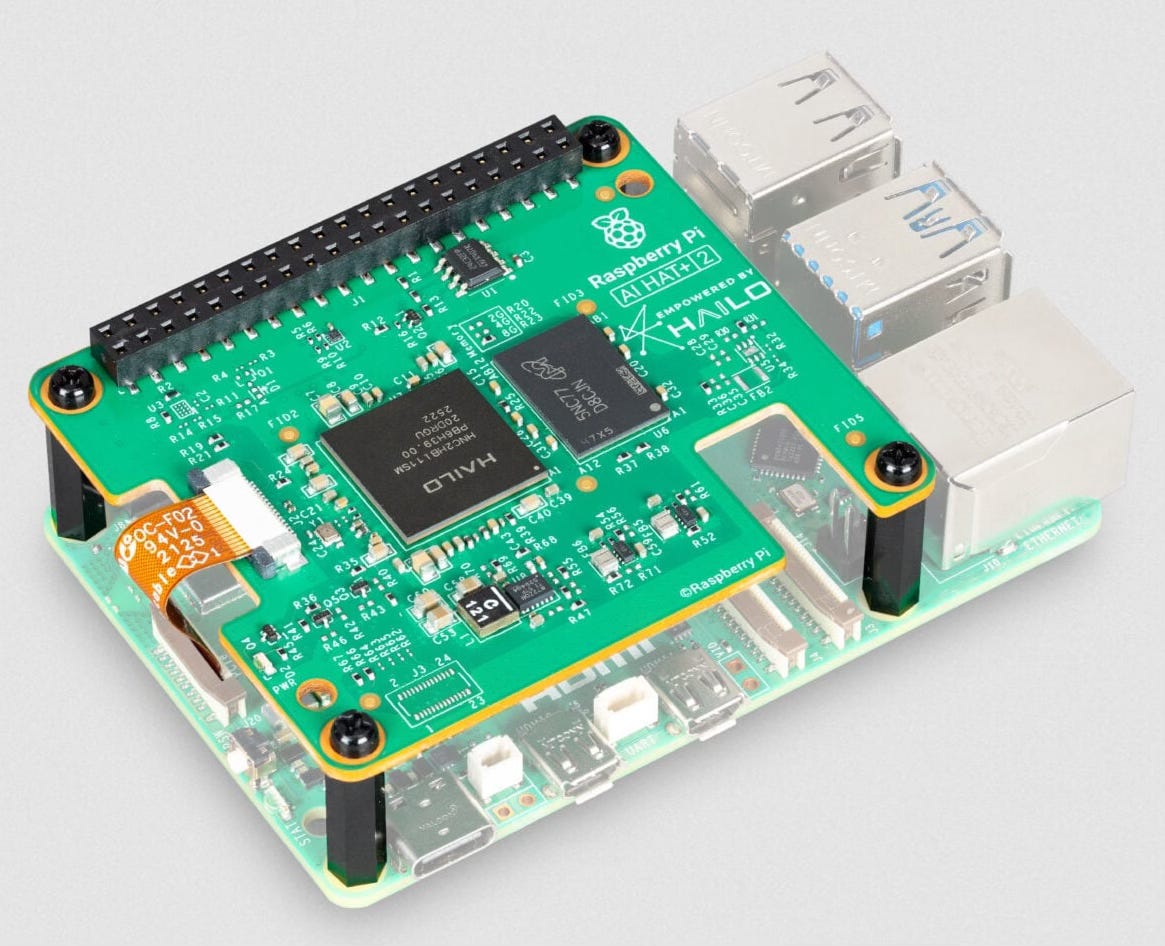
Featuring the new Hailo-10H neural network accelerator, the Raspberry Pi AI HAT+ 2 delivers 40 TOPS (INT4) of inferencing performance, ensuring generative AI workloads run smoothly on Raspberry Pi 5. Performing all AI processing locally and without a network connection, the AI HAT+ 2 operates reliably and with low latency, maintaining the privacy, security, and cost-efficiency of cloud-free AI computing that we introduced with the original AI HAT+.
Unlike its predecessor, the AI HAT+ 2 features 8GB of dedicated on-board RAM, enabling the accelerator to efficiently handle much larger models than previously possible. This, along with an updated hardware architecture, allows the Hailo-10H chip to accelerate large language models (LLMs), vision-language models (VLMs), and other generative AI applications.
Honestly, I can’t parse out very much of that other than it’s even more feasible now to run Artificial Intelligence and Machine Learning applications on a relatively inexpensive combination of a Raspberry Pi 5 and this new unit. It takes Amateur Radio a while to start taking advantage of capabilities like this, but I find hardware like this very attractive as a platform because:
It’s not a (physically big, power demanding) desktop computer,
It’s not running on a system in the cloud, requiring Internet access, an account on a “Mother, May I” application from a company that will change its policies next week,
It can run Machine Language applications locally, under your control, reliably.
Two such innovative Machine Language applications in Amateur Radio (that can be run on embedded / local hardware like this) I’m fond of citing are:
I imagine that I’m missing many others that I’m simply not aware of.
I’m looking forward to someone creating a Machine Learning application that incorporates all known Amateur Radio data communication modes, and gets turned loose on a radio receiver, and it just “figures it out”. We don’t have to tune individual channels on an HF receiver any more - ka9q-radio can “receive it all”. In 2026, we shouldn’t have to “select” a data mode that we’d like to receive - some application - “OmniData?” should just be able to “figure it out”.
Once upon a time, when I knew radio technology (hubris), a claim like
Track and transmit with confidence. Powered by space-grade coverage.
Unlock low-cost global transmission and visibility for any device with a Bluetooth® chip. No modems, no infrastructure, no custom hardware required.
… would trip my BS filter and I would disregard an idea as communicating (anything…) reliably from a radio device designed to communicate for only a few feet in an indoor setting… to a satellite in low earth orbit… as preposterous.
But virtually nothing related to radio is truly impossible these days if you can throw enough compute power, process gain, antenna gain, forward error correction, etc. at the problem. We’ve seen such “impossible” things as just a few milliwatts of transmit power being received on the far side of the planet using WSPR. Not to mention that LoRa was never designed to communicate with satellites, but it’s being used that way.
So I’m willing to be convinced. Hubble Network is based in the Seattle Washington area, and perhaps a coincidence, or perhaps not, that the Bluetooth Special Interest Group (SIG) is also based in the Seattle area. If things settle down and time permits 🤣, I’d like to talk to someone at Hubble to understand how Bluetooth can be used with satellites.
See the Zero Retries Boilerplate page for significant acknowledgements and other information relevant to Zero Retries. For new readers of Zero Retries, that page, and the About Zero Retries page has useful information to check out.
My ongoing Thanks to: Tina Stroh KD7WSF for, well, everything! Jack Stroh, Late Night Assistant Editor Emeritus Fiona and Shreky Stroh, Late Night Assistant Editors In Training Annual Founding Members who generously support Zero Retries financially: Founding Member 0000 - Steven Davidson K3FZT (Renewed 2025, 3rd year!) Founding Member 0001 - Randy Smith WU2S (Renewed 2025, 3rd year!) Founding Member 0002 - Chris Osburn KD7DVD (Renewed 2025, 3rd year!) Founding Member 0003 - Don Rotolo N2IRZ (Renewed 2025, 3rd year!) Founding Member 0004 - William Arcand W1WRA (Renewed 2025, 3rd year!) Founding Member 0005 - Ben Kuhn KU0HN (Renewed 2025, 3rd year!) Founding Member 0006 - Todd Willey KQ4FID (Renewed 2025, 3rd year!) Founding Member 0007 and 0010 - Merik Karman VK1DF / VK2MKZ (Renewed 2025 x2, 3rd year!) Founding Member 0008 - Prefers to Remain Anonymous 08 (Renewed 2025, 3rd year!) Founding Member 0009 - Prefers to Remain Anonymous 19 (Renewed 2025, 2nd year!) Founding Member 0011 - Rick Prelinger W6XBE (Renewed 2025, 2nd year!) Founding Member 0012 - Ryan Tolboom N2BP (Renewed 2025, 2nd year!) Founding Member 0013 - Newton White N4EWT (New 2025) Founding Member 0014 - Joe Hamelin W7COM (New 2025) Founding Member 0015 - Rich Stocking N7OP (New 2025) Founding Member 0016 - Prefers to Remain Anonymous 77 (New 2025) Founding Member 0017 - Phil Karn KA9Q (New 2025) Founding Member 0018 - Prefers to Remain Anonymous 95 (New 2025) Founding Member 0019 - Prefers to Remain Anonymous 0108 (New 2025) Founding Member 0020 - Prefers to Remain Anonymous 110 (New 2025) Founding Member 0021 - Prefers to Remain Anonymous 111 (New 2025) Founding Member 0022 - Prefers to Remain Anonymous 112 (New 2025) Founding Member 0023 - Prefers to Remain Anonymous 116 (New 2026)
Numerous Annual and Monthly subscribers who also generously support Zero Retries financially!
You thousands of readers of Zero Retries without which there would be little point in publishing this newsletter.
Permission for Reuse of Zero Retries Content
Blanket permission is granted for Amateur Radio use of any Steve Stroh content in Zero Retries for Amateur Radio newsletters and distribution via Amateur Radio such as (but not limited to) Packet Radio Networks, Packet Radio Bulletin Board Systems, Repeater Nets, etc. Specific blanket permission is granted to TAPR to use any Steve Stroh content in Zero Retries for the TAPR Packet Status Register (PSR) newsletter (I owe them from way back).
In such usage, please provide appropriate authorship credit for the content (especially for guest authors) and mention that it was first published in Zero Retries newsletter, preferably in this format:
This article is reprinted with permission. It was first published in Zero Retries newsletter, issue Zero Retries (number), (date) - (include full web link of the specific issue).
It’s appreciated (a courtesy, but not required) to notify Zero Retries Editor Steve Stroh N8GNJ of any reuse of Zero Retries content - editor@zeroretries.net.
If you’d like to republish an article in this issue for other uses, just ask.
All excerpts from other authors or organizations, including images, are intended to be fair use. Unless otherwise noted in the article, there are no paid promotional items in any Zero Retries articles.
It seems feasible and desirable, to me, to integrate basic 44Net Connect compatibility into AREDN. But it might be too complex, the code too big, configuration too fussy for that to be realistic. In my fantasy scenario, selecting a tunnel server via 44Net Connect would be a simple selection in the configuration of an AREDN tunnel server. Perhaps work things out so that setting up an account on 44Net Connect, there’s a bit of additional configuration to provide easy tunnel support for AREDN.
The “correct interfacing” issue is one reason why 9600 bps Frequency Shift Keying generally worked acceptably in the Kenwood TM-D700 and TM-D710 radios because Kenwood optimized the internal 9600 bps FSK Terminal Node Controller (TNC) to the radio section, including drive levels and deviation.
APRS over LoRa has been happening for years, but that was being done by individual vendors. Hopefully the involvement of APRS Foundation will encourage full interoperability between APRS over LoRa implementations.